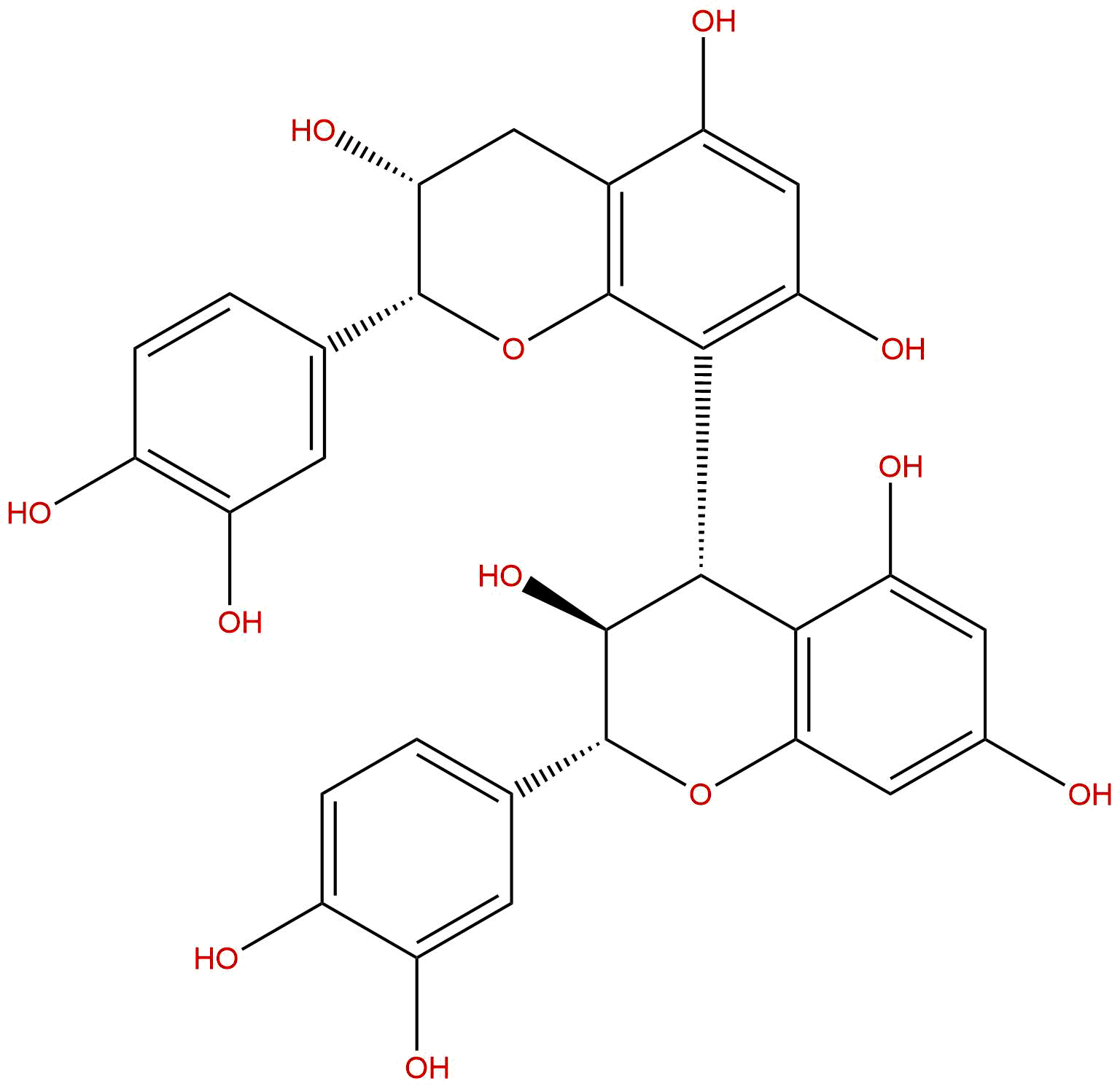


Product name: Procyanidin B4
Synonym name: Procyanidol B4;(+)-Catechin-(4α-8)-(-)-epicatechin; (-)-Procyanidin B4
Catalogue No.: BP4256
Cas No.: 29106-51-2
Formula: C30H26O12
Mol Weight: 578.526
Botanical Source:
Type of Compound: Procyanidins
Purity: 95%~99%
Analysis Method: HPLC-DAD or/and HPLC-ELSD
Identification Method: Mass, NMR
Packing: Brown vial or HDPE plastic bottle
Storage: Store in a well closed container, protected from air and light. Put into refrigerate or freeze for long term storage.
Whenever possible, you should prepare and use solutions on the same day. However, if you need to make up stock solutions in advance, we recommend that you store the solution as aliquots in tightly sealed vials at -20℃. Generally, these will be useable for up to two weeks.
The product could be supplied from milligrams to grams
Inquire for bulk scale.
For Reference Standard and R&D, Not for Human Use Directly.
Storage conditions:Short-term storage at 2~8℃, long-term storage at -20 ~ -80℃
220.7600
1.7536
1.7102
.1369
.9923
.5559
Low
87.3857
4.5185
No
No
No
No
Yes
No
0.0
Yes
No
Yes
No
Procyanidin B4 (CAS number: 29106-51-2), as an important natural polyphenolic compound, belongs to the dimer member of the Procyanidins family. It is composed of (-) - epicatechin and (+) - epicatechin units connected by C4 → C8 bonds, and structurally belongs to the class of hydroxyflavane compounds. In recent years, with the deepening development of natural product pharmacology, anthocyanin B4 has attracted widespread attention due to its significant antioxidant, anti-tumor, and DNA topoisomerase inhibitory activities. Especially in the prevention and treatment of chronic liver diseases such as alcoholic liver injury, anthocyanin B4 exhibits unique therapeutic potential and has become an important candidate molecule for the development of natural medicines.
This article will provide a systematic review of the chemical structure and physicochemical properties, plant sources, and extraction methods of anthocyanin B4, with a focus on analyzing its pharmacological activity and mechanism of action. Combined with the research progress of related molecular targets, it will comprehensively evaluate its pharmacological properties and pharmacokinetic characteristics. Finally, it will explore its clinical application prospects and future research directions, aiming to provide theoretical basis and practical guidance for the medicinal development of this natural product.
Proanthocyanidin B4 is a dimer formed by connecting two flavan-3-ol units through a C4 → C8 carbon carbon bond. Its specific structure is the condensation product of (-) - epicatechin and (+) - epicatechin. Its molecular formula is C30H26O12 and its molecular weight is 578.5260. Structurally, anthocyanin B4 contains multiple phenolic hydroxyl groups, endowing it with excellent antioxidant capacity.
In terms of physical and chemical properties, the LogP value of anthocyanin B4 is 1.7536, indicating its moderate lipid solubility, which facilitates cell membrane penetration but has low water solubility (0.1369), which to some extent limits its bioavailability. Its topological polar surface area (TPSA) is 220.76 Å ², and higher polarity may affect its transmembrane absorption ability. The low penetration ability of the blood-brain barrier suggests limited distribution in the central nervous system. The negative result of hERG channel inhibition experiment indicates a low risk of cardiac toxicity. The Ames mutagenicity test result is 0.0, indicating that its genotoxicity risk is relatively low and has a good safety basis.
Proanthocyanins B4 are widely present in various plants, especially in plants rich in catechins such as grape seeds, cocoa beans, tea, and certain berry plants. Grape seed extract has become the main industrial source of anthocyanin B4 due to its high content of anthocyanins.
The extraction method usually uses organic solvent extraction combined with ultrasound assisted extraction or microwave-assisted extraction techniques to improve extraction efficiency and purity. Common solvents include ethanol, methanol, and their aqueous solutions. After extraction, they are separated and identified by liquid chromatography (HPLC) and mass spectrometry (MS) techniques. In recent years, green extraction technologies such as supercritical CO2 extraction and membrane separation have also been applied to the efficient extraction of anthocyanin B4, balancing environmental friendliness and product quality.
Anthocyanin B4, due to its multi hydroxyl structure, has significant free radical scavenging ability and can effectively neutralize reactive oxygen species (ROS) and nitrogen free radicals, reducing oxidative stress damage to cells. In vitro experiments have shown that anthocyanin B4 can significantly increase the activity of superoxide dismutase (SOD1, SOD2) and catalase (CAT), enhance the antioxidant defense system of cells, and reduce the generation of lipid peroxidation products.
Multiple in vitro and in vivo studies have confirmed that anthocyanin B4 has inhibitory effects on various tumor cells. Its mechanism includes inducing tumor cell apoptosis, blocking cell cycle progression, inhibiting tumor cell migration and invasion. Especially in terms of DNA topoisomerase II (EC 5.99.1.3) inhibition, anthocyanin B4 inhibits tumor cell proliferation by blocking ATP hydrolysis activity, interfering with DNA replication and transcription processes.
Proanthocyanins B4 exhibit good protective effects in alcoholic liver injury models. It inhibits inflammatory response by regulating the expression of inflammatory factors such as tumor necrosis factor (TNF), interleukin-6 (IL6), and interleukin-1 β (IL1B). At the same time, regulating the activity of nitric oxide synthase 2 (NOS2) and cytochrome P450 2E1 (CYP2E1) can alleviate oxidative damage and lipid peroxidation in liver cells, and promote liver function recovery. In addition, activating the detoxifying enzyme glutathione S-transferase P1 (GSTP1) enhances cellular detoxification ability, further protecting the liver from damage caused by alcohol and its metabolites.
The pharmacological effects of anthocyanin B4 involve multiple molecular targets and signaling pathways:
Antioxidant mechanism By activating the nuclear factor E2 related factor 2 (Nrf2) signaling pathway, promoting the expression of antioxidant enzymes (SOD1, SOD2, CAT, NQO1), enhancing cellular antioxidant capacity, and reducing cellular damage caused by oxidative stress.
Anti inflammatory mechanism Inhibiting the nuclear factor kappa B (NF - κ B) signaling pathway, reducing the expression of pro-inflammatory factors TNF, IL6, IL1B, and NOS2, alleviating inflammatory response, and protecting tissues from inflammatory damage.
Inhibition of DNA Topoisomerase As an inhibitor of DNA topoisomerase II, it blocks ATP hydrolysis activity, interferes with DNA replication and repair processes, induces tumor cell apoptosis, and exerts anti-tumor effects.
Detoxification and metabolic regulation Regulating CYP2E1 activity, reducing the production of harmful free radicals in alcohol metabolism, activating GSTP1 to promote the metabolic elimination of harmful substances, and synergistically protecting liver cells.
In summary, anthocyanin B4 exerts its extensive biological effects through multi-target and multi pathway synergistic effects.
From the perspective of medicinal properties, anthocyanin B4 has the following characteristics:
In terms of pharmacokinetics, existing studies have shown that anthocyanin B4 has limited absorption and low bioavailability after oral administration, mainly affecting its blood drug concentration through intestinal metabolism and liver first pass effects. Its metabolites include various phenolic acids and small molecule flavanols, which have certain biological activities. In the future, it is necessary to improve its pharmacokinetic performance through new drug delivery systems such as nanocarriers and liposomes.
As a natural polyphenolic compound, anthocyanins B4 have multi-target and multi mechanism pharmacological activities, especially showing good application prospects in the fields of antioxidant, anti-inflammatory, and liver protection. Its protective effect in alcoholic liver injury provides new ideas for the adjuvant treatment of chronic liver disease. In addition, its anti-tumor activity also lays the foundation for its development in the field of adjuvant therapy for tumors.
However, the clinical translation of anthocyanin B4 still faces many challenges, including low bioavailability, insufficient in vivo stability, and weak targeting. Future research should focus on:
In addition, combining modern omics technology and computational pharmacology to promote the precise drug development of anthocyanin B4 will greatly facilitate its clinical application.
As a natural product with unique structure and rich biological activity, anthocyanin B4 has demonstrated broad medicinal value due to its multiple pharmacological effects such as antioxidant, anti-tumor, and liver protection. Through systematic chemical, pharmacological, and pharmacological studies, anthocyanin B4 is expected to become an important candidate molecule for the development of new natural medicines. In the future, it is necessary to strengthen its pharmacokinetic optimization and clinical validation, promote its transition from laboratory to clinical application, and provide new natural drug solutions for the prevention and treatment of related diseases.
