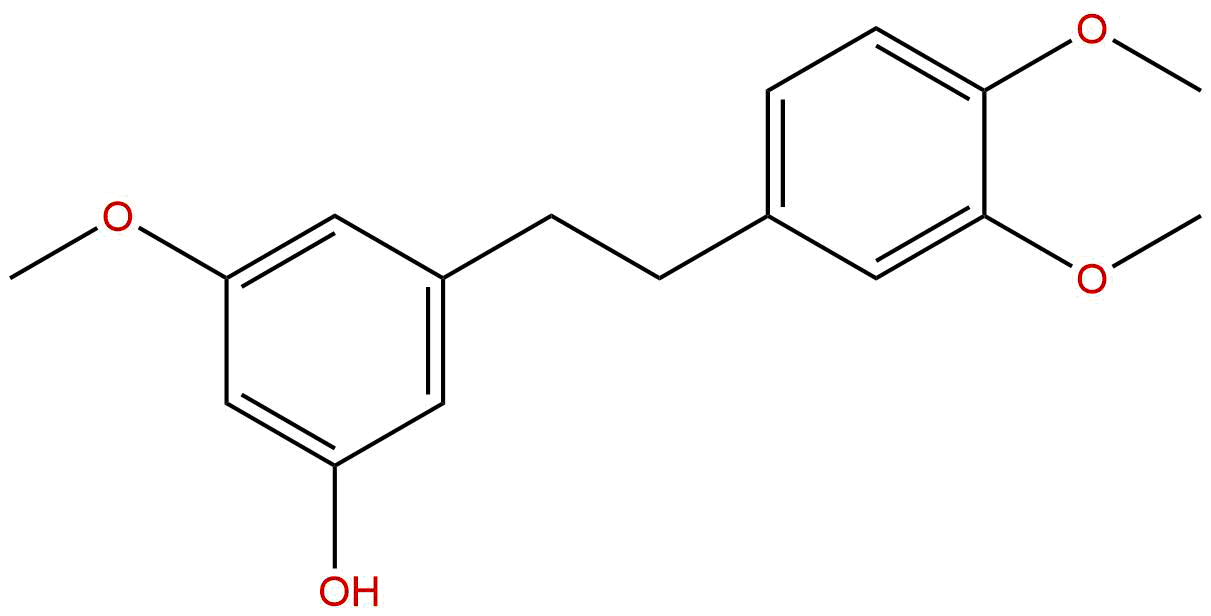


Product name: 3'-hydroxy-3,4,5'-trimethoxybibenzyl
Synonym name:
Catalogue No.: BP5365
Cas No.: 135545-84-5
Formula: C17H20O4
Mol Weight: 288.343
Botanical Source:
Type of Compound: Phenols
Purity: 95%~99%
Analysis Method: HPLC-DAD or/and HPLC-ELSD
Identification Method: Mass, NMR
Packing: Brown vial or HDPE plastic bottle
Storage: Store in a well closed container, protected from air and light. Put into refrigerate or freeze for long term storage.
Whenever possible, you should prepare and use solutions on the same day. However, if you need to make up stock solutions in advance, we recommend that you store the solution as aliquots in tightly sealed vials at -20℃. Generally, these will be useable for up to two weeks.
The product could be supplied from milligrams to grams
Inquire for bulk scale.
For Reference Standard and R&D, Not for Human Use Directly.
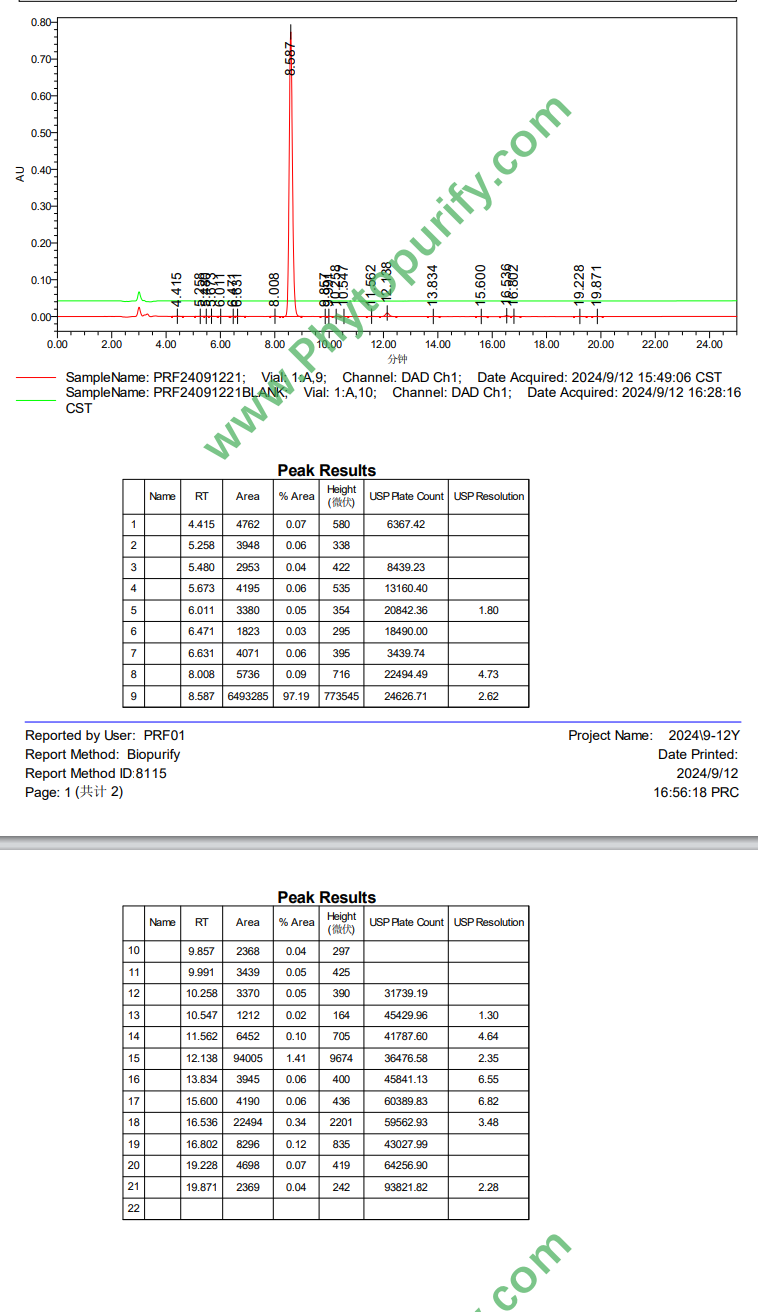
HPLC of 3'-hydroxy-3,4,5'-trimethoxybibenzyl
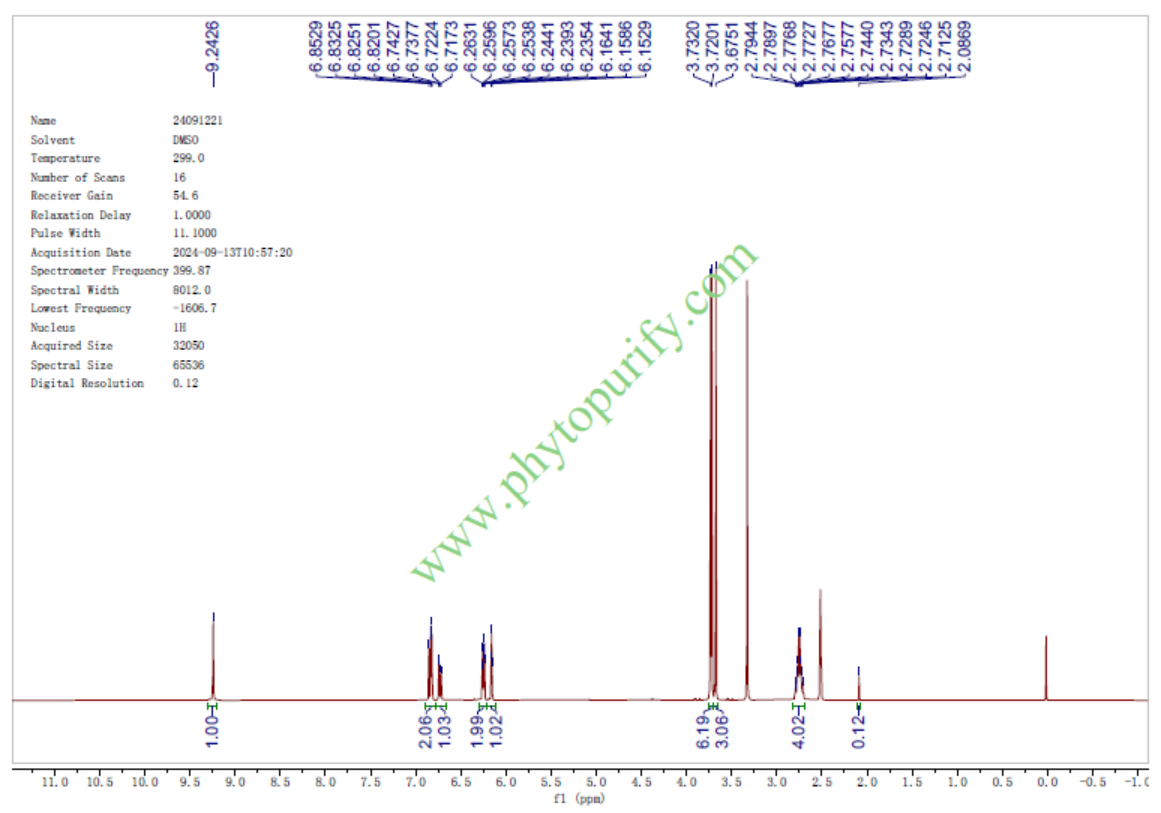
HNMR of 3'-hydroxy-3,4,5'-trimethoxybibenzyl
Storage conditions:Short-term storage at 2~8℃, long-term storage at -20 ~ -80℃
47.9200
3.5128
3.5111
.1248
6.3315
10.0366
High
91.7975
1.8554
Yes
No
Yes
No
No
No
0.0
No
Yes
No
No
Natural products, as an important source of drug discovery, play an irreplaceable role in the long history of human fight against diseases. From classic aspirin and paclitaxel to artemisinin, countless natural compounds with unique chemical structures and significant biological activities have provided valuable lead molecules for modern drug development. Among a wide variety of natural products, bibenzyls have attracted much attention due to their structural diversity and extensive pharmacological activities. This type of compound has two benzene rings connected by an ethyl bridge (- CH ₂ - CH ₂ -) as its basic skeleton, and is widely found in mosses, lichens, orchids, and certain higher plants.
3 '- Hydroxy-3,4,5' - trimethoxybibenzyl (HTMB) is a prominent member of the benzyl family. Its unique methoxy and hydroxyl substitution modes endow it with chemical properties and biological activity distinct from other benzyl compounds. In recent years, research on HTMB has gradually deepened, especially in the field of anti-tumor, demonstrating the potential for multi-target and multi pathway regulation, making it a hot molecule in natural product chemistry and pharmacology research. This article aims to systematically review the chemical structure, physicochemical properties, plant origin, extraction methods, pharmacological activity, mechanism of action, pharmacological evaluation, and clinical application prospects of HTMB, in order to provide comprehensive references for the in-depth research and development of this compound.
The chemical name of HTMB is 3 '- hydroxy-3,4,5' - trimethoxybiphenyl, and its core structure is a benzyl skeleton, where two benzene rings (A ring and B ring) are connected by an ethyl bridge (- CH ₂ - CH ₂ -). Specifically, the 3rd and 4th positions of the A ring (usually referring to the benzene ring connected to an ethyl bridge) are each connected to a methoxy group (- OCH ∝), while the 3rd 'position of the B ring is connected to a hydroxyl group (- OH) and the 5th' position is connected to a methoxy group. Therefore, its molecular formula is C ₁₇ H ₂₀ O ₄, and its molecular weight is 288.3430 Da.
From the perspective of physicochemical properties, the lipid water partition coefficient (LogP) of HTMB is 3.5128, indicating its strong lipophilicity, which facilitates its penetration of cell membranes but may also affect its solubility in aqueous environments. Its topological polar surface area (TPSA) is 47.92 Å ², which is a moderate value. It is generally believed that molecules with TPSA less than 60-70 Å ² have good oral bioavailability and cell membrane permeability. The solubility of HTMB is 0.1248 mg/mL, which belongs to low water solubility compounds, which to some extent limits its in vivo administration route and bioavailability. It is worth noting that the predicted results show that HTMB has high blood-brain barrier (BBB) penetration ability, which suggests that it may have the potential to act on central nervous system targets, but may also bring side effects to the central nervous system. In addition, hERG inhibition was predicted as' no ', indicating a lower risk of cardiac toxicity; The Ames test result is 0.0, indicating a low risk of genetic toxicity, which provides preliminary positive signals for the safety of HTMB as a candidate drug.
HTMB, as a natural benzyl compound, was discovered and isolated mainly through chemical research on certain specific plants. The main known sources of HTMB currently include:
The extraction and separation of HTMB usually follow the classic process of natural product chemistry, which mainly includes the following steps:
Existing research has revealed that HTMB has multiple pharmacological activities, among which anti-tumor activity is the most prominent, and it also shows potential in anti-inflammatory, antioxidant and other aspects.
1. Antitumor activity
The anti-tumor activity of HTMB is the most concentrated area of research. Multiple in vitro experiments have shown that HTMB exhibits significant inhibitory effects on the proliferation of various human tumor cell lines, including but not limited to:
Its anti-tumor activity is usually evaluated by the half maximal inhibitory concentration (IC ₅₀). The IC ₅₀ values reported in different studies vary depending on the cell line and experimental conditions, but are generally at the micromolar (μ M) level, exhibiting moderate to strong activity. For example, in some studies, the IC ₅₀ value of HTMB on MCF-7 cells is approximately 10-20 μ M.
2. Anti inflammatory activity
Inflammation is an important link in the occurrence and development of various diseases, including cancer. Preliminary studies suggest that HTMB may exert anti-inflammatory effects by inhibiting the production of inflammatory mediators. For example, it may inhibit the production of nitric oxide (NO) and prostaglandin E2 (PGE2) in macrophages stimulated by lipopolysaccharide (LPS), and downregulate the expression of pro-inflammatory cytokines such as tumor necrosis factor - α (TNF - α) and interleukin-6 (IL-6). These effects are related to the inhibition of the nuclear factor kappa B (NF - κ B) signaling pathway.
3. Antioxidant activity
Benzyl compounds usually have a certain antioxidant capacity. The phenolic hydroxyl group (3 '- OH) in the molecular structure of HTMB is a key functional group for its antioxidant activity, which can effectively scavenge free radicals (such as DPPH free radicals and ABTS free radicals) and may inhibit lipid peroxidation. This antioxidant activity may have a synergistic relationship with its anti-inflammatory and anti-tumor effects.
The pharmacological activity of HTMB, especially its anti-tumor effect, involves multiple molecular targets and complex signaling pathway regulation. According to existing research, its main mechanism of action can be summarized as follows:
1. Inducing cell apoptosis (Apoptosis)
This is one of the core mechanisms of HTMB's anti-tumor effect. It triggers programmed cell death in tumor cells by regulating the expression of apoptosis related proteins.
2. Inhibit tumor cell invasion and metastasis
Tumor metastasis is the main cause of patient death. HTMB exerts anti metastatic effects by inhibiting the activity of matrix metalloproteinases (MMPs).
3. Inhibit topoisomerase activity
Topoisomerases are key enzymes involved in DNA replication and transcription processes, and are also important targets for anti-tumor drugs.
4. Interference with tumor microenvironment and angiogenesis
The growth and metastasis of tumors depend on the formation of new blood vessels.
5. Regulating other signaling pathways
In summary, HTMB has the potential to overcome single target drug resistance by simultaneously acting on multiple key targets such as MCL1, BCL2, STAT3, MMP2, TOP1, HIF1A, TOP2A, MAPK1, ESR1, CYP19A1, forming a multi-target and multi pathway anti-tumor network.
Based on its physicochemical properties and preliminary pharmacological activity, evaluating the pharmacological properties of HTMB is a key step in pushing it towards preclinical research.
1. Analysis of pharmacological parameters
2. Pharmacokinetic (PK) characteristics (prediction and preliminary study)
At present, there are few detailed research reports on the pharmacokinetics of HTMB in vivo, but based on its physicochemical properties and studies of its analogues, its PK characteristics can be inferred
Future research requires conducting systematic in vivo PK experiments, including measuring its concentration time curve, half-life, clearance rate, bioavailability, and metabolite identification in plasma and tissues, to comprehensively evaluate its pharmacokinetic properties.
Although HTMB is still in the basic research stage, its unique chemical structure and multi-target pharmacological activity have shown promising application prospects in multiple therapeutic fields.
1. Anti tumor therapy
2. Other disease areas
3. Future research directions
3 '- Hydroxy-3,4,5' - trimethoxybiphenyl (HTMB), as a natural benzyl compound derived from plants, exhibits significant anti-tumor potential due to its unique chemical structure and multi-target pharmacological activity, especially by regulating key anti-tumor targets such as MCL1, BCL2, STAT3, MMP2, TOP1, HIF1A, etc. Its good drug like properties and preliminary safety evaluation results have laid the foundation for its use as a lead compound in the development of new drugs. However, low water solubility, unknown pharmacokinetic characteristics in vivo, and complex multi-target action networks remain challenges for its clinical application. In the future, through structural optimization, in-depth mechanism research, advanced drug delivery technology, and systematic in vivo evaluation, HTMB is expected to develop into a novel multi-target anti-tumor candidate drug, bringing new treatment options for cancer patients. The research on HTMB not only enriches the connotation of natural product chemistry, but also provides another successful example for discovering innovative drugs from traditional medicinal plants.
