


Product name: Bicuculline
Synonym name: (+)-Bicuculline; d-Bicuculline
Catalogue No.: BP0273
Cas No.: 485-49-4
Formula: C20H17NO6
Mol Weight: 367.357
Botanical Source: Corydalis decumbens (Thunb. )Pers.
Physical Description:
Type of Compound: Alkaloids
Purity: 95%~99%
Analysis Method: HPLC-DAD or/and HPLC-ELSD
Identification Method: Mass, NMR
Packing: Brown vial or HDPE plastic bottle
Storage: Store in a well closed container, protected from air and light. Put into refrigerate or freeze for long term storage.
Whenever possible, you should prepare and use solutions on the same day. However, if you need to make up stock solutions in advance, we recommend that you store the solution as aliquots in tightly sealed vials at -20℃. Generally, these will be useable for up to two weeks.
The product could be supplied from milligrams to grams
Inquire for bulk scale.
Chengdu Biopurify Phytochemicals Ltd. is a leading company in the research, development, manufacture and marketing of High Quality Phytochemicals and Extracts(especially Active Ingredients from Traditional Chinese Medicine,TCM), Natural Active Pharmaceutical Ingredients worldwide.
The main services:
A. Supply active ingredients and reference standards of TCM, from mgs to kgs scale
B. Custom extraction and purification, target Herb Active Ingredients
C. Custom synthesis and semi-synthesis for Natural Active Ingredients
D. CR(contract research), CM(contract manufacture) and PD(process development) services from lab scale, pilot scale to commercial scale(GMP is also available)
E. TCM compounds library for drug screen,more than 3000 compounds available, many of them are rare and unique.
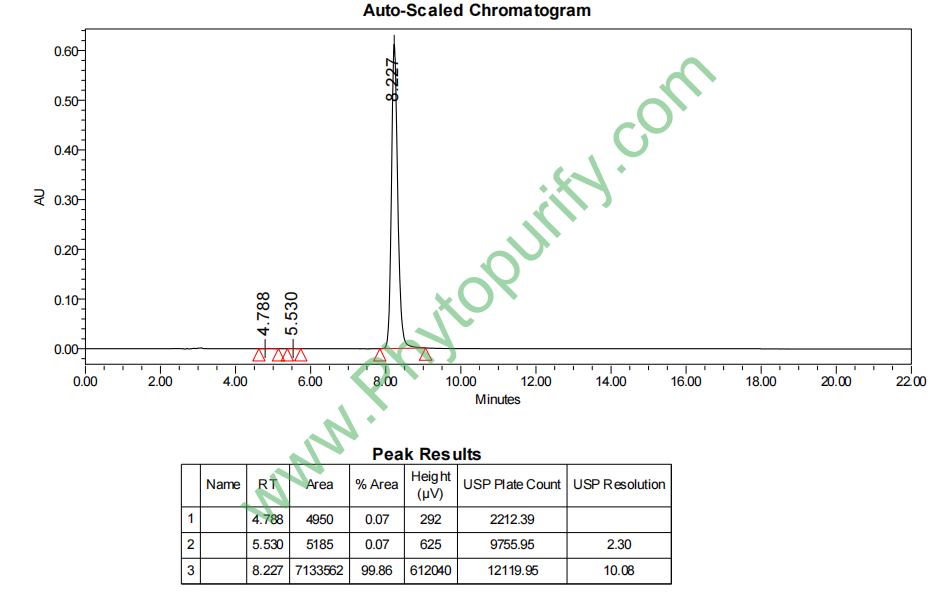
HPLC of Bicuculline
Storage conditions:Short-term storage at 2~8℃, long-term storage at -20 ~ -80℃
Bicuculine is a natural product with important neuropharmacological significance, belonging to the benzylisoquinoline alkaloid class. As early as 1932, it was discovered from plant alkaloid extracts that bipartite has attracted widespread attention due to its selective antagonistic effect on specific receptors in the central nervous system. As a competitive antagonist of gamma aminobutyric acid type A receptor (GABA_A receptor), Bisoprolol plays an important role in neural excitability regulation, epileptic seizure mechanism research, and neuropharmacology. This article will provide a systematic review of the chemical structure and physicochemical properties, plant sources and extraction methods, pharmacological activity and mechanism of action, pharmacological evaluation and pharmacokinetic characteristics of Bi Kou Kou Ling, and explore its potential prospects and challenges in clinical applications.
The chemical structure of Bi Kou Kou Ling is 6-methyl-5,6,7,8-tetrahydro [1,3] dioxolane [4,5-g] isoquinoline, and its 5-pro-S position is replaced by (6R) -8-oxo-6,8-dihydrofurano [3,4-e] [1,3] benzodioxolane-6-yl. This structure endows Biqiuoling with a unique spatial configuration and biological activity. Its molecular weight is 367.35 and LogP value is 1.49, indicating that it has moderate lipid solubility and is beneficial for crossing the blood-brain barrier. The topological polar surface area (TPSA) is 92.07 and the number of hydrogen bond acceptors is 7, indicating that its molecular polarity is moderate and it can form multi-point binding with acceptors.
The physical and chemical properties of Bi Kou Kou Ling make it highly bioavailable and capable of penetrating the nervous system in the body. The isoquinoline ring and furan ring system in its structure provide key spatial sites for its binding to GABA_A receptors. In addition, Bi Kou Kou Ling did not exhibit significant hepatotoxicity, cardiotoxicity, or hERG channel inhibition, demonstrating good safety potential.
Bi Kou Kou Ling was first isolated from the plant Dicentra cucullaria in the family Paeoniaceae, and later found in Adlumia fungosa, Fumariaceae, and various species of Corydalis spp. This type of plant is widely distributed in North America and some parts of Asia, traditionally used for folk treatment of neurological diseases.
The common methods for extracting Bi Kou Kou Ling include organic solvent extraction, acid-base separation, and column chromatography purification. Generally, ethanol or methanol is used for reflux extraction of dried plant materials, followed by acid-base adjustment to precipitate alkaloids in the form of hydrochloride salts, followed by alkalization to release free bases. Solvent extraction and silica gel column chromatography are used for separation and purification. In recent years, ultrasound assisted extraction and high-performance liquid chromatography (HPLC) techniques have been introduced to improve extraction efficiency and purity.
As a competitive antagonist of GABA_A receptors, Bikoukouling exhibits significant excitatory effects in the nervous system. GABA_A receptors are the main inhibitory neurotransmitter receptors in the central nervous system, mediating the opening of chloride ion channels, leading to neuronal hyperpolarization and inhibitory synaptic transmission. Bi Kou Kou Ling competes with GABA binding sites to block GABA mediated chloride ion influx, relieve neuronal inhibition, and induce neuronal excitation.
In both in vitro and in vivo experiments, Biqiuoling has been widely used to induce epileptic like discharges and neural excitability models, becoming an important tool for studying the mechanism of epileptic seizures. It has a high affinity for GABA_A receptors of various neuronal subtypes and can significantly enhance the excitatory response of neurons. In addition, Bi Kou Kou Ling also affects the plasma channel functions of calcium channels (CACNA1H, CACNA1A) and potassium channels (KCNQ2), participating in the regulation of neuronal membrane potential and excitability.
The main molecular target of Bi Kou Kou Ling is the GABA_A receptor, especially the receptor complex containing GABRA1 and GABRB2 subunits. By competitively binding to the ligand binding site of GABA receptors, Bisoprolol blocks the opening of GABA mediated chloride ion channels, reduces inhibitory neurotransmission, and leads to increased neuronal excitability.
In addition, the effects of Bi Kou Kou Ling involve various ion channels and receptor proteins related to epilepsy, including:
Bi Kou Kou Ling indirectly affects the excitability balance of neurons by regulating the functions of these targets, making it an important molecular tool for studying neuroexcitatory diseases such as epilepsy.
The pharmacokinetic parameters of Bi Kou Kou Ling show that it has good potential. The molecular weight is moderate, and the LogP value indicates moderate lipid solubility, which is beneficial for blood-brain barrier penetration and meets the ideal characteristics of central nervous system drugs. Its TPSA and hydrogen bond receptor numbers are moderate, supporting its high affinity binding to the target.
In terms of safety, Bi Kou Kou Ling did not show significant hepatotoxicity or cardiotoxicity, and did not inhibit hERG channels, reducing the risk of arrhythmia. Although the results of Ames mutagenicity test are not yet clear, existing data support its safe application in neuropharmaceutical research.
Pharmacokinetic studies have shown that Bi Kou Kou Ling has good oral absorption, high blood-brain barrier permeability, and can quickly reach central nervous system targets. Its metabolic pathway is mainly through liver enzyme metabolism, and the activity and toxicity of metabolites need further research.
As a classic GABA_A receptor antagonist, Bi Kou Kou Ling is mainly used in basic neuroscience research, especially in the fields of epileptic seizure mechanism and neural excitability regulation. Its ability to induce epileptic seizures makes it an important tool for establishing animal epilepsy models, providing a powerful means for screening and studying the mechanisms of antiepileptic drugs.
Although the strong neural excitatory effect and potential risk of epilepsy of Biqiuoling itself limit its direct clinical application, its structure and mechanism of action provide important molecular basis for the design of novel GABA_A receptor modulators. In the future, through structural modification and drug design, it is expected to develop derivatives with selective regulatory functions and higher safety for the treatment of epilepsy and other neurological diseases.
In addition, the application of Bi Kou Kou Ling in neuropharmacological research can also be extended to explore the pathological mechanisms of cognitive disorders, anxiety disorders, and other diseases, providing theoretical support for the development of related drugs.
As an important natural product, Bi Kou Kou Ling occupies an irreplaceable position in neuroscience research due to its unique chemical structure and photosensitive competitive antagonistic effect on GABA_A receptors. Its application in the study of epileptic seizure mechanisms has greatly promoted the development of neuropharmacology. Although Bi Kou Kou Ling has not yet become a clinical treatment drug, its good pharmacological parameters and clear mechanism of action have laid a solid foundation for the development of new neuromodulators in the future. With the advancement of molecular pharmacology and drug design technology, the potential of Bisoprolol and its derivatives in the treatment of neurological diseases deserves continuous attention and in-depth exploration.
