


Synonym name:
Catalogue No.: BP0517
Cas No.: 3520-14-7
Formula: C21H25NO4
Mol Weight: 355.434
Botanical Source: Alkaloid from several Corydalis spp., Berberis tinctoria and Coptis tecta (Fumariaceae, Menispermaceae, Berberidaceae, Ranunculaceae)
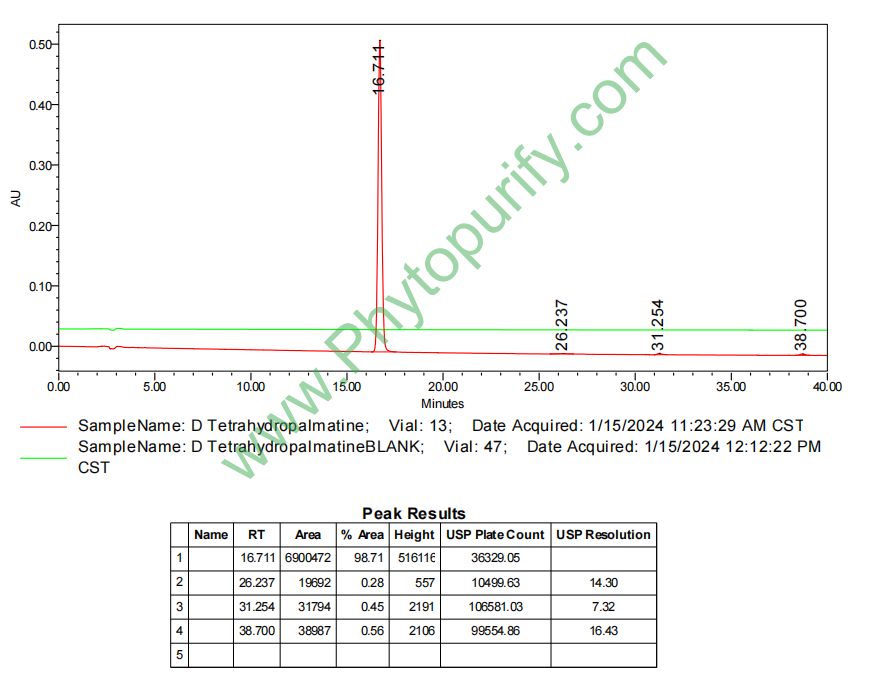
Purity: 95%~99%
Analysis Method: HPLC-DAD or/and HPLC-ELSD
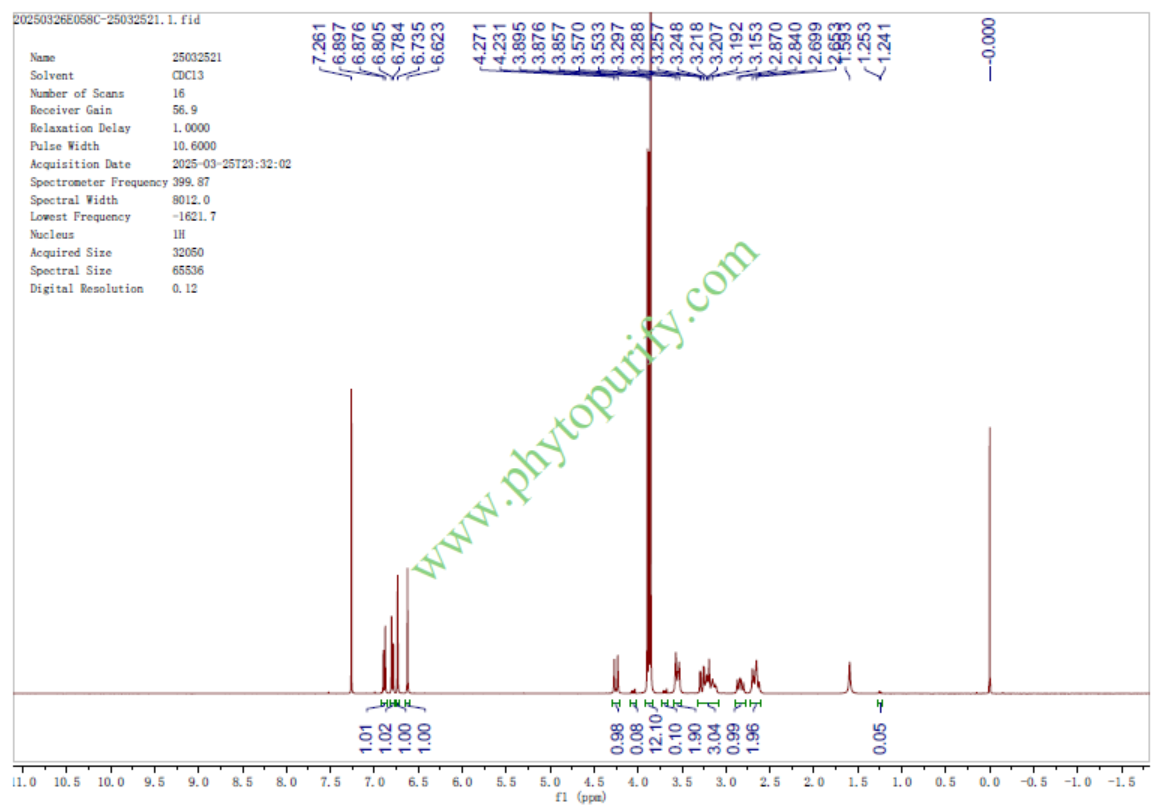
Identification Method: Mass, NMR
Packing: Brown vial or HDPE plastic bottle
Can be supplied from milligrams to grams.
For Reference Standard and R&D, Not for Human Use Directly.
Inquire for bulk scale.
HPLC of D-Tetrahydropalmatine
HNMR of D-Tetrahydropalmatine
Storage conditions:Short-term storage at 2~8℃, long-term storage at -20 ~ -80℃
D-Tetrahydropalmatine (D-THP) is an important isoquinoline alkaloid mainly isolated from Corydalis spp. plants. As one of the active ingredients in traditional Chinese medicine, Corydalis yanhusuo, dextetrahydropalmatine has a long history of application in the field of traditional Chinese medicine analgesia and sedation. In recent years, with the deepening of natural product pharmacology and neuropharmacology research, dextetrahydropalmatine has become a hot topic in the study of various neurological diseases such as analgesia, anti anxiety, and neuroprotection due to its unique dopamine receptor regulation and multi-target pharmacological activity.
This review aims to systematically summarize the chemical structure and physicochemical properties, plant sources, and extraction methods of right-handed tetrahydropalmatine, with a focus on its pharmacological activity and mechanism of action. Combined with drug parameters and pharmacokinetic characteristics, it explores its clinical application potential and future development directions. By comprehensively reviewing the relevant research progress, it is expected to provide theoretical basis and reference for the drug development and clinical translation of right-handed tetrahydropalmatine.
The chemical name of right-handed tetrahydropalmatine is (R) -2,3,9,10-tetrahydro-7,8-dimethoxy-2-methyl-5H benzo [d] isoquinoline, with the molecular formula C21H25NO4 and a molecular weight of 355.4340. Its structure belongs to the isoquinoline alkaloids, with a typical tetrahydroisoquinoline skeleton and two methoxy substituents, endowing it with certain hydrophobicity and aromaticity.
In terms of physical and chemical properties, the LogP value of right-handed tetrahydropalmatine is 3.3789, indicating its moderate lipid solubility, which is beneficial for crossing the blood-brain barrier (BBB). Its polar surface area (TPSA) is 40.16 Å ², and its lower polarity contributes to the distribution of the central nervous system. Low water solubility (0.0234 mg/mL) suggests limited solubility in aqueous phase, which may affect oral bioavailability. In vitro safety evaluation showed that dextetrahydropalmatine does not have hERG channel inhibitory effect, and the Ames mutagenicity test was negative, indicating its high safety and good potential for drug development.
Dexmedetomidine mainly exists in plants of the Corydalis genus, such as Corydalis yanhusuo and Corydalis turtschaninovii. Yanhusuo is a plant of the poppy family, and its rhizome is rich in various isoquinoline alkaloids, among which right-handed tetrahydropalmatine is more abundant.
The extraction method usually uses organic solvent extraction combined with column chromatography separation technology. The specific process includes:
In recent years, the application of ultrasound assisted extraction, microwave-assisted extraction, and membrane separation technologies has gradually improved extraction efficiency and purity, providing technical support for industrial production.
The pharmacological activity of right-handed tetrahydropalmatine is mainly concentrated in the central nervous system, especially in terms of analgesic, sedative, and anti anxiety effects.
A large number of in vitro and in vivo experiments have shown that right-handed tetrahydropalmatine has significant analgesic effects. Its analgesic effect is not only manifested in relieving acute pain, but also effectively inhibiting chronic and neuropathic pain. The classic hot plate test, acetic acid torsion test, and nerve injury model have all confirmed its analgesic activity.
Dexmedetomidine exerts sedative and anti anxiety effects by regulating dopamine receptors, especially the D1 and D2 receptor subtypes. Animal experiments have shown that right-handed tetrahydropalmatine can reduce spontaneous movement and anxiety behavior, exhibiting good central sedative effects.
In addition to its neurological effects, dextrorotatory tetrahydropalmatine also exhibits anti-inflammatory, antioxidant, and neuroprotective effects. Some studies have indicated its inhibitory effect on organic cation transporter 1 (OCT1), which may affect drug metabolism and transport, and has potential drug interaction risks.
The pharmacological mechanism of right-handed tetrahydropalmatine is complex, involving multiple neurotransmitter systems and ion channels.
Dexmedetomidine, as a dopamine receptor antagonist, exhibits preferential affinity for D1 receptors and also has a certain antagonistic effect on D2 receptors. By blocking dopamine signaling, regulating the excitability of the central nervous system, and exerting sedative and analgesic effects.
Research has shown that right-handed tetrahydropalmatine can regulate various ion channels and receptors, including:
Dexmedetomidine is an effective OCT1 inhibitor that affects the uptake of various organic cations by the liver and kidneys, potentially regulating drug absorption, distribution, and metabolism, indicating its important role in drug interactions.
The molecular weight of right-handed tetrahydropalmatine is 355.4340, which meets the molecular weight requirements of Lipinski's rule. LogP is 3.3789, indicating good lipid solubility and facilitating penetration of the blood-brain barrier (BBB). Its TPSA is 40.16 Å ², with moderate polarity, which is in line with the ideal polarity range for central nervous system drugs. Low water solubility suggests that oral formulations need to optimize solubility to improve bioavailability.
In terms of safety, right-handed tetrahydropalmatine has no hERG channel inhibitory effect, reducing the risk of cardiac toxicity; The Ames test is negative, indicating no significant mutagenicity and high safety.
Animal experiments and preclinical studies have shown that right-handed tetrahydropalmatine is rapidly absorbed after oral administration, with a high peak plasma concentration (Cmax) and widespread distribution, especially in brain tissue, confirming its excellent blood-brain barrier penetration ability. Its half-life is moderate, and its metabolism is mainly through the CYP450 enzyme system in the liver. Metabolites are mainly excreted through urine and bile.
In addition, the inhibitory effect of right-handed tetrahydropalmatine on OCT1 may affect its own and other drug transport and metabolism, suggesting the need to pay attention to potential drug interactions in clinical medication.
Dexmedetomidine, as a naturally occurring multi-target central nervous system active compound, has broad clinical application potential. Its analgesic, sedative, and anti anxiety effects make it of great value in the fields of pain management and treatment of mental and neurological disorders.
At present, right-handed tetrahydropalmatine has been used as an over-the-counter analgesic or adjuvant therapy in some Asian countries. With in-depth research on its pharmacological mechanism and safety, it is expected to develop more efficient and safe derivatives or compound preparations in the future, expanding its indications, such as neuropathic pain, depression, and Parkinson's disease.
In addition, the characteristics of right-handed tetrahydropalmatine as an OCT1 inhibitor provide a new research direction for its application in drug metabolism regulation and personalized medication. By combining modern medicinal chemistry and pharmacology techniques, optimizing its pharmacokinetic properties, improving its water solubility and bioavailability, it will further promote its clinical translation.
Future research should focus on:
Dexmedetomidine, as a natural quinoline alkaloid with multi-target effects, has shown broad clinical application prospects due to its excellent central nervous system activity and good safety. Its unique dopamine receptor antagonism and OCT1 inhibition provide new ideas and strategies for pain relief and treatment of neurological diseases. In the future, through in-depth pharmacological mechanism research, drug efficacy optimization, and clinical evaluation, it is expected to promote the development of dextetrahydropalmatine and its derivatives into a new generation of safe and effective neurological drugs, bringing good news to patients.
