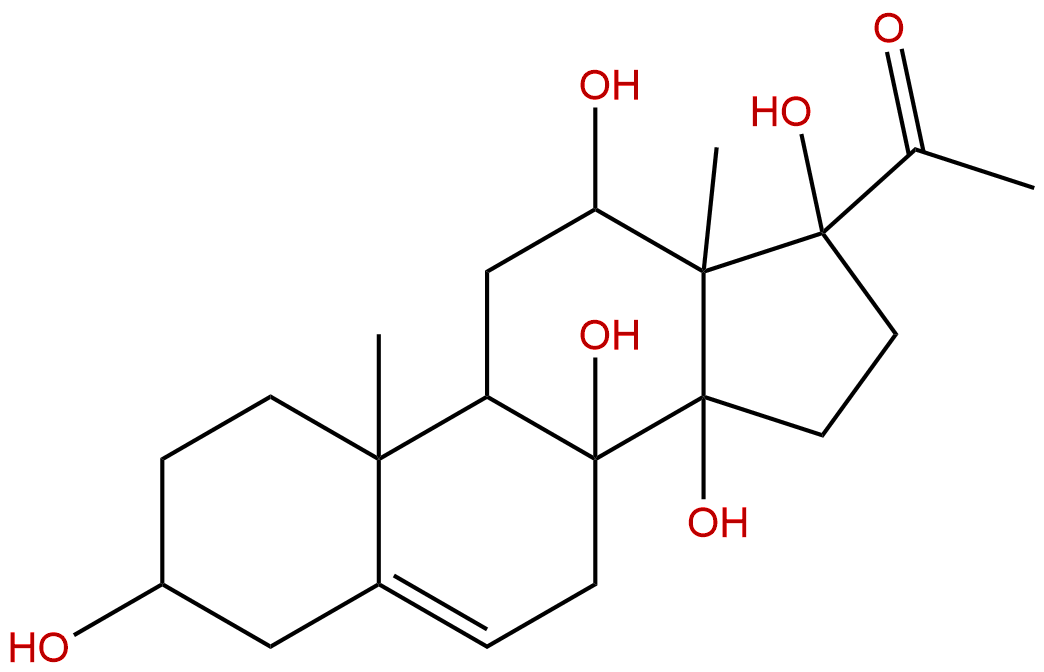


Synonym name:
Catalogue No.: BP0458
Cas No.: 3513-04-0
Formula: C21H32O6
Mol Weight: 380.481
Botanical Source: Cynanchum wallichii and Marsdenia globifera
Purity: 95%~99%
Analysis Method: HPLC-DAD or/and HPLC-ELSD
Identification Method: Mass, NMR
Packing: Brown vial or HDPE plastic bottle
Can be supplied from milligrams to grams.
For Reference Standard and R&D, Not for Human Use Directly.
Inquire for bulk scale.
Storage conditions:Short-term storage at 2~8℃, long-term storage at -20 ~ -80℃
Deacylmeldaplexigenin (CAS number: 3513-04-0) is a typical natural product of pregnane glycosides, first isolated from the plant Asclepias incarnata in the Ranunculaceae family. Pregnane glycoside compounds play an important role in natural medicinal chemistry and pharmacology research due to their unique chemical structure and diverse biological activities. In recent years, with the in-depth analysis of tumor molecular mechanisms, deacetylated quercetin has gradually become a research hotspot due to its potential inhibitory effect in tumor models such as prostate cancer. Prostate cancer is a malignant tumor with high incidence rate and difficult treatment in male urinary system. It is urgent to find new effective and low toxic drugs. This article will provide a systematic review of the chemical structure, plant origin, pharmacological activity, mechanism of action, and pharmacological evaluation of acyl glucosinolates, aiming to provide theoretical basis and research direction for their clinical development and application.
The deacetylated quercetin glycoside belongs to the pregnane glycoside class of compounds, which is composed of a pregnane steroid skeleton and a glycoside moiety. Its molecular formula is C2H32O7 and its molecular weight is 364.4700. Structurally, the deacetylated quercetin glycoside removes the acyl portion of quercetin, retaining the core steroid structure and multiple hydroxyl groups, endowing it with high polarity and biological activity.
In terms of physical and chemical properties, the LogP value of deacetylated kaempferol glycoside is 1.7, indicating its moderate lipid solubility, which is beneficial for membrane penetration and in vivo distribution. The polar surface area (TPSA) is 110.87 Å ² and the number of hydrogen bond acceptors is 6, indicating that it may participate in various molecular interactions through hydrogen bonds in vivo. The low permeability of the blood-brain barrier suggests its limited distribution in the central nervous system. Toxicological evaluation shows no hepatotoxicity and hERG channel inhibitory activity, with high safety. However, cardiac toxicity and Ames mutagenicity are not yet clear and require further research.
The main source of deacetylated quercetin is Asclepias incarnata (Ranunculaceae), which is widely distributed in wetlands in North America and is a commonly used medicinal plant in traditional Chinese medicine. Its roots, stems, and leaves all contain various pregnane glycosides, among which deacetylated quercetin is one of the important active ingredients with high content and pharmacological activity.
During the extraction process, alcohol extraction (such as ethanol or methanol) is often used to extract the dried plant powder, followed by separation and purification techniques such as liquid-liquid distribution and column chromatography (silica gel or C18 reverse phase column) to obtain high-purity deacetylated quercetin. Modern separation techniques such as high-performance liquid chromatography (HPLC) and mass spectrometry (LC-MS) are widely used for their qualitative and quantitative analysis, ensuring the quality and batch stability of extracts.
The pharmacological activity research of deacetylated puerarin mainly focuses on its anti-tumor effect, especially in prostate cancer models. Multiple in vitro cell experiments have shown that deacetylated quercetin can significantly inhibit the proliferation, migration, and invasion ability of prostate cancer cells, while inducing cell apoptosis and cell cycle arrest.
In addition, deacetylated quercetin also exhibits multiple biological activities such as anti-inflammatory and antioxidant effects, which provide auxiliary mechanism support for its anti-tumor effect. For example, its regulation of oxidative stress-related signaling pathways can help alleviate inflammatory responses in the tumor microenvironment and inhibit the malignant progression of tumor cells.
Although there is currently limited research on the in vivo efficacy and toxicology of deacetylated quercetin, existing animal model experiments have preliminarily demonstrated its good safety and significant anti-tumor potential, laying the foundation for subsequent drug development.
The mechanism of action of deacetylated puerarin in prostate cancer involves multiple key molecular targets, reflecting its multi-target regulatory characteristics. The main targets include:
The above multi-target mechanism of action shows that deacetylated quercetin not only directly inhibits tumor cell proliferation, but also achieves comprehensive anti-tumor effects by regulating the tumor microenvironment and signaling network.
The pharmacological parameters of deacetylated puerarin indicate that it has good potential for drug development. The moderate molecular weight (364.47 Da) and LogP value (1.7) comply with Lipinski's rule, which is beneficial for in vivo absorption and distribution. A higher TPSA (110.87 Å ²) and hydrogen bond acceptor count (6) suggest good water solubility, facilitating transport in the bloodstream.
The low permeability of the blood-brain barrier reduces the risk of central nervous system toxicity and side effects. The liver toxicity and hERG channel inhibition experiments were both negative, indicating a high level of liver and liver safety and reducing safety hazards in drug development.
However, the data on cardiac toxicity and genotoxicity (Ames test) are not yet clear, and further validation is needed through in vitro and in vivo experiments. In addition, there is a lack of systematic research on the pharmacokinetic characteristics of deacetylated quercetin, such as absorption rate, bioavailability, metabolic pathways, and excretion mode. In the future, animal models and preclinical trials need to be conducted to improve relevant data.
Based on the multi-target inhibitory effect and good safety evaluation of deacetylated quercetin in prostate cancer cells, its development prospects as an anti-tumor candidate drug are broad. Future research can focus on:
In summary, as a natural pregnane glycoside compound, deacetylated quercetin has unique pharmacological activity and good pharmacological properties, making it a highly promising natural drug lead compound in the field of prostate cancer treatment.
As a natural product of pregnane glycosides derived from Asclepias incarnata, deacetylated rosmarin has shown potential in the treatment of prostate cancer due to its multi-target anti-tumor mechanism and good safety performance. The unique chemical structure and physicochemical properties provide favorable conditions for drug design. Although there is still insufficient research on its pharmacokinetics and preclinical safety, with the advancement of molecular biology and medicinal chemistry techniques, deacetylated quercetin is expected to become a representative of the new generation of natural anticancer drugs. In the future, it is necessary to strengthen its mechanism research and clinical translation, promote its transition from laboratory to clinical, and benefit patients.
