| Catalog No | Package | Original Price | Price | Inventory | Quantity | Operating |
|---|---|---|---|---|---|---|
| SBP00175-5mg | 5mg | $480.00 | Sign in |
|


Storage conditions:Short-term storage at 2~8℃, long-term storage at -20 ~ -80℃
136.6800
-.0841
-.0838
15.7602
.4977
.6720
Low
44.7733
4.7527
Yes
No
No
No
No
No
0.0
Yes
Yes
Yes
Yes
Roseoside (CAS number: 54835-70-0) is a type of plant derived from the Japanese tree of Ele.me(Elaeocarpus japonicus)Natural products separated from leaves. As a natural compound with significant biological activity, rose glycoside has attracted widespread attention in the field of natural product pharmacology in recent years. Its unique chemical structure endows it with excellent antioxidant capacity, involving the regulation of various intracellular antioxidant enzymes and signaling pathways, demonstrating potential application value in preventing and treating oxidative stress-related diseases. This article aims to systematically review the chemical structure and physicochemical properties, plant sources and extraction methods, pharmacological activity and mechanism of action, pharmacological evaluation, pharmacokinetic characteristics, and future clinical application prospects of rose glycosides, providing theoretical basis and reference for subsequent research and development.
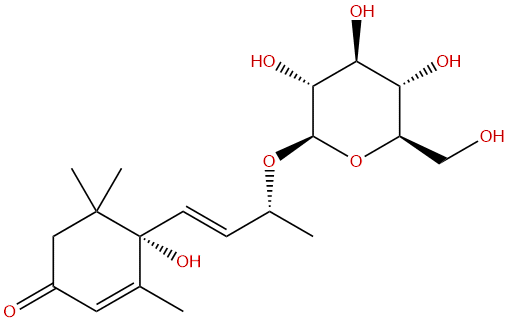
The molecular formula of rose glycoside is C19H26O9, with a molecular weight of 386.4410. Its structural feature is characterized by a glycosidic bond connecting a aglycone and a sugar group, with high polarity. The LogP value is -0.0841, indicating strong hydrophilicity and a water solubility of 15.7602, demonstrating good water solubility. The polar surface area (TPSA) is 136.68 Å ², indicating that the molecule has more polar groups, which may affect its cell membrane permeability and bioavailability. The structure of rose glycosides contains multiple hydroxyl and ether bonds, which not only endow them with good antioxidant activity, but also have important effects on their stability and metabolic pathways.
Its low blood-brain barrier permeability (BBB low) indicates that rosmarin is difficult to penetrate the central nervous system barrier, limiting its direct application in central nervous system diseases, but at the same time reducing the potential risk of central neurotoxicity. The hERG inhibition experiment showed a negative result, indicating a low risk of cardiac toxicity. The Ames test result is 0.0, indicating that rose glycosides have no significant mutagenicity and good safety.
Rosehip glycoside was originally derived from the Japanese elephantine tree(Elaeocarpus japonicus)Separated from the leaves. This plant is widely distributed in East Asia, and its leaves are rich in various bioactive components. The extraction of rose glycosides is usually carried out by solvent extraction combined with chromatographic separation. Common extraction solvents include a mixed solvent system of methanol, ethanol, and water to ensure sufficient dissolution of polar compounds.
The specific extraction process is generally as follows: first, the dried leaves are crushed, and then refluxed with 70% ethanol for extraction. After concentration, the extract is removed from fat soluble impurities using liquid-liquid distribution method. Subsequently, the rose glycoside was further purified by silica gel column chromatography or high-performance liquid chromatography (HPLC) to obtain high-purity rose glycoside. In recent years, the application of ultrasound assisted extraction and microwave-assisted extraction technologies has significantly improved extraction efficiency and purity, reduced extraction time and solvent dosage, and is suitable for large-scale production.
The main pharmacological activity of rose glycosides is focused on antioxidant effects. Oxidative stress is an important pathogenesis of many chronic diseases (such as cardiovascular diseases, neurodegenerative diseases, diabetes and tumors). Rose glycoside exhibits significant antioxidant potential by regulating intracellular redox balance through multiple targets and pathways.
In vitro experiments have shown that rose glycosides can effectively scavenge free radicals, inhibit lipid peroxidation, and protect cells from oxidative damage. Its antioxidant activity is closely related to its regulation of the expression of various antioxidant enzymes, including superoxide dismutase (SOD1, SOD2), catalase (CAT), glutathione peroxidase (GPX1), and heme oxygenase-1 (HMOX1). These enzyme systems play a crucial role in clearing reactive oxygen species (ROS) and maintaining cellular redox homeostasis.
Oxidative stress is closely related to inflammatory response. Rose glycoside downregulates the expression of matrix metalloproteinases (MMP1, MMP3), inhibits extracellular matrix degradation, and reduces tissue damage. In addition, rose glycosides activate the nuclear factor erythroid 2-related factor 2 (NFE2L2/NRF2) signaling pathway, enhance cellular antioxidant defense system, indirectly inhibit inflammatory response, and demonstrate potential tissue protective effects.
Although current research on rose glycosides mainly focuses on the antioxidant field, preliminary studies also suggest that they may have multiple biological activities such as antibacterial, anti-tumor, and neuroprotective properties, which are worth further exploration.
The biological activity of rose glycosides depends on their interactions with various molecular targets, especially key targets in antioxidant mechanisms.
NRF2 is a core transcription factor that regulates cellular antioxidant response. Rose glycoside can promote the translocation of NRF2 from cytoplasm to nucleus, enhance its binding with antioxidant response elements (ARE), induce the expression of downstream antioxidant enzyme genes (such as SOD1, CAT, GPX1, HMOX1), enhance the ability of cells to clear ROS, and alleviate oxidative damage.
By upregulating antioxidant enzymes such as SOD1, SOD2, CAT, and GPX1, rose glycosides enhance the clearance efficiency of superoxide anions and hydrogen peroxide, reduce intracellular oxidative stress levels, and protect cell membrane lipids and proteins from oxidative damage.
MMP1 and MMP3 play important roles in extracellular matrix degradation and tissue remodeling, and excessive activation can lead to tissue damage and inflammation. Rose glycoside exerts anti-inflammatory and tissue protective effects by inhibiting the expression of MMP1 and MMP3, slowing down the process of tissue destruction.
Tyrosinase (TYR) is a key enzyme in pigment synthesis, and its activity regulation is related to skin protection. The regulatory effect of rose glycoside on TYR is not fully understood, but it may be involved in regulating cytochrome metabolism and has potential beauty and skin protection value.
The pharmacological evaluation of rose glycoside shows that it has good safety and certain pharmacokinetic advantages.
Rose glycoside has good water solubility, which is beneficial for oral absorption. However, its high polarity and large TPSA limit its passive diffusion through the cell membrane, which may limit its bioavailability. Low blood-brain barrier permeability limits its distribution in the central nervous system, but reduces the risk of central neurotoxicity.
The hERG channel inhibition experiment was negative, indicating a low risk of cardiac toxicity from rose glycosides. The Ames test result is 0, indicating no mutagenicity and high safety. Based on its natural sources and traditional usage background, rose glycoside has a good safety foundation.
At present, there is a lack of systematic research on the interaction between rose glycoside and other drug metabolizing enzymes (such as CYP450 family). In the future, attention needs to be paid to its impact on drug metabolizing enzymes to evaluate potential drug interaction risks.
Rose glycoside, with its significant antioxidant and tissue protective effects, has shown broad application prospects in the prevention and treatment of various oxidative stress-related diseases.
Oxidative stress plays a central role in the pathogenesis of cardiovascular diseases, diabetes, neurodegenerative diseases, cancer and other chronic diseases. Rose glycoside is expected to serve as an adjuvant therapy by activating the NRF2 pathway and regulating the expression of antioxidant enzymes, slowing down disease progression and improving patients' quality of life.
The inhibitory effect of rose glycoside on MMPs and its potential regulation of tyrosinase suggest its potential application in anti-inflammatory, anti-aging, and whitening products. In the future, it can be developed as a functional skincare ingredient to meet market demand.
Combining the good safety and multi-target mechanism of action of rose glycoside, it can be used as a candidate molecule for the development of new natural medicines or in combination with other drugs to enhance efficacy. In the future, efforts should be made to strengthen pharmacokinetic optimization research, improve bioavailability, and expand clinical indications.
At present, there is a lack of clinical research on rose glycoside, and it is urgent to carry out systematic in vivo efficacy evaluation and clinical trials to clarify its effective dosage, safety range, and long-term use effect. Meanwhile, in-depth analysis of its molecular mechanism of action and exploration of more potential targets will provide a solid foundation for its clinical translation.
Rose glycoside, as a source from Elaeocarpus japonicus The natural glycoside compounds in leaves have become a hot topic in natural product pharmacology research due to their unique chemical structure and significant antioxidant activity. It exhibits excellent antioxidant and tissue protective effects by activating the NRF2 signaling pathway and regulating various antioxidant enzymes, and has broad potential for disease prevention and treatment. The drug efficacy evaluation shows good safety, but the bioavailability and pharmacokinetic characteristics still need to be optimized. In the future, by combining modern drug development technology and conducting in-depth research on its pharmacological mechanisms and clinical applications, rose glycosides are expected to become an important candidate for the new generation of natural antioxidant drugs, providing new strategies and means for the prevention and treatment of oxidative stress-related diseases.
