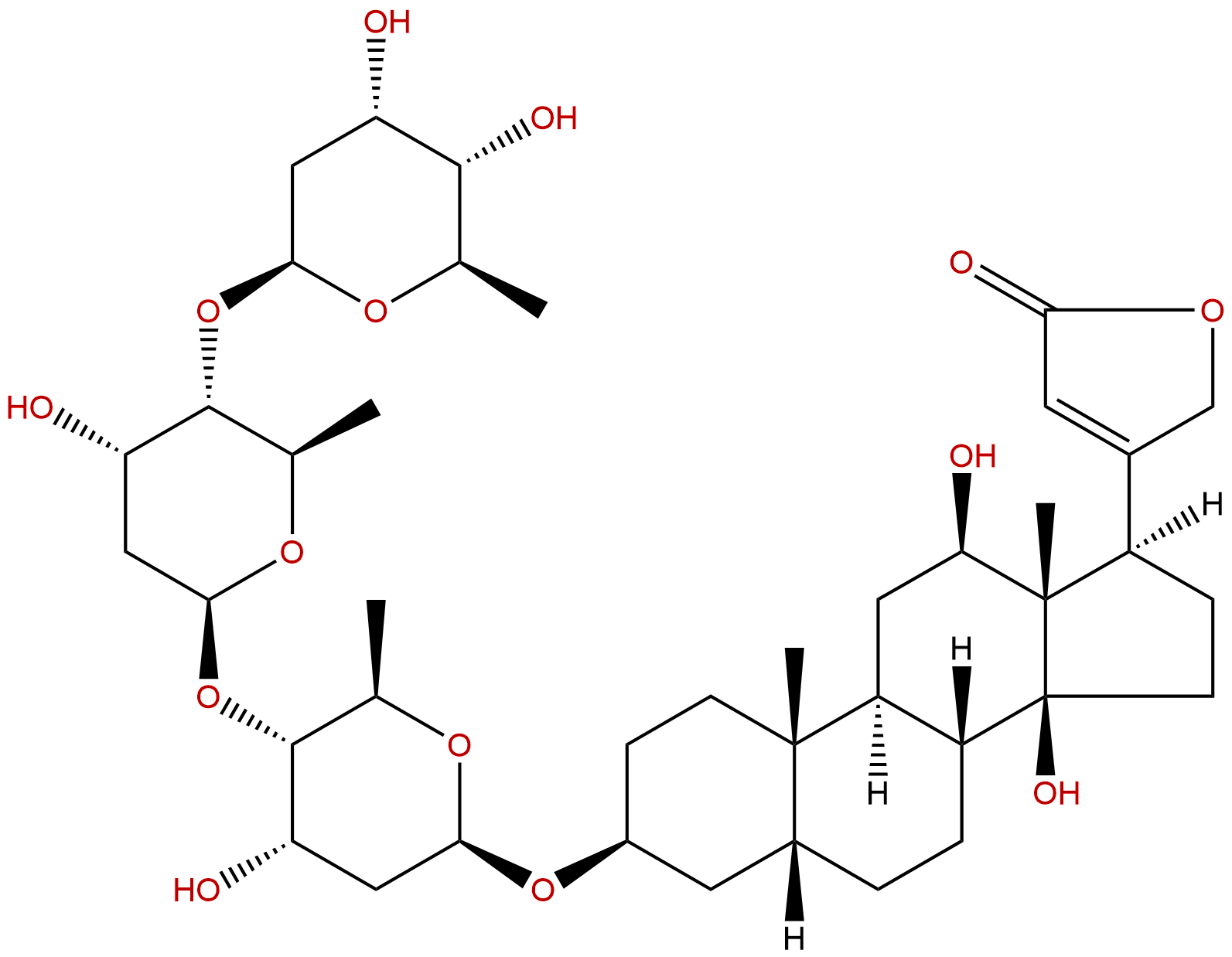


Synonym name: Davoxin; Digacin; Dilanacin; Lanoxin; Rougoxin; Digosin; Cordioxil
Catalogue No.: BP0490
Cas No.: 20830-75-5
Formula: C41H64O14
Mol Weight: 780.949
Botanical Source: Digitalis lanata
Purity: 95%~99%
Analysis Method: HPLC-DAD or/and HPLC-ELSD
Identification Method: Mass, NMR
Packing: Brown vial or HDPE plastic bottle
Can be supplied from milligrams to grams.
For Reference Standard and R&D, Not for Human Use Directly.
Inquire for bulk scale.
Description:
Digoxin is a classical Na,K-ATPase inhibitor, with selectivity for the α2β3 isoform over the common α1β1 isoform, used in the treatment of atrial fibrillation and heart failure. Digoxin and other cardiac glycosides can inhibit hypoxia-inducible factor 1 (HIF-1)α synthesis and block tumor growth.
References:
Lancet. 2015 Jun 13;385(9985):2363-70.
Digoxin use in patients with atrial fibrillation and adverse cardiovascular outcomes: a retrospective analysis of the Rivaroxaban Once Daily Oral Direct Factor Xa Inhibition Compared with Vitamin K Antagonism for Prevention of Stroke and Embolism Trial in
Digoxin is a widely used drug for ventricular rate control in patients with atrial fibrillation (AF), despite a scarcity of randomised trial data.
METHODS AND RESULTS:
We studied the use and outcomes of Digoxin in patients in the Rivaroxaban Once Daily Oral Direct Factor Xa Inhibition Compared with Vitamin K Antagonism for Prevention of Stroke and Embolism Trial in Atrial Fibrillation (ROCKET AF). For this retrospective analysis, we included and classified patients from ROCKET AF on the basis of Digoxin use at baseline and during the study. Patients in ROCKET AF were recruited from 45 countries and had AF and risk factors putting them at moderate-to-high risk of stroke, with or without heart failure. We used Cox proportional hazards regression models adjusted for baseline characteristics and drugs to investigate the association of Digoxin with all-cause mortality, vascular death, and sudden death. ROCKET AF was registered with ClinicalTrials.gov, number NCT00403767. Digoxin treatment was associated with a significant increase in all-cause mortality, vascular death, and sudden death in patients with AF.
CONCLUSIONS:
This association was independent of other measured prognostic factors, and although residual confounding could account for these results, these data show the possibility of Digoxin having these effects. A randomised trial of Digoxin in treatment of AF patients with and without heart failure is needed.
Circ Arrhythm Electrophysiol. 2015 Feb;8(1):49-58.
Digoxin and risk of death in adults with atrial fibrillation: the ATRIA-CVRN study.
Digoxin remains commonly used for rate control in atrial fibrillation, but limited data exist supporting this practice and some studies have shown an association with adverse outcomes. We examined the independent association between Digoxin and risks of death and hospitalization in adults with incident atrial fibrillation and no heart failure.
METHODS AND RESULTS:
We performed a retrospective cohort study of 14,787 age, sex, and high-dimensional propensity score-matched adults with incident atrial fibrillation and no previous heart failure or Digoxin use in the AnTicoagulation and Risk factors In Atrial fibrillation-Cardiovascular Research Network (ATRIA-CVRN) study within Kaiser Permanente Northern and Southern California. We examined the independent association between newly initiated Digoxin and the risks of death and hospitalization using extended Cox regression. During a median 1.17 (interquartile range, 0.49-1.97) years of follow-up among matched patients with atrial fibrillation, incident Digoxin use was associated with higher rates of death (8.3 versus 4.9 per 100 person-years; P<0.001) and hospitalization (60.1 versus 37.2 per 100 person-years; P<0.001). Incident Digoxin use was independently associated with a 71% higher risk of death (hazard ratio, 1.71; 95% confidence interval, 1.52-1.93) and a 63% higher risk of hospitalization (hazard ratio, 1.63; 95% confidence interval, 1.56-1.71). Results were consistent in subgroups of age and sex and when using intent-to-treat or on-treatment analytic approaches.
CONCLUSIONS:
In adults with atrial fibrillation, Digoxin use was independently associated with higher risks of death and hospitalization. Given other available rate control options, Digoxin should be used with caution in the management of atrial fibrillation.
Storage conditions:Short-term storage at 2~8℃, long-term storage at -20 ~ -80℃
Digoxin, CAS number 20830-75-5, is a classic natural product of cardiac glycosides, mainly extracted from plants of the genus Digitalis spp. As an effective inhibitor of Na ⁺/K ⁺ - ATPase, digoxin plays an important role in the treatment of cardiovascular diseases, especially heart failure and arrhythmia. Its unique pharmacological mechanism of action and clinical efficacy make it one of the representatives of cardiotonic drugs. Although digoxin has a narrow therapeutic window and significant toxic side effects, it still shows irreplaceable value in controlling ventricular rate of atrial fibrillation and improving symptoms of heart failure. This article will systematically review the chemical structure and physicochemical properties, plant sources and extraction methods, pharmacological activity, mechanism of action and molecular targets, pharmacological evaluation and pharmacokinetic characteristics of digoxin, and finally explore its clinical application prospects and future development directions.
Digoxin is a typical cardiac glycoside compound with a molecular formula of C41H64O14 and a molecular weight of 780.9490. The core of its structure is the steroid skeleton, with β - hydroxylation at the C-12 position and a glycosidic chain composed of three glucose residues attached. Structurally, digoxin belongs to the class of iridoid glycosides and has dual characteristics of steroid nucleus and glycoside moiety.
In terms of physical and chemical properties, the LogP value of digoxin is about 2.0052, indicating its moderate lipid solubility, which is beneficial for membrane penetration. Its polar surface area (TPSA) is 203.0600, and a higher TPSA value indicates strong polarity, which affects its ability to pass through biofilms. The low water solubility, about 0.0420 mg/mL, limits its oral absorption rate and degree. Digoxin has a lower blood-brain barrier permeability, reducing the risk of central nervous system toxicity. The negative result of hERG channel inhibition experiment indicates that it has a low risk of direct arrhythmia in cardiac electrophysiology. The Ames test was 0.0, indicating no significant genotoxicity.
Digoxin mainly comes from plants of the genus Digitalis, especially Digitalis lanata and Digitalis purpurea. This type of plant is widely used in traditional herbal medicine to treat heart disease. The leaves of Rehmannia plants are the main accumulation site of digoxin, with high and relatively stable content.
Traditional extraction methods usually use organic solvent extraction, such as ethanol or methanol extraction, combined with acid-base adjustment and liquid-liquid distribution techniques, to further purify digoxin. In modern technology, methods such as ultrasound assisted extraction and supercritical fluid extraction are gradually being applied to improve extraction efficiency and purity. The crude extract after extraction was separated and purified by liquid chromatography (HPLC) to ensure the quality and activity of digoxin.
In addition, the content of plant derived digoxin is greatly affected by factors such as variety, harvesting period, and environmental conditions. The establishment of standardized cultivation and extraction processes is crucial to ensure the stability and safety of medicinal digoxin.
Digoxin, as a cardiac glycoside, mainly exerts pharmacological effects by inhibiting Na ⁺/K ⁺ - ATPase on the myocardial cell membrane. Its cardiotonic effect is manifested by increasing the concentration of sodium ions in myocardial cells, which in turn enhances intracellular calcium ion levels through the sodium calcium exchange mechanism, strengthens myocardial contractility, and improves cardiac pumping function.
In the treatment of arrhythmia, digoxin regulates the autonomic nervous system of the heart, reduces atrial conduction velocity, controls the ventricular rate of atrial fibrillation, and reduces the occurrence of arrhythmia. Its antiarrhythmic effect also involves regulating the electrophysiological properties of myocardial cells.
In recent years, pharmacological research on digoxin has further expanded to its effects on various molecular targets, such as AMPK (PRKAA1), EHMT2, APP, PTPN1, MAOA, ESR2, etc. These targets are closely related to the pathological mechanism of heart failure, providing a molecular basis for the multi-target action of digoxin.
In addition, digoxin has shown certain potential in regulating cell apoptosis, oxidative stress, and inflammatory response, indicating its multidimensional pharmacological effects in the comprehensive treatment of heart failure.
The core mechanism of action of digoxin is the specific inhibition of Na ⁺/K ⁺ - ATPase (EC 3.6.3.9). Na ⁺/K ⁺ - ATPase is a transmembrane protein on the cell membrane that maintains a gradient of sodium and potassium ions inside and outside the cell. Digoxin binds to the alpha subunit of the enzyme, blocking its activity and causing an increase in intracellular sodium ion concentration.
The increase in sodium ion concentration affects the function of the sodium calcium exchanger (NCX), reduces the efflux of calcium ions, promotes intracellular calcium ion accumulation, and enhances myocardial contractility. In addition, digoxin improves cardiac function by regulating sympathetic nervous system activity, reducing heart rate and myocardial oxygen consumption.
In terms of molecular targets, in addition to Na ⁺/K ⁺ - ATPase, digoxin also interacts with various proteins:
The diversity of these molecular targets reflects the complex pharmacological network of digoxin, providing theoretical support for its multiple mechanisms of action in the treatment of cardiovascular diseases.
The pharmacological evaluation of digoxin shows that it has certain potential for drug development, but there are also challenges. Its high molecular weight (780.9490) and low water solubility (0.0420 mg/mL) limit the efficiency of oral absorption. The LogP value is 2.0052, indicating that it has moderate lipid solubility, which is beneficial for cell membrane penetration, but a higher TPSA (203.0600) may affect its transmembrane transport.
The low permeability of the blood-brain barrier reduces the risk of central nervous system side effects. The hERG channel inhibition experiment was negative, indicating a low direct risk of arrhythmia. The Ames test results showed no significant genotoxicity and good safety.
In terms of pharmacokinetics, digoxin has good oral absorption, but its bioavailability is greatly affected by gastrointestinal environment and individual differences. It is mainly excreted by the kidneys, and patients with renal insufficiency need to adjust the dosage. Digoxin interacts with various drugs, especially drug transport related to P-gp (ABCB1), which affects its blood drug concentration.
The therapeutic index of digoxin is relatively narrow, and the difference between therapeutic dose and toxic dose is small. Clinical application requires strict monitoring of blood drug concentration to prevent poisoning. Its pharmacokinetic characteristics and pharmacological parameters provide important basis for rational clinical drug use.
Digoxin, as a cardiac glycoside drug, has long played an important role in the treatment of heart failure and arrhythmia. It significantly improves patients' clinical symptoms and quality of life by enhancing myocardial contractility and regulating heart rate.
With the advancement of molecular biology and pharmacology, the multi-target mechanism of action of digoxin has gradually been revealed, providing new ideas for its precise use in the treatment of heart failure. In the future, combining genomics and pharmacogenomics research, it is expected to achieve personalized treatment of digoxin, optimize efficacy, and reduce toxic side effects.
In addition, the potential applications of digoxin in non cardiovascular fields such as anti-tumor and antiviral have also attracted widespread attention. Its ability to regulate cell apoptosis and immune response provides the possibility for developing novel indications.
However, the narrow therapeutic window and complex drug interactions of digoxin remain the main limitations of clinical application. Future research should focus on improving administration routes, developing low toxicity derivatives, and novel formulation technologies to enhance their safety and efficacy.
Digoxin, as a classic natural cardiac glycoside, plays an irreplaceable role in the treatment of heart failure and arrhythmia due to its unique chemical structure and multi-target pharmacological effects. Its mechanism of action involves Na ⁺/K ⁺ - ATPase inhibition and regulation of multiple molecular targets, reflecting a complex pharmacological network.
Despite challenges such as narrow treatment window and significant toxic side effects, digoxin remains an important component of clinical cardiovascular drugs. In the future, by combining modern pharmacology and molecular biology techniques, in-depth exploration of its mechanism of action and optimization of medication strategies will help enhance the clinical application value of digoxin and promote its widespread application in cardiovascular and other disease fields.
