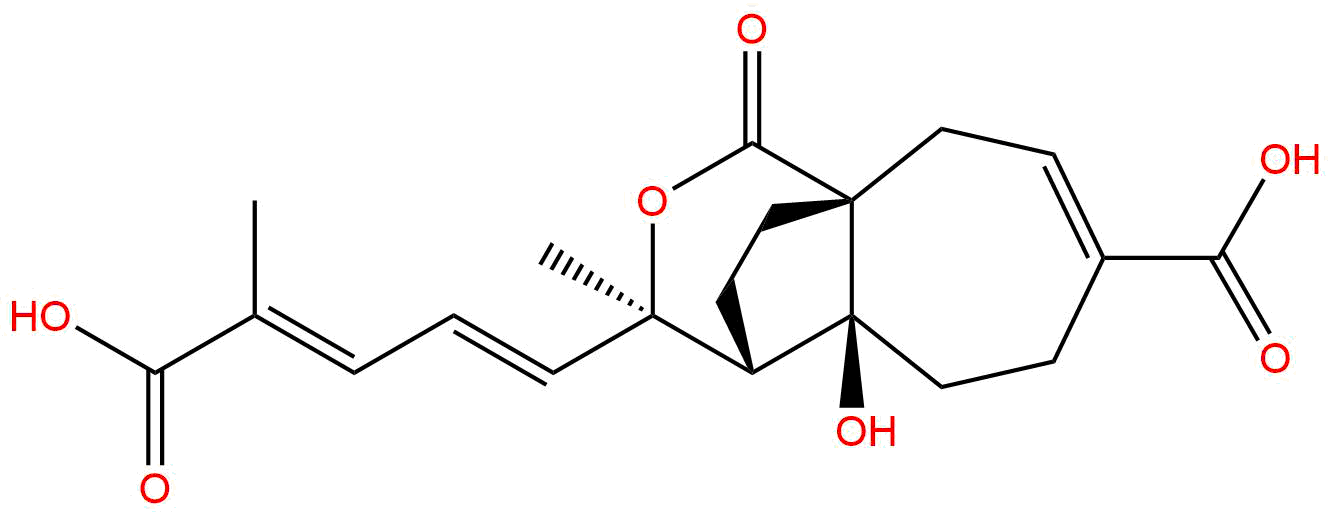


Product name: Demethylpseudolaric acid C
Synonym name: Deacetylpseudolaric acid C2; Deacetyldemethylpseudolaric acid B; Demethoxydeacetoxypseudolaric acid B
Catalogue No.: BP0473
Cas No.: 82508-36-9
Formula: C20H24O7
Mol Weight: 376.405
Botanical Source: Pseudolarix amabilis(Nelson)Rehd.
Physical Description:
Type of Compound: Diterpenoids
Purity: 95%~99%
Analysis Method: HPLC-DAD or/and HPLC-ELSD
Identification Method: Mass, NMR
Packing: Brown vial or HDPE plastic bottle
Storage: Store in a well closed container, protected from air and light. Put into refrigerate or freeze for long term storage.
Whenever possible, you should prepare and use solutions on the same day. However, if you need to make up stock solutions in advance, we recommend that you store the solution as aliquots in tightly sealed vials at -20℃. Generally, these will be useable for up to two weeks.
The product could be supplied from milligrams to grams
Inquire for bulk scale.
Chengdu Biopurify Phytochemicals Ltd. is a leading company in the research, development, manufacture and marketing of High Quality Phytochemicals and Extracts(especially Active Ingredients from Traditional Chinese Medicine,TCM), Natural Active Pharmaceutical Ingredients worldwide.
The main services:
A. Supply active ingredients and reference standards of TCM, from mgs to kgs scale
B. Custom extraction and purification, target Herb Active Ingredients
C. Custom synthesis and semi-synthesis for Natural Active Ingredients
D. CR(contract research), CM(contract manufacture) and PD(process development) services from lab scale, pilot scale to commercial scale(GMP is also available)
E. TCM compounds library for drug screen,more than 3000 compounds available, many of them are rare and unique.
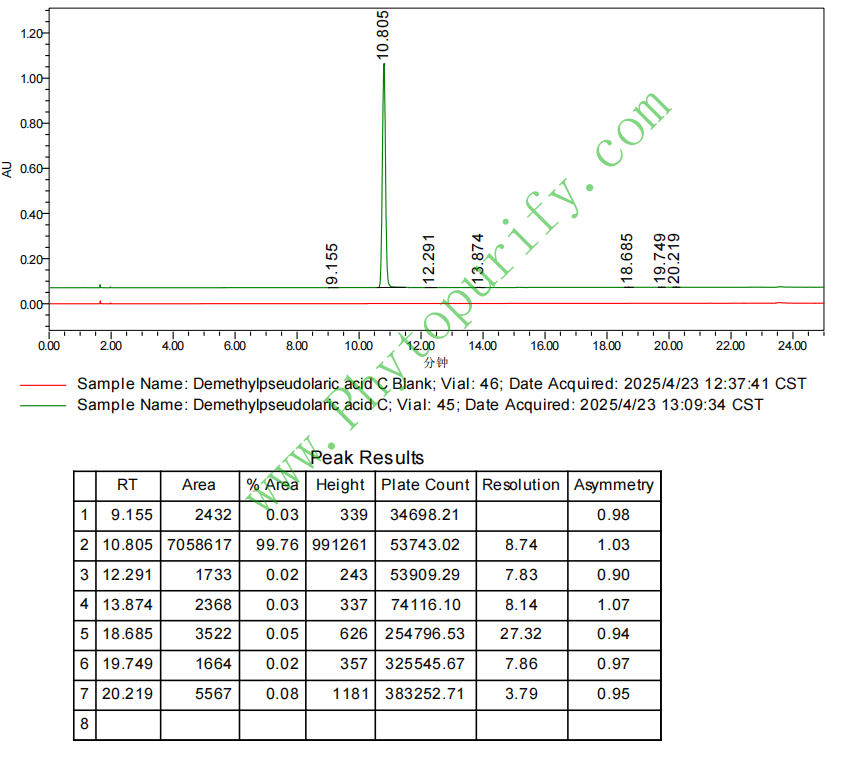
HPLC of Demethylpseudolaric acid C
Storage conditions:Short-term storage at 2~8℃, long-term storage at -20 ~ -80℃
121.1300
1.5912
-1.2139
.4517
1.5645
4.2916
Low
87.9188
5.3661
Yes
Yes
No
No
Yes
No
0.0
No
Yes
Yes
Yes
Demethylpseudolaric acid C (CAS number: 82508-36-9, product number: BP0473) is a plant derived from the Rutaceae family Cortex Pseudolaricis(Dictamnus dasycarpus)Natural diterpenoid compounds isolated from the middle. Its molecular formula is C20H24O7 and its molecular weight is 376.4050 g/mol. As a structurally unique natural product, it has attracted widespread attention from researchers in the field of anti-tumor drug development in recent years. Its research background is rooted in the application practice of traditional Chinese medicine. The skin of Vitex negundo has long been recorded in the ancient books of Chinese medicine and is often used to treat eczema, dermatitis and some infectious diseases. Modern pharmacological research has gradually revealed that the plant contains various active ingredients, especially diterpenoid acid compounds represented by demethylated abscisic acid, which exhibit significant anti-tumor potential. The current research focus is on elucidating its precise molecular mechanism of action, especially its regulatory effect on multiple key tumor related targets, which provides valuable lead compounds and theoretical basis for the development of novel, multi-target anti-tumor drugs.
Demethylated quercetin belongs to highly oxidized diterpenoid compounds of the rosin alkane type. The SMILES structural formula (C/C (=C \ C=C [C @ @] 1 (C) OC (=O) [C @] 23CC=C (C (=O) O) CC [C @] 2 (O) [C @ H] 1CC3) C (=O) O) reveals its complex stereochemical structure, including multiple chiral centers and conjugated double bond systems. This unique structure is the material basis for its biological activity.
According to the analysis of drug parameters, its molecular weight (MW) is 376.4 g/mol, which meets the requirement of "molecular weight less than 500" in Lipinski's five rules. The calculated logarithm of the lipid water partition coefficient (LogP) is 1.5912, indicating that the compound has moderate lipophilicity, which is conducive to transmembrane transport and absorption. However, its LogD value (-1.2139) is lower at physiological pH, indicating that its ionization degree may be higher, which can affect its distribution in different physiological environments. The topological polar surface area (TPSA) is 121.13 Å ², which is relatively large and mainly due to multiple carboxyl and ester groups in the molecule. This may affect its ability to passively diffuse through the cell membrane, but it is still within an acceptable range (TPSA<140 Å ² is generally considered to be beneficial for oral absorption). The water solubility is 0.4517 mg/mL, which is slightly soluble. Solubilization strategies may need to be considered during formulation development. Overall, its physicochemical properties generally conform to the basic characteristics of drug like molecules, but some parameters (such as LogD and TPSA) suggest that there may be room for optimization in its pharmacokinetics.
The source of demethylated abscisic acid is from the Rutaceae family of plants in the genus Paeonia Cortex Pseudolaricis(Dictamnus dasycarpus Turcz.), The main medicinal part of it is the root bark, which is often referred to as "white fresh bark" in traditional Chinese medicine. This plant is widely distributed in northern China and Northeast Asia. In traditional Chinese medicine theory, Bai Xianpi has a bitter and cold nature, and can regulate the spleen, stomach, and bladder meridians. It has the effects of clearing heat, drying dampness, dispelling wind, and detoxifying. Throughout history, herbal medicines such as the Shennong Bencao Jing and the Compendium of Materia Medica have been recorded and commonly used to treat conditions such as damp heat sores, yellow water dripping, eczema, rubella, scabies, sores and abscesses, as well as jaundice and hematuria. It is also used by the people to treat rheumatism and rheumatism.
Although traditional applications do not directly target tumor treatment, their effects of "clearing heat and detoxifying" and "dispelling wind" are similar to the concepts of anti-inflammatory, immune regulation, and inhibition of abnormal proliferation in modern medicine. This provides important clues and evidence for modern researchers to search for anti-tumor active ingredients from this plant. Modern plant chemistry research has isolated and identified various alkaloids, limonenes, and terpenoids from the bark of Quercus acutissima, including berberine, quercetin, phellodendron, and various diterpenoid acids such as formic acid, acetic acid, propionic acid, and their demethylated derivatives. Many of them have been proven to have anti-inflammatory, antibacterial, antifungal, and anti-tumor activities. Demethylated quercetin is an important member of this active ingredient family.
The most notable pharmacological activity of demethylated quercetin is its antitumor Function. Existing research data indicates that this compound interferes with the proliferation, survival, and progression of tumor cells by acting on multiple key targets closely related to tumor occurrence and development. Its known molecular targets include:
TERT (telomerase reverse transcriptase)Telomerase is a key enzyme that maintains the unlimited proliferation ability of tumor cells, and its catalytic subunit TERT is highly expressed in the vast majority of malignant tumors. Inhibition of TERT activity can lead to telomere shortening, ultimately causing tumor cell senescence or apoptosis. Demethylated resveratrol may limit the immortalized potential of tumor cells by downregulating the expression or inhibiting the activity of TERT.
TP53 (tumor protein P53)P53 is a well-known "guardian of the genome" that plays a central role in cell cycle arrest, DNA repair, and apoptosis. More than 50% of human tumors have TP53 gene mutations or functional inactivation. Research has shown that certain natural products can restore or mimic the function of mutant p53, or stabilize wild-type p53. Demethylated resveratrol may induce tumor cell apoptosis by regulating the p53 signaling pathway, activating downstream pro apoptotic genes such as BAX and PUMA.
CDKN2A (cyclin dependent kinase inhibitor 2A)This gene encodes the p16INK4a protein, which is an important negative regulator of the cell cycle and blocks the G1 phase progression by inhibiting CDK4/6. In various tumors, CDKN2A is silenced due to deletion or methylation. Demethylated resveratrol may upregulate the expression of p16INK4a through epigenetic regulation or other means, thereby inducing cell cycle arrest.
CTNNB1 (β - catenin)β - catenin is a core effector molecule of the Wnt/β - catenin signaling pathway. The abnormal activation of this pathway is closely related to the occurrence of various cancers, such as colorectal cancer and liver cancer. Excessive β - catenin entering the nucleus will initiate transcription of proliferation promoting genes such as c-Myc and Cyclin D1. Demethylated quercetin may inhibit abnormal signals in the Wnt pathway by promoting phosphorylation degradation of β - catenin or inhibiting its nuclear translocation.
AXIN1 (Axial Protein 1)AXIN1 is a scaffold protein of the β - catenin degradation complex, which negatively regulates the Wnt signaling pathway. The inactivation of AXIN1 function leads to the stabilization and accumulation of β - catenin. Demethylated quercetin may enhance the degradation of β - catenin by stabilizing or upregulating AXIN1, thereby synergistically inhibiting the Wnt pathway.
Integrated analysis of mechanism of action:
The demethylated oxalic acid showed Multi target, multi pathway Characteristics of anti-tumor effects. Its mechanism of action network may be as follows: on the one hand, it targets through TP53 and CDKN2A Directly activating the intrinsic apoptosis program and cell cycle checkpoints in cells, forcing tumor cells towards death or arrest. On the other hand, through simultaneous regulation CTNNB1 and AXIN1 It effectively inhibits the key signaling pathway that drives tumor growth and maintains stemness, the Wnt/β - catenin pathway. In addition, regarding TERT The inhibition fundamentally weakens the unlimited replication ability of tumor cells. This synergistic intervention on the "cell cycle/apoptosis regulatory system" (TP53, CDKN2A), "developmental signaling pathway" (Wnt/β - catenin), and "immortalization sequence" (telomerase) enables it to more comprehensively and effectively attack multiple fatal weaknesses of tumor cells, which may help overcome the problem of resistance to single target drugs. However, currently these target information are mostly based on database association prediction or preliminary molecular docking research. The precise direct target action, binding mode, and downstream detailed signal transduction network still need further biochemical and cell biology experiments (such as surface plasmon resonance, confocal microscopy, reporter gene experiments, etc.) to confirm and clarify.
Based on the provided pharmacological parameters, we can conduct a preliminary evaluation of the potential development prospects of demethylated quercetin as a drug:
Lipinski Rule of Five Evaluation:
Absorption, distribution, metabolism, excretion (ADME) characteristics:
Summary The demethylated quercetin has a multi-target advantage in anti-tumor activity, and its basic physicochemical properties generally meet the requirements of drug like properties. However, its medicinal properties face significant challenges, mainly including:Potential chromosomal aberration genetic toxicity, clear hepatotoxicity signals, and potentially limited oral absorption These safety issues will be the primary core challenges that must be addressed in the process of transitioning from active lead compounds to candidate drugs.
At present, research on demethylated oxalic acid is still in progress Preclinical research stage Mainly focused on plant chemical isolation and identification, in vitro anti-tumor activity screening, and preliminary exploration of the mechanism of action. The target information provided by existing databases provides important clues and directions for the study of its mechanism of action, but further experimental verification is needed. It has shown inhibitory and pro apoptotic activities in a variety of tumor cell lines (such as liver cancer, breast cancer, colon cancer, etc.), but its in vivo efficacy, pharmacokinetics and toxicology data are still very scarce.
Future research directions:
1. Deepening mechanism research The primary task is to utilize techniques such as gene knockout/knockdown, overexpression, confocal imaging, and immunoprecipitation at the cellular and molecular levels Verify and clarify Its specific mode of action on targets such as TERT, TP53, CDKN2A, CTNNB1, AXIN1 (whether directly bound or indirectly regulated) and its downstream signaling network.
2. Research on Structural Optimization and Structure Activity Relationship (SAR)Systematically investigate its liver toxicity, genetic toxicity, and physicochemical property defects (such as LogD and solubility)Structural modification and optimization For example, masking carboxyl groups through esterification, amidation, or synthesis of prodrugs may improve their LogD, permeability, and toxicity. By simplifying the structure or introducing different functional groups, exploring the necessary pharmacophores for its activity, while maintaining or enhancing anti-tumor activity, reducing toxic side effects.
3. Comprehensive preclinical evaluation On the basis of optimizing the structure, conduct standardized in vivo pharmacological experiments (establish mouse or rat transplant tumor models), and systematically evaluate their pharmacokinetic (PK) characteristics (absorption, distribution, metabolism, excretion) and toxicological (acute toxicity, long-term toxicity, genetic toxicity, reproductive toxicity, etc.) profiles.
4. Exploration of combination therapy Given its multi-target nature, explore its combination application with existing clinical chemotherapy drugs or targeted drugs to see if it can produce synergistic effects, reduce their respective dosages and toxic side effects, or overcome drug resistance.
Application Prospects:
As a natural lead compound derived from traditional Chinese medicine, the greatest value of demethylated quercetin lies in providing a novel multi-target chemical framework. Although it may be difficult to directly develop into a drug due to toxicity issues, it serves as a tool for pharmaceutical chemists Rational drug design Provides an excellent starting point. Through modern medicinal chemistry and computer-aided drug design methods, it is expected to derive a series of new candidate compounds with higher activity, lower toxicity, and better drug properties. In addition, in-depth research on its mechanism of action can also help reveal the modern scientific connotation of traditional Chinese medicine's "clearing heat and detoxifying" anti-tumor effect, and promote the modernization and internationalization of traditional Chinese medicine. In short, the research on demethylated quercetin is a promising path that connects the wisdom of traditional Chinese medicine with the development of modern innovative drugs.
