


Synonym name:
Catalogue No.: BP1167
Cas No.: 82508-32-5
Formula: C22H28O6
Mol Weight: 388.46
Botanical Source: Pseudolarix kaempferi
Purity: 95%~99%
Analysis Method: HPLC-DAD or/and HPLC-ELSD
Identification Method: Mass, NMR
Packing: Brown vial or HDPE plastic bottle
Can be supplied from milligrams to grams.
For Reference Standard and R&D, Not for Human Use Directly.
Inquire for bulk scale.
HPLC of Pseudolaric Acid A
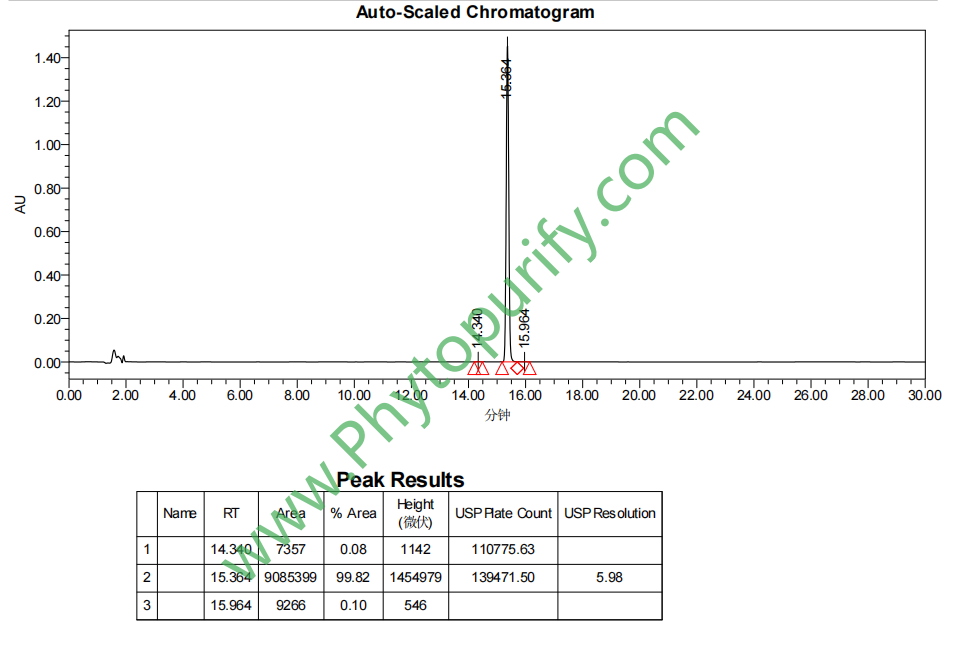
Storage conditions:Short-term storage at 2~8℃, long-term storage at -20 ~ -80℃
89.9000
3.2713
.3841
.0547
2.4284
4.2602
Low
90.8645
5.3257
Yes
Yes
No
No
Yes
No
0.0
No
Yes
Yes
Yes
In the long river of natural product chemistry and pharmacology research, discovering lead compounds with novel structures and unique activities from traditional medicinal plants has always been an important source of innovative drug development. Pseudolaric Acid A (PAA), a diterpenoid acid isolated from the traditional Chinese medicine Pseudolaric bark, has attracted much attention since its discovery due to its significant antifungal activity. With the deepening of research, its target of action is gradually revealed, demonstrating a unique mechanism of action different from existing clinical antifungal drugs, providing new candidate molecules for coping with increasingly severe drug-resistant fungal infections. This article aims to systematically review the chemical structure, plant origin, pharmacological activity, mechanism of action, pharmacological evaluation, and clinical application prospects of oxalic acid, in order to provide comprehensive academic references for the in-depth research and development of this compound.
Turmeric bark formic acid (CAS number: 82508-32-5) is a rosin type diterpenoid acid with a unique skeleton. Its molecular formula is C23H28O6 and its molecular weight is 388.4600. Its core structure consists of a condensed polycyclic system (usually tricyclic or tetracyclic) connected by carboxyl, acetoxy, and unsaturated bonds (such as double bonds or epoxy structures), which are crucial for its biological activity. Its chemical structure determines its specific physicochemical properties.
According to the provided pharmacological parameters, the logarithm of the lipid water partition coefficient (LogP) of oxalic acid is 3.2713, indicating that the compound has moderate lipophilicity and tends to be distributed in a lipid environment. The topological polar surface area (TPSA) is 89.9000 Å ², reflecting the degree of exposure of polar atoms (such as oxygen atoms) in the molecule, which affects its solubility and membrane permeability. Its water solubility value is relatively low (0.0547, usually measured in mg/mL or mol/L, not specified here, but a low value indicates poor solubility), which is consistent with a higher LogP value, suggesting poor solubility in aqueous media and may require consideration of solubilization strategies in formulation development. In the Biopharmaceutical Classification System (BCS), it may belong to Class II (low solubility, high permeability) or Class IV (low solubility, low permeability) compounds, which require further experimental confirmation. In addition, its blood-brain barrier permeability is predicted to be "low", indicating that it may not easily enter the central nervous system. In early safety screening, hERG inhibition was rated as' no ', indicating a low potential risk of cardiac toxicity; The Ames test result is 0.0, indicating preliminary non mutagenicity, but these results need to be validated in more comprehensive preclinical toxicology studies.
Turmeric bark formic acid mainly comes from plants of the Pinaceae genus in the Pinaceae family Jin Qiansong(Pseudolarix amabilis The dried root bark or near root bark of (J. Nelson) Rehder, also known as "Tujingpi" or "Jinqiansongpi" in traditional Chinese medicine. Jinqiansong is a unique tree species in China. Traditionally, its bark has insecticidal and anti itch effects when applied topically, and is commonly used to treat skin diseases such as scabies and eczema.
The extraction and separation of formic acid from soil bark usually follow the conventional process of natural product chemistry. Firstly, the dried Chinese herbal medicine of Eucommia ulmoides is crushed and subjected to extraction or reflux extraction using an appropriate solvent (such as methanol, ethanol, or ethanol water mixture) to obtain the crude extract. After vacuum concentration, the crude extract was preliminarily separated using solvent partitioning method (such as extraction with petroleum ether, ethyl acetate, n-butanol, etc. in sequence), and the formic acid in Sophora japonica was mainly enriched in the moderately polar ethyl acetate fraction. Subsequently, purification is carried out through a series of column chromatography techniques, often using silica gel column chromatography with different ratios of petroleum ether ethyl acetate or chloroform methanol gradient elution. Collect the fractions containing the target components by combining thin layer chromatography (TLC) or high-performance liquid chromatography (HPLC) monitoring. To further obtain high-purity monomeric compounds, repeated column chromatography or preparative high-performance liquid chromatography (pre HPLC) is often required. Modern extraction techniques such as ultrasound assisted extraction and microwave-assisted extraction can also be used to improve extraction efficiency. Structural identification involves the comprehensive use of nuclear magnetic resonance (NMR, including 1H-NMR, 13C-NMR, 2D-NMR), mass spectrometry (MS), infrared spectroscopy (IR), and X-ray single crystal diffraction.
The most notable pharmacological activity of oxalic acid in the bark of Atractylodes macrocephala is its Broad spectrum and potent antifungal activity Numerous in vitro studies have shown that PAA exhibits significant inhibitory activity against various clinically relevant pathogenic fungi, including:
- Candida genus Like Candida albicans(Candida albicans)Smooth Candida albicans(C. glabrata)Candida krusei(C. krusei)It also shows activity, especially against certain azole resistant strains.
- Skin ringworm fungus Like red ringworm fungus(Trichophyton rubrum)Trichophyton fungus(T. mentagrophytes)Wait, this is consistent with the traditional external application of Tujingpi for anti ringworm purposes.
- Other fungi Like Cryptococcus neoformans(Cryptococcus neoformans)Aspergillus fumigatus(Aspergillus fumigatus)Wait.
Its minimum inhibitory concentration (MIC) value is usually in the micromolar (μ M) range, and its activity is stronger or equivalent to some traditional antifungal drugs. It is worth noting that the antifungal activity of PAA has Concentration dependent dual effect At lower concentrations, it mainly inhibits hyphal growth and morphological transformation (such as yeast hyphal phase transition), while at higher concentrations, it can directly kill fungal cells. This specific inhibition of hyphal growth is of great significance for intervening in fungal invasiveness and biofilm formation.
In addition to its core antifungal activity, research has also found that oxalic acid has other potential pharmacological effects, such as anti-tumor, anti angiogenic, anti-inflammatory, and immune regulatory activities. However, most of these studies are in the stage of cell or animal models, and its main development direction as an antifungal drug is more clear and prominent.
The antifungal mechanism of oxalic acid is complex and multi-target, which is different from the current mainstream antifungal drugs such as azoles, polyenes, and echinocandins, giving it a unique advantage in overcoming drug resistance. Existing research has revealed multiple key links in its action on fungal cells, involving multiple potential target proteins:
Inhibition of microtubule proteins and disruption of the cytoskeleton This is one of the earliest and most important mechanisms of action elucidated by PAA. PAA can specifically bind to fungal β - tubulin, inhibit the polymerization of tubulin, and thus disrupt the normal assembly of fungal cytoskeleton. This directly leads to the inability to form mitotic spindles, cell cycle arrest, and severely affects cell morphology (especially the transport of apical growth vesicles necessary for hyphal growth), ultimately causing cell death. This mechanism is similar to the anti-tumor drugs paclitaxel (promoting polymerization) and colchicine (inhibiting polymerization), but the binding sites may be different.
Cell wall synthesis interference The fungal cell wall is its unique and important drug target. Research has shown that PAA can affect the biosynthesis of key cell wall components such as chitin and β - glucan. This may be achieved by indirectly affecting the activity or localization of related synthases. For example, abnormalities in the targets CHS3 (chitin synthase 3) and FKS1 (β -1,3-glucan synthase catalytic subunit) may be related to cell wall stress induced by PAA.
The influence of ergosterol synthesis pathway Ergosterol is a key sterol component of fungal cell membranes. Although PAA does not directly inhibit ERG11 (lanosterol 14 α - demethylase, the main target of azole drugs) or CYP51 (its homolog), studies have shown that it can cause changes in ergosterol content in fungal cells, possibly by interfering with upstream or downstream metabolic processes, or indirectly affecting this pathway by inducing oxidative stress.
Inhibition of efflux pump and reversal of drug resistance Overexpression of active efflux pumps in fungi, such as ABC transporter CDR1, CDR2, and MFS transporter MDR1, is the main cause of azole drug resistance. PAA has been found to inhibit the function of these efflux pumps, reduce drug efflux, and potentially restore the sensitivity of drug-resistant fungi to existing antifungal drugs, with the potential of being a "resistance reversal agent".
Other targets and stress response PAA can also affect fungal adhesion factors (such as ALS3, affecting bacterial adhesion and biofilm formation), mitochondrial function (possibly involving MLS1, etc.), and trigger strong oxidative stress response and cell apoptosis like death.
In summary, the formic acid in the bark of Atractylodes macrocephala can be obtained through Multi target, multi pathway The synergistic effect, which destroys the fungal cytoskeleton, interferes with the integrity of cell walls and membranes, inhibits energy metabolism, and induces programmed cell death, makes it difficult for fungi to develop high-level drug resistance through a single gene mutation.
Based on the physical and chemical parameters mentioned earlier, the preliminary evaluation of the pharmacological properties of oxalic acid in soil bark shows that Opportunities and challenges coexist The characteristics.
Advantage aspects Moderate molecular weight (<500), novel structure, clear and unique mechanism of action different from existing drugs, effective against drug-resistant bacteria, and preliminary safety screening (hERG negative, Ames negative) results are good.
Challenge aspect:
1. Solubility and permeability Low water solubility and moderate LogP values may lead to poor oral bioavailability. As a topical antifungal drug (such as for treating dermatophytosis), this drawback may be avoided. But if developed as a systemic antifungal drug, its solubility and absorption need to be improved through pharmaceutical methods, such as making nanocrystals, liposomes, cyclodextrin inclusion complexes, or prodrugs.
2. Metabolism and stability As a diterpenoid acid compound, its in vivo metabolic pathways (such as liver CYP450 enzyme metabolism, glucuronic acid binding, etc.) and metabolite activity need to be further studied. The ester bonds and unsaturated bonds in its chemical structure may face the risk of hydrolysis or metabolic inactivation in vivo.
3. Pharmacokinetics (PK)Currently, there are relatively limited reports on pharmacokinetic studies of PAA systems. Limited animal studies suggest that its oral absorption may be poor and widely distributed in the body, but key PK parameters such as half-life, clearance rate, and protein binding rate need to be fully elucidated. Its low blood-brain barrier permeability is an unfavorable factor for treating fungal infections in the central nervous system, but it may be beneficial for reducing central nervous system side effects.
4. toxicology Although the initial genetic toxicity test was negative, a comprehensive preclinical toxicology evaluation, including acute toxicity, chronic toxicity, reproductive toxicity, etc., is crucial for its clinical development. Its anti microtubule mechanism suggests the need for careful evaluation of the potential cytotoxicity of mammalian cells to determine its therapeutic window.
The clinical application prospects of Tuchengpi formic acid mainly revolve around its antifungal Especially Dealing with drug-resistant fungal infections This core value unfolds.
Development of topical preparations for local use This is the most direct and fastest conversion path. Based on the traditional medication experience of Vitex negundo, PAA cream, gel, spray or film agent are developed for the treatment of dermatophytosis (beriberi, tinea cruris, tinea corporis), onychomycosis (onychomycosis) and cutaneous candidiasis. Its multi-target mechanism may be particularly effective for infections caused by refractory ringworm disease and azole resistant bacteria.
Systemic antifungal new drug Through chemical modification (synthesis of derivatives or prodrugs) and advanced formulation technologies (such as intravenous nano formulations), the solubility, stability, and pharmacokinetic properties of PAA are improved, aiming to develop injection or oral new drugs for the treatment of severe systemic fungal infections such as invasive candidiasis and aspergillosis. It has no cross resistance with existing drugs and can be used as a second-line or combination therapy option.
Antifungal resistance reversal agent By utilizing its ability to inhibit efflux pumps (CDR1, MDR1), the combination of PAA or its structurally simplified derivatives with conventional azole drugs (such as fluconazole) may restore drug sensitivity of drug-resistant strains and prolong the clinical lifespan of existing antifungal drugs. This "old medicine new use" strategy has important economic value and clinical significance.
Combination therapy Due to its unique mechanism of action, the combination of PAA with other types of antifungal drugs (such as echinocandins and polyenes) may produce synergistic or additive effects, improve efficacy, and reduce individual dosage and toxicity.
Future research priorities should include:
- In depth target validation Accurately identify its direct target proteins and binding sites using chemical biology methods such as photoaffinity labeling and proteomics.
- structural optimization Conduct systematic structure-activity relationship research, modify the structure of PAA through semi synthetic or total synthetic methods, and optimize its solubility, metabolic stability, and safety while maintaining its activity.
- Preclinical development Complete a complete set of pharmacological, pharmacokinetic, and toxicological evaluations that meet the requirements for new drug registration, and clarify their therapeutic indices.
- Pharmaceutical research Develop appropriate formulations for different clinical applications (local/systemic).
As a natural diterpenoid acid extracted from the traditional Chinese medicine Turmeric bark, Turmeric bark formic acid has injected new vitality into the field of antifungal drug development with its novel chemical structure and unique multi-target antifungal mechanism. It not only exhibits potent activity against sensitive and drug-resistant fungi in vitro and in vivo models, but also opens up new pathways in its mechanism of action that are different from existing drugs, providing a highly promising candidate molecule for addressing the global challenge of fungal resistance. Although the challenges in drug formulation, such as solubility and pharmacokinetics, urgently need to be addressed through interdisciplinary cooperation on the road to clinical drug development, with its solid pharmacological activity and mechanism research foundation, oxalic acid and its derivatives are expected to develop into a new class of antifungal drugs in the future. Whether as topical preparations, systemic drugs or resistance reversal agents through modification, they have broad development prospects and important clinical value. Continued in-depth research on it will further enrich the scientific connotation of drug discovery guided by natural products.
