Introduction/Overview
Demethylpseudolaric acid B (DPA-B) is a natural product derived from the traditional Chinese medicine Pseudolarix kaempferi, and belongs to the flavonoid derivatives. In recent years, with the increasing importance of natural products in the development of anti-tumor drugs, DPA-B has gradually become a research hotspot in the fields of pharmacology and medicinal chemistry due to its significant anti-cancer activity, especially its potential therapeutic value in malignant tumors such as prostate cancer. Prostate cancer, as one of the common malignant tumors in men, has a complex pathogenesis involving abnormal activation of multiple signaling pathways and regulation of multiple molecular targets. DPA-B exhibits excellent anti-tumor potential through multi-target and multi pathway regulation, providing important molecular basis and theoretical basis for the development of novel anti prostate cancer drugs.
This article provides a systematic review of the chemical structure and physicochemical properties, plant sources, and extraction methods of demethylated cellulose acetate. It delves into its pharmacological activity and mechanism of action, with a focus on analyzing its molecular target effects in prostate cancer. Pharmacokinetic evaluation is conducted based on drug parameters, and its clinical application prospects are discussed. The aim is to provide comprehensive scientific references for further research and development of this natural product.
Chemical structure and physicochemical properties
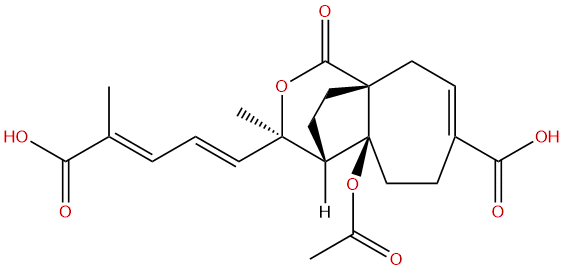
The molecular formula of demethylated oxalic acid is C24H30O7, with a molecular weight of 418.4420. Its structural characteristics are modified derivatives of flavonoid skeleton, containing multiple hydroxyl and carboxyl functional groups, endowing it with certain polarity and biological activity. The LogP value is 2.0847, indicating that it has moderate lipid solubility, which is beneficial for cell membrane penetration but not excessively hydrophobic, suitable for the in vivo distribution of drug molecules. Its topological polar surface area (TPSA) is 127.2 Å ², indicating that the molecule has strong polarity and hydrogen bond donor/acceptor ability, which is of great significance for its binding to biomolecule targets.
The water solubility is 0.1973 mg/mL, which belongs to low solubility compounds, indicating the need to consider solubility improvement strategies in drug formulation design. The low permeability of the blood-brain barrier indicates its limited distribution in the central nervous system, which may reduce the risk of central nervous system toxicity. The negative result of hERG channel inhibition experiment indicates a low risk of cardiac toxicity. The Ames test result is 0, indicating no significant genotoxicity and meeting the preliminary requirements for safety evaluation.
In summary, the physicochemical properties of DPA-B support its potential as a drug molecule to exert biological activity in vivo, while also suggesting the need to optimize its solubility and bioavailability during drug development.
Plant sources and extraction methods
The main source of acetic acid in demethylated soil bark is Pseudolarix kaempferi, which belongs to the genus Pseudolarix in the pine family and is an important traditional Chinese medicine for promoting blood circulation and removing blood stasis. The bark and resin of Quercus acutissima contain abundant flavonoids and terpenoids, among which DPA-B, as one of the main active ingredients, has significant biological activity.
The extraction method usually uses organic solvent extraction combined with column chromatography separation and purification technology. The specific process includes:
- Raw material pretreatment Collect the bark and bark of the soil chestnut, dry and crush it into fine powder.
- Solvent extraction Ethanol or methanol is used for reflux extraction, and the extraction time is generally 2-3 hours. Repeat the extraction several times to improve the extraction rate.
- Crude extract concentration Concentrate the extract under reduced pressure to obtain the crude extract.
- Separation and purification Using silica gel column chromatography combined with gradient elution (such as ethyl acetate methanol system) for separation, collect components containing DPA-B.
- Purification by High Performance Liquid Chromatography (HPLC)Further purify to high purity, confirm its structure and purity.
In recent years, modern extraction techniques such as ultrasound assisted extraction (UAE) and microwave-assisted extraction (MAE) have also been applied to the extraction of DPA-B, significantly improving extraction efficiency and purity, reducing solvent consumption, and having good industrial application prospects.
Pharmacological activity research
Demethylated quercetin has shown extensive pharmacological activity in various disease models, with the most prominent anti-tumor effect. Its inhibitory effect in prostate cancer cell lines has been confirmed by multiple in vitro and in vivo studies.
Anti prostate cancer activity
DPA-B exhibits significant proliferation inhibition on various prostate cancer cell lines, such as PC-3, LNCaP, and DU145, with IC50 values typically in the low micromolar range. Its anti-cancer effect is mainly manifested as:
- Inducing cell apoptosis By activating the endogenous apoptotic pathway, regulating the expression of BCL2 family proteins, and promoting programmed cell death.
- cell cycle arrest DPA-B can induce G1/S or G2/M phase cell cycle arrest and inhibit cell proliferation.
- Inhibit migration and invasion Reduce the migration ability of cancer cells and inhibit the potential for tumor metastasis.
- Angiogenesis inhibition Inhibiting tumor angiogenesis by regulating relevant signaling pathways.
Other pharmacological effects
In addition to its anti prostate cancer properties, DPA-B also exhibits anti-inflammatory, antioxidant, and antibacterial activities. Its anti-inflammatory effect is achieved by inhibiting the expression of inflammatory factors and regulating immune cell function, while its antioxidant effect is closely related to its regulation of the NFE2L2 (nuclear factor erythroid 2-related factor 2) signaling pathway.
Mechanism of action and molecular targets
The anti prostate cancer mechanism of DPA-B involves multiple signaling pathways and key molecular targets, reflecting its multi-target drug properties. The main targets include:
BCL2 (B-cell lymphoma 2)
BCL2 is an anti apoptotic protein that is commonly overexpressed in various tumor cells and promotes tumor cell survival. DPA-B downregulates BCL2 expression, promotes mitochondrial pathway apoptosis, and enhances cancer cell sensitivity to apoptotic signals.
PTPN1 (protein tyrosine phosphatase 1B)
PTPN1 is involved in various signal transduction regulations, affecting the proliferation and metabolism of tumor cells. DPA-B regulates PTPN1 activity, interferes with tumor cell signaling, and inhibits its growth.
STAT3 (Signal Transduction and Transcription Activation Factor 3)
STAT3 plays a crucial role in the occurrence and development of tumors, promoting cell proliferation, anti apoptosis, and immune escape. DPA-B inhibits the phosphorylation and nuclear translocation of STAT3, blocks its transcriptional activity, and suppresses tumor growth.
ESR2 (estrogen receptor beta)
ESR2 has an inhibitory effect on tumor growth in prostate cancer. DPA-B may exert anti-tumor effects by regulating ESR2 expression, affecting hormone related signaling pathways.
NFE2L2 (nuclear factor erythroid 2 related factor 2)
NFE2L2 regulates cellular antioxidant response, DPA-B activates the NFE2L2 pathway, enhances cellular antioxidant capacity, reduces oxidative stress damage to cells, and indirectly inhibits tumor progression.
MAPK1 (mitogen activated protein kinase 1)
MAPK1 is involved in cell proliferation and differentiation signaling. DPA-B affects the cell cycle and apoptosis process by regulating MAPK1 signaling.
CYP19A1 (aromatase)
CYP19A1 plays a crucial role in androgen metabolism, regulating hormone levels. DPA-B inhibition of CYP19A1 helps regulate hormone dependent growth in prostate cancer.
AR (androgen receptor)
AR is the core driving factor of prostate cancer. DPA-B inhibits hormone dependent proliferation of tumor cells by interfering with the AR signaling pathway.
PIK3CA (Phosphatidylinositol 3-kinase catalytic subunit alpha)
PIK3CA participates in the PI3K/AKT signaling pathway, regulating cell survival and metabolism. DPA-B inhibits the activity of this pathway and promotes tumor cell apoptosis.
LGALS3 (galectin 3)
LGALS3 plays a role in cell adhesion, migration, and immune regulation. DPA-B inhibits tumor cell invasion and metastasis by regulating LGALS3 expression.
In summary, DPA-B exhibits complex and effective anti-cancer mechanisms by synergistically regulating tumor cell proliferation, apoptosis, migration, and microenvironment through multi-target interactions.
Evaluation of drug properties and pharmacokinetics
The pharmacological parameters of demethylated oxalic acid show that it has good potential for drug development. The molecular weight of 418.44 conforms to the ideal range of Lipinski's rule, with a moderate LogP value of 2.08, which is beneficial for the membrane permeation and in vivo distribution of drugs. The TPSA is 127.2, slightly higher than the ideal value (<140 Å ²), indicating moderate polarity that facilitates binding to the target but may limit oral absorption.
The low water solubility (0.1973 mg/mL) is a major challenge for its drug development, and its bioavailability needs to be improved through formulation technologies such as nanocarriers and solid dispersions. The low permeability of the blood-brain barrier reduces the risk of central nervous system side effects, but limits its potential for treating central nervous system diseases.
The negative hERG channel inhibition experiment indicates a low risk of cardiac toxicity, which is beneficial for safety evaluation. The Ames test showed no mutagenicity, further supporting its safety.
In terms of pharmacokinetics, existing research is relatively limited. The metabolism in the body may involve the CYP450 enzyme system in the liver, and further research is needed on its metabolic stability, half-life, and excretion pathways. Preliminary animal experiments have shown that DPA-B has good tolerability and biological activity, but systematic pharmacokinetic and toxicological studies still need to be strengthened to support clinical translation.
Clinical application prospects and prospects
Given the significant inhibitory effect of demethylated acetic acid on prostate cancer cells and its multi-target regulatory mechanism, DPA-B has the potential to become a novel anti prostate cancer drug. Its low toxicity and multi-target characteristics help overcome the problems of traditional single target drug resistance and side effects.
The key to future clinical applications lies in:
- Formulation optimization Improve water solubility and bioavailability to ensure the maintenance of effective drug concentrations in the body.
- Pharmacokinetic and toxicological studies Evaluate its internal behavior and safety, clarify the dosage range and administration plan.
- Preclinical model validation Verify its anti-tumor effect and mechanism using animal tumor models, and evaluate the potential of combination therapy.
- Clinical trial design Conduct early clinical trials to evaluate its safety, tolerability, and initial efficacy.
In addition, the potential of DPA-B in anti-inflammatory, antioxidant and other fields is also worth further exploration, which may expand its indications. Combining modern drug design and biotechnology methods, such as structural modification and targeted delivery, is expected to further enhance its clinical application value.
Conclusion
As a natural product with multi-target anti-tumor activity, demethylated quercetin has shown significant potential in the treatment of prostate cancer. Its unique chemical structure and physicochemical properties support its biological activity, and the synergistic mechanism of multiple molecular targets provides new ideas for the development of anti-tumor drugs. Although there are still shortcomings in pharmacokinetics and preclinical research, with the advancement of extraction and purification technology and drug formulation technology, DPA-B is expected to become a model for the development of natural anti-cancer drugs.
Future research should focus on in-depth analysis of its mechanism of action, optimization of drug properties, and exploration of clinical translation pathways, in order to promote the transition of demethylated quercetin from laboratory to clinical use and provide new treatment options for prostate cancer patients.