Introduction/Overview
As the core organ for metabolism and detoxification in the body, the liver is highly susceptible to attacks from drugs, environmental toxins, and metabolic disorders, leading to liver damage, fibrosis, and even cirrhosis and liver cancer. Liver disease has become a serious public health issue threatening human health worldwide. Although modern medicine has made significant progress in the treatment of liver disease, existing drugs such as glucocorticoids and immunosuppressants often have significant side effects or limited efficacy. Therefore, searching for highly efficient and low toxicity liver protective active ingredients from natural products has always been a hot topic in medicinal chemistry and pharmacology research.
Schizandraceae plants, as important hepatoprotective herbs in traditional Chinese medicine, have long been widely recognized for their medicinal value. Among them, Schisandra chinensis belongs to the genus(Kadsura)Plants, such as the alien Schisandra chinensis(Kadsura heteroclita)It is commonly used in southern China and Southeast Asia to treat hepatitis, stomach pain, and rheumatism. Kadsurin is a lignan compound with significant liver protective activity isolated from the stem of this plant. Since its discovery, Schisandrin has attracted widespread attention from scholars both domestically and internationally due to its clear anti lipid peroxidation, anti-inflammatory, and anti fibrotic potential. This article aims to systematically review the chemical properties, plant sources, pharmacological activities, mechanisms of action, and medicinal characteristics of Schisandrin, in order to provide comprehensive academic references for the in-depth research and clinical translation of this natural product.
Chemical structure and physicochemical properties
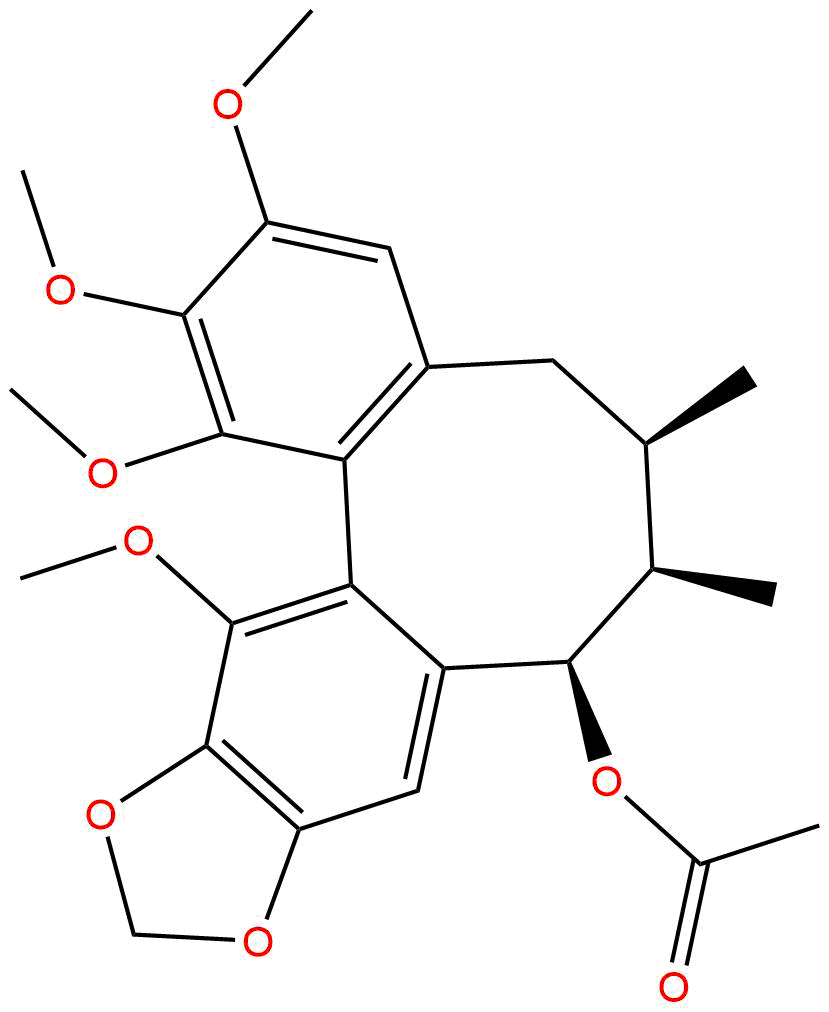
Kadsurin belongs to the dibenzocyclooctadiene lignan class and is a characteristic secondary metabolite of Schisandraceae plants. Its chemical structure is composed of two benzene rings connected by an eight membered ring, with multiple methoxy and methylenedioxy substituents attached to the ring. This unique rigid skeleton endows the molecule with good lipid solubility and specific biological activity.
From the perspective of physicochemical properties, the molecular weight of Schisandrin is 458.5070 Da, which conforms to the typical characteristics of small molecule drugs (usually<500 Da). Its lipid water partition coefficient (LogP) is 3.6580, indicating that the compound has moderate to high lipid solubility, which makes it easy to penetrate biofilms, but may also limit its solubility in aqueous environments. In fact, its water solubility is only 0.0197 mg/mL, which is a difficult to dissolve compound, posing a challenge to its formulation development. The topological polar surface area (TPSA) is 81.68 Å ², which is lower than 100 Å ², indicating that the molecule has good oral absorption potential. It is worth noting that pharmacological evaluation shows that Schisandrin has a high blood-brain barrier (BBB) penetration ability, which suggests that it may have central nervous system activity, but may also pose potential neurotoxic risks. In addition, the hERG inhibition prediction was negative, and the Ames test result was 0.0, indicating that it does not pose a risk of cardiac toxicity or mutagenicity in the preliminary assessment and has good safety. These physicochemical parameters together outline the basic profile of Schisandrin as a lead compound: clear activity, good lipid solubility, and preliminary good safety, but poor water solubility is the main bottleneck restricting its application.
Plant sources and extraction methods
The main source of Schisandrin is from plants in the Schisandraceae family and the Schisandra genus, among which the heteromorphic Schisandra is present(Kadsura heteroclita)The stem has the richest content. In addition, in the long stem South Schisandra chinensis(Kadsura longipedunculata)And Schisandra chinensis(Schisandra chinensis)It has also been found in closely related species, but the content is usually low. Alien Schisandra chinensis is mainly distributed in Yunnan, Guangxi, Guangdong, Vietnam, Myanmar and other regions of China. Its vine stems are often used as "blood vine" or "sea breeze vine" in folk medicine.
For the extraction of schisandrin, traditional methods often use organic solvent extraction. Due to its lipid solubility characteristics, 95% ethanol or methanol is commonly used for reflux extraction of dried and crushed plant stem bark. After the extraction solution is concentrated under reduced pressure, the total extract is obtained. Subsequently, using liquid-liquid extraction method, different polar solvents such as petroleum ether, ethyl acetate, n-butanol are usually used for fractional extraction. Schisandrin is mainly enriched in the ethyl acetate or chloroform extraction layer. Further separation and purification rely on modern chromatographic technologies, such as silica gel column chromatography, Sephadex LH-20 gel column chromatography and preparative high-performance liquid chromatography (Prep HPLC). In silica gel column chromatography, petroleum ether acetone or chloroform methanol systems are commonly used for gradient elution, and the fractions containing the target compound are collected by monitoring with thin layer chromatography (TLC). Finally, high-purity schisandrin monomers were obtained through recrystallization or preparative HPLC. In recent years, with the rise of green extraction concepts, new technologies such as supercritical fluid extraction (SFE-CO ₂) and ultrasound assisted extraction have also been attempted to be applied to the extraction of Schisandrin, aiming to improve extraction efficiency and reduce organic solvent residues.
Pharmacological activity research
The pharmacological activity research of Schisandrin mainly focuses on its liver protective effect, while also exploring in the fields of anti-inflammatory, antioxidant, and anti-tumor effects.
Liver protective effect This is the core pharmacological activity of Schisandrin. Early studies used a mouse model of acute liver injury induced by carbon tetrachloride (CCl ₄) and found that schisandrin can significantly reduce the levels of lipid peroxidation products in the liver, including thiobarbituric acid reactants (TBA-RS), conjugated dienes, and fluorescent products. This indicates that it can effectively inhibit the lipid peroxidation chain reaction triggered by CCl ₄ during liver metabolism, thereby protecting the integrity of liver cell membranes. In addition, Schisandrin can significantly reduce the activity of alanine aminotransferase (ALT) and aspartate aminotransferase (AST) in serum, alleviate pathological damage to liver tissue, such as hepatocyte necrosis, steatosis, and inflammatory infiltration. Subsequent studies have further confirmed that Schisandrin has protective effects on various liver injury models, including acetaminophen induced liver injury, alcoholic liver injury, and non-alcoholic fatty liver disease (NAFLD) models.
Antioxidant and anti-inflammatory activities The liver protective effect of Schisandrin is closely related to its strong antioxidant capacity. The phenolic hydroxyl and methoxy groups in its molecular structure are effective free radical scavenging groups. In vitro experiments have shown that Schisandrin can directly scavenge DPPH free radicals, ABTS ⁺ free radicals, and superoxide anions. At the cellular level, it can upregulate the expression of endogenous antioxidant enzymes such as superoxide dismutase (SOD), catalase (CAT), and glutathione peroxidase (GPx). Meanwhile, Schisandrin can also inhibit the activation of the nuclear factor kappa B (NF - κ B) signaling pathway, thereby reducing the release of pro-inflammatory cytokines such as tumor necrosis factor - α (TNF - α), interleukin-1 β (IL-1 β), and interleukin-6 (IL-6), exerting anti-inflammatory effects.
Anti hepatic fibrosis effect Liver fibrosis is a key link in the progression of chronic liver injury to cirrhosis. Research has found that Schisandrin can inhibit the activation of hepatic stellate cells (HSCs), which is a core cellular event in the occurrence of liver fibrosis. It can significantly reduce the expression of alpha smooth muscle actin (alpha SMA, encoded by the ACTA2 gene) and inhibit the deposition of extracellular matrix (ECM) components such as collagen I and III. In addition, Schisandrin can regulate the balance between matrix metalloproteinases (MMPs) and their inhibitors (TIMPs), especially by inhibiting the activity of MMP9, thereby reversing the process of liver fibrosis.
Other activities Preliminary studies also suggest that Schisandrin has certain anti-tumor activity and can induce apoptosis in certain tumor cells (such as HepG2 liver cancer cells), but its concentration is high and selectivity needs to be improved. In addition, given its high BBB penetration, its potential protective effect on neurodegenerative diseases is also worth exploring.
Mechanism of action and molecular targets
The pharmacological effects of Schisandrin are the result of the synergistic action of multiple targets and pathways. Based on existing research, its core mechanism of action can be summarized as follows:
1. Activate the Nrf2/ARE antioxidant signaling pathway This is the most critical mechanism by which Schisandrin exerts liver protective effects. Nuclear factor E2 related factor 2 (Nrf2) is a core transcription factor that cells use to respond to oxidative stress. Under physiological conditions, Nrf2 binds to Keap1 protein in the cytoplasm and is inhibited. When stimulated by electrophilic compounds such as schisandrin, Nrf2 dissociates from Keap1 and translocates into the nucleus, binding to antioxidant response elements (ARE) and initiating transcription of downstream antioxidant enzyme and phase II detoxifying enzyme genes. These target genes include:NQO1(Quinone oxidoreductase 1)HMOX1(Heme oxygenase 1)SOD1(Copper zinc superoxide dismutase)SOD2(Manganese Superoxide Dismutase)CAT(Catalase) and GPX1(Glutathione peroxidase 1). By upregulating the expression of these enzymes, Schisandrin greatly enhances the liver's antioxidant defense ability, effectively removes reactive oxygen species (ROS), and blocks lipid peroxidation.
2. Inhibition of TGF - β 1/Smad signaling pathway and anti fibrosis effect Transforming Growth Factor - β 1(TGFB1)It is the core cytokine that drives liver fibrosis. Schisandrin can significantly inhibit the expression of TGF - β 1 and the phosphorylation of downstream Smad2/3 proteins. This effect directly leads to: ① inhibition of hepatic stellate cell (HSC) activation, reducing ACTA2(α - SMA) expression; ② Reduce the synthesis of ECM; ③ Regulating the balance of MMPs/TIMPs, especially inhibiting MMP9 The activity. MMP9 participates in the degradation of basement membrane and migration of HSC during fibrosis, and its overexpression is closely related to the progression of liver fibrosis. The inhibition of MMP9 by Schisandrin helps maintain ECM homeostasis and delay or reverse fibrosis process.
3. Regulating apoptosis and autophagy In the liver injury model, Schisandrin inhibits the expression of pro apoptotic protein Bax and upregulates the expression of anti apoptotic protein Bcl-2 by regulating the mitochondrial pathway, thereby reducing hepatocyte apoptosis. Meanwhile, studies suggest that it may help cells clear damaged proteins and mitochondria and maintain a stable intracellular environment by inducing moderate autophagy.
In summary, Schisandrin exerts liver protective effects through a three in one network regulation mode of "antioxidant anti-inflammatory anti fibrosis". Its core target network includes: as upstream sensors NRF2 As an antioxidant executor NQO1、HMOX1、SOD1/2、CAT、GPX1 As a driver of fibrosis TGFB1, and as a fibrotic effector molecule ACTA2 and MMP9 This multi-target mode of action is the advantage that distinguishes it from single target chemical drugs.
Evaluation of drug properties and pharmacokinetics
Schisandrin has shown great potential for medicinal use, but it also faces some challenges.
Pharmaceutical advantages:
- drug-likeness Molecular weight 458.5 Da, LogP 3.66, TPSA 81.68, in accordance with Lipinski's five rules, possessing the basic characteristics of oral medication.
- safety Preliminary toxicological evaluations (hERG inhibition negative, Ames test negative) indicate low risks of cardiac and genetic toxicity, and a wide safety window.
- Clear activity Significant liver protective activity has been demonstrated in both in vivo and in vitro models, with clear mechanisms of action and clear targets.
Drug Challenge:
- Poor water solubility The water solubility of 0.0197 mg/mL is its biggest weakness. This can lead to low oral bioavailability and affect the efficacy of the drug in the body. It is necessary to use formulation technologies such as solid dispersions, liposomes, nanocrystals, or cyclodextrin inclusion complexes to improve their solubility and dissolution rate.
- Metabolic stability At present, there is insufficient research on the pharmacokinetics (PK) of Schisandrin. Its high lipid solubility suggests that it may be widely metabolized by the liver's cytochrome P450 enzyme system (CYP450), leading to significant first pass effects. In addition, although its high BBB penetration may bring central activity, it is also necessary to be vigilant about potential neurotoxicity, especially during long-term use.
- Pharmacokinetic characteristics Preliminary animal experimental data shows that Schisandrin is absorbed quickly after oral administration, but its absolute bioavailability may not be high. It is widely distributed in the body, especially at high concentrations in the liver, which is consistent with its liver protective targeting. Metabolic pathways may involve demethylation, hydroxylation, and glucuronic acid binding reactions. The key PK parameters such as half-life and clearance rate still need to be systematically studied.
Clinical application prospects and prospects
As a natural product with clear liver protective activity, Schisandrin has broad clinical application prospects, but there is still a long way to go before it can be truly used as a medicine.
Application Prospects:
1. Development of hepatoprotective drugs Regarding various types of acute and chronic hepatitis, alcoholic liver disease, drug-induced liver injury, and non-alcoholic steatohepatitis (NASH), Schisandrin is expected to be developed as a new type of hepatoprotective drug. Its multi-target mechanism of action is particularly suitable for treating NASH with complex pathological mechanisms.
2. Anti liver fibrosis drugs Given its inhibitory effect on the TGF - β 1 signaling pathway and HSC activation, Schisandrin has unique advantages in reversing liver fibrosis, which may fill the current clinical gap in the lack of effective anti fibrotic drugs.
3. Dietary supplements or health supplements After clarifying its long-term safety, Schisandrin can be used as a functional food ingredient for daily liver health care.
Future research directions:
1. Research on Structure Modification and Structure Activity Relationship (SAR)Using Schisandrin as the lead compound, its skeleton can be modified through chemical synthesis or biotransformation, such as introducing hydrophilic groups (hydroxyl, carboxyl, sugar, etc.) to improve water solubility or optimize its metabolic stability, in order to obtain derivatives with better drug properties.
2. In depth pharmacokinetic research Systematically elucidate the entire process of absorption, distribution, metabolism, and excretion (ADME) of Schisandrin in the body, clarify its metabolic enzymes, transporters, and potential drug drug interactions.
3. Pharmaceutical research Develop efficient and safe drug delivery systems, such as phospholipid complexes, self microemulsifying drug delivery systems (SMEDS), or nano lipid carriers, to address the issues of poor water solubility and low oral bioavailability.
4. Long term toxicological evaluation Conduct standardized long-term toxicity, reproductive toxicity, and carcinogenicity studies to provide sufficient safety data for their entry into clinical trials.
5. Clinical translational research After completing sufficient preclinical research, design rigorous Phase I, II, and III clinical trials to validate its efficacy and safety in patients with liver disease.
Conclusion
As a dibenzocyclooctadiene lignan derived from traditional Chinese medicine plants, Schisandrin exhibits excellent antioxidant, anti-inflammatory, and anti liver fibrosis activities through multiple mechanisms such as activating the Nrf2 pathway, inhibiting TGF - β 1 signaling, and regulating MMP9 activity. It is a highly promising natural candidate molecule for liver protection. Its excellent drug like characteristics and preliminary safety assessment have laid the foundation for its subsequent research. However, bottleneck issues such as poor water solubility and unclear pharmacokinetic properties urgently need to be addressed. In the future, by combining modern medicinal chemistry, pharmacy, and pharmacology methods, in-depth structural optimization and systematic development of schisandrin are expected to transform it into an efficient and safe new liver disease treatment drug, bringing new treatment options to billions of liver disease patients worldwide. The research process of Schisandrin from phytochemistry to clinical translation is a typical epitome of the discovery and development of natural product drugs, demonstrating the enormous potential of the integration of traditional wisdom and modern technology.