Introduction/Overview
Alzheimer's disease, as a progressive neurodegenerative disease, has become a global public health challenge. Its pathological features include β - amyloid deposition, excessive phosphorylation of Tau protein, loss of cholinergic neurons, and persistent neuroinflammatory responses. The current mainstream therapeutic drugs are mainly acetylcholinesterase inhibitors and NMDA receptor antagonists. Although they can alleviate symptoms, they are difficult to reverse the disease process and often accompanied by side effects. Therefore, exploring new therapeutic molecules with multi-target, high efficiency and low toxicity characteristics from natural products has become an important direction for drug development. Zhujie Ginseng Saponin Ib, a triterpenoid saponin compound isolated from traditional Chinese medicine Zhujie Ginseng, has attracted much attention in recent years due to its significant in vitro acetylcholinesterase inhibitory activity, demonstrating potential for anti Alzheimer's disease. Further research reveals that its pharmacological effects extend far beyond this, particularly in regulating complex immune networks, involving multiple key signaling targets such as TLR4, STAT3, NF - κ B. This suggests that bamboo ginseng saponin Ib may exert an intervention effect on multifactorial diseases such as Alzheimer's disease by synergistically regulating neuroinflammation and cholinergic system. This article aims to systematically review the chemical properties, plant sources, pharmacological activities, molecular mechanisms of action, medicinal properties, and clinical application prospects of bamboo ginseng saponin Ib, in order to provide scientific basis for the deep development of this natural product.
Chemical structure and physicochemical properties
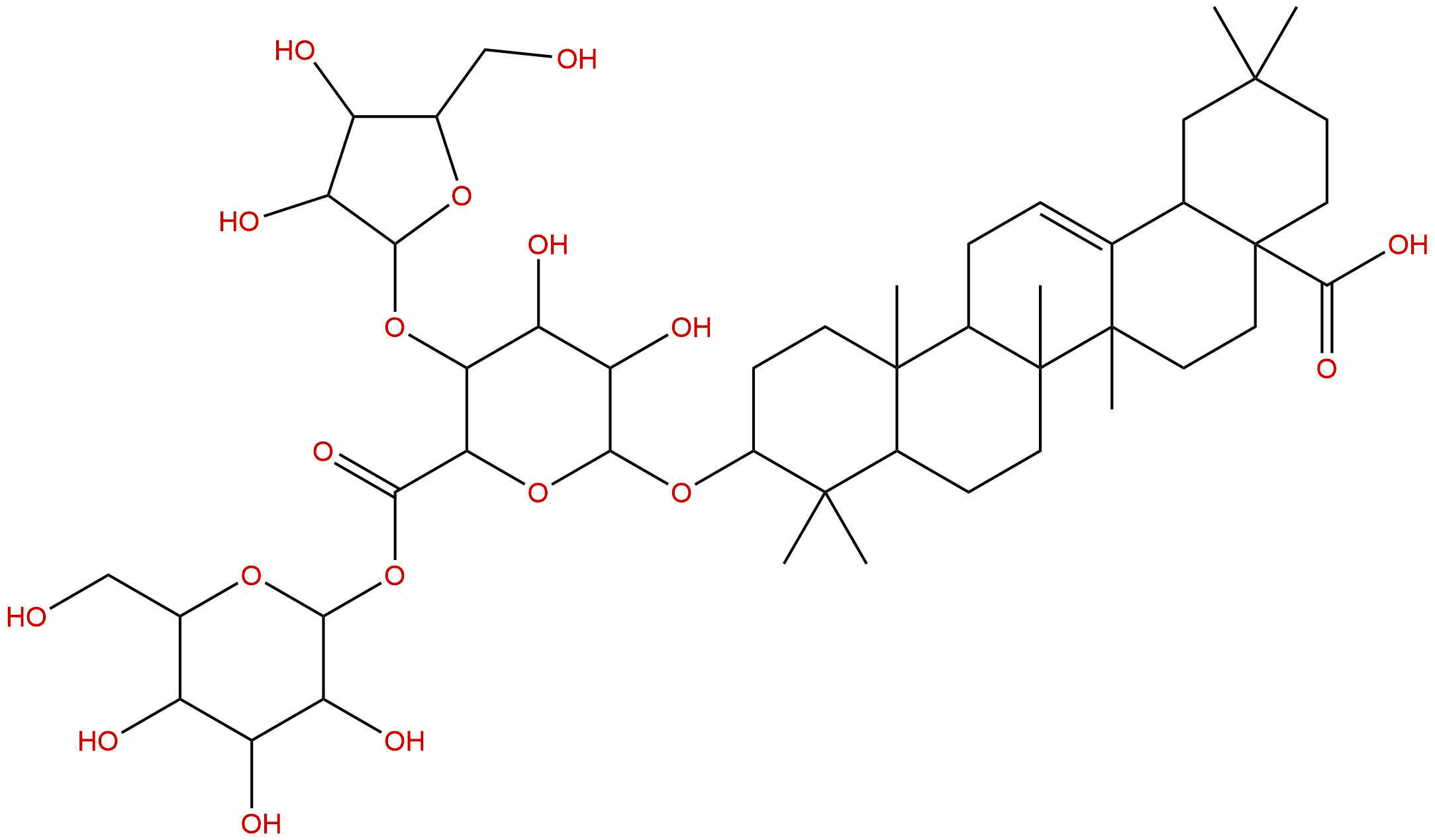
The chemical name of bamboo ginseng saponin Ib is 3-O - [β - D-glucopyranosyl (1 → 2) - β - D-glucopyranosyl] -28-O - [β - D-xylopyranosyl (1 → 6) - β - D-glucopyranosyl] oleanolic acid, and its CAS number is 59252-87-8. This compound belongs to the oleanane type pentacyclic triterpenoid saponin and is its core glycoside structure. In its molecule, the C-3 hydroxyl group is connected to a disaccharide chain [glucose (1 → 2) glucose], while the C-28 carboxyl group is connected to another disaccharide chain [xylose (1 → 6) glucose] through an ester bond, forming a disaccharide chain structure. This complex glycosylation pattern has a decisive impact on its water solubility, biological activity, and recognition of target proteins.
Its molecular weight is 927.0910 g/mol. The calculated lipid water partition coefficient LogP value is 2.3348, indicating that the molecule has a certain degree of lipophilicity, but not high hydrophobicity. Its topological polar surface area is as high as 291.8200 Å ², which is mainly attributed to the abundant oxygen atoms on multiple hydroxyl and sugar rings in the molecule. A large TPSA value usually indicates poor membrane permeability. The theoretically calculated water solubility value is 0.0922 mg/mL, which belongs to the category of slight solubility, which is consistent with the characteristics of high molecular weight and high TPSA. Based on the preliminary evaluation of its physicochemical parameters (high TPSA, moderate LogP, high molecular weight), its ability to cross the blood-brain barrier is predicted to be "low", which poses the primary challenge for its application in treating central nervous system diseases such as Alzheimer's disease. In the early safety warning indicators, the lack of inhibition of hERG potassium channels by this compound suggests a low potential risk of cardiac toxicity. The Ames test result of 0.0 preliminarily indicates that it is non mutagenic, providing a preliminary safety basis for its further development.
Plant sources and extraction methods
Zhujie ginseng saponin Ib mainly comes from the dried rhizomes of the Panax ginseng plant in the Araliaceae family. Zhujie ginseng is mainly produced in southwestern China and Japan. In traditional Chinese medicine theory, it has the effects of nourishing and strengthening the body, dispersing blood stasis and relieving pain, stopping bleeding and eliminating phlegm. It is commonly used for post illness weakness, tuberculosis hemoptysis, and traumatic injuries. As one of the characteristic active saponins in bamboo ginseng, its content is closely related to the place of origin, harvesting season, and medicinal parts.
The extraction and isolation of ginsenosides Ib from plant materials usually follow the conventional process of natural product chemistry. Firstly, dry and crush the roots and stems of bamboo ginseng. Alcohol extraction is commonly used for extraction, and 70% -95% ethanol or methanol is commonly used for hot reflux extraction or ultrasound assisted extraction to efficiently dissolve saponin components. The extract is concentrated under reduced pressure to obtain a paste. Subsequently, utilizing the polarity characteristics of saponins, the aqueous solution of the extract is often extracted multiple times with water saturated n-butanol to enrich the saponin sites. The obtained n-butanol fraction is further purified by a series of chromatographic separation techniques, including silica gel column chromatography (using chloroform methanol water system gradient elution), reverse phase silica gel column chromatography (such as ODS, using methanol water or acetonitrile water system elution), and high-performance liquid chromatography preparation. During the separation process, thin-layer chromatography, high-performance liquid chromatography, and mass spectrometry techniques are commonly used for tracking, detection, and identification, ultimately obtaining high-purity monomers of saponins Ib from bamboo ginseng. Modern green extraction technologies such as supercritical fluid extraction are also being explored to improve efficiency and reduce the use of organic solvents.
Pharmacological activity research
The pharmacological activity research of bamboo ginseng saponin Ib has revealed its multifaceted biological effects, with a focus on two major areas: nervous system protection and immune regulation.
1. Anti Alzheimer's disease and cholinesterase inhibitory activity:
This is the earliest activity of bamboo ginseng saponin Ib that received attention. In vitro enzyme inhibition experiments have clearly confirmed that bamboo ginseng saponin Ib has significant inhibitory ability on acetylcholinesterase, with IC50 values reaching micromolar or even sub micromolar levels, which is competitive compared to classical drugs such as donepezil. In cell models (such as A β 25-35-induced PC12 cell injury model) and animal models (such as scopolamine induced memory impairment mouse model), bamboo saponin Ib can improve learning and memory function and alleviate neuronal damage. Its function is not limited to increasing the level of acetylcholine in synaptic cleft, but may also involve inhibiting A β aggregation, alleviating oxidative stress, and so on.
2. Immune regulatory activity:
This is another important dimension of the pharmacological effects of bamboo ginseng saponin Ib, which has been shown to have bidirectional regulatory potential on the immune system.
* Anti inflammatory effect: In the macrophage model stimulated by lipopolysaccharides (such as RAW264.7), bamboo ginseng saponin Ib can dose dependently inhibit the production of nitric oxide, prostaglandin E2, and pro-inflammatory cytokines (such as TNF - α, IL-1 β, IL-6), demonstrating clear anti-inflammatory effects. Similar anti-inflammatory effects have also been observed in animal inflammation models, such as mouse ear swelling and arthritis models.
* Immunosuppression and Regulation: Research has shown that saponins Ib from bamboo ginseng may affect the differentiation and function of T lymphocyte subsets. It may exert immunosuppressive or regulatory effects in the context of autoimmune diseases or excessive immune responses by regulating relevant signaling pathways, affecting the proportion and function of key immune cells such as helper T cells17 and regulatory T cells. Its regulation of the expression of cytokines such as IL-2, IL-10, and IFN - γ further supports its broad immune intervention capabilities.
3. Other potential activities:
Some studies also suggest that saponins Ib from Panax ginseng may have hepatoprotective and anti-tumor activities, but these studies are still in the preliminary stage and require more evidence to support them.
Mechanism of action and molecular targets
The multiple pharmacological activities of bamboo ginseng saponin Ib stem from its interactions with multiple key signaling molecules and pathways within cells, forming a multi-target action network.
1. Mechanisms related to anti Alzheimer's disease:
* Directly inhibit AChE: As a competitive or non competitive inhibitor, it directly binds to the active site of AChE to prevent acetylcholine hydrolysis, which is the most direct mechanism for improving cholinergic transmission.
* Regulating neuroinflammatory pathways: Microglia mediated neuroinflammation is the core pathological link of Alzheimer's disease. Zhujie ginseng saponin Ib can be intervened with TLR4 Receptor and its downstream signals, inhibition NF-κB Nuclear translocation reduces the transcriptional expression of NF - κ B target genes (such as TNF - α, IL-1 β, IL-6, iNOS, COX-2) and alleviates inflammatory damage. Meanwhile, it has an impact on STAT3 The regulation of signaling pathways may also be involved in inhibiting excessive activation of microglia.
2. Mechanisms related to immune regulation:
The immunomodulatory effect of bamboo ginseng saponin Ib involves a more complex network:
* Intrinsic immune regulation: By inhibiting TLR4/NF-κB and TLR4/MAPKs Pathways negatively regulate the activation of innate immune cells such as macrophages and the storm of inflammatory factors.
* Adaptive immune regulation: This compound may affect TGFB1/Smad Signal, involved in inducing the differentiation of regulatory T cells (and FOXP3 Upregulation of expression is associated with promoting immune tolerance. Correct IL2 The regulation of signaling pathways may affect the proliferation and activation of T cells. Correct STAT3 and STAT4 The differential regulation of pathways may further affect the differentiation balance of effector T cell subsets such as Th17 and Th1. It inhibits co inhibitory molecules such as CTLA4 The potential impact of expression is also a possible pathway for regulating T cell function.
* Cytokine network balance: Zhujie ginseng saponin Ib can downregulate pro-inflammatory factors such as IFNG、 The expression of IL-6 may also upregulate anti-inflammatory factors such as IL10 The level of inflammation promotes the transition of the immune microenvironment from a pro-inflammatory state to an anti-inflammatory or steady-state state.
In summary, bamboo ginseng saponin Ib does not act on a single target, but acts as a "network regulator" that synergistically regulates neuroinflammation and systemic immune response by intervening in multiple core nodes such as TLR4, STAT3, NF - κ B, TGFB1, etc. This provides a unique mechanistic advantage for its treatment of autoimmune diseases such as Alzheimer's disease (which combines neurodegeneration and neuroinflammation) and rheumatoid arthritis.
Evaluation of drug properties and pharmacokinetics
Although bamboo ginseng saponin Ib has shown good activity in vitro and some in vivo models, its pharmacological development, especially as an oral drug, faces a series of challenges.
1. Analysis of pharmacological parameters:
According to the provided parameters, the main bottleneck of its pharmacological properties lies in Permeability and solubility The high TPSA (291.82 Å ²) and large molecular weight (927 Da) severely limit its passive transmembrane diffusion ability, resulting in low expected oral bioavailability and poor blood-brain barrier permeability, which directly hinders its therapeutic effect on central nervous system diseases. A moderate LogP value (2.33) suggests that it has some lipid solubility, but it is not sufficient to overcome the permeation barrier caused by high TPSA. The micro solubility characteristic (0.0922 mg/mL) may affect its dissolution and absorption in the gastrointestinal tract.
2. Prospects for pharmacokinetic research:
At present, there are insufficient reports on the pharmacokinetic studies of the saponin Ib system in bamboo ginseng. However, based on the commonality of its saponin compounds, reasonable speculation can be made:
* Absorption: After oral administration, due to its high molecular weight and polarity, its passive absorption in the small intestine may be poor. The gut microbiota may hydrolyze its sugar chains, generating secondary glycosides with deglycosylation or monosaccharide groups. The lipid solubility and absorption of these metabolites may be improved, but their activity may be altered.
* Distribution: The prototype drug is difficult to distribute to brain tissue. To exert a central role, it may be necessary to improve its BBB penetration ability through formulation techniques such as nano drug delivery systems and prodrug strategies, or rely on its active metabolites with better brain entry ability.
* Metabolism: Liver metabolism and gut microbiota metabolism are its main metabolic pathways. The cytochrome P450 enzyme system may be involved in the oxidative metabolism of its aglycones. The hydrolysis of sugar chains is a key phase I metabolic reaction.
* Excretion: It may be mainly excreted through bile and kidneys.
3. Preliminary safety evaluation:
Non hERG inhibition and Ames negativity are good starting points, but comprehensive preclinical safety evaluations, including acute toxicity, chronic toxicity, reproductive toxicity, etc., are still needed to evaluate their therapeutic window.
Clinical application prospects and prospects
As a natural product lead compound with multi-target effects, bamboo ginseng saponin Ib has broad clinical application prospects but a tortuous path.
1. Potential therapeutic areas:
* Alzheimer's disease and related cognitive impairments: As a core indication, its dual mechanism of AChE inhibition and anti neuroinflammation is quite attractive. In the future, it may be used as an adjuvant drug, combined with existing therapies, or developed for early intervention of diseases.
* Autoimmune and inflammatory diseases: Such as rheumatoid arthritis, inflammatory bowel disease, multiple sclerosis, etc., their immunomodulatory properties make them potentially novel immunomodulators.
* Other neurological disorders: Diseases with neuroinflammatory components, such as Parkinson's disease and cerebral ischemia-reperfusion injury, are also worth exploring.
2. Development challenges and strategies:
* Improving pharmacokinetic properties: This is the biggest bottleneck in its conversion. The strategy includes: ① Structural modification Chemical modification of glycosides or glycosides to enhance lipid solubility and reduce polarity while retaining activity, or designing prodrugs. ② Advanced Delivery System Develop drug delivery systems such as liposomes, polymer nanoparticles, and microemulsions to improve their oral absorption rate, targeting ability, and BBB penetration capability. ③ Explore active metabolites Identify the active molecules that truly exert their effects in the body, and it is possible that their metabolites are more medicinal.
* Deepen mechanism research: It is necessary to use techniques such as gene knockout, molecular docking, and chemical biology to more accurately elucidate its direct interaction mode with key targets such as TLR4 and STAT3, as well as its upstream and downstream pathway network.
* Conduct systematic preclinical and clinical research: Long term efficacy evaluation needs to be conducted in animal models that are closer to human diseases, such as APP/PS1 transgenic AD mice, and standardized preclinical safety pharmacology and toxicology studies need to be completed to provide solid data for clinical trial applications.
Conclusion
Zhujie ginseng saponin Ib is a natural triterpenoid saponin with significant research value discovered from traditional Chinese medicine Zhujie ginseng. It not only exhibits direct AChE inhibitory activity in the fight against Alzheimer's disease, but also exerts extensive anti-inflammatory and immune regulatory effects by regulating multiple signaling pathways such as TLR4/NF - κ B and JAK/STAT, reflecting the characteristic of multi-component and multi-target synergistic effects of natural products. However, its inherent physicochemical properties (high polarity, high molecular weight) result in low permeability and low oral bioavailability, which are the main obstacles on its path from lead compounds to drugs. Future research should focus on overcoming these drug development weaknesses through rational drug chemical modifications and innovative drug delivery strategies, while further revealing their complex molecular action networks at the systems biology level. Only by deeply integrating the wisdom of traditional Chinese medicine with modern drug research and development technology can natural molecules such as bamboo ginseng saponins Ib truly benefit patients and provide new hope for the treatment of complex diseases such as Alzheimer's disease.