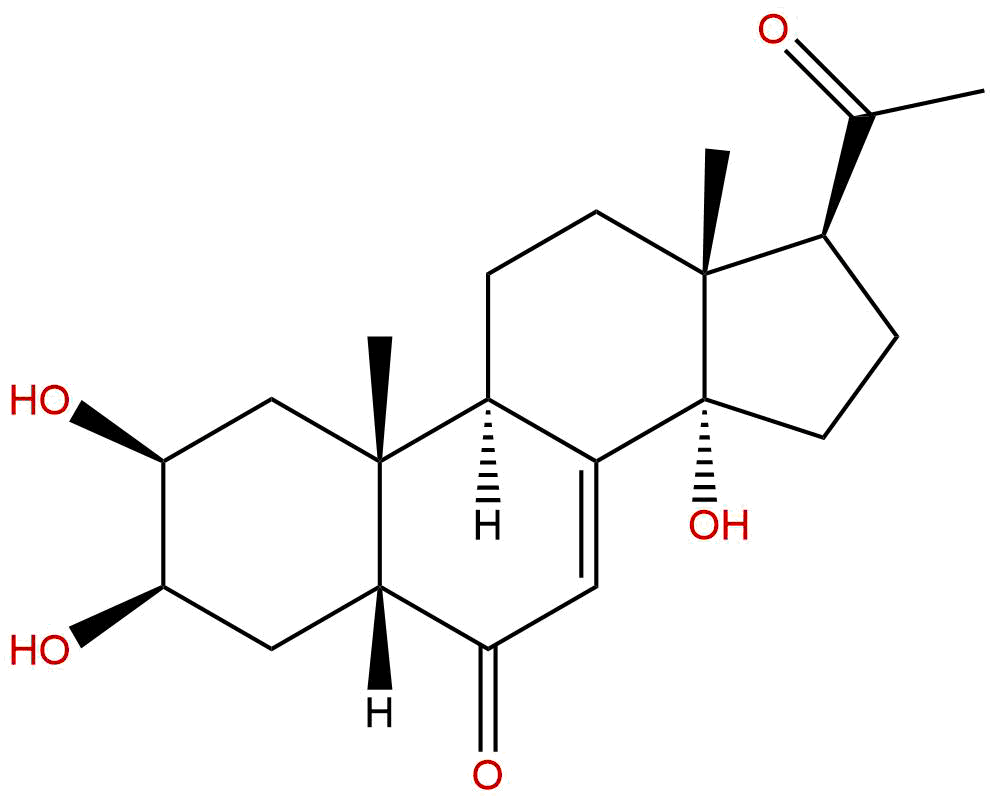
Storage conditions:Short-term storage at 2~8℃, long-term storage at -20 ~ -80℃
94.8300
1.2678
1.2679
.2621
1.7040
30.8692
High
59.2951
4.7530
No
No
No
No
Yes
No
0.0
Yes
No
No
Yes
Natural products, as an important source of drug discovery, play an irreplaceable role in the long history of human struggle against diseases. From ancient plant medicines to modern high-throughput screening, the rich chemical diversity inherent in nature continues to provide unique molecular frameworks and lead compounds for the development of innovative drugs. Among various structural types, steroid compounds have always been a hot topic in medicinal chemistry and pharmacology research due to their wide range of physiological activities, such as hormone regulation, anti-inflammatory, anti-tumor, etc. Poststerone, as a metabolic product of insect metamorphosis hormones originating from the plant kingdom, is attracting increasing research attention due to its unique chemical structure and potential biological activity, especially its outstanding role in promoting hematopoietic function in recent years.
The discovery and research of posterone originated from the exploration of insect physiology. The life processes of insects, such as molting and metamorphosis, are precisely regulated by a class of steroid hormones called ecdysteroids. These hormones are synthesized and secreted by the thymus gland in insects, and through a series of complex signaling pathways, initiate and coordinate molecular events of molting and metamorphosis. It is interesting that many plants, especially certain ferns and angiosperms, have been found to synthesize compounds that are highly structurally similar to insect molting hormones, known as phytoecdysteroids. The functions of these compounds in plants are not fully understood, but they are believed to be related to resisting the invasion of herbivorous insects. Postostane is a member of the plant molting hormone family. It was initially identified as a metabolite during insect metamorphosis and later discovered in various plants, including the Amaranthaceae plant Achyranthes chuanxiong(Cyathula capata)The content in is relatively abundant.
For a long time, research on posterone has mainly focused on its physiological effects as an insect molting hormone analogue. However, as research deepens, its potential mammalian pharmacological activity is gradually revealed. Early studies have shown that certain plant molting hormones, such as β - ecdysone, exhibit various beneficial effects in mammals, including promoting protein synthesis, regulating blood sugar, and protecting the liver. Whether posterone, as a structurally similar and metabolite, also has similar or even more unique biological activities has become a scientific question worth exploring. In recent years, the research focus has gradually shifted towards the potential regulatory effects of posterone on the hematopoietic system. Hematopoiesis, the process of generating blood cells, is a highly complex and precisely regulated physiological process. Its dysregulation is closely related to various hematological diseases, such as aplastic anemia, myelodysplastic syndrome, and bone marrow suppression caused by radiotherapy and chemotherapy. Preliminary research evidence suggests that posterone may exhibit hematopoietic activity by affecting the proliferation and differentiation of hematopoietic stem/progenitor cells, as well as regulating key hematopoietic related factors.
This article aims to provide a systematic review of the natural product, posterone. We will start from its chemical structure and physicochemical properties, trace its plant origin and extraction methods, deeply explore its pharmacological activity, especially its hematopoietic promoting effect and its potential molecular mechanism, and evaluate its potential as a drug lead compound based on its pharmacological parameters. Finally, we will look forward to the prospects and challenges faced by posterone in clinical applications, in order to provide comprehensive and in-depth references for researchers in this field.
The chemical name of Poststerone is (2 β, 3 β, 5 β, 22R) -2,3,14,22-pentahydroxy-7-cholesterol-6-one, with a molecular formula of C ₂ ₁ H ∝₀ O ₅ and a molecular weight of 362.4660 g/mol. Structurally, posterone belongs to the class of C ₂₁ steroid compounds, with its core skeleton being a derivative of cholestane. Compared with classic mammalian steroid hormones such as sex hormones and adrenal cortex hormones, its structure has significant characteristics. The steroid mother nucleus of posterone contains an A/B cyclic cis (5 β - H) condensation pattern, which is a typical feature of many plant molting hormones. In addition, its structure contains multiple hydroxyl functional groups located at C-2, C-3, C-14, C-20, and C-22 positions, as well as a conjugated Δ - β -6-ketone structural unit (i.e., the C-7 position is a double bond and the C-6 position is a ketone group). This conjugated system is a key structural feature of ecdysteroid compounds, typically considered necessary for their binding to receptors and exerting biological activity.
From the perspective of physical and chemical properties, these structural features of posterone determine its specific property parameters. Its topological polar surface area (TPSA) is 94.8300 Å ², which is relatively high, indicating that the molecule has more polar groups (hydroxyl and carbonyl). This usually means that it has good water solubility, but it may also affect its transmembrane permeability. The calculated LogP value is 1.2678, which is a relatively low lipid water partition coefficient, further confirming its strong hydrophilicity. The water solubility data (0.2621 mg/mL) also supports this judgment, indicating that the solubility of posterone in water is still acceptable, which provides favorable conditions for its absorption and transport in organisms. However, it is worth noting that its blood-brain barrier (BBB) penetration is predicted to be "high". This prediction seems to contradict its high polarity and TPSA, as molecules with high polarity typically have difficulty penetrating the blood-brain barrier composed of lipid bilayers. This may mean that posterone may enter the central nervous system through some active transport mechanism, or that its molecule can adopt a conformation favorable for transmembrane permeation under specific conditions. This is crucial for the study of its potential neuropharmacological activity or central nervous system side effects and deserves further experimental verification.
In addition, two key indicators in drug efficacy evaluation are also worth paying attention to. The prediction result of hERG inhibition is' no ', which is a positive signal, indicating that it is unlikely that posterone could theoretically cause serious cardiac toxicity risks such as QT interval prolongation by blocking the hERG potassium ion channel in the heart. The Ames test result was 0.0, indicating that it did not show mutagenicity in the bacterial recovery mutation test, suggesting a low risk of genetic toxicity. Based on these physicochemical properties and preliminary pharmacological parameters, posterone exhibits some advantageous characteristics as a drug lead compound, such as good water solubility, low hERG inhibition, and mutagenicity risk. However, its high BBB penetration requires special attention in subsequent neurological safety evaluations.
As a natural product, posterone is mainly sourced from the plant kingdom, especially those species that can synthesize and accumulate plant molting hormones. Although it was initially discovered as a metabolite of ecdysteroids in insects, plants are its main natural source. Among many plants, Amaranthaceae plants are known to be one of the groups rich in ecdysteroids, among which Achyranthes chuanxiong is one of them(Cyathula capata)It is an important source of progesterone. Chuanxi Achyranthes is a traditional Chinese medicinal herb that has the effects of promoting blood circulation, nourishing the liver and kidneys, and strengthening muscles and bones. Its chemical composition is complex, including various active ingredients such as steroids, saponins, and polysaccharides. Apart from Sichuan Achyranthes, there are other plants such as Achyranthes(Achyranthes bidentata)Dew grass(Cyanotis arachnoidea)And some ferns may also contain progesterone, but the content is usually low. Therefore, Sichuan Achyranthes is currently the main raw material for studying the pharmacological activity and extraction and separation of posterone.
The content of posterone in plants is usually much lower than its main molting hormone analogues, such as β - ecdysone and cyasterone. Therefore, its extraction and purification process is challenging and requires efficient and specific methods. A typical extraction process typically includes the following steps:
Raw material pretreatment and extraction Dry Sichuan Achyranthes rhizome is crushed to an appropriate particle size. The selection of extraction solvent is crucial. Given the high polarity of posterone, polar solvents such as methanol, ethanol, or their aqueous solutions are often used for extraction. In order to improve extraction efficiency and selectivity, different concentrations of ethanol are sometimes used for gradient extraction. Extraction methods include traditional cold soaking, reflux extraction, as well as modern technologies such as ultrasound assisted extraction, microwave-assisted extraction, etc. The latter can significantly shorten extraction time and improve yield.
Preliminary purification and enrichment The crude extract contains a large amount of fat soluble impurities, pigments, sugars, etc. Usually, liquid-liquid extraction is used for preliminary purification. For example, after concentrating the alcohol extract, it is extracted sequentially with solvents of different polarities such as petroleum ether, ethyl acetate, n-butanol, etc. Due to its equipolarity, posterone may be mainly distributed in the ethyl acetate or n-butanol extraction layer. In addition, macroporous adsorption resin column chromatography (such as D101 and HPD100) is also a commonly used enrichment method. After loading the crude extract, gradient elution with different concentrations of ethanol water system can effectively separate steroid ketone compounds from sugars, pigments, etc., achieving the enrichment of target components.
Separation and Purification After initial enrichment, the components need to be finely separated using various modern chromatographic techniques. Silica gel column chromatography is the most classic method, often using solvent systems such as chloroform methanol and dichloromethane methanol for gradient elution. Due to the high similarity in structure between posterone and β - ecdysteroides, as well as cytarabine, it is often difficult to achieve complete separation solely by silica gel column chromatography. Therefore, it is necessary to combine other separation methods, such as high-performance liquid chromatography (HPLC), especially preparative HPLC. By using a reverse phase C18 chromatography column with methanol water or acetonitrile water as the mobile phase and optimizing the elution gradient, high-purity separation of povidone can be achieved. In addition, high-speed countercurrent chromatography (HSCCC), as a liquid-liquid distribution chromatography technique, has been successfully applied in the separation and purification of ecdysteroid compounds in recent years due to its advantages of irreversible adsorption and high sample recovery rate.
Structural Identification The final purified product needs to be structurally confirmed by spectroscopic methods. Common methods include nuclear magnetic resonance spectroscopy (NMR, including ¹ H-NMR, ¹ ³ C-NMR, DEPT, COSY, HSQC, HMBC, etc.) and mass spectrometry (MS, such as high-resolution mass spectrometry HR-MS). By comparing with known literature data, it can be ultimately determined that the compound is posterone.
The pharmacological activity research of posterone mainly focused on its function as an insect molting hormone analogue in the early stage. However, in recent years, its potential role in mammalian systems, particularly in regulating the hematopoietic system, has become a research hotspot. In addition, some studies have also revealed its potential other biological activities.
1. Hematopoiesis Promotion
This is currently the most widely studied area in the study of progesterone. Hematogenesis is a complex process driven by hematopoietic stem cells (HSCs) and hematopoietic progenitor cells (HPCs), and precisely regulated by multiple cytokines and transcription factors. Multiple studies have shown that posterone can promote hematopoietic function.
2. Other pharmacological activities
In addition to its hematopoietic promoting effect, posterone has also been reported to have other biological activities.
The molecular mechanism by which posterone exerts its pharmacological activity, especially its hematopoietic promoting effect, is currently the core issue of research. Existing evidence suggests that its mechanism of action may involve multiple levels and be closely related to specific molecular targets.
1. Activate key signaling pathways
2. Regulating key transcription factors
The hematopoietic promoting effect of posterone is closely related to its regulation of a series of key hematopoietic transcription factors. These transcription factors are the "master switches" in the process of hematopoietic development.
3. Regulating hematopoietic growth factors and their receptors
The effect of posterone may also be partially achieved by affecting the expression of hematopoietic growth factors and their receptors.
4. Possible receptor mechanisms
Although the direct receptor of progesterone in mammals has not been clearly identified, research suggests that its mechanism of action may be different from that of classical ecdysteroid receptors. In insects, ecdysteroids exert their effects by binding to heterodimers formed by ecdysteroid receptors (EcR) and supervalve proteins (USP). However, there are no homologs of EcR in mammals. Therefore, the role of posterone in mammalian cells is likely not through a single, high affinity receptor, but through acting on multiple targets such as signaling pathway proteins, transcription factors, or cell surface receptors, exerting a "multi-target" regulatory effect. There are also hypotheses that suggest it may mediate its effects by interacting with certain nuclear receptors (such as pregnane X receptor PXR, constitutive androgen receptor CAR) or G protein coupled receptors (GPCRs), but these require further experimental validation.
Based on the provided pharmacological parameters and existing knowledge, conduct a preliminary evaluation of the drug development potential of posterone.
1. Analysis of pharmacological parameters
2. Pharmacokinetic characteristics (speculation and outlook)
At present, there is very limited data on the pharmacokinetics (ADME) of posterone in mammals, and most of the information is based on reasonable speculation based on the known properties of its structural analogue, β - ecdysteroid.
Summary The preliminary evaluation of the pharmacological properties of posterone is positive, especially in terms of safety. The main challenge is how to improve its oral bioavailability and manage the potential impact of its high BBB penetration. Future research requires systematic in vivo ADME experiments to accurately reveal its pharmacokinetic characteristics and provide key data for subsequent drug design and development.
The unique hematopoietic activity of posterone, combined with its preliminary good safety characteristics, has opened up broad prospects for its clinical application, especially in the treatment of hematological related diseases.
1. Bone marrow suppression caused by tumor radiotherapy and chemotherapy
This is one of the most promising clinical application directions for posterone. Currently, growth factors such as granulocyte colony-stimulating factor (G-CSF) and erythropoietin (EPO) used in clinical practice are effective, but they have side effects such as high cost, need to be injected, and may cause bone pain. Additionally, their efficacy in reducing platelets is limited. As a small molecule compound, posterone would have significant advantages if an orally effective dosage form could be developed. It may promote the production of white blood cells, red blood cells, and platelets simultaneously by acting on earlier hematopoietic stem cells and progenitor cells, achieving a comprehensive improvement of "whole blood cell reduction", thereby better protecting the patient's hematopoietic function, improving their tolerance to chemotherapy, and enhancing their quality of life.
2. Aplastic anemia (AA)
Aplastic anemia is a serious disease characterized by bone marrow hematopoietic failure. Its treatment options are limited, including immunosuppressive therapy and hematopoietic stem cell transplantation. Postostane may provide a new treatment option for AA patients by promoting the proliferation and differentiation of hematopoietic stem/progenitor cells. It may partially restore the hematopoietic function of the bone marrow by stimulating residual hematopoietic stem cells. Of course, this requires extensive preclinical and clinical research to validate its efficacy and safety.
3. Other blood system diseases
Podostane may also play a role in other diseases accompanied by decreased blood cells, such as myelodysplastic syndrome (MDS), certain types of anemia (such as thalassemia, chronic disease anemia), and immune thrombocytopenia (ITP). Its mechanism of action may help improve the insufficient blood cell production in these disease states.
4. Challenges and Future Research Directions
Despite the promising prospects, the clinical translation of posterone still faces many challenges.
Posterone, a metabolite of insect ecdysone from the plant kingdom, is gradually changing from a supporting role in insect physiology to a rising star in the field of natural product pharmacology. Its unique chemical structure - a C ₂₁ steroid skeleton with multiple polar groups - endows it with good water solubility and encouraging safety features in preliminary evaluations. More importantly, the accumulated research evidence in recent years clearly shows that posterone has significant hematopoietic activity, which can activate key signaling pathways such as PI3K/Akt, upregulate hematopoietic core transcription factors and receptors such as GATA1, MYB, c-Kit, etc., thereby promoting the proliferation and differentiation of hematopoietic stem/progenitor cells, and demonstrating the potential to accelerate blood cell recovery in bone marrow suppression animal models.
This discovery provides new ideas and potential drug leads for the treatment of hematopoietic failure diseases such as bone marrow suppression and aplastic anemia caused by tumor radiotherapy and chemotherapy. However, the road from laboratory discovery to clinical application of posterone remains long and challenging. The low oral bioavailability, unclear mechanism of action, and lack of long-term safety data are all urgent challenges that need to be overcome. Future research requires the integration of multidisciplinary forces such as medicinal chemistry, pharmacology, pharmacy, and toxicology, in-depth study of structure-activity relationships, optimization of their pharmacokinetic properties, and thorough elucidation of their targets and signaling networks using modern molecular biology techniques.
In summary, posterone represents a class of natural hematopoietic active molecules with unique mechanisms of action and promising development prospects. In depth research on it is not only expected to bring new treatment hope for patients suffering from blood diseases, but also further enrich our understanding of the biological activity of natural products, especially plant ecdysteroids, in mammalian systems, providing valuable insights for discovering more innovative drugs from nature. We have reason to believe that with the continuous deepening of research, posterone and its derivatives will shine even brighter in the field of medicine in the future.
Batch can search by a CAS number,one per line