Introduction/Overview
Corticosteroids are a class of steroid hormones that play a key regulatory role in the growth and development of arthropods, and their discovery and research mainly originate from the field of insect physiology. With the deepening of research on natural product chemistry and pharmacology, it has been discovered that certain plants synthesize and accumulate compounds with structures similar to insect molting hormones to resist herbivorous insects. These substances are collectively referred to as plant molting hormones. Turkesterone (CAS number: 41451-87-0) is one of the representative plant molting steroid compounds with significant biological activity. It was initially recognized for its potent ecdysteroid activity in the insect system, acting as an agonist of the ecdysteroid receptor (EcR) and disrupting normal insect development.
In recent years, the research perspective has far exceeded the scope of entomology. Numerous in vitro and in vivo pharmacological studies have shown that docetaxel exhibits various biological regulatory activities on mammalian cells, including but not limited to promoting protein synthesis, regulating glucose and lipid metabolism, anti-inflammatory, antioxidant, and potential anti-tumor effects. Especially in the field of tumor research, its multiple mechanisms of action demonstrated in prostate cancer models have attracted high attention from pharmacologists. Prostate cancer, as one of the most common malignant tumors in men worldwide, still faces significant challenges in its treatment, including castration resistance, metastasis, and drug resistance. Therefore, exploring novel therapeutic molecules with multi-target effects and minimal side effects is of great significance. This article aims to provide a systematic review of the chemical properties, plant sources, and pharmacological activities of tetracycline, with a focus on its mechanism of action and molecular targets in the treatment of prostate cancer and other related diseases. It also objectively evaluates and prospects its pharmacological properties and clinical application prospects.
Chemical structure and physicochemical properties
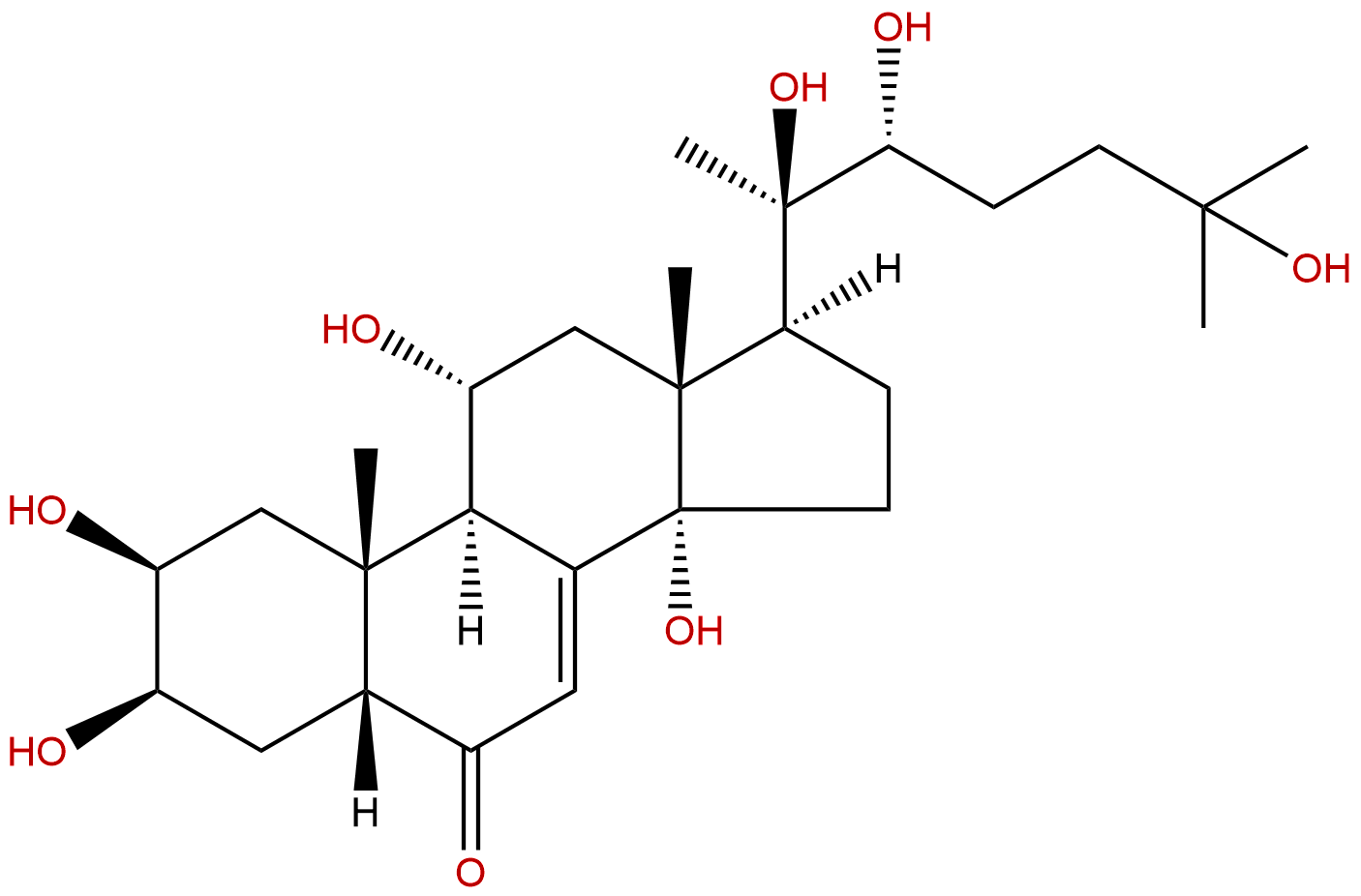
Turkestanone belongs to the class of plant molting sterols, and its chemical structure is based on the cyclopentane and tetrahydrophenanthrene steroid parent nucleus, belonging to sterol derivatives. Its system is named (2 β, 3 β, 5 β, 11 α) -2,3,11,14,20,25-hexahydroxy-5-cholestan-7-en-6-one. The molecular formula is C27H44O8, with a molecular weight of 496.6410 g/mol.
Structurally, tuksterone has several key characteristics: 1) A/B rings are cis coupled (5 β - H), which is a common feature of many highly active plant molting hormones; 2) Multiple hydroxyl groups are connected at positions C-2, C-3, C-11, C-14, C-20, and C-25, with C-2 and C-3 being adjacent dihydroxy structures in the β - configuration, C-14 being an α - hydroxyl group, and C-25 being connected to a hydroxymethyl group. These abundant polar functional groups are crucial for their water solubility and biological activity; 3) The C-6 position is a ketone carbonyl group, and the C-7 position has a double bond, forming an α, β - unsaturated ketone structure, which may be a key site for its interaction with certain biomolecules.
These structural features determine its physicochemical properties. The calculated coefficient of lipid water partition (LogP) is 1.0558, indicating that docetaxel has a certain lipophilicity but not high lipid solubility. Its topological polar surface area (TPSA) is as high as 158.68 Å ², mainly attributed to the numerous hydroxyl and carbonyl groups in the molecule, which can form strong hydrogen bonding networks. The theoretical calculation of water solubility is about 0.2391 mg/mL, which belongs to the category of slightly soluble to poorly soluble. This is a problem that needs to be considered in the development of practical formulations. Preliminary pharmacological prediction parameters indicate that its ability to cross the blood-brain barrier is low, suggesting that it mainly acts on the peripheral system; There is no significant inhibitory risk on hERG potassium channels, indicating low potential arrhythmogenic toxicity; The Ames test predicted a value of 0.0, indicating that it may not have direct genetic toxicity. These preliminary physicochemical and pharmacological parameters provide a fundamental framework for further in-depth research.
Plant sources and extraction methods
Turkestanone is not widely present in the plant kingdom, it is mainly enriched in certain specific families and genera of plants, especially Lemico Plant The most famous source is Genus Berberis Plants, for example Türkiye thorn berberis That's how it got its name, Turkestanone. In addition, in Asian prickly ash wood、Heart leaf oak and Some fern plants and Amaranthaceae plants It has also been detected.
In plants, docetaxel is usually present as a secondary metabolite, and its content is greatly influenced by plant variety, origin, harvesting site (such as roots, leaves, seeds), and growing season. For example, the roots of Türkiye Amber are usually high in content.
Organic solvent extraction is commonly used to extract tetracycline from plant materials. The classic process includes: reflux extraction or room temperature leaching of dried and crushed plant materials (such as root powder) using polar solvents (such as methanol, ethanol, or methanol water mixture). After filtration and concentration, the crude extract is initially enriched using liquid-liquid distribution (such as n-butanol water system) based on the polarity characteristics of plant molting hormones. Further purification relies on column chromatography techniques, often using silica gel, reverse phase silica gel (such as C18), or macroporous adsorption resin as the stationary phase, with different ratios of chloroform methanol or water methanol/acetonitrile gradient elution. High performance liquid chromatography, especially preparative HPLC, is the ultimate key step in obtaining high-purity Tukterone monomers. In recent years, some green extraction techniques such as ultrasound assisted extraction and microwave-assisted extraction have also been applied to improve extraction efficiency and shorten extraction time.
Pharmacological activity research
The pharmacological activity research of tetracycline has expanded from the initial insect hormone effects to a wide range of mammalian biological effects.
1. Synthetic metabolism and anti fatigue activity: This is the reason why testosterone is highly regarded in the field of sports nutrition. Research has shown that it can significantly promote protein synthesis in mammalian skeletal muscle cells, inhibit protein degradation, and thus increase muscle mass and strength. Animal experiments have shown that supplementing with docetaxel can increase the weight-bearing swimming time of rats, reduce post exercise blood lactate and serum urea nitrogen levels, and accelerate fatigue recovery. Its effect is similar to that of "plant sterols", but existing research has not shown that it has serious side effects typical of synthetic steroid hormones.
2. Antitumor activity: This is a current research hotspot, especially in the field of prostate cancer. In vitro experiments have confirmed that docetaxel can effectively inhibit the proliferation of various prostate cancer cell lines (such as LNCaP, PC-3, DU145) and induce cell apoptosis. In animal models, it can slow down the growth of prostate cancer xenografts. Its anti-tumor activity has multi-target characteristics, not only for prostate cancer, but also for breast cancer, colon cancer and other cell lines.
3. Anti inflammatory and immune regulatory activity: Turkestanone can inhibit the production of pro-inflammatory cytokines (such as TNF - α, IL-6) by macrophages induced by lipopolysaccharides. In animal models of acute and chronic inflammation, it exhibits anti-inflammatory and immunomodulatory effects.
4. Antioxidant and cell protective activity: Turkestanone can scavenge free radicals, enhance the activity of intracellular antioxidant enzymes such as superoxide dismutase and glutathione peroxidase, and alleviate oxidative stress damage. Has shown protective potential in liver injury and neurodegenerative disease models.
5. Metabolic regulatory activity: Preliminary studies suggest that turkesterone may improve insulin sensitivity, regulate lipid metabolism, and have potential value in the prevention and treatment of diabetes and obesity.
Mechanism of action and molecular targets
The mechanism of action of docetaxel in mammalian cells is complex, involving network regulation of multiple pathways and targets, especially in the field of anti prostate cancer, where its targets are highly correlated with the provided list.
1. Inducing cell apoptosis:
* Regulating the BCL2 family: Turkestanone can downregulate the expression of anti apoptotic protein BCL2, while upregulating the expression of pro apoptotic proteins such as BAX, disrupting mitochondrial membrane potential, leading to the release of cytochrome C, and subsequently Activate CASP9 (cysteine protease-9)Initiate cell apoptosis through the mitochondrial pathway.
* Death receptor pathway: Turkestanone can be upregulated TNF (tumor necrosis factor) The expression of its receptors activates CASP8, cross activates CASP3, and triggers apoptosis in the death receptor pathway.
2. Inhibition of survival and proliferation signaling pathways:
* STAT3 signaling pathway: STAT3 It is a key transcription factor for the survival and proliferation of cancer cells. Turkestanone can inhibit the phosphorylation (activation) of STAT3, prevent its nuclear translocation, thereby downregulating the expression of downstream target genes (such as Cyclin D1, Survivor), inhibiting cell proliferation and promoting apoptosis.
* MAPK/ERK pathway: MAPK1 (i.e. ERK2) It is a key kinase that regulates cell growth and differentiation. Turkestanone can regulate the activity of the MAPK/ERK pathway, but its effect may be context dependent, inhibiting its overactivation in some cases to suppress proliferation.
* PTPN1 (protein tyrosine phosphatase 1B) regulation: PTPN1 is a negative regulator of the insulin and leptin signaling pathways and is also associated with tumorigenesis. Turkestanone may indirectly affect the insulin/IGF-1 signaling pathway by regulating the activity of PTPN1, thereby affecting the metabolism and growth of cancer cells.
3. Regulating hormone related targets:
* Estrogen receptor beta (ESR2): Unlike estrogen receptor alpha (ESR1), ESR2 is often considered to have tumor suppressive functions. Turkestanone may exert anti prostate cancer proliferation effects by stimulating or regulating the activity of ESR2.
* Aromatase (CYP19A1): Aromatase converts androgens into estrogens. Turkestanone may alter the sex hormone balance in the tumor microenvironment by inhibiting the activity of CYP19A1, thereby affecting the growth of hormone dependent prostate cancer.
4. Overcoming multidrug resistance and antioxidant stress:
* P-glycoprotein (ABCB1): ABCB1 is the main multidrug resistance protein that leads to chemotherapy failure. Research has shown that docetaxel may act as a regulator of ABCB1, inhibiting its efflux pump function, increasing the accumulation of chemotherapy drugs in cancer cells, and reversing drug resistance.
* Activation of antioxidant response elements: NFE2L2(NRF2) It is the main regulator of cellular antioxidant stress response. Turkestanone can activate the NRF2 signaling pathway, promote the expression of downstream antioxidant enzymes and phase II detoxifying enzymes, which not only contribute to its cell protective effect, but may also help normal cells resist the toxicity of chemotherapy drugs. However, the sustained activation of NRF2 in cancer cells needs to be carefully evaluated.
5. Other potential mechanisms: Turkestanone may also exert rapid biological effects through non genomic pathways, such as regulating cell membrane fluidity and affecting ion channels. Its high affinity for insect EcR suggests the possibility of unrecognized receptors or action proteins in mammals.
Evaluation of drug properties and pharmacokinetics
Despite exhibiting rich pharmacological activity, the development of tuxetine as a drug depends on a systematic pharmacological evaluation.
Pharmacodynamics: At present, there is relatively limited research on the systematic pharmacokinetics of tetracycline in mammals. Existing animal experiments (mainly in rats) suggest that its oral bioavailability may not be high, which is related to its large polar surface area and moderate LogP value, which may affect its passive diffusion across intestinal mucosa. Its metabolic pathway in the body is not yet clear, and it is speculated that the liver may undergo II binding reactions through glucuronidation or sulfation of hydroxyl groups, and the ketone group at C-6 position may also be reduced. The excretion pathways (renal or biliary) of prototype drugs and their metabolites need to be elucidated. Key parameters such as plasma protein binding rate and tissue distribution characteristics (especially accumulation in prostate tissue) need to be studied through standardized radioactive labeling or high-sensitivity mass spectrometry methods.
Challenges and optimization directions for drug development:
1. Solubility and permeability: Moderate LogP and high TPSA result in it being classified as a low solubility, low permeability, or high solubility, low permeability compound in the Biopharmaceutical Classification System (BCS), which is the main bottleneck limiting its oral absorption.
2. Chemical stability: Multiple hydroxyl groups and α, β - unsaturated ketones in the structure may be sensitive to light, heat, and pH, and need to be stabilized and protected in the formulation.
3. Formulation strategy: To improve its oral bioavailability, advanced formulation technologies such as nanocrystals, liposomes, solid dispersions, self microemulsion delivery systems, etc. can be considered to increase solubility and promote lymphatic absorption. Cyclodextrin inclusion technology can also be used to improve its water solubility and stability.
4. Structural modification: On the premise of retaining the core pharmacophore, modifying some hydroxyl groups with prodrugs (such as esterification, formation of phosphate prodrugs) may significantly improve their lipid solubility and membrane permeability, and then hydrolyze them into active forms in vivo.
5. Preliminary safety assessment: The existing short-term toxicity studies have not reported severe toxicity, but their long-term toxicity, reproductive toxicity, carcinogenicity, etc. still need to be systematically evaluated in strict accordance with the drug non clinical research quality management standards. Its potential impact on the hormone system (through targets such as ESR2 and CYP19A1) requires special attention.
Clinical application prospects and prospects
The clinical application prospects of tetracycline are broad, but the road is long and needs to be explored in stages and fields.
1. Potential application areas:
* Tumor adjuvant therapy: As a natural candidate drug for anti prostate cancer, its multi-target mechanism of action is particularly suitable for addressing tumor heterogeneity and drug resistance. In the future, it may be developed as a single drug or in combination with existing chemotherapy and endocrine therapy drugs to enhance efficacy, reverse drug resistance, and reduce side effects. Its value in breast cancer, colon cancer and other cancers is also worth digging.
* Sarcopenia and Sports Medicine: Based on its strong synthetic metabolic activity, docetaxel is expected to be used for the treatment of clinical conditions such as age-related muscle loss, cancer cachexia, and postoperative rehabilitation that require weight loss. In the field of sports nutrition, as a potentially safe and effective dietary supplement ingredient that promotes recovery and increases muscle strength, the market potential is enormous, but its quality standards and efficacy claims need to be strictly regulated.
* Metabolic disorders: Its regulatory effect on glucose and lipid metabolism provides new ideas for the development of novel insulin sensitizers or lipid-lowering drugs.
* Neuroprotection and anti-inflammatory: In neurodegenerative diseases such as Alzheimer's disease and Parkinson's disease, as well as chronic inflammatory diseases such as rheumatoid arthritis, their antioxidant and anti-inflammatory activities may bring therapeutic benefits.
2. Challenges and future research directions:
* Deep exploration of mechanisms: Chemical biology methods such as affinity fishing and proteomics need to be used to identify its direct target (receptor or protein) in mammalian cells and elucidate its initial action event.
* System efficacy and toxicity evaluation: It is necessary to validate its efficacy in more rigorous preclinical disease models, especially genetically engineered mouse prostate cancer models, and complete comprehensive GLP toxicology studies.
* Clinical translational studies: Conducting early clinical trials on human pharmacokinetics, safety, and efficacy is a necessary step. Firstly, small-scale human efficacy trials can be conducted in the field of sports nutrition to accumulate safety data.
* Intellectual Property and Quality Control: Establish quality control standards for the entire process from plant cultivation, extraction to finished products, ensuring the stability and uniformity of active ingredients. Creating new chemical entities with independent intellectual property rights through structural modification is the key to enhancing their drug development value.
Conclusion
Turkestanone, a molting steroid compound found in traditional plants, has successfully transformed from an insect physiology research subject to a star natural product with multiple pharmacological activities. Its multi-target mechanism of action in the treatment of prostate cancer covers multiple key aspects such as inducing apoptosis, inhibiting survival signals, regulating hormone environment, and reversing drug resistance, demonstrating its unique advantages as a candidate anti-tumor drug. At the same time, its activities in synthetic metabolism, anti-inflammatory and antioxidant aspects have laid the foundation for its application in a wider range of disease fields.
However, there are multiple barriers spanning from active natural products to successful drugs, including efficacy, pharmacokinetics, safety, and quality. At present, research on the in vitro and preliminary in vivo efficacy of tetracycline is still focused on, and its systematic pharmacological evaluation and in-depth molecular mechanism research need to be strengthened. In the future, through interdisciplinary collaboration and combining modern research methods in medicinal chemistry, pharmacy, molecular pharmacology, and clinical medicine, it is expected to overcome its existing shortcomings and unlock its full therapeutic potential. Whether ultimately used as a prescription drug or as a functional dietary supplement ingredient, the in-depth study of docetaxel will provide valuable experience and inspiration for humans to seek new disease treatment strategies from nature.