


Product name: Trigonelline
Synonym name: N-Methylnicotinic betaine; Gynesis; Coffearin
Catalogue No.: BP1407
Cas No.: 535-83-1
Formula: C7H7NO2
Mol Weight: 137.138
Botanical Source: Trigonella foenum-graecum L.
Physical Description:
Type of Compound: Alkaloids
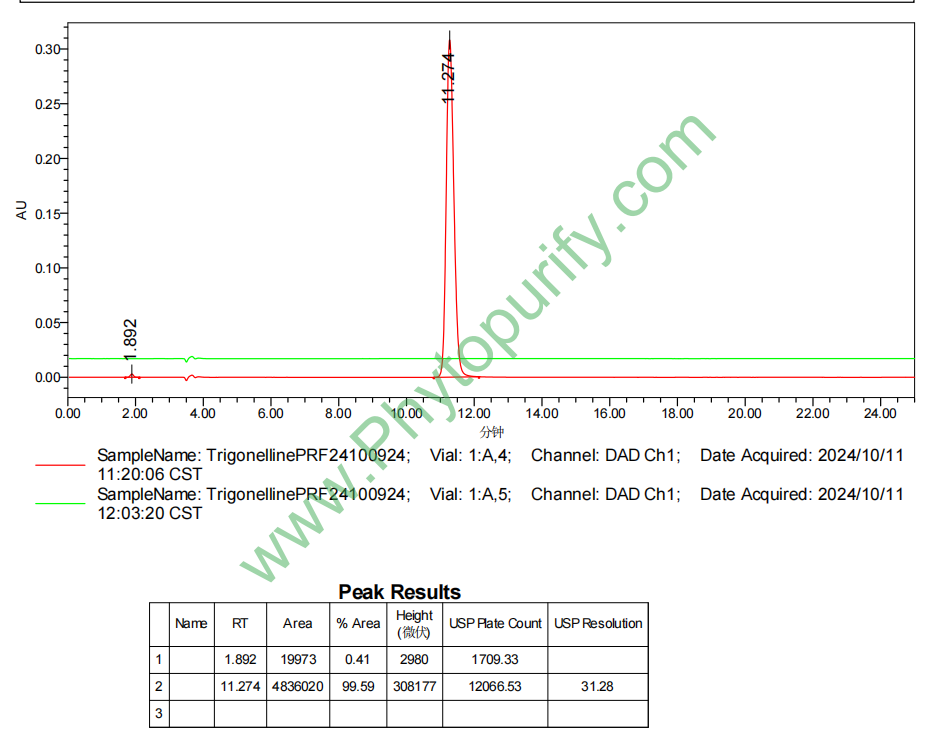
Purity: 95%~99%
Analysis Method: HPLC-DAD or/and HPLC-ELSD
Identification Method: Mass, NMR
Packing: Brown vial or HDPE plastic bottle
Can be supplied from grams to kilograms.
Inquire for bulk scale.
Trigonelline, also known as caffearin or gynesine, belongs to the class of organic compounds known as alkaloids and derivatives. These are naturally occurring chemical compounds that contain mostly basic nitrogen atoms. This group also includes some related compounds with neutral and even weakly acidic properties. Also some synthetic compounds of similar structure are attributed to alkaloids. In addition to carbon, hydrogen and nitrogen, alkaloids may also contain oxygen, sulfur and more rarely other elements such as chlorine, bromine, and phosphorus. It is also found in coffee, where it may help to prevent dental caries by preventing the bacteria Streptococcus mutans from adhering to teeth. Trigonelline is a moderately acidic compound (based on its pKa). Trigonelline exists in all living organisms, ranging from bacteria to humans. Outside of the human body, Trigonelline is found, on average, in the highest concentration within a few different foods, such as arabica coffee, fenugreeks, and common pea and in a lower concentration in yellow bell peppers, orange bell peppers, and muskmelons. Trigonelline has also been detected, but not quantified in, several different foods, such as rices, triticales, alfalfa, cereals and cereal products, and ryes. This could make trigonelline a potential biomarker for the consumption of these foods. Trigonelline is a product of the metabolism of niacin (vitamin B3) which is excreted in the urine. Trigonelline in the urine is a biomarker for the consumption of coffee, legumes and soy products. Trigonelline is an alkaloid with chemical formula C7H7NO2 and CAS number 535-83-1. Trigonelline occurs in many other plants, including fenugreek seeds, garden peas, hemp seed, oats and potatoes.
HPLC of Trigonelline
Storage conditions:Short-term storage at 2~8℃, long-term storage at -20 ~ -80℃
44.0100
-3.4306
-3.4312
30.2023
.8412
8.7233
High
13.5438
3.4494
Yes
No
No
No
Yes
Yes
3.0
No
Yes
No
No
In the vast field of natural product chemistry and pharmacology research, alkaloid compounds have always occupied a core position due to their structural diversity and significant biological activity. Trigonelline, as a quaternary ammonium alkaloid widely distributed in various medicinal plants, is increasingly becoming a star molecule that connects traditional medical wisdom with modern scientific exploration. Its CAS number is 535-83-1 and its chemical name is N-methylnicotinic acid internal salt. Cucurbitacin was initially discovered and named due to its high content in the seeds of traditional hypoglycemic herb Trigonella foenum graecum L., and has since been isolated and reported in various plants such as Leonurus japonicus.
For a long time, cucurbitacin has been regarded as a flavor substance in food due to its conversion from niacin during coffee roasting. However, in the past two decades, with the deepening of research technology, its multiple pharmacological activities beyond the scope of nutrition have gradually been revealed. Among them, the most striking is its clear anti diabetes potential, making it a hot candidate molecule for drug research and development of metabolic diseases. More importantly, the research perspective has expanded from metabolic regulation to multiple fields such as tumors, infections, and neurodegenerative diseases. For example, trigonelline has been proved to be an effective inhibitor of nuclear factor E2 related factor 2 (Nrf2), which can selectively enhance apoptosis of pancreatic cancer cells by interfering with Nrf2 dependent proteasome activity. In addition, its new activities such as anti herpes simplex virus type 1 (HSV-1), broad-spectrum antibacterial, antifungal, and ferroptosis inducing effects continue to enrich its pharmacological spectrum.
This article aims to systematically review the chemical properties, plant sources, extraction methods, multidimensional pharmacological activities, mechanisms of action, and molecular targets of cucurbitacin, and to comprehensively evaluate its potential and challenges in transitioning from laboratory to clinical use by combining its pharmacological parameters and pharmacokinetic characteristics. The goal is to provide comprehensive scientific references for the deep development and utilization of this natural product.
The chemical structure of cucurbitacin is relatively simple, which is an N-methyl derivative of niacin (vitamin B3), specifically 1-methylpyridin-1-ium-3-carboxylate, belonging to the inner quaternary ammonium salt compound. Its molecular formula is C7H7NO2 and its molecular weight is 137.1380. This structural feature determines its unique physicochemical properties.
In terms of physical properties, cucurbitacin is a white to pale yellow crystalline or crystalline powder at room temperature, odorless, and slightly bitter in taste. The presence of polar quaternary ammonium cations and carboxylate anions (in the form of internal salts) in its molecule gives it strong hydrophilicity. The calculated lipid water partition coefficient (LogP) is -3.4306, indicating that it is a highly hydrophilic molecule. The topological polar surface area (TPSA) is 44.01 Å ², further confirming its good polarity. These parameters are directly related to its excellent water solubility, with a measured water solubility of up to 30.2023 mg/mL, indicating that it is highly soluble in water, which provides convenience for the preparation of water-soluble formulations.
The chemical stability of cucurbitacin is good, but its internal salt structure may decompose under strong acid or alkali conditions. Its UV absorption characteristics can be used for quantitative analysis. It is worth noting that its high hydrophilicity and small molecular weight, combined with its charge characteristics, make it exhibit a high predictive value of blood-brain barrier permeability, which provides a structural basis for the study of its potential central nervous system related activities (such as neuroprotection). In addition, preliminary pharmacological screening showed no significant inhibitory effect on hERG potassium channels at conventional test concentrations (hERG inhibition: No), suggesting a low potential risk of cardiac toxicity. The Ames test result was 3.0, indicating that its mutagenic risk needs to be carefully evaluated in subsequent studies.
Cucurbitacin is widely distributed in the plant kingdom and is its main natural source.
1. Main plant sources:
* Trigonella foenum graecum L.: Leguminous plants, whose dry and mature seeds are the most abundant and famous source of cucurbitacin. The content of cucurbitacin in cucurbitacin seeds can reach 0.2% -0.38%, which is also the reason for its name. Fenugreek is commonly used in traditional medicine in India, the Middle East and China to treat diabetes, high cholesterol and indigestion.
* Leonurus japonicus: Lamiaceae plants, used as medicine for their entire plant. Motherwort is another important source of cucurbitacin, and its content varies depending on the location and growth period, providing clues for the discovery of new active ingredients from traditional Chinese medicine for promoting blood circulation and regulating menstruation.
* Other sources: Cucurbitacin is also present in coffee beans (especially converted from chlorogenic acid and niacin during roasting), peas, hemp, oats, corn, and some marine organisms, but its content is usually lower than that of cucurbitacin and motherwort.
2. Extraction and Separation Methods:
The extraction of cucurbitacin mainly utilizes its good water solubility and certain alcohol solubility. The standard procedure is as follows:
* Extraction: Usually, water or low concentration alcohols (such as methanol and ethanol) are used as solvents for heating reflux extraction, ultrasound assisted extraction, or microwave-assisted extraction of dried and crushed plant materials (such as fenugreek seeds). Among them, the water extraction method has low cost and environmental friendliness, but it contains more impurities; The alcohol extraction method has high efficiency and is easy to concentrate later.
* Purification: After filtration and concentration, the crude extract needs to be further purified to obtain high-purity cucurbitacin. Common methods include:
* Column chromatography: Enrichment and separation are carried out using cation exchange resin (such as Diaion HP-20, Amberlite IR-120) or reverse phase silica gel (such as C18) column chromatography. Elution is carried out by utilizing the polarity of cucurbitacin and its differential interaction with the stationary phase.
* Recrystallization method: By utilizing the difference in solubility of cucurbitacin in specific solvents (such as methanol ether mixed solvents) for repeated crystallization, high-purity products can be obtained, but there may be significant losses.
* Modern separation technology: High speed counter current chromatography (HSCCC) and preparative high performance liquid chromatography (Prep HPLC) have become effective methods for obtaining high-purity cucurbitacin standards on a laboratory scale due to their high resolution and recovery rate.
Optimizing the extraction process (such as solvent, temperature, time) is crucial for improving yield and maintaining activity.
Huluba alkaloids exhibit a wide range of pharmacological activities, and their research has extended from traditional metabolic regulation to emerging fields such as anti-tumor and anti infection.
1. Anti diabetes and metabolic regulation activity:
This is the most extensively studied and well supported activity of cucurbitacin. A large number of in vivo and in vitro studies have shown that trigonelline can significantly reduce fasting blood glucose and glycosylated hemoglobin levels in diabetes model animals (such as streptozotocin induced diabetes rats), and improve abnormal glucose tolerance. Its effects are not limited to reducing glucose, but also include improving insulin resistance, regulating lipid metabolism (reducing triglycerides and total cholesterol), protecting the function of pancreatic islet β cells, and reducing complications of diabetes (such as kidney disease and liver injury). Its multi-target action characteristics give it an advantage in regulating complex metabolic networks.
2. Antitumor activity:
In recent years, studies have found that cucurbitacin has inhibitory effects on proliferation and induces death in various cancer cells.
* Pancreatic cancer: Cucurbitaine can effectively inhibit the growth of pancreatic cancer cells, one of the key mechanisms is to inhibit Nrf2 signaling pathway. Nrf2 is the main regulator of cellular antioxidant response, overactivated in various cancers, promoting tumor cell survival and chemotherapy resistance. Cucurbitaine can specifically induce apoptosis of pancreatic cancer cells by inhibiting Nrf2 and blocking its downstream proteasome activity, leading to the accumulation of pro apoptotic proteins.
* Induced ferroptosis: Iron dependent cell death is a regulatory cell death mode characterized by the accumulation of lipid peroxides. Research shows that cucurbitaine can inhibit the activity of glutathione peroxidase 4 (GPX4) by consuming the key antioxidant glutathione (GSH) in cells, leading to the accumulation of lipid reactive oxygen species (ROS), thus triggering the iron death of breast cancer, lung cancer and other cancer cells, which opens a new way for its anti-tumor research.
* Other cancers: It also shows certain inhibitory effects on prostate cancer, colon cancer, neuroblastoma, etc., involving mechanisms such as cell cycle arrest and apoptosis induction.
3. Antimicrobial activity:
* Antiviral: Huluba alkaloids have inhibitory effects on herpes simplex virus type 1 (HSV-1), possibly by interfering with the virus's adsorption or entry into host cells.
* Antibacterial and antifungal: It exhibits inhibitory activity against various Gram positive bacteria (such as Staphylococcus aureus), Gram negative bacteria (such as Escherichia coli), and fungi such as Candida albicans, but its antibacterial efficacy is usually weaker than that of specialized antibiotics. Its mechanism may be related to the destruction of microbial cell membrane integrity or interference with metabolism.
4. Neuroprotective and Cognitive Improvement Activities:
Due to its excellent blood-brain barrier permeability, the role of cucurbitacin in the central nervous system has attracted attention. In animal models of Alzheimer's disease and ischemic brain injury, cucurbitacin has shown the potential to alleviate neuroinflammation, reduce beta amyloid deposition, improve synaptic plasticity and memory function. Its mechanism may be related to antioxidant, anti apoptotic, and cholinergic system regulation.
5. Other activities:
It also includes reports on antioxidant, anti-inflammatory, cardiovascular protection (such as anti arrhythmic, reducing myocardial hypertrophy), and promoting hair growth, reflecting its multifunctional characteristics.
The multiple pharmacological activities of cucurbitacin stem from its interactions with multiple key biomolecules and signaling pathways. Its mechanism of action is complex, and the following core aspects are summarized:
1. Core target network for hypoglycemic effects:
The hypoglycemic mechanism of cucurbitacin is the result of the synergistic effect of multiple targets, rather than relying on a single pathway.
* Enhancement of insulin signaling pathway: Huluba alkaloids can upregulate tyrosine phosphorylation of insulin receptor substrate 1 (IRS1), activate the downstream phosphatidylinositol 3-kinase/protein kinase B (PI3K/Akt) pathway, thereby promoting the translocation of glucose transporter 4 (SLC2A4/GLUT4) to the cell membrane and increasing glucose uptake and utilization in muscle and adipose tissue.
* Regulation of key metabolic enzymes: Research has shown that cucurbitacin can activate glucokinase (GCK), which is the rate limiting enzyme for glucose metabolism in liver and pancreatic beta cells, and helps promote glucose phosphorylation and metabolism. Meanwhile, it may act as a weak agonist of peroxisome proliferator activated receptor gamma (PPARG), improving insulin sensitivity.
* Intestinal insulinotropic system: Huluba alkaloids can inhibit the activity of dipeptidyl peptidase-4 (DPP4). DPP4 is responsible for degrading glucagon like peptide-1 (GLP-1), inhibiting its activity can prolong the action time of endogenous GLP-1, promote glucose dependent insulin secretion, and inhibit glucagon release.
* Potential regulation of insulin receptor (INSR): There are studies suggesting that cucurbitacin may exert its effects by affecting the expression or sensitivity of INSR.
2. Core mechanism of anti-tumor effect:
* Nrf2 pathway inhibition: This is the key mechanism of its anti pancreatic cancer. By interfering with the Keap1-Nrf2 interaction or influencing the post transcriptional regulation of Nrf2, cucurbitaine leads to the reduction of Nrf2 nuclear translocation, and the down-regulation of genes driven by its downstream antioxidant response element (ARE) (such as genes encoding proteasome subunits), thereby weakening the antioxidant defense and protein homeostasis of tumor cells and inducing apoptosis.
* Iron induced death: By directly or indirectly consuming intracellular GSH, inhibiting GPX4 activity, disrupting cellular redox balance, leading to fatal lipid peroxidation, and triggering ferroptosis.
3. Possible mechanisms of neuroprotective effects:
Involved in inhibiting acetylcholinesterase activity and increasing acetylcholine levels in the brain; Reduce oxidative stress and mitochondrial dysfunction; Inhibiting neuroinflammation mediated by excessive activation of microglia; And regulate signaling pathways related to learning and memory, such as cAMP response element binding proteins, CREB)。
As a small intramolecular salt, the interaction mode of cucurbitacin with the aforementioned targets, such as direct binding, conformational regulation, or indirect effects, is still under further investigation. Its multi-target characteristic is not only its advantage in treating complex diseases (such as diabetes and cancer), but also challenges its mechanism interpretation and potential side effects assessment.
Based on the parameters provided in the previous text and existing research, a preliminary evaluation of the pharmacological properties of cucurbitacin is conducted.
1. Physical and chemical properties and preliminary ADMET properties:
* Advantage: The molecular weight is small (137 Da) and the water solubility is excellent, which is beneficial for the development of formulations (especially oral and injection solutions) and their dissolution and absorption in vivo. The predicted high permeability of the blood-brain barrier provides the possibility for it to exert central nervous system activity. No hERG inhibition warning reduces early cardiac safety risks.
* Challenge: The extremely high hydrophilicity (LogP-3.43) may limit its oral bioavailability due to poor cross cellular passive diffusion ability. The Ames test value is 3.0, indicating the need for further genetic toxicity studies to clarify its safety.
2. Overview of pharmacokinetic studies:
The existing pharmacokinetic studies are mainly based on animal experiments, and there is a lack of human data.
* Absorption: After oral administration, cucurbitacin is rapidly but incompletely absorbed in the gastrointestinal tract, which may involve active transport or passive diffusion in the intestine. Food may affect its absorption.
* Distribution: After absorption, it can be widely distributed in various tissues throughout the body, including the liver, kidneys, pancreas, and brain, which is consistent with its observed multi organ protective effect in experiments. Its plasma protein binding rate is expected to be low.
* Metabolism: The metabolism of cucurbitacin in the body is relatively simple. The main metabolic pathway is demethylation to regenerate niacin (vitamin B3), which may be catalyzed by the liver enzyme system. Niacin itself also has biological activity (such as regulating blood lipids), which may be a joint contributor to the pharmacological effects of cucurbitacin.
* Excretion: It is mainly rapidly excreted from urine in the form of prototype or metabolites (niacin and its derivatives) through the kidneys, with a short half-life. This requires multiple administrations or the use of sustained-release formulations to maintain effective blood drug concentrations during clinical application.
3. Comprehensive evaluation of drug properties:
Huluba alkaloid has a good foundation for becoming a drug lead compound: natural source, clear structure, wide activity, novel mechanism of action, and preliminary safety is acceptable. The main bottleneck of its medicinal properties lies in Oral bioavailability may be low and Potential genetic toxicity concerns Future research needs to improve its bioavailability through pharmacokinetic optimization strategies, such as preparing prodrugs, using absorption enhancers, and developing novel drug delivery systems, and must clear safety barriers through complete preclinical safety evaluations, including detailed genetic toxicity and long-term toxicity tests.
The transition of cucurbitacin from laboratory research to clinical translation has broad prospects, but the path is clear and full of challenges.
1. Potential clinical application directions:
* Adjuvant treatment of type 2 diabetes and its complications: As a supplement to oral hypoglycemic drugs or for intervention in pre diabetes. Its multi-target mechanism of action, especially DPP4 inhibition and insulin sensitization, may lead to synergistic effects when combined with traditional drugs such as metformin. It also has potential in the prevention and treatment of complications such as diabetes nephropathy and liver injury.
* Adjuvant therapy and sensitizers for tumors: Especially for malignant tumors with excessive Nrf2 activation (such as pancreatic cancer and lung cancer). Huluba alkaloids, as Nrf2 inhibitors, when combined with conventional chemotherapy or radiotherapy, may reverse tumor drug resistance and enhance treatment efficacy. Its ability to induce ferroptosis also provides a new approach for treating tumors that are insensitive to apoptosis.
* Neurodegenerative diseases: Prevention or delay of progression of diseases such as Alzheimer's and Parkinson's. Its multi-target neuroprotective properties deserve further exploration.
* Functional foods and health products: Given its natural presence in coffee and fenugreek, developing health foods with blood sugar regulation, antioxidant properties, and cognitive improvement functions is a more achievable industrialization path in the near future.
2. Challenges and future research directions:
* Improved bioavailability: This is the core challenge in developing it into an oral medication. It is necessary to systematically study its absorption mechanism and modify it using pharmaceutical methods such as nanocrystals, liposomes, phospholipid complexes, and prodrug design.
* Deep analysis of the mechanism of action: It is necessary to clarify its direct interaction mode, binding site, and structure-activity relationship with key targets such as Nrf2 and DPP4. Using chemical biology methods (such as photoaffinity labeled probes) to search for proteins that directly interact with it.
* System security evaluation: It is necessary to complete a full set of preclinical safety evaluations for acute toxicity, chronic toxicity, reproductive toxicity, genetic toxicity, etc. under standardized GLP conditions, especially clarifying the risks indicated by Ames tests.
* Clinical research evidence: At present, there is a serious lack of high-quality human clinical trial data. In the future, rigorous Phase I-III clinical trials need to be designed to verify their effectiveness, safety, and optimal dosing regimen in humans.
* Structural optimization and derivative development: It is an important direction in the field of medicinal chemistry to use it as the parent nucleus for rational chemical modification, while preserving or enhancing its activity, to improve its pharmacokinetic properties (such as increasing lipid solubility and prolonging half-life).
Huluba alkaloid, a natural alkaloid derived from traditional medicinal plants, has risen from an ordinary plant component to an important lead compound with significant development value due to its unique chemical structure and increasingly rich pharmacological activity spectrum. Its multi target regulatory role in the field of anti diabetes, the novel mechanism demonstrated by inhibiting Nrf2 and inducing iron death in the field of anti-tumor, and its potential in anti infection, neuroprotection, etc. jointly draw a promising application blueprint.
However, the path from "active molecules" to "marketed drugs" is long and rigorous. The pharmacokinetic bottlenecks and safety concerns currently faced by cucurbitacin are the real challenges on its conversion path. This requires researchers to adopt a multidisciplinary collaborative strategy: pharmaceutical chemists focus on structural optimization, pharmacologists tackle delivery systems, pharmacologists delve into their network pharmacology mechanisms, and toxicologists comprehensively evaluate their safety margins.
Looking ahead to the future, with a more detailed analysis of the mechanism of action of cucurbitacin, the emergence of innovative derivatives based on its structure, and the application of new drug delivery technologies, we have reason to believe that cucurbitacin or its optimized products have the potential to occupy a place in the prevention and treatment of major diseases such as metabolic disorders and tumors, ultimately achieving a magnificent transformation from ancient herbs to modern drugs, and contributing to human health with the power of nature. The research process itself also provides a classic example for how to scientifically explore and enhance the value of traditional natural medicines.
