| Catalog No | Package | Original Price | Price | Inventory | Quantity | Operating |
|---|---|---|---|---|---|---|
| BP5060-5mg | 5mg | $650.00 | Sign in |
|


Storage conditions:Short-term storage at 2~8℃, long-term storage at -20 ~ -80℃
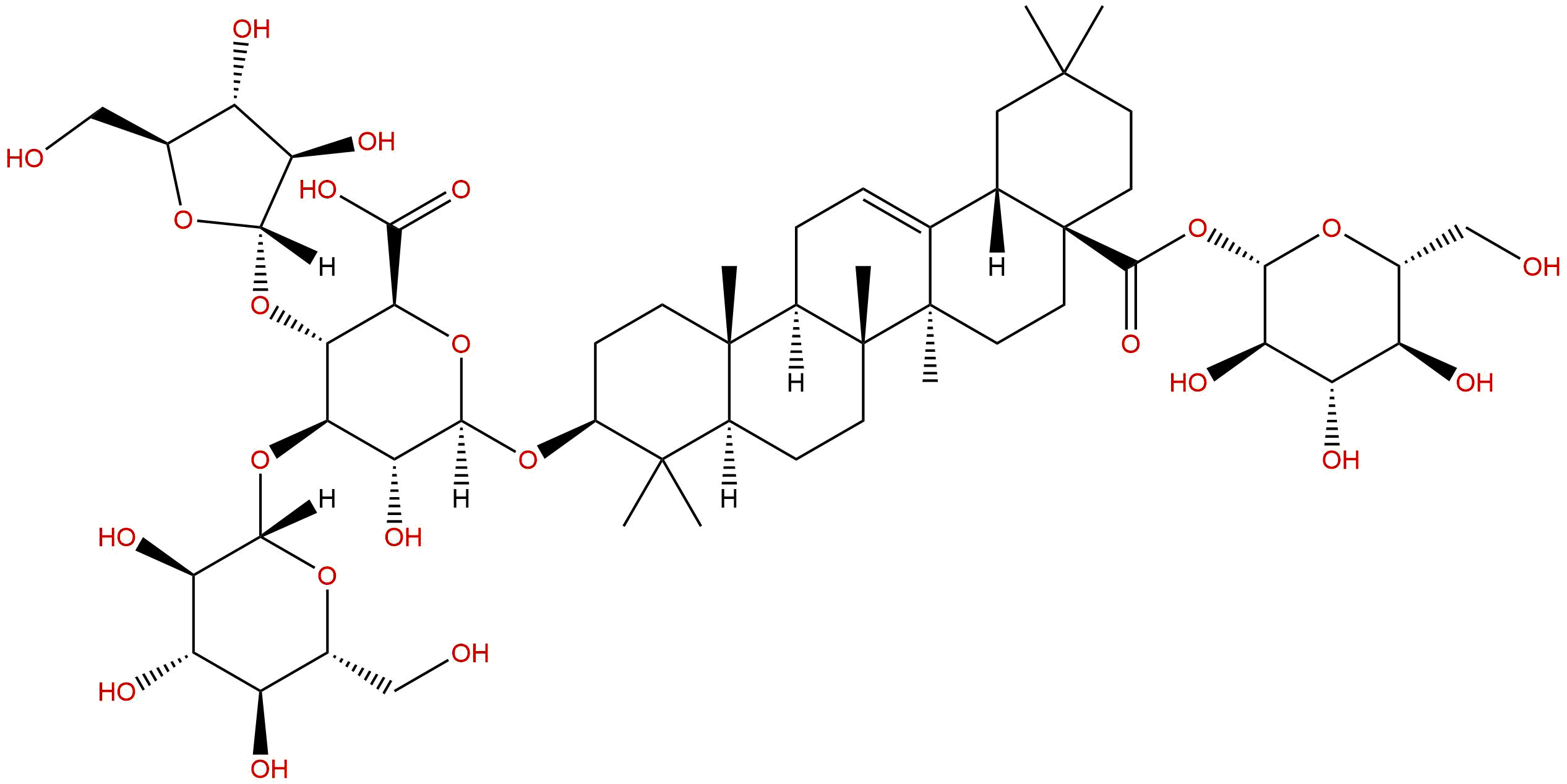
Stipuleanoside R2 (CAS number: 96627-72-4) is a natural product derived from traditional Chinese medicinal herbs, which has received widespread attention in recent years due to its significant pharmacological activity and potential clinical application value. As a natural compound with a complex glycosidic structure, Sanqi glycoside R2 exhibits unique advantages in regulating inflammatory responses and myocardial protection, especially in inhibiting tumor necrosis factor alpha (TNF alpha) - induced activation of nuclear factor kappa B (NF - κ B) with a dose-dependent inhibitory effect. Its IC50 value is 4.1 μ M, indicating high biological activity. The NF - κ B signaling pathway plays a key role in the pathogenesis of various cardiovascular diseases, therefore, the study of Sanqi glycoside R2 in the field of myocardial protection has important theoretical significance and application prospects.
This review aims to systematically summarize the chemical structure and physicochemical properties, plant sources and extraction methods, pharmacological activity and mechanism of action, pharmacological evaluation and pharmacokinetic characteristics of Sanqi glycoside R2, and explore its clinical application potential in the field of myocardial protection in combination with its related targets and disease background. It is expected to provide scientific basis and theoretical support for subsequent basic research and clinical translation.
Pingbian Sanqi Glycoside R2 is a natural triterpenoid saponin compound with a high molecular weight of 1089.2320, exhibiting a complex molecular structure. The LogP value of this compound is 1.5847, indicating that it has moderate lipid solubility, which is beneficial for cell membrane penetration but not too hydrophobic to affect bioavailability. Its polar surface area (TPSA) is as high as 370.9700, reflecting the presence of a large number of polar groups in the molecule, especially the glycosidic part, which endows it with good water solubility (0.2549), which has a positive impact on the solubility and in vivo distribution of oral administration.
Structurally, Pingbian Sanqi Glycoside R2 contains multiple glycosylated triterpenoid skeletons. The presence of glycosides not only increases the polarity of the molecule, but may also affect its binding ability to biological targets and metabolic stability. Its lower blood-brain barrier permeability indicates that the compound has limited penetration ability in the central nervous system, reducing the risk of central side effects. The hERG channel inhibition test result was negative, indicating a low risk of cardiac toxicity. The Ames mutagenicity test result was 0.0, indicating that Sanqi glycoside R2 has no significant genetic toxicity and has a good safety basis.
Pingbian Sanqi Glycoside R2 mainly exists in certain specific traditional Chinese medicine plants, especially Panax notoginseng and its related species as the main source. Sanqi, as a traditional Chinese medicinal herb, has always been used for promoting blood circulation, removing blood stasis, stopping bleeding, and relieving pain. Modern research has found that it contains abundant triterpenoid saponins, among which Sanqi glycoside R2 is one of the important active ingredients.
The extraction of Sanqi glycoside R2 from Pingbian is usually carried out using a multi-step solvent extraction combined with chromatographic separation technology. Firstly, the dried plant powder is subjected to reflux extraction using ethanol or methanol. After concentration, the extract is preliminarily separated using a water ethanol gradient elution method. Subsequently, further purification was performed using high-performance liquid chromatography (HPLC) or reverse phase column chromatography, followed by structural identification using mass spectrometry (MS) and nuclear magnetic resonance (NMR) techniques. In recent years, the application of ultrasound assisted extraction and microwave-assisted extraction technologies has improved extraction efficiency and purity, while reducing solvent usage and extraction time, in line with the concept of green chemistry.
The pharmacological activity research of Sanqi glycoside R2 in Pingbian mainly focuses on its anti-inflammatory and cardioprotective effects. A large number of in vitro cell experiments have shown that Sanqi glycoside R2 can significantly inhibit the activation of NF - κ B signaling pathway induced by TNF α, showing a dose-dependent effect. Its IC50 value is 4.1 μ M, indicating strong inflammatory regulatory ability. NF - κ B, as a transcription factor, regulates the expression of various inflammatory factors and apoptosis related genes. Its abnormal activation is closely related to cardiovascular diseases such as myocardial ischemia-reperfusion injury and heart failure.
In addition, animal model studies further confirm the potential value of Sanqi glycoside R2 in myocardial protection. By regulating key targets such as angiotensin-converting enzyme (ACE), endothelial nitric oxide synthase (NOS3), calcium channel protein (CACNA1C), sodium calcium exchange protein (SLC8A1), potassium channel protein (KCNJ2), sarcoplasmic reticulum calcium release channel (RYR2), and angiotensin II receptor type 1 (AGTR1), Sanqi glycoside R2 can improve the ion homeostasis of myocardial cells, alleviate oxidative stress and inflammatory reactions, thereby reducing myocardial injury and improving heart function.
Pingbian Sanqi Glycoside R2 achieves its cardioprotective effect through multi-target and multi pathway synergistic effects. The main mechanisms include:
Inhibition of NF - κ B signaling pathway
Pingbian Sanqi Glycoside R2 can block TNF α - induced degradation of I κ B α, inhibit the translocation of NF - κ B from the cytoplasm to the nucleus, reduce the expression of inflammatory factors such as IL-6, IL-1 β, and TNF α, and alleviate the inflammatory response of myocarditis.
Regulating the angiotensin system
By inhibiting ACE activity and downregulating AGTR1 expression, Sanqi glycoside R2 reduces the generation of angiotensin II and receptor-mediated contraction signals, lowers myocardial load, and prevents myocardial remodeling.
Promote nitric oxide synthesis
Upregulation of NOS3 expression and activity enhances endothelial cell release of NO, dilates blood vessels, improves myocardial ischemia, inhibits platelet aggregation, and protects myocardial cells.
Regulating ion channels in cardiomyocytes
By regulating key ion channel proteins such as CACNA1C, SLC8A1, KCNJ2, and RYR2, the electrophysiological stability of myocardial cells is maintained, preventing arrhythmia and cell apoptosis.
The synergistic effect of the above mechanisms enables Pingbian Sanqi Glycoside R2 to exhibit multidimensional pharmacological effects in myocardial protection, with strong clinical translational potential.
The pharmacological evaluation of Pingbian Sanqi Glycoside R2 shows that it has good safety and drug compatibility. Although the molecular weight is relatively large, a moderate LogP value and good water solubility contribute to its in vivo absorption and distribution. Its low blood-brain barrier permeability reduces the risk of central nervous system side effects. The negative hERG channel inhibition test indicates a low risk of cardiac toxicity, and the Ames test shows no mutagenicity, indicating good safety.
In terms of pharmacokinetics, although there is currently limited systematic research on Sanqi glycoside R2, its oral bioavailability may be limited by its high polarity and molecular weight based on its structural characteristics. In the future, drug delivery systems need to be optimized through strategies such as nanocarriers and liposome encapsulation to enhance their in vivo stability and targeting. In addition, metabolic pathways may mainly be carried out through hepatic glycoside hydrolases and corresponding phase I and phase II metabolic enzymes, and the activity and safety of related metabolites also need to be further studied.
Pingbian Sanqi Glycoside R2 has shown broad clinical application prospects in the field of myocardial protection. It has the potential to treat diseases such as myocardial ischemia, heart failure, and arrhythmia by regulating inflammation, oxidative stress, and ion homeostasis of myocardial cells through multiple targets. Combining its good safety and low toxicity, Sanqi glycoside R2 is expected to become an important candidate for the development of new cardiovascular drugs.
Future research should focus on the following aspects:
Systematic pharmacokinetic and pharmacodynamic studies
Clarify its absorption, distribution, metabolism, and excretion characteristics in the body, and optimize the dosing regimen.
In depth mechanism analysis and target validation
Using modern technologies such as gene editing and proteomics, further elucidate its functional network and key targets.
Preclinical safety and efficacy evaluation
Ensure the safety of clinical applications through animal models and toxicology studies.
Formulation development and optimization of administration routes
Explore various routes such as oral, injection, and local administration to improve bioavailability and patient compliance.
Research on Combination Medication Strategy
Evaluate synergistic effects and potential drug interactions in combination with existing cardiovascular drugs.
As a natural product with significant NF - κ B inhibitory activity and multi target myocardial protection, Panax notoginseng saponin R2 shows good pharmacological activity and pharmaceutical characteristics. Its potential in the prevention and treatment of cardiovascular diseases is constantly being revealed, providing new ideas and directions for natural product pharmacology and cardiovascular drug development. In the future, through in-depth mechanism research and preclinical evaluation, it is expected to promote the translation of Sanqi glycoside R2 into clinical applications, benefiting a large number of cardiovascular disease patients.
