


Product Name: Tetraalbaspidin ABBA
Synonym name: Dryocrassin; Methylenebisnorflavaspidic acid ABBA
Catalogue No.: BP0516
Cas No.: 12777-70-7
Formula: C43H48O16
Mol Weight: 820.841
Botanical Source: Dryopteris crassirhizoma and Dryopteris polylepis
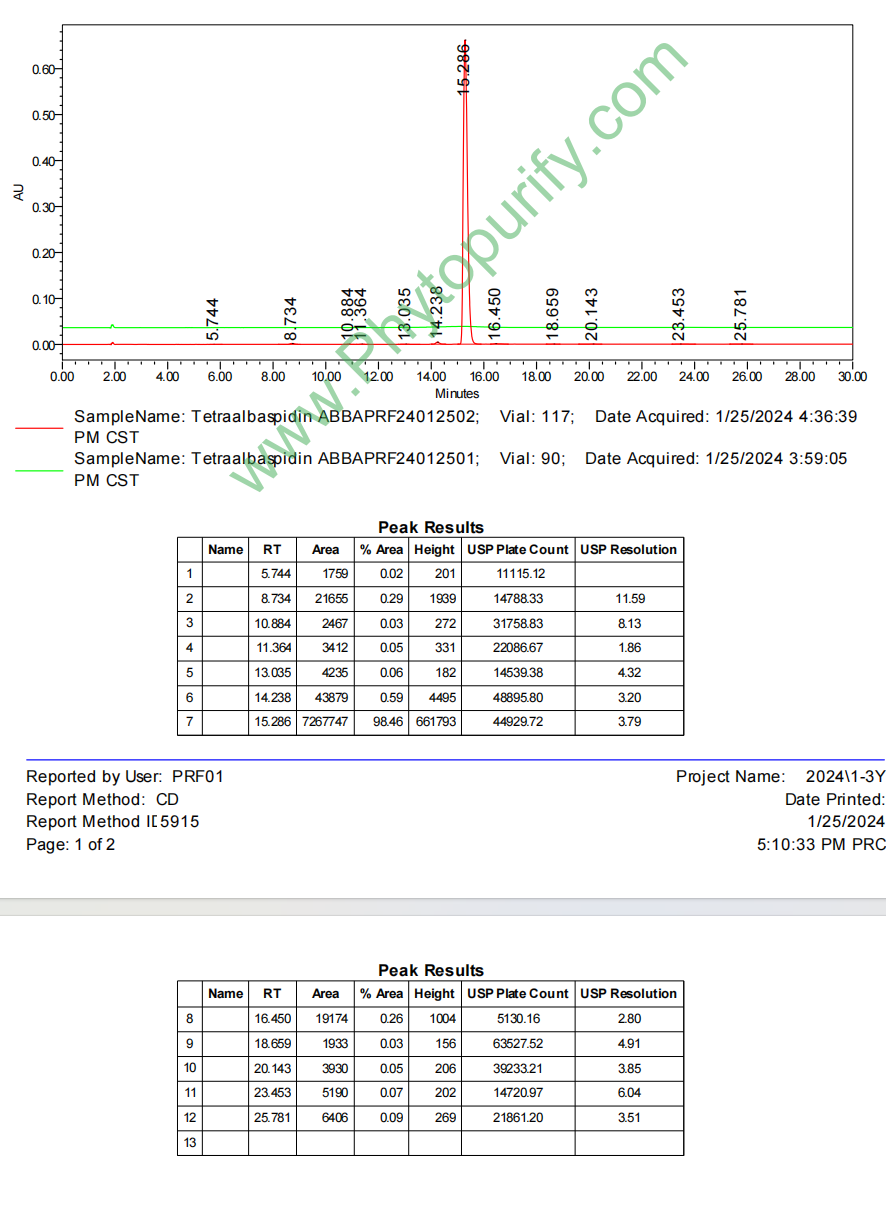
Purity: 95%~99%
Analysis Method: HPLC-DAD or/and HPLC-ELSD
Identification Method: Mass, NMR
Packing: Brown vial or HDPE plastic bottle
Can be supplied from milligrams to grams.
For Reference Standard and R&D, Not for Human Use Directly.
Inquire for bulk scale.
HPLC of Tetraalbaspidin ABBA
Storage conditions:Short-term storage at 2~8℃, long-term storage at -20 ~ -80℃
304.7200
3.0664
.8669
.1689
2.0057
2.3245
Low
90.3714
4.2050
Yes
No
Yes
No
Yes
Yes
0.6
Yes
No
Yes
No
Tetraalbastidin ABBA (CAS number 12777-70-7) is a natural product derived from the traditional Chinese medicine Swertia tetralipis. In recent years, it has attracted much attention due to its multi-target and multi disease spectrum pharmacological activities. This compound has shown potential application value in the treatment of Alzheimer's disease, rheumatoid arthritis and a variety of malignant tumors (including breast cancer, lung cancer and colon cancer) and other major diseases. With the advancement of natural product pharmacology and molecular biology techniques, the mechanism of action, molecular targets, and pharmacological characteristics of Mianma Guanzhong Su ABBA have gradually been revealed, providing scientific basis for its drug development.
This article will systematically review the chemical structure and physicochemical properties, plant sources and extraction methods, pharmacological activity research progress, mechanism of action and molecular targets, pharmacological evaluation and pharmacokinetic characteristics of Mianma Guanzhong Su ABBA, and explore its clinical application prospects and future research directions, aiming to provide reference for the in-depth research and drug development of this compound.
The molecular weight of Mianma Guanzhong Su ABBA is 820.8410, which is a natural product with a relatively high molecular weight. Its chemical structure has a complex multi ring skeleton and multifunctional group distribution, endowing it with unique biological activity. The LogP value of this compound is 3.0664, indicating its moderate lipophilicity, which is beneficial for cell membrane penetration. The polar surface area (TPSA) is as high as 304.7200, indicating that its molecular polarity is strong and may affect the permeability and distribution characteristics of its biofilm.
The water solubility is 0.1689, which belongs to low solubility compounds, indicating that solubility improvement strategies need to be considered in drug formulation design. The low permeability of the blood-brain barrier means that its ability to directly act on the central nervous system is limited, but this may also reduce the risk of central nervous system side effects. The hERG channel inhibition experiment result was negative, indicating that the compound has a low risk of cardiac toxicity. The Ames test score is 0.6, indicating a low risk of genotoxicity and meeting safety requirements.
In summary, the physicochemical properties of Mianma Guanzhong Su ABBA indicate that it has a certain pharmacological basis, but it also faces challenges in drug formation such as solubility and blood-brain barrier permeability.
ABBA mainly comes from Swertia tetralipis, a perennial herbaceous plant belonging to the Gentianaceae family and widely distributed in southwestern China. Mianma Guanzhong is used in traditional Chinese medicine as a medicinal herb for clearing heat and detoxifying, promoting blood circulation and removing blood stasis. Modern research has found that it contains various bioactive ingredients, among which Mianma Guanzhong extract ABBA is one of its important active ingredients.
The extraction method usually uses organic solvent extraction combined with column chromatography separation technology. The specific process includes: crushing the dried whole plant of Mianma Guanzhong, refluxing with ethanol or methanol for extraction, concentrating the extract, and separating and purifying it using silica gel column chromatography or reverse phase high performance liquid chromatography (RP-HPLC). The structure of purified Mianma Guanzhong Su ABBA was confirmed by mass spectrometry and nuclear magnetic resonance (NMR).
In recent years, the application of ultrasound assisted extraction and microwave-assisted extraction technologies has improved the extraction efficiency and purity of Mianma Guanzhong Su ABBA, reduced the use of organic solvents, and is in line with the trend of green extraction. In addition, the study of biosynthetic pathways also provides the possibility for the bioengineering synthesis of Mianma Guanzhong Su ABBA.
Mianma Guanzhong Su ABBA exhibits significant pharmacological activity in various disease models, including neurodegenerative diseases, immune inflammatory diseases, and various malignant tumors.
In the Alzheimer's disease (AD) model, Mianma Guanzhong Su ABBA exerts neuroprotective effects by regulating multiple targets. It can activate AMPK (PRKAA1), promote energy metabolism and neuronal autophagy, reduce the expression of amyloid precursor protein (APP) and β - secretase 1 (BACE1), and decrease the deposition of β - amyloid protein (A β). In addition, the compound regulates the balance between anti apoptotic protein BCL2 and pro apoptotic protein MCL1, inhibiting neuronal apoptosis. By inhibiting TLR4 mediated inflammatory response, reducing neuroinflammation, and improving cognitive function. Mianma Guanzhong Su ABBA also affects the NOTCH1 signaling pathway and ABCA1 mediated cholesterol metabolism, regulating neuronal homeostasis.
Mianma Guanzhong Su ABBA exhibits anti-inflammatory and immunomodulatory effects in a rheumatoid arthritis (RA) model. It inhibits the activation of inflammatory cells by activating the AMPK signaling pathway, regulates the expression of BCL2 and NOTCH1, and reduces cell apoptosis and inflammatory response. This compound also inhibits the TLR4 and STAT3 signaling pathways, reducing the release of inflammatory factors. It has an inhibitory effect on the ALOX5 mediated lipoxygenase pathway, reducing joint inflammation and bone destruction. In addition, Mianma Guanzhong Su ABBA regulates targets such as ABCG2, PRKCA, PRKCD, and NFE2L2, enhancing antioxidant capacity and alleviating joint damage.
Ambrosin ABBA has anti-tumor activity in breast cancer, lung cancer, colon cancer and other tumors. It achieves anti proliferation, pro apoptosis, and anti metastasis by regulating multiple signaling pathways.
breast cancer Mianma Guanzhong Su ABBA activates AMPK, inhibits STAT3 and BCL2, and induces tumor cell apoptosis. Regulating the activity of estrogen receptor beta (ESR2) and affecting hormone dependent tumor growth. Reverse multidrug resistance by inhibiting ABC transporters ABCB1 and ABCG2. Regulating MMP2 and LCK to inhibit tumor cell invasion and migration.
Lung cancer This compound regulates BCL2, STAT3, and TLR4 signaling, promotes tumor cell apoptosis, and inhibits the inflammatory microenvironment. Inhibiting tumor cell proliferation and metastasis by affecting the PIK3CG, RELA, and MAPK1 signaling pathways. Regulating ABCA1 and ESR2, regulating cellular metabolism and hormone signaling.
colon cancer Mianma Guanzhong Su ABBA activates AMPK, inhibits STAT3 and BCL2, and induces tumor cell apoptosis. Inhibit cell proliferation and DNA repair by regulating ALOX5, LCK, TOP1, and MAPK1. Affects the TNF and GSK3B signaling pathways, regulates inflammatory response and cell cycle.
In summary, Mianma Guanzhong Su ABBA exhibits broad-spectrum anti-tumor and anti-inflammatory activities through multi-target and multi pathway synergistic effects.
The pharmacological basis of Mianma Guanzhong Su ABBA lies in its regulation of multiple key molecular targets, forming a complex signaling network that affects cell metabolism, apoptosis, inflammation, and tumor microenvironment.
As a central regulatory factor of cellular energy metabolism, the activation of AMPK helps restore cellular energy balance, promote autophagy, inhibit inflammation and tumor growth. Mianma Guanzhong Su ABBA exerts neuroprotective and anti-tumor effects by activating AMPK, regulating downstream signals.
By regulating the expression of BCL2 family proteins, Mianma Guanzhong Su ABBA balances cell survival and apoptosis, promoting programmed cell death of abnormal cells under pathological conditions.
NOTCH1 is involved in cell differentiation, proliferation, and immune regulation, while Mianma Guanzhong Su ABBA regulates this pathway, affecting inflammatory response and tumor cell fate.
These transporters regulate the exchange of substances inside and outside the cell, affecting cholesterol metabolism and drug tolerance. Mianma Guanzhong Su ABBA improves metabolic imbalance and reverses multidrug resistance by regulating these targets.
Mianma Guanzhong Su ABBA inhibits key immune inflammatory pathways, reduces the release of inflammatory factors, and alleviates tissue damage.
These molecules include nuclear receptors, protein kinases, transcription factors, and enzymes, involved in cell signaling, gene expression regulation, cytoskeleton remodeling, and DNA repair. Mianma Guanzhong Su ABBA forms a complex pharmacological network through multi-target synergistic regulation.
The pharmacological evaluation of Mianma Guanzhong Su ABBA shows that it has certain potential for drug development, but there are also challenges.
Molecular weight and polarity The high molecular weight (820.8410) and high TPSA (304.72) may limit its oral bioavailability and cell membrane permeability, and need to be improved through drug design optimization or formulation technology.
fat-soluble LogP is 3.0664, moderate lipid solubility is beneficial for cell membrane penetration, but water solubility needs to be balanced to ensure absorption.
Water solubility The water solubility of 0.1689 is relatively low, which may affect oral absorption and in vivo distribution. Nanoformulations, solid dispersions, and other technologies can improve its solubility.
Blood-brain barrier permeability Low permeability limits its direct central nervous system effects, but can reduce central toxicity, making it suitable for the treatment of peripheral target diseases.
safety HERG channel inhibition negative and low genotoxicity risk in Ames test indicate good safety.
pharmacokinetics At present, there is limited data on the in vivo metabolism, distribution, and clearance of Mianma Guanzhong Su ABBA, and there is an urgent need for systematic pharmacokinetic studies to guide clinical dose design.
Mianma Guanzhong Su ABBA has shown extensive pharmacological activity in the fields of neurodegenerative diseases, immune inflammation, and tumors, and has the potential to become a multi-target drug. Its neuroprotective effect in Alzheimer's disease, combined with its regulation of inflammation and apoptosis, provides new ideas for the development of novel neuroprotective agents. The anti-inflammatory and immunomodulatory effects of rheumatoid arthritis have the potential to become candidate drugs for immunomodulatory therapy. The anti proliferative and anti metastatic effects in various tumors, especially in overcoming multidrug resistance, have shown outstanding potential as adjuvant or combination therapy drugs for tumors.
Future research should focus on:
In depth mechanism of action Using genomics, proteomics, and metabolomics techniques, systematically analyze its multi-target action network.
Pharmacokinetic optimization Conduct research on in vivo metabolism, distribution, and clearance, combined with drug design and formulation technology, to enhance bioavailability and targeting.
safety evaluation The system conducts long-term toxicology and preclinical safety evaluations to ensure the safety of clinical applications.
Clinical trial design Based on existing pharmacological evidence, design a reasonable clinical trial plan to verify its efficacy and safety.
Biological synthesis and production process Explore biosynthetic pathways and fermentation processes to achieve large-scale and standardized production of Mianma Guanzhong Su ABBA.
Mianma Guanzhong Su ABBA, as a natural product with multiple targets and disease spectrum, has rich pharmacological activity and good safety foundation. Its potential application in Alzheimer's disease, rheumatoid arthritis, and various tumors highlights the important value of natural products in modern drug development. Despite facing challenges in drug formulation and pharmacokinetics, through the integrated application of modern pharmaceutical technology, Mianma Guanzhong Su ABBA is expected to become a powerful candidate for novel therapeutic drugs. Future systematic research and clinical validation will lay a solid foundation for its translational applications, promoting the deep integration of natural product pharmacology and clinical medicine.
