


Product name: Afzelin
Synonym name: Kaempferol-3-rhamnoside; Kaempferin; Afzeloside
Catalogue No.: BP0818
Cas No.: 482-39-3
Formula: C21H20O10
Mol Weight: 432.381
Botanical Source: Afzelia sp. heartwood and many other plant spp. incl. ferns
Physical Description: Yellow powder
Type of Compound: Flavonoids
Purity: 95%~99%
Analysis Method: HPLC-DAD or/and HPLC-ELSD
Identification Method: Mass, NMR
Packing: Brown vial or HDPE plastic bottle
Storage: Store in a well closed container, protected from air and light. Put into refrigerate or freeze for long term storage.
Whenever possible, you should prepare and use solutions on the same day. However, if you need to make up stock solutions in advance, we recommend that you store the solution as aliquots in tightly sealed vials at -20℃. Generally, these will be useable for up to two weeks.
The product could be supplied from milligrams to grams, up to kilograms
Inquire for bulk scale.
Descriptions:
Afzelin, isolated from Cornus macrophylla, has antibacterial effects on Pseudomonas aeruginosa, its minimum inhibitory concentration (MIC) is 31 μg/mL.[1]
Afzelin has several cellular activities such as DNA-protective, antioxidant, and anti-inflammatory as well as UV-absorbing activity and may protect human skin from UVB-induced damage by a combination of UV-absorbing and cellular activities.[2]
Afzelin has potenial anti-cancer activity against prostate cancer, the activity is due to inhibition of LIM domain kinase 021 expression, it can inhibit the proliferation of LNCaP and PC302cells, and block the cell cycle in the G002phase.[3]
Afzelin can attenuate asthma phenotypes is based on reduction of Th2 cytokine via inhibition of GATA-binding protein 3 transcription factor, which is the master regulator of Th2 cytokine differentiation and production.[4]
Afzelin promotes melanogenesis by occurs through increased MITF gene expression, which is mediated by activation of p38 MAPK, and suggest that afzelin may be useful as a protective agent against ultraviolet irradiation. [5]
References:
[1] Lee S Y, So Y J, Shin M S, et al. Molecules, 2014, 19(3):3173-80.
[2] Shin S W, Jung E, Kim S, et al. Plos One, 2013, 8(4):e61971-e61971.
[3] Zhu K C, Sun J M, Shen J G, et al. Oncol Lett, 2015, 10(4):2359-65.
[4] Zhou W, Nie X. Mol Med Rep, 2015, 12(1):71-6.
[5] Jung E, Jin H K, Mi O K, et al. Chem-Biol Interact, 2016, 254:167-72.
[6] Huo L, Chen X H, Cao Y, et al. Chinese J Pharm Anal, 2010(05):831-3.
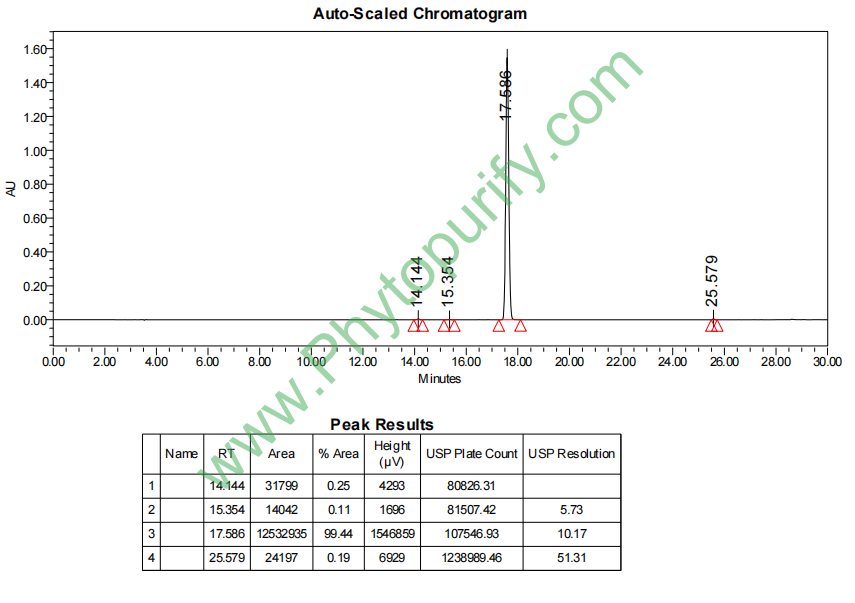
HPLC of Afzelin
Storage conditions:Short-term storage at 2~8℃, long-term storage at -20 ~ -80℃
Afzelin (CAS number: 482-39-3) is a natural flavonol glycoside with the chemical name Kaempferol-3-O-rhamnoside. As an important member of flavonoids, adzucchini has received widespread attention in the fields of pharmacology and natural product chemistry due to its diverse biological activities. In recent years, with the in-depth study of the pharmacological mechanisms of natural products, adzufen has shown significant potential in anti-inflammatory, anti oxidative stress, anti apoptotic, and cardioprotective effects, and has become an important candidate molecule for exploring new therapeutic strategies.
The purpose of this review is to systematically summarize the chemical structure and physicochemical properties, plant sources, and extraction methods of arbutin, with a focus on its pharmacological activity and mechanism of action. Combined with the latest molecular target research, it explores its pharmacological properties and pharmacokinetic characteristics, and finally looks forward to its clinical application potential and future research directions, providing comprehensive theoretical basis and practical guidance for researchers in related fields.
Afutoside belongs to the class of flavonol glycosides, and its basic skeleton is the flavonol quercetin (Kaempferol), which is connected to a rhamnose sugar group at the 3rd hydroxyl position, hence it is called Kaempferol-3-O-rhamnoside. Its molecular formula is C21H20O10 and its molecular weight is 432.3810. The molecular structure contains multiple hydroxyl groups, which endow it with good hydrophilicity and antioxidant activity.
In terms of physical and chemical properties, the LogP value of arbutin is about 0.8906, indicating its moderate lipid solubility, which is beneficial for in vivo distribution but not easily accumulated in the lipid environment. The polar surface area (TPSA) is 170.05 Å ², and a higher polar surface area suggests better water solubility (approximately 0.7505), but may limit its ability to penetrate cell membranes. The low permeability of the blood-brain barrier suggests limited distribution in the central nervous system. The negative result of hERG channel inhibition experiment indicates a low risk of cardiac toxicity. The Ames test result is 0.6, indicating a low risk of genotoxicity and meeting the preliminary requirements for drug safety.
Afutoside is widely present in various plants, especially in traditional Chinese medicine and edible plants. Typical sources include plants rich in quercetin, such as Afzelia spp., ginkgo leaves, maple leaves, and various herbaceous plants. Its content is greatly influenced by factors such as plant species, growth environment, harvesting time, and location.
The commonly used methods for extracting arbutin include solvent extraction, ultrasound assisted extraction, and high-performance liquid chromatography (HPLC) separation and purification. Generally, methanol or ethanol aqueous solution is used as the extraction solvent, combined with ultrasonic assisted technology to improve the extraction efficiency. The extraction solution undergoes concentration, liquid-liquid extraction, and silica gel column chromatography, and is finally purified and separated by HPLC. In recent years, green extraction technologies such as supercritical CO2 extraction and microwave-assisted extraction have also been gradually applied to the efficient extraction of adzuki bean glycosides, improving yield and purity and reducing environmental burden.
The pharmacological activities of Afutoside include anti-inflammatory, antioxidant, anti apoptosis, anti cardiotoxicity, and immune regulation, reflecting its potential as a multi-target natural product.
Multiple in vitro and in vivo experiments have shown that adzufen can significantly inhibit the release of inflammatory mediators, such as tumor necrosis factor - α (TNF - α), interleukin-6 (IL-6), and nitric oxide (NO). It reduces the expression of pro-inflammatory cytokines and alleviates tissue inflammation by regulating the nuclear factor kappa B (NF - κ B) signaling pathway. For example, in the asthma model induced by ovalbumin, afuroside significantly reduces airway inflammatory cell infiltration and mucus secretion, exhibiting good anti allergic and anti asthma activity.
Afutoside has strong free radical scavenging ability, which can inhibit reactive oxygen species (ROS) and lipid peroxidation, protecting cells from oxidative damage. It enhances the antioxidant defense ability of cells by activating the NFE2L2/NRF2 signaling pathway, inducing the expression of downstream antioxidant enzymes such as superoxide dismutase (SOD1, SOD2), catalase (CAT), glutathione peroxidase (GPX1), and heme oxygenase-1 (HMOX1).
Afutoside can alleviate mitochondrial damage, enhance mitochondrial biosynthesis, regulate mitochondrial related protein expression, reduce Parkin and PTEN induced putative kinase 1 levels, thereby inhibiting cell apoptosis signaling. This mechanism of action is particularly prominent in the protection of cardiac cells, and can prevent doxorubicin (HY-15142A) - induced cardiac toxicity. Animal experiments have shown that arbutin significantly increases the survival rate of mice treated with D-galactosamine (GalN)/lipopolysaccharide (LPS), and reduces liver and heart damage.
Afutoside has a protective effect on neural damage induced by scopolamine (HY-N0296), and may slow down neuronal damage and apoptosis through antioxidant and anti-inflammatory mechanisms, suggesting its potential application value in neurodegenerative diseases.
In the model of allergic diseases, Afudinoside exhibits good immune regulatory function by regulating the balance of Th1/Th2 cells, inhibiting IgE production, and alleviating allergic reactions.
The multiple pharmacological effects of Afudinoside are attributed to its regulation of multiple signaling pathways and molecular targets, mainly including:
The synergistic effect of these mechanisms enables adzufen to exert protective effects in various pathological states, demonstrating its advantages as a multi-target drug.
The pharmacological parameters of Afutoside indicate that it has certain potential for development. The molecular weight of 432.3810 conforms to the Lipinski rule range, and the LogP value of 0.8906 indicates moderate lipid solubility, which is beneficial for drug absorption and distribution. The high TPSA value and water solubility suggest that its oral bioavailability may be limited, and its blood-brain barrier permeability is low, which limits its application in the central nervous system.
The in vitro safety evaluation showed that Afudinoside does not inhibit hERG channels and reduces the risk of cardiac toxicity. A negative Ames test indicates a low risk of genotoxicity and meets drug safety requirements.
At present, the pharmacokinetic data of arbutin is relatively limited. Previous studies have shown that its oral absorption is slow and its bioavailability is limited, which may be related to its high polarity and glycosidic structure. The metabolic pathway mainly involves the liver enzyme system, where glycosidic bonds are hydrolyzed to release quercetin, which is further metabolized into various flavonoid metabolites. Further systematic pharmacokinetic and toxicological studies are needed in the future to clarify its in vivo behavior and safety.
Afutoside, with its multi-target and multifunctional pharmacological properties, has shown broad clinical application prospects in fields such as anti-inflammatory, antioxidant, cardioprotective, and immune regulation. Especially in the fields of cardiovascular disease, neurodegenerative diseases, allergic diseases, and liver injury, Afudinoside is expected to become a new choice for natural medicine or adjuvant therapy.
However, the current clinical research on arbutin is still in its infancy and lacks systematic clinical trial data. Future research should focus on:
In addition, as a representative of natural products, the structural basis of Afudinoside provides an important template for the development of new flavonoid drugs. In the future, it is expected to develop more clinically valuable derivatives through drug design and synthesis optimization.
Afutoside, as a natural flavonol glycoside with multiple pharmacological activities, exhibits a wide range of biological functions and good safety. Its mechanism of action in anti-inflammatory, antioxidant, cardiac protection, and immune regulation is gradually becoming clear, providing an important example for the pharmacological research of natural products. Although there are still challenges in terms of bioavailability and systematic research in clinical applications, with the advancement of modern drug development technology, adzucchini is expected to become an important candidate molecule for natural drug development, promoting innovative treatment strategies for related diseases.
In the future, interdisciplinary collaboration combining molecular pharmacology, pharmacokinetics, and clinical research will further promote the translational application of adzucchini and unleash its unique value in the field of natural product pharmacology.
