| Catalog No | Package | Original Price | Price | Inventory | Quantity | Operating |
|---|---|---|---|---|---|---|
| BP5038-5mg | 5mg | $420.00 | Sign in |
|


Storage conditions:Short-term storage at 2~8℃, long-term storage at -20 ~ -80℃
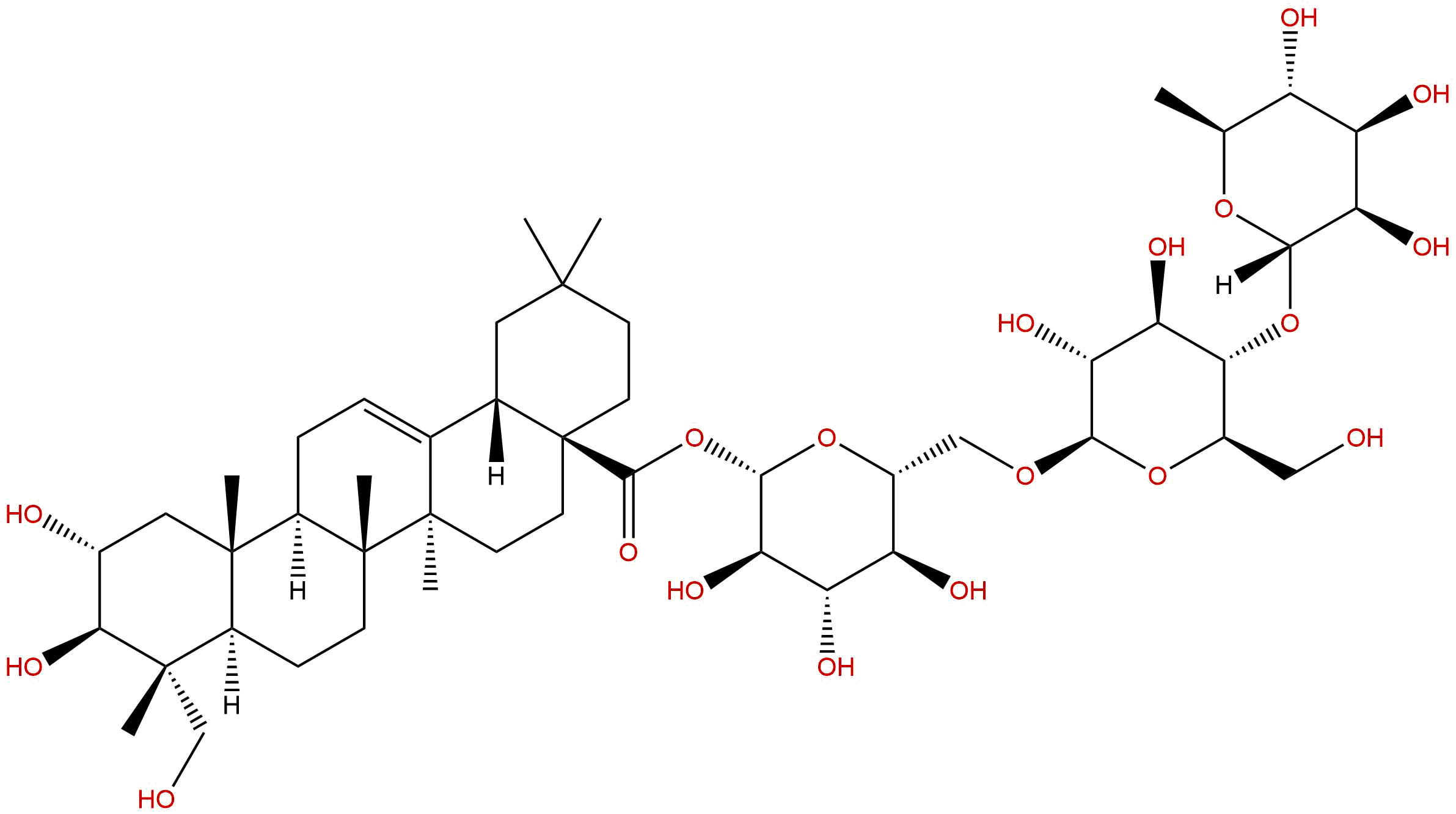
Scheffoleoside A, a traditional Chinese medicine plant, is composed of oxalic acid-28-O rhamnose (1-4), glucose (1-6), and glucoside (Scheffoleoside A)(Centella asiatica)The natural product obtained from the separation belongs to triterpenoid saponins. Snow grass, as a widely used medicinal plant in traditional Asian medicine, has attracted much attention due to its significant promotion of wound healing, anti-inflammatory, antioxidant, and neuroprotective effects. Scheffoleoside A, as one of the important active ingredients in centella asiatica, has shown potential pharmacological value in the fields of neuroprotection and skin repair in recent years. This article aims to systematically review the chemical structure and physicochemical properties, plant sources and extraction methods, pharmacological activity, mechanism of action, drug evaluation, and clinical application prospects of Scheffoleoside A, in order to provide theoretical basis and reference for subsequent related research and new drug development.
The chemical name of Scheffoleoside A is oxalic acid-28-O rhamnose (1-4) glucose (1-6) glucoside, with a molecular formula of C48H76O19 and a molecular weight of 959.1330. Its core structure is the triterpenoid skeleton of asiatic acid, with a 28 carboxyl group connected by glycosidic bonds to a trisaccharide chain consisting of xylose and two molecules of glucose. The connection mode of the three sugar chains is rhamnose (1 → 4) glucose (1 → 6) glucose, forming a complex glycosidic structure.
In terms of physical and chemical properties, Scheffoleoside A has a LogP value of approximately 1.92, indicating moderate hydrophobicity that facilitates membrane penetration but has limited water solubility. Its topological polar surface area (TPSA) is as high as 315.21 Å ², indicating strong molecular polarity, which may limit its ability to cross the blood-brain barrier. The water solubility is 0.1882, which belongs to low solubility compounds. The negative result of hERG channel inhibition experiment indicates a low risk of cardiac toxicity; The Ames mutagenicity test result is 0, indicating no significant genetic toxicity risk. Overall, Scheffoleoside A exhibits good safety and certain biological activity potential in terms of physicochemical properties, but its high polarity and molecular weight pose challenges to the bioavailability of the drug.
Scheffoleoside A mainly exists in snow grass(Centella asiatica)Leaves and stems. Snow grass is a perennial herbaceous plant in the Umbelliferae family, widely distributed in tropical and subtropical regions of Asia. Its medicinal history is long, traditionally used to treat skin wounds, scars, varicose veins, and neurological diseases.
The common methods for extracting Scheffoleoside A include solvent extraction, liquid-liquid partitioning, and column chromatography separation. Generally, ethanol or methanol is used as the initial extraction solvent to utilize its good solubility for triterpenoid saponins. After concentration, the extract is separated and purified using a silica gel column or a C18 reverse phase column with water ethanol gradient elution. High performance liquid chromatography (HPLC) and mass spectrometry (MS) techniques are used for purity detection and structural confirmation. In recent years, ultrasound assisted extraction and microwave-assisted extraction techniques have also been applied to improve the extraction efficiency and purity of Scheffoleoside A.
The research on Scheffoleoside A in the field of neuroprotection is gradually increasing. In vitro experiments have shown that the compound has moderate inhibitory activity against neuronal toxicity induced by 6-hydroxydopamine (6-OHDA). 6-OHDA is a commonly used toxin in Parkinson's disease models, which induces oxidative stress and mitochondrial dysfunction leading to the death of dopaminergic neurons. Scheffoleoside A demonstrates its potential neuroprotective effect by reducing cellular oxidative damage and inflammatory response, protecting neuronal survival.
In addition, Scheffoleoside A may enhance its neuroprotective effect by regulating intracellular signaling pathways, inhibiting the expression of apoptosis related proteins, promoting neuronal regeneration. Although there is currently limited research on this topic in vivo, its potential applications in neurodegenerative diseases deserve further exploration.
The role of centella asiatica and its main components in promoting skin repair has been widely confirmed. Scheffoleoside A, as a glycoside derivative of oxalic acid, is involved in regulating various molecular targets related to skin repair, including matrix metalloproteinases (MMP1, MMP2, MMP9), epidermal growth factor receptor (EGFR), fibroblast growth factor 2 (FGF2), transforming growth factor beta 1 (TGFB1), collagen (COL3A1, COL4A1), vascular endothelial growth factor A (VEGFA), and integrin beta 1 (ITGB1).
These targets play key roles in skin cell proliferation, migration, collagen synthesis, angiogenesis, and inflammation regulation. Scheffoleoside A promotes skin wound healing, inhibits excessive inflammatory reactions, and improves skin structural integrity by regulating the expression and activity of the aforementioned targets. Relevant cell experiments and animal model studies support its potential as a skin repair agent.
The pharmacological effects of Scheffoleoside A mainly depend on its interactions with multiple molecular targets, regulating the cellular signaling network.
Matrix metalloproteinases (MMPs) regulation
MMP1, MMP2, and MMP9 are key enzymes involved in extracellular matrix (ECM) degradation. Overactivation can lead to collagen degradation, affecting skin structure and function. Scheffoleoside A can regulate the expression of MMPs, inhibit their excessive activation, maintain the stability of ECM, and promote skin repair.
Growth factors and their receptors
EGFR and FGF2 play important roles in cell proliferation and migration. Scheffoleoside A promotes fibroblast proliferation and collagen synthesis by activating the EGFR signaling pathway. The regulation of FGF2 contributes to angiogenesis and tissue regeneration.
Transforming Growth Factor Beta 1 (TGFB1)
TGFB1 is a multifunctional factor that regulates cell proliferation, differentiation, and ECM synthesis. The effect of Scheffoleoside A on TGFB1 helps to control inflammatory responses and promote fibrotic reactions during wound healing.
Collagen and integrin
COL3A1 and COL4A1 are the main types of skin collagen, while ITGB1 serves as a bridge between the extracellular matrix and cells, participating in cell adhesion and signal transduction. Scheffoleoside A enhances the integrity and functional recovery of skin structure by promoting the expression of these proteins.
Antioxidant and anti-inflammatory mechanisms
In terms of neuroprotection, Scheffoleoside A inhibits oxidative stress-related pathways, reduces reactive oxygen species (ROS) production, lowers cell apoptosis, and protects neurons from toxin damage. In addition, its anti-inflammatory effect reduces neuroinflammatory response by inhibiting the expression of pro-inflammatory factors.
The high molecular weight (959.1330 Da) and high TPSA value (315.21 Å ²) of Scheffoleoside A indicate its strong polarity, which may limit its oral absorption and blood-brain barrier penetration ability. The LogP value is 1.92, indicating moderate lipid solubility that facilitates membrane penetration, but overall bioavailability may be limited.
The permeability assessment of the blood-brain barrier shows that its permeability is low, suggesting that its direct action in the central nervous system may be limited, and drug delivery needs to be improved through structural modifications or carrier systems. The hERG channel inhibition experiment was negative, reducing the risk of cardiac toxicity. The Ames test result is 0, indicating no mutagenicity and high safety.
At present, there is a lack of pharmacokinetic data on Scheffoleoside A. Given its high polarity and large molecular weight, it is speculated that its metabolism in vivo is mainly through glycoside hydrolysis and triterpenoid skeleton metabolism by the liver enzyme system, and its excretion pathways may be mainly through bile and urine. In the future, in vivo pharmacokinetic studies are needed to clarify its absorption, distribution, metabolism, and excretion (ADME) characteristics, providing a basis for clinical applications.
Scheffoleoside A, as an important active ingredient in centella asiatica, has demonstrated broad clinical application potential due to its dual pharmacological activities of neuroprotection and skin repair.
In the field of neuroprotection, Scheffoleoside A is expected to become an adjuvant therapy for neurodegenerative diseases such as Parkinson's disease and Alzheimer's disease. Its antioxidant, anti-inflammatory, and anti apoptotic effects can slow down the process of neuronal damage and improve patients' neurological function. However, low blood-brain barrier permeability limits its central role, and in the future, drug delivery system optimization or structural modification is needed to increase its brain concentration.
In the field of skin repair, Scheffoleoside A can be used as an external formulation ingredient to promote wound healing, reduce scar formation, and improve skin aging. Its ability to regulate various skin repair related targets provides a theoretical basis for the development of new wound treatment drugs. Combining modern formulation technologies such as nanocarriers and transdermal drug delivery systems is expected to enhance their local bioavailability and therapeutic efficacy.
In addition, Scheffoleoside A has good safety, and both hERG and Ames tests showed no significant toxicity, which is beneficial for its clinical translation. In the future, it is necessary to strengthen in vivo efficacy evaluation, toxicology research, and clinical trial design, clarify the effective dose and safe dose range, and promote its transition from laboratory to clinical application.
Scheffoleoside A, an important triterpenoid saponin in centella asiatica, has significant neuroprotective and skin repairing activities. Its complex glycoside structure endows it with unique physicochemical properties and biological functions. By regulating multiple key molecular targets, Scheffoleoside A plays a role in promoting cell proliferation, inhibiting inflammatory response, and antioxidant activity, demonstrating excellent pharmacological potential.
Although its high molecular weight and polarity limit oral absorption and blood-brain barrier penetration, it has good safety and provides favorable conditions for further drug development. In the future, it is necessary to combine modern drug delivery technology and structural optimization strategies to overcome the bottleneck of drug development and promote its clinical application in neurodegenerative diseases and skin repair.
In summary, Scheffoleoside A, as a natural product drug candidate molecule, has broad research and application prospects, and is worthy of in-depth and systematic research in pharmacological mechanisms, pharmacokinetics, and clinical translation.
