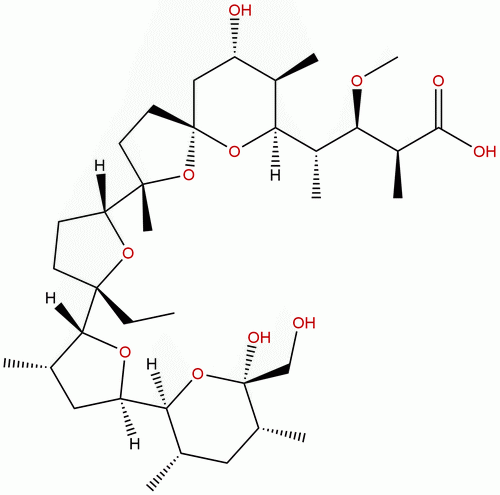


Product name: Monensin sodium
Synonym name: Monensin(17090-79-8); Monensin A;
Catalogue No.: BP2018
Cas No.: 22373-78-0
Formula: C36H62O11
Mol Weight: 670.881
Botanical Source:
Physical Description: White Powder
Type of Compound: Antibiotics
Purity: 99%
Analysis Method: HPLC-DAD or/and HPLC-ELSD
Identification Method: Mass, NMR
Packing: Brown vial or HDPE plastic bottle
The product could be supplied from milligrams to grams. Inquire for bulk scale.
For Reference Standard and R&D, Not for Human Use Directly.
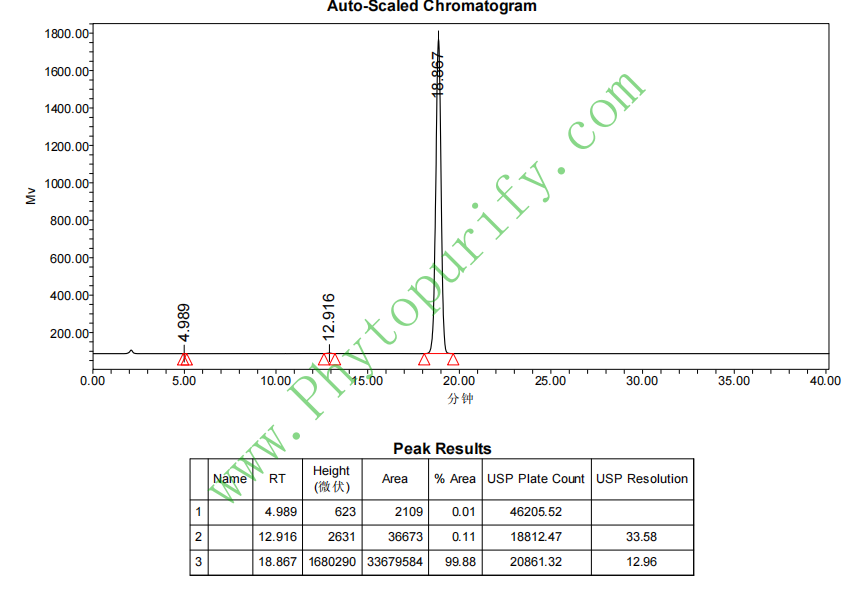
HPLC of Monensin sodium
Storage conditions:Short-term storage at 2~8℃, long-term storage at -20 ~ -80℃
153.3700
3.4938
1.2871
.0776
1.5181
.9410
Low
87.7989
6.4358
No
No
Yes
No
No
No
0.0
Yes
No
Yes
No
Natural products, as an important source of drug discovery, play an irreplaceable role in the long-term struggle between humans and diseases. Among numerous natural products with biological activity, Monensin sodium has aroused sustained and in-depth research interest in the field of pharmacology due to its unique ion carrier properties and extensive pharmacological activities. Monensin sodium was first extracted from Streptomyces in 1967(Streptomyces cinnamonensis)It was isolated from the fermentation product and belongs to the polyether ion carrier antibiotic family. As an orally active antibiotic, monensin sodium was first widely used in the veterinary field, especially as an anti coccidioid drug in poultry farming. However, as research continues to deepen, scientists have gradually discovered that the pharmacological activity of Monensin Sodium goes far beyond its antibacterial and antiparasitic effects. In recent years, the potential application value of monensin sodium in anti-tumor, regulating cell signaling pathways, and affecting exosome secretion has been increasingly recognized, making it a hot molecule in the field of natural product pharmacology research. This article will provide a systematic review of the research progress of Monensin Sodium from multiple dimensions, including chemical structure, physicochemical properties, pharmacological activity, mechanism of action, drug evaluation, and clinical application prospects, in order to provide reference for the in-depth research and development of this compound.
The chemical name of Monensin Sodium is Monensin Sodium A, with a molecular formula of C36H61NaO11 and a molecular weight of 670.88 g/mol. Structurally, Monensin Sodium belongs to the class of polyether ionophore antibiotics, with its core structure consisting of a linear polyether chain containing multiple tetrahydrofuran and tetrahydropyran rings, and a carboxylic acid group at the end. This unique structure enables it to form a circular conformation similar to a "donut", in which the lipophilic outer skeleton allows it to embed into the lipid bilayer of the biofilm, while the polar cavity inside can selectively bind cations. The sodium form of monensin sodium gives it good stability under physiological conditions, and its CAS number is 22373-78-0.
The physicochemical properties of Monensin Sodium provide important basic information for its pharmacological applications. Its lipid water partition coefficient (LogP) is 3.4938, indicating that the compound has moderate lipophilicity, which is consistent with its ability to embed into the lipid bilayer of the cell membrane. The topological polar surface area (TPSA) is 153.37 Å ², which is relatively high and reflects the presence of multiple polar oxygen atoms in the molecule. The water solubility of Monensin Sodium is relatively low, only 0.0776 mg/mL, which to some extent limits its administration method. It usually requires the use of appropriate solvents or formulation techniques to improve its bioavailability. It is worth noting that the blood-brain barrier penetration ability of Monensin Sodium is relatively low, which may reduce central nervous system side effects when administered systemically, but also limits its application in the treatment of brain diseases. In addition, the hERG inhibition test result was negative and the Ames test result was 0.0, indicating that the risk of genetic toxicity and cardiac toxicity of Monensin Sodium is low, which provides a favorable safety basis for its further drug development.
Monensin sodium is not derived from plants, but is produced through secondary metabolism by Streptomyces microorganisms in actinomycetes. Specifically, the strain that produces sodium monensin is Streptomyces cinnamomi(Streptomyces cinnamonensis). This discovery originated from the systematic screening of soil microbial metabolites by Eli Lilly and Company researchers in the 1960s. Streptomyces, as an important source of natural products, contains abundant biosynthetic gene clusters in its genome, which can produce secondary metabolites with diverse structures and broad activities. The biosynthetic pathway of monensin sodium involves a complex reaction process catalyzed by polyketide synthase (PKS), including the extension, cyclization, oxidative modification, and final sodium ion coordination of polyketide chains.
The industrial production of Monensin Sodium mainly adopts microbial fermentation method. The fermentation process is usually carried out in a medium containing carbon sources (such as glucose, starch), nitrogen sources (such as soybean flour, corn syrup), and inorganic salts. The yield of the target product is increased by optimizing the fermentation conditions (temperature, pH, dissolved oxygen, fermentation period, etc.). After fermentation, the extraction of sodium monensin usually includes the following key steps: first, the mycelium in the fermentation broth is separated by centrifugation or filtration; Secondly, extract the target product from the fermentation broth using organic solvents such as ethyl acetate, methanol, etc; Then, the crude extract was obtained by removing the solvent through vacuum distillation; Finally, purification methods such as column chromatography and recrystallization were used to obtain high-purity Monensin Sodium product. The development of modern separation technologies, such as high-speed countercurrent chromatography and preparative high-performance liquid chromatography, has provided more options for the efficient purification of monensin sodium.
The earliest and most classic application of Monensin Sodium was as an anti coccidioid drug. Coccidiosis is caused by the genus Aemilia(Eimeria)A parasitic protozoan disease caused by coccidiosis parasitizing on the intestinal epithelial cells of animals, causing significant economic losses to the poultry industry. Monensin sodium interferes with the ion balance in the body of nematodes, especially affecting Na+/H+exchange, leading to the disruption of pH homeostasis in the cells of nematodes, thereby inhibiting their growth and reproduction. Research has shown that monensin sodium has an effect on various types of Eimeria (such as...)Eimeria tenella、Eimeria acervulina、Eimeria maxima All of them have good killing effects. In veterinary clinical practice, monensin sodium is usually used in the form of a feed additive to control the occurrence of coccidiosis through prophylactic administration. Its target involves key organelles such as mitochondrial function (MITO), ATP synthase (ATP6), and acrosome (APIC) of coccidiosis, exerting anti coccidiosis effects through the synergistic action of multiple targets.
As an ion carrier antibiotic, Monensin Sodium exhibits significant antibacterial activity against various Gram positive bacteria. Its antibacterial mechanism is mainly based on the destruction of the ion gradient of bacterial cell membrane, resulting in an imbalance of intracellular ion concentration, which in turn affects the normal metabolic activity of bacteria. Research has shown that Monensin Sodium exhibits inhibitory effects on pathogenic bacteria such as Staphylococcus aureus, Streptococcus, and Clostridium. However, the activity of Monensin Sodium against Gram negative bacteria is relatively weak, mainly due to the presence of the outer membrane of Gram negative bacteria limiting drug penetration. In terms of antifungal activity, Monensin Sodium has shown efficacy against certain pathogenic fungi such as Candida(Candida)It also exhibits certain inhibitory activity, but its antifungal spectrum is relatively narrow. It is worth noting that the antibacterial activity of Monensin Sodium is closely related to its ion carrier properties. By changing the permeability of the cell membrane to monovalent cations and interfering with the transmembrane ion gradient, it affects the energy metabolism and substance transport processes of bacteria.
In addition to its anti coccidiosis effect, Monensin Sodium also exhibits certain activity against other parasites. Research shows that monensin sodium has an effect on malaria parasites(Plasmodium)It has inhibitory effects and can interfere with the development of malaria parasites in red blood cells. Its anti malaria mechanism may be related to interference with the ion homeostasis and energy metabolism of malaria parasites. In addition, Monensin Sodium has also shown certain killing effects on certain nematodes and flukes. These findings expand the potential application of Monensin Sodium in the field of antiparasitic treatment, especially in the context of increasingly severe drug resistance. Developing antiparasitic drugs with new mechanisms of action has important clinical significance.
In recent years, the anti-tumor activity of Monensin Sodium has become a research hotspot. Several in vitro and in vivo studies have confirmed that monensin sodium has significant cytotoxic effects on a variety of tumor cell lines, including breast cancer, prostate cancer, lung cancer, colon cancer, liver cancer, melanoma, etc. Its anti-tumor mechanism involves multiple aspects: firstly, Monensin Sodium can inhibit the Wnt signaling pathway, which plays a key role in the occurrence and development of various tumors; Secondly, Monensin Sodium interferes with intracellular ion balance, particularly Na+/H+exchange, leading to intracellular acidification and inducing tumor cell apoptosis; In addition, Monensin Sodium can also affect autophagy, inhibit tumor cell migration and invasion, and reverse multidrug resistance. It is worth noting that Monensin Sodium also exhibits a certain selective killing effect on tumor stem cells, which provides new ideas for its application in tumor therapy. Research has found that sodium monensin can significantly increase the size of multivesicular vesicles (MVBs) and regulate the secretion of extracellular vesicles. This discovery reveals its potential role in regulating intercellular communication and provides a new perspective for the study of tumor microenvironment.
The core mechanism of action of Monensin Sodium is its function as an ion carrier. Monensin sodium can selectively bind monovalent cations, especially Na+, and mediate their transmembrane transport. Specifically, the sodium Monensin molecule forms a circular conformation in the biofilm, with polar cavities inside forming coordination bonds with Na+through oxygen atoms, and an external hydrophobic skeleton allowing it to freely diffuse within the lipid bilayer. Through this "shuttle" mechanism, Monensin Sodium can transport Na+from one side of the membrane to the other, thereby disrupting the ion gradient on both sides of the cell membrane. More importantly, the Na+/H+exchange mechanism mediated by monensin sodium involves transporting one Na+into the cell and simultaneously expelling one H+from the cell. This electrically neutral exchange process directly affects the pH homeostasis within the cell. The disruption of ion gradients affects various physiological processes that rely on ion gradients, including nutrient transport, energy metabolism, signal transduction, etc.
The Wnt signaling pathway plays a crucial role in embryonic development, tissue regeneration, and tumorigenesis. Monensin sodium has been proven to be an effective Wnt signaling inhibitor. Research has shown that Monensin Sodium can inhibit the activity of the Wnt/β - catenin signaling pathway, and its mechanism of action may be related to interference with the intracellular ion environment. Specifically, Monensin Sodium affects the phosphorylation status and degradation process of β - catenin by altering the intracellular Na+and H+concentrations, thereby inhibiting the transcription of Wnt target genes. In addition, Monensin Sodium may also regulate signal transduction by affecting the endocytosis and circulation processes of Wnt receptors. Given the abnormal activation of the Wnt signaling pathway in various tumors, Monensin Sodium has potential application value as a Wnt inhibitor in tumor therapy.
One notable effect of Monensin Sodium is its ability to significantly increase multivesicular vesicles (MVBs) and regulate exosome secretion. Extracellular vesicles are nanoscale vesicles secreted by cells, playing an important role in intercellular communication and participating in various pathological processes such as tumor metastasis, immune regulation, and neurodegenerative diseases. Research has found that after treatment with sodium mononucleoside, the volume of intracellular MVB significantly increases, while the secretion and composition of extracellular vesicles change. The mechanism of this phenomenon may be related to the effect of sodium monensin on intracellular ion balance. Changes in the ionic environment may affect the formation, maturation, and secretion processes of MVB, particularly affecting the function of the endoplasmic reticulum sorting transport complex (ESCRT). In addition, Monensin Sodium may also regulate exosome secretion by affecting cytoskeleton rearrangement and membrane dynamics. This discovery provides a new tool for studying exosome biology and offers new ideas for developing therapeutic strategies targeting exosomes.
The effect of sodium monensin on mitochondrial function is also an important aspect of its mechanism of action. As an ion carrier, Monensin Sodium can disrupt mitochondrial membrane potential and affect mitochondrial ion homeostasis. Mitochondria are the center of cellular energy metabolism, and the proton gradient on both sides of their inner membrane is the driving force for ATP synthesis. Monensin sodium inhibits ATP synthesis by interfering with the ion permeability of mitochondrial membranes, leading to a decrease in proton gradient. For rapidly proliferating tumor cells, their high dependence on energy metabolism makes them particularly sensitive to interference with mitochondrial function. In addition, Monensin Sodium may induce cell apoptosis by affecting mitochondrial calcium ion homeostasis and the production of reactive oxygen species (ROS).
The pharmacological parameters of Monensin Sodium provide important references for its drug development. As mentioned earlier, its molecular weight is 670.88 Da, slightly higher than the upper limit of the "five rules" for traditional small molecule drugs (500 Da), but considering the specificity of natural products, this molecular weight is still within an acceptable range. The LogP value is 3.4938, indicating that it has moderate lipophilicity and is conducive to transmembrane transport. The TPSA value is 153.37 Å ², which is relatively high and suggests that its oral absorption may be limited to some extent. The low water solubility (0.0776 mg/mL) is a challenge for its drug development and needs to be improved through formulation technology. The low penetration ability of the blood-brain barrier limits its application in brain diseases, but reduces the risk of central nervous system toxicity. A negative hERG inhibition test indicates a low risk of cardiac toxicity, while a negative Ames test suggests a low risk of genetic toxicity. Overall, Monensin Sodium has a good safety foundation, but its physicochemical properties suggest that optimization is needed in terms of formulation and administration routes.
The pharmacokinetic characteristics of Monensin Sodium are closely related to its physicochemical properties. After oral administration, the absorption of Monensin Sodium in the gastrointestinal tract is relatively limited, and its bioavailability is low, which is related to its poor water solubility and high molecular weight. In veterinary clinical practice, monensin sodium is usually administered in the form of a feed additive for a long time, achieving preventive and therapeutic effects through continuous low-dose exposure. After absorption, Monensin Sodium is widely distributed in the body, but due to its lipophilicity, it tends to accumulate in adipose tissue and lipid rich organs. The metabolism of Monensin Sodium mainly occurs in the liver, undergoing oxidative metabolism through the cytochrome P450 enzyme system. Metabolites are mainly excreted into the intestine through bile and partially excreted from the body through feces. Its half-life is relatively long, which is related to its accumulation in tissues. It is worth noting that there are species differences in the pharmacokinetic characteristics of Monensin Sodium in animals, which need to be considered in clinical applications.
The safety evaluation of Monensin Sodium is an important basis for its clinical application. In veterinary clinical practice, the therapeutic index of monensin sodium is relatively narrow, and excessive use may lead to poisoning. Acute toxicity is mainly manifested as neurotoxic symptoms, including ataxia, muscle weakness, difficulty breathing, etc., which can lead to death in severe cases. Chronic toxicity studies have shown that long-term high-dose exposure may lead to myocardial damage, abnormal liver and kidney function, and so on. However, at the recommended dosage, the safety of Monensin Sodium is good. It is worth noting that Monensin Sodium has higher toxicity to certain animal species (such as horses), which may be related to inter species pharmacokinetic differences. In humans, the toxicity data of Monensin Sodium is relatively limited, but based on its mechanism of action and animal experimental data, the potential risks of its clinical application need to be carefully evaluated.
The application of Monensin Sodium in the veterinary field has a history of several decades, especially in the field of poultry anti coccidiosis, and its effectiveness has been widely recognized. However, with the development of drug resistance and the increasing public attention to food safety, the application of Monensin Sodium in veterinary clinical practice is facing new challenges. On the one hand, it is necessary to develop new dosing regimens and combination therapy strategies to delay the development of drug resistance; On the other hand, it is necessary to strengthen residue monitoring and discontinuation period management to ensure the safety of animal derived foods. In addition, the application of monensin sodium in ruminant animal production, such as as as a growth promoter, also deserves further research.
The anti-tumor activity of Monensin Sodium provides a new direction for its application in human medicine. Given its unique ion carrier mechanism and Wnt signaling pathway inhibitory activity, Monensin Sodium may become a new candidate drug for tumor therapy. Especially for tumor types with abnormal activation of Wnt signaling pathway, such as colorectal cancer, liver cancer, breast cancer, etc., monensin sodium may have a better therapeutic effect. In addition, the selective killing effect of Monensin Sodium on tumor stem cells gives it potential advantages in preventing tumor recurrence and metastasis. However, the transition from veterinary drugs to human anti-tumor drugs requires overcoming many obstacles, including formulation optimization, toxicity assessment, clinical trial design, and so on. The development of new drug delivery systems such as nano formulations and liposome encapsulation may help improve the anti-tumor efficacy of Monensin Sodium and reduce its side effects.
The unique role of Monensin Sodium in regulating exosome secretion makes it an important tool for exosome biology research. By regulating the size of MVB and the secretion of extracellular vesicles, Monensin Sodium can be used to study the functions of extracellular vesicles in intercellular communication, tumor microenvironment regulation, immune regulation, and other aspects. In addition, Monensin Sodium may also be used to develop therapeutic strategies targeting extracellular vesicles, such as blocking tumor metastasis by inhibiting the secretion of tumor derived extracellular vesicles. This research direction is still in its early stages, but it has important scientific significance and application prospects.
Given the multi-target mechanism of action of Monensin Sodium, combination therapy strategies may become an important way to improve its therapeutic efficacy. For example, the combination of Monensin Sodium and conventional chemotherapy drugs may enhance anti-tumor effects through synergistic effects; The combined use of immune checkpoint inhibitors may improve the tumor immune microenvironment by regulating exosome secretion; The combined use with other ion carriers or ion channel modulators may enhance anti-tumor activity by synergistically interfering with ion homeostasis. These combination therapy strategies require further preclinical and clinical studies to validate their effectiveness and safety.
The chemical structure of Monensin Sodium provides multiple possibilities for its structural modification. By chemically modifying its polyether skeleton, terminal carboxylic acid groups, and sugar side chains, it is possible to obtain derivatives with better pharmacological activity and pharmacokinetic characteristics. For example, by introducing new functional groups to improve water solubility, enhance selectivity, and reduce toxicity. In addition, based on the ion carrier mechanism of monensin sodium, the development of analogs with different ion selectivity may expand their applications in other disease fields. The study of the structure-activity relationship will provide important guidance for the rational design of Monensin Sodium derivatives.
As a polyether ionophore antibiotic discovered from Streptomyces, the research process of Monensin Sodium fully reflects the typical path of natural products from discovery to application to new functional exploration. From its initial widespread application as an anti coccidioid drug in the veterinary field to breakthrough discoveries in cutting-edge fields such as anti-tumor and exosome regulation in recent years, pharmacological research on monensin sodium continues to expand people's understanding of this ancient natural product. Its unique ion carrier mechanism, multi-target action characteristics, and good safety foundation have demonstrated potential application value in the treatment of multiple diseases. However, from laboratory research to clinical application, Monensin Sodium still faces many challenges, including optimization of physicochemical properties, improvement of administration routes, and control of toxic side effects. In the future, with in-depth research on structural modification, formulation technology, and combination therapy strategies, Monensin Sodium and its derivatives are expected to play a greater role in the treatment of human diseases. At the same time, the study of Monensin Sodium also provides useful references for pharmacological research of other natural products, demonstrating a scientific paradigm of discovering new functions from traditional uses and excavating new value from known compounds.
