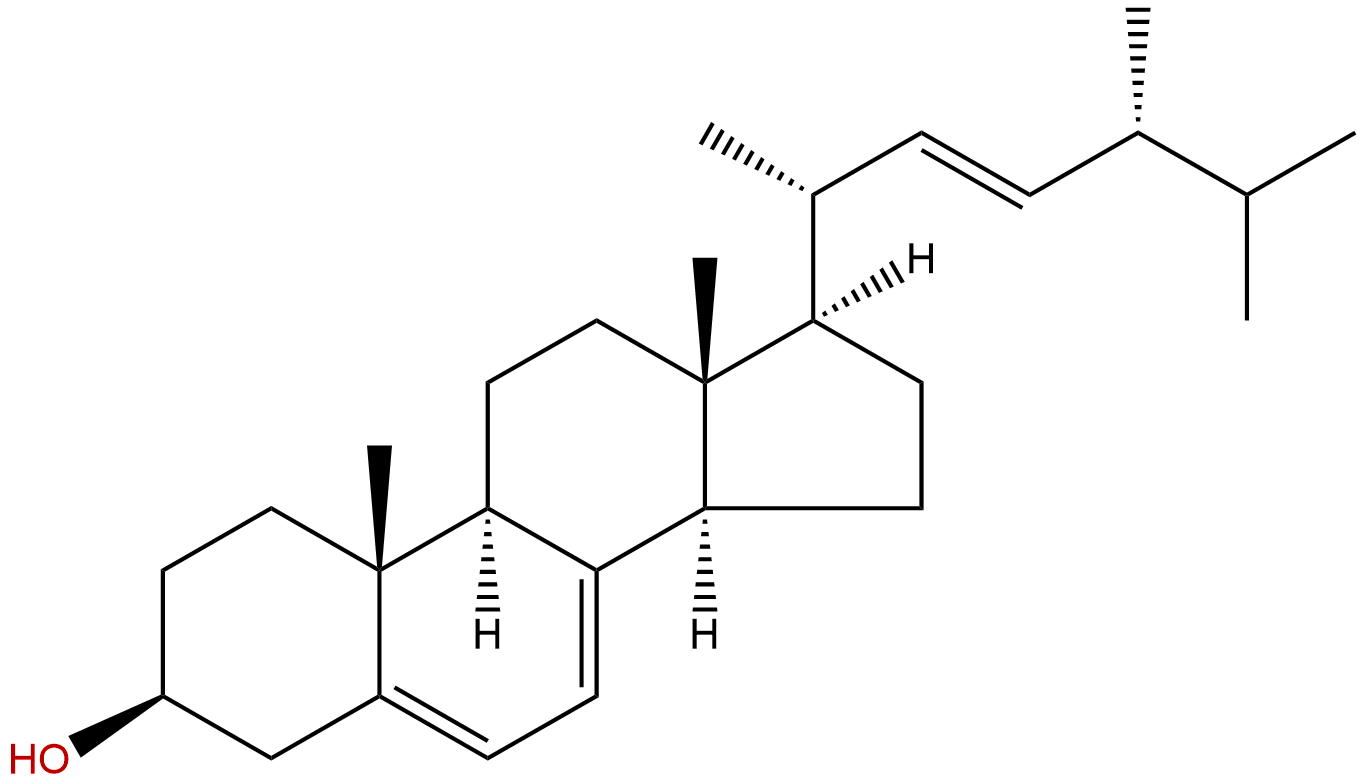


Product name: Ergosterol
Synonym name: Ergosterin; Provitamin D2; Ertron
Catalogue No.: BP0549
Cas No.: 57-87-4
Formula: C28H44O
Mol Weight: 396.659
Botanical Source: Ganoderma
Physical Description:
Type of Compound: Steroids
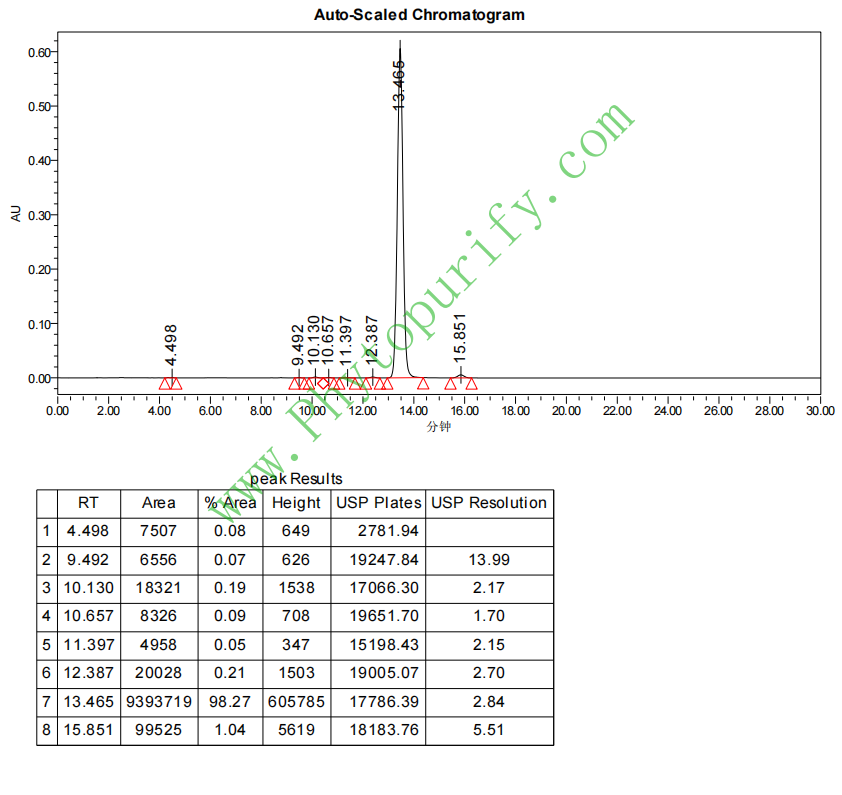
Purity: 95%~99%
Analysis Method: HPLC-DAD or/and HPLC-ELSD
Identification Method: Mass, NMR
Packing: Brown vial or HDPE plastic bottle
Storage: Store in a well closed container, protected from air and light. Put into refrigerate or freeze for long term storage.
Whenever possible, you should prepare and use solutions on the same day. However, if you need to make up stock solutions in advance, we recommend that you store the solution as aliquots in tightly sealed vials at -20℃. Generally, these will be useable for up to two weeks.
The product could be supplied from milligrams to grams
Inquire for bulk scale.
Chengdu Biopurify Phytochemicals Ltd. is a leading company in the research, development, manufacture and marketing of High Quality Phytochemicals and Extracts(especially Active Ingredients from Traditional Chinese Medicine,TCM), Natural Active Pharmaceutical Ingredients worldwide.
The main services:
A. Supply active ingredients and reference standards of TCM, from mgs to kgs scale
B. Custom extraction and purification, target Herb Active Ingredients
C. Custom synthesis and semi-synthesis for Natural Active Ingredients
D. CR(contract research), CM(contract manufacture) and PD(process development) services from lab scale, pilot scale to commercial scale(GMP is also available)
E. TCM compounds library for drug screen,more than 3000 compounds available, many of them are rare and unique.
HPLC of Ergosterol
Storage conditions:Short-term storage at 2~8℃, long-term storage at -20 ~ -80℃
20.2300
8.0277
8.0277
.0001
8.2261
4.1131
High
92.0508
4.6313
No
No
No
No
No
No
0.0
No
No
Yes
Yes
Ergosterol, as the main sterol component in fungal cell membranes, has long been widely studied in the field of natural product pharmacology. It is not only a metabolite of brewing yeast and various fungi, but also an important member of the plant sterol family. Ergosterol has unique structural characteristics and diverse biological activities, especially showing significant effects in antioxidant, anti proliferative, and anti-inflammatory aspects. In addition, the research on ergosterol in the field of antifungal infections is becoming increasingly in-depth, and it has become an important candidate molecule for exploring new antifungal drugs. This article aims to systematically review the chemical structure, sources, pharmacological activities, mechanisms of action, and pharmacological evaluation of ergosterol, explore its clinical application prospects and development trends, and provide theoretical basis for subsequent research and drug development.
Ergosterol (CAS number: 57-87-4) is a 3 β - hydroxy-Delta (5) - steroid, belonging to the family of plant sterols and ergosterol. Its molecular formula is C28H44O and its molecular weight is 396.6590. Structurally, ergosterol contains multiple unsaturated double bonds located at positions 5, 6-, 7, 8-, and 22, 23, endowing it with unique chemical activity. The hydroxyl group at the 3 β position is an important functional group for its biological activity, involved in binding to biological targets and signal transduction.
In terms of physicochemical properties, the LogP value of ergosterol is as high as 8.0277, indicating its high hydrophobicity and extremely low water solubility (about 0.0001), which has a significant impact on its bioavailability and in vivo distribution. Its topological polar surface area (TPSA) is 20.23 Å ², indicating low molecular polarity and favorable penetration of lipid membrane structures. The high permeability of the blood-brain barrier suggests that ergosterol may affect central nervous system function. The hERG channel inhibition test was negative, and the Ames mutagenicity test result was 0.0, indicating good safety and low toxicological risk.
Ergosterol mainly exists in fungal cell membranes and is a key metabolite of yeast, mold, and various fungi. It is also distributed in the plant kingdom, especially as a secondary metabolite in certain plants rich in sterols. In industry, ergosterol is usually extracted from brewing yeast (Saccharomyces cerevisiae) or other fungal strains through fermentation.
The extraction process often uses organic solvent extraction combined with chromatographic purification technology. Common solvents include ethanol, methanol, ethyl acetate, and hexane. The extraction process generally includes bacterial collection, drying and crushing, solvent extraction, concentration, and silica gel column chromatography separation. In recent years, supercritical CO2 extraction technology has gradually been applied to the extraction of ergosterol due to its green environmental protection and high selectivity, improving purity and yield. In addition, the combination of enzymatic assisted extraction and membrane separation technology has provided new ideas for industrial production.
The pharmacological activities of ergosterol are rich and diverse, covering multiple aspects such as antioxidant, anti proliferative, anti-inflammatory, and antifungal.
antioxidant activity
Ergosterol can effectively eliminate free radicals and alleviate oxidative stress damage to cells. Its 3 β - hydroxy and unsaturated double bond structure provides it with electron donor ability, participating in the capture and neutralization of free radicals. In vitro cell models have shown that ergosterol can inhibit lipid peroxidation, protect cell membrane integrity, and delay the process of cell aging.
Anti proliferative effect
Multiple in vitro experiments have shown that ergosterol has inhibitory effects on the proliferation of various tumor cell lines. Its mechanism involves cell cycle arrest, induction of cell apoptosis, and regulation of signaling pathways. Especially in breast cancer, colon cancer and other solid tumor models, ergosterol shows potential anti-tumor activity, providing a new target for the development of natural anti-cancer drugs.
anti-inflammatory effect
Ergosterol can significantly inhibit the release of inflammatory mediators such as tumor necrosis factor alpha (TNF - α), interleukin-6 (IL-6), and nitric oxide (NO). It reduces inflammation and protects tissues from chronic inflammatory damage by regulating the nuclear factor kappa B (NF - κ B) signaling pathway. Animal model studies have confirmed that ergosterol has a relieving effect on inflammatory diseases.
Antifungal activity
As a key component of fungal cell membranes, ergosterol's metabolism and synthesis pathways are important targets for antifungal drugs. Research has shown that ergosterol can regulate the fluidity and integrity of fungal cell membranes, affecting fungal growth and reproduction. It has inhibitory effects on various fungal infections, especially showing potential therapeutic value in drug-resistant fungal strains.
The biological functions and pharmacological activities of ergosterol are mainly achieved through interactions with various molecular targets, especially in the field of antifungal therapy, where its mechanism of action is relatively clear.
ERG11(CYP51)
ERG11 encodes fungal cytochrome P450 14 α - demethylase, which is a key enzyme in ergosterol biosynthesis. Ergosterol, as a substrate or regulatory factor, participates in regulating the activity of ERG11, affecting the synthesis of ergosterol and the stability of fungal cell membranes. Inhibition of ERG11 activity can lead to disruption of fungal cell membrane structure and exert antifungal effects.
CYP51A1
CYP51A1 is a homologous enzyme of steroid 14 α - demethylase in fungi and plants, involved in the sterol synthesis pathway. Ergosterol affects sterol metabolism by regulating CYP51A1 activity, thereby regulating cell membrane function and fungal growth.
CDR1 and MDR1
CDR1 and MDR1 are multidrug resistance proteins in fungi, belonging to the ATP binding cassette transporter family, involved in drug efflux and resistance formation. Ergosterol can affect the expression or function of these transporters, increase intracellular concentrations of antifungal drugs, and overcome resistance phenomena.
FKS1
FKS1 encodes β -1,3-glucan synthase, which is a key enzyme in fungal cell wall synthesis. Ergosterol indirectly regulates FKS1 activity, affects cell wall integrity, and enhances antifungal efficacy.
MLS1
MLS1 participates in the metabolic regulation of fungi, affecting energy metabolism and stress response. The regulation of MLS1 by ergosterol helps to inhibit fungal growth and virulence expression.
In summary, ergosterol exhibits broad-spectrum antifungal activity by synergistically regulating fungal cell membrane synthesis, cell wall structure, and drug tolerance mechanisms through multiple targets and pathways. In addition, its antioxidant and anti-inflammatory effects also involve regulating signaling pathways such as NF - κ B and MAPK, exerting cellular protective effects.
The pharmacological evaluation of ergosterol shows that it has certain advantages and challenges.
Physical and chemical properties and pharmacokinetics
The high hydrophobicity of ergosterol (LogP=8.0277) results in extremely low water solubility, limiting oral absorption and bioavailability. Low TPSA (20.23 Å ²) is beneficial for cell membrane penetration, and its high blood-brain barrier permeability suggests that it may have an impact on the central nervous system. The metabolism in the body is mainly carried out through the liver cytochrome P450 enzyme system, and the metabolites and clearance pathways still need further research.
safety evaluation
The hERG channel inhibition test was negative, indicating that ergosterol has a lower risk of prolonging the QT interval in the heart. The Ames mutagenicity test result was 0.0, indicating no significant mutagenicity and good safety. Long term toxicology and clinical safety data are still lacking, and further systematic evaluation is needed.
Drug interactions and formulation development
Ergosterol may interact with other drugs through metabolic enzyme competition. Its low water solubility poses a challenge to formulation development, and the application of new drug delivery systems such as nanocarriers, liposomes, and solid dispersions is expected to improve its solubility and bioavailability.
As a natural sterol compound, ergosterol has broad prospects in clinical applications due to its multiple pharmacological activities, especially antifungal, anti-inflammatory, and antioxidant effects.
Development of antifungal drugs
The current treatment of fungal infections faces dual challenges of drug resistance and side effects. Ergosterol provides an ideal target for the development of new antifungal drugs by regulating fungal sterol synthesis and multidrug resistance proteins. In the future, its antifungal activity and pharmacokinetic performance can be enhanced through structural modification and drug combination strategies.
Anti inflammatory and antioxidant therapy
The potential application of ergosterol in inflammatory diseases and oxidative stress-related diseases is receiving increasing attention. Its ability to regulate inflammatory signaling pathways and eliminate free radicals provides a new therapeutic approach for chronic inflammatory diseases, neurodegenerative diseases, and metabolic syndrome.
neoadjuvant therapy
Given its anti proliferative and apoptosis inducing activities, ergosterol is expected to be used as an adjuvant therapy for tumors, combined with existing chemotherapy drugs to improve efficacy and reduce toxic side effects.
Formulation innovation and administration methods
In response to the low water solubility and bioavailability of ergosterol, it is necessary to strengthen the development of nanotechnology, liposome carriers, and sustained-release formulations in the future, optimize their pharmacokinetic properties, and enhance their clinical application value.
Safety and Toxicology Research
Although the preliminary safety evaluation is good, there is still insufficient toxicological research and clinical trial data for the system. In the future, long-term toxicology, pharmacokinetics, and clinical safety studies need to be conducted to ensure the safety of its clinical application.
As an important natural sterol compound, ergosterol has significant value in pharmacological research and drug development due to its unique chemical structure and diverse biological activities. It has demonstrated broad application potential in anti fungal infection, anti-inflammatory, antioxidant, and anti-tumor fields. Although its high hydrophobicity and low water solubility limit clinical applications, it is expected to overcome these obstacles through modern formulation technology and structural optimization. In the future, combining molecular mechanism research and preclinical evaluation, ergosterol is expected to become an important candidate for new natural medicines, providing new strategies and choices for the treatment of antifungal and related diseases.
