


Product name: Tussilagone
Synonym name: Farfaratin
Catalogue No.: BP1419
Cas No.: 104012-37-5
Formula: C23H34O5
Mol Weight: 390.52
Botanical Source: Tussilago farfara L.
Physical Description:
Type of Compound: Sesquiterpenoids
Purity: 95%~99%
Analysis Method: HPLC-DAD or/and HPLC-ELSD
Identification Method: Mass, NMR
Packing: Brown vial or HDPE plastic bottle
Storage: Store in a well closed container, protected from air and light. Put into refrigerate or freeze for long term storage.
Whenever possible, you should prepare and use solutions on the same day. However, if you need to make up stock solutions in advance, we recommend that you store the solution as aliquots in tightly sealed vials at -20℃. Generally, these will be useable for up to two weeks.
The product could be supplied from milligrams to grams
Inquire for bulk scale.
Chengdu Biopurify Phytochemicals Ltd. is a leading company in the research, development, manufacture and marketing of High Quality Phytochemicals and Extracts(especially Active Ingredients from Traditional Chinese Medicine,TCM), Natural Active Pharmaceutical Ingredients worldwide.
The main services:
A. Supply active ingredients and reference standards of TCM, from mgs to kgs scale
B. Custom extraction and purification, target Herb Active Ingredients
C. Custom synthesis and semi-synthesis for Natural Active Ingredients
D. CR(contract research), CM(contract manufacture) and PD(process development) services from lab scale, pilot scale to commercial scale(GMP is also available)
E. TCM compounds library for drug screen,more than 3000 compounds available, many of them are rare and unique.
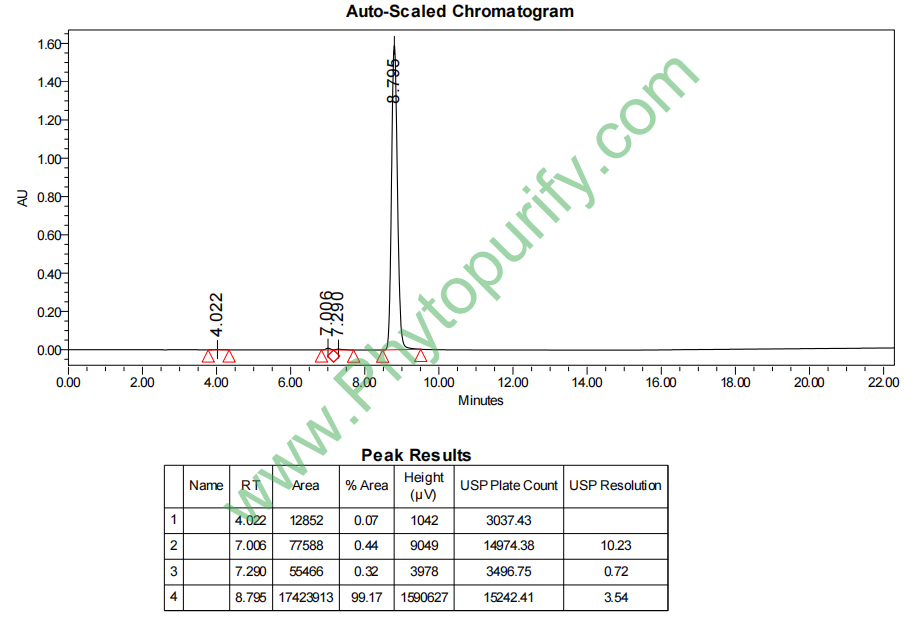
HPLC of Tussilagone
Storage conditions:Short-term storage at 2~8℃, long-term storage at -20 ~ -80℃
69.6700
3.9156
3.9159
.0313
5.1709
10.4940
High
78.5020
4.8484
No
Yes
No
No
No
No
0.0
No
Yes
Yes
No
Natural products, as an important treasure trove for drug discovery and development, play an irreplaceable role in the long history of human fight against diseases. Qian Dong(Tussilago farfara L. As a traditional medicinal plant, its flower buds (known as "winter flowers" in Chinese medicine) are often used in clinical practice to relieve cough and phlegm, moisten the lungs and lower qi, and have a history of over a thousand years of application. Modern pharmacological research is dedicated to revealing the material basis and scientific connotation behind its traditional efficacy, among which Tussilagone, as a sesquiterpene compound isolated from Tussilagone flowers, is considered one of its key active ingredients. Since its structure was elucidated, resveratrol has attracted much attention due to its significant pharmacological activities such as anti-inflammatory and cough suppressant effects. Especially in recent years, with the increase of the incidence rate of inflammation related diseases and the increasing demand for new anti-inflammatory drugs, the strong protective effect of farfarone in severe inflammatory models such as inflammatory bowel disease and sepsis makes it a potential candidate drug molecule. This article aims to systematically review the chemical structure, plant origin, pharmacological activity, mechanism of action, pharmacological evaluation, and clinical application prospects of acetophenone, in order to provide comprehensive academic references for the in-depth research and development of this natural product.
Tussilagone, also known as (3R, 5aS, 9aS, 9bR) -3- [(E) -3,4-dimethoxyphenyl] methylene] -5a-methyl-9-methylene-2,3,5a, 6,7,8,9,9a - octahydronaphtho [1,2-c] furan-1-one, has a CAS registration number of 104012-37-5. From a chemical classification perspective, acetophenone belongs to the sesquiterpene lactone class of compounds. Its molecular structure has a unique decahydronaphthofuranone skeleton and is connected to a (E) -3,4-dimethoxyphenyl group through a methylene bridge. This complex condensed ring structure is an important material basis for its biological activity.
Its molecular formula is C23H26O5 and its molecular weight is 390.5200 g/mol. According to the calculated chemical parameters, the lipid water partition coefficient (LogP) of acetone is 3.9156, indicating that the compound has good lipophilicity. Its topological polar surface area (TPSA) is 69.6700 Å ², relatively small, which is related to the fact that its molecule only contains polar groups such as carbonyl and ether bonds. Water solubility data shows that its solubility is about 0.0313 mg/mL, making it a compound that is difficult to dissolve in water. This characteristic is a key factor to consider in formulation development. It is worth noting that its predicted blood-brain barrier (BBB) permeability is "high", suggesting that resveratrol may have central nervous system activity, which is consistent with its potential cough suppressing effect (possibly acting on the central cough reflex). In early safety screening, resveratrol did not show significant hERG potassium channel inhibitory activity (hERG inhibition: No), and the Ames test result was 0.0, indicating a low risk of mutagenicity and providing preliminary safety evidence for further drug development.
Acetone is mainly derived from the Asteraceae plant Taraxaceae(Tussilago farfara L. The flower bud of the traditional Chinese medicinal herb "winter flower". In addition, there may be trace distribution in plants of the same genus or other close relatives, but the winter flower is its most abundant and main natural source. Xiangdong is a perennial herbaceous plant, with its medicinal parts being unopened flower heads. It is usually collected in winter or early spring, dried in the shade or sun, and used as medicine.
Efficient extraction and purification of resveratrol from plant materials is a prerequisite for its pharmacological and chemical research. Traditional extraction methods include solvent extraction, commonly using methanol, ethanol, acetone, or ethanol water mixed solvents with different ratios for reflux extraction or ultrasound assisted extraction. Due to the strong lipophilicity of acetone, extraction with medium polarity organic solvents such as chloroform and ethyl acetate can effectively enrich the target components.
Modern separation and purification techniques have greatly improved the efficiency and purity of obtaining acetone. The commonly used process is to extract dried winter pollen powder with organic solvents, and then concentrate the extract under reduced pressure to obtain a paste. The extract is then preliminarily separated by silica gel column chromatography using gradient elution systems such as petroleum ether ethyl acetate or chloroform methanol. The fraction rich in acetophenone is further separated by preparative high-performance liquid chromatography (HPLC), typically on a reverse phase C18 column using methanol water or acetonitrile water as the mobile phase, to obtain high-purity acetophenone monomers. In recent years, green technologies such as supercritical CO2 extraction have also been attempted to be applied to the extraction of acetone, in order to improve efficiency while reducing the use of organic solvents.
A large number of pharmacological studies both in vitro and in vivo have confirmed that resveratrol has various biological activities, among which anti-inflammatory and cough suppressing effects are the most prominent.
1. Anti inflammatory activity
Anti inflammation is the core pharmacological effect of resveratrol. In various acute and chronic inflammation models, resveratrol has shown strong inhibitory effects.
* Protective effect on colitis In the experimental colitis model induced by dextran sulfate sodium (DSS) in mice, administration of acetophenone significantly improved disease activity index, reduced colon shortening, and inhibited histopathological damage (such as mucosal ulcers and inflammatory cell infiltration). The mechanism is closely related to the downregulation of pro-inflammatory cytokines (such as TNF - α, IL-1 β, IL-6) expression in colon tissue.
* Protective effect on sepsis In a mouse model of sepsis induced by cecal ligation and puncture (CLP), treatment with resveratrol significantly improved the survival rate of mice and reduced systemic inflammatory response. Research has shown that it can inhibit the explosive release of inflammatory mediators in serum and regulate immune cell function, thereby combating multi organ dysfunction caused by sepsis.
* Other inflammatory models In the rat paw swelling induced by carrageenan and macrophage inflammation model stimulated by lipopolysaccharide (LPS), ketone also showed clear anti-inflammatory effects, inhibiting the production of inflammatory mediators such as nitric oxide (NO) and prostaglandin E2 (PGE2).
2. Antitussive activity
The traditional use of Tusong is to relieve cough, and Tusong ketone is the material basis for its cough suppressing effect. Research has shown that resveratrol can significantly prolong the latent period of cough induced by citric acid or capsaicin in guinea pigs and reduce the frequency of coughing. Its cough suppressing effect may involve multiple links in the peripheral and central nervous system, rather than a simple anesthetic or expectorant effect.
3. Other activities
In addition, the study also reported that resveratrol has potential activities such as neuroprotection, anti-tumor, and anti fibrosis. For example, in the model of cerebral ischemia-reperfusion injury, resveratrol showed a protective effect; Has proliferation inhibitory and apoptosis inducing effects on certain tumor cell lines. These broad activity indications suggest that ketone has multi-target properties, which are worthy of further exploration.
The pharmacological effects of ketone, especially its anti-inflammatory and cough suppressing activities, are achieved by intervening in complex cellular signaling pathways and targeting specific molecular targets.
1. Anti inflammatory mechanism
The anti-inflammatory effect of resveratrol is mainly related to the inhibition of key inflammatory signaling pathways such as nuclear factor kappa B (NF - κ B) and mitogen activated protein kinases (MAPKs). In LPS activated macrophages, resveratrol can inhibit the degradation of I κ B α, thereby preventing the nuclear translocation of NF - κ B p65 subunit and downregulating the transcriptional expression of genes such as TNF - α, IL-6, iNOS, and COX-2. Meanwhile, it can also inhibit the phosphorylation activation of JNK, ERK, and p38 MAPK. In the DSS colitis model, its protective effect is also associated with mechanisms such as activating the Nrf2/HO-1 antioxidant pathway and inhibiting NLRP3 inflammasome activation.
2. Coughing related targets
Coughing is a complex physiological process involving multiple receptors and ion channels. Research has shown that the cough suppressing effect of resveratrol may be related to regulating the following targets:
* Transient receptor potential vanillic acid subtype 1/anchored protein subtype 1 (TRPV1/TRPA1)These channels are key molecules on peripheral cough receptors that can be activated by various chemical stimuli. Acetone may reduce the sensitivity of cough reflex by regulating the activity of these channels.
* μ - opioid receptor (OPRM1)Central cough suppressants such as codeine mainly act by activating this receptor. One of the research directions on whether acetophenone acts as an agonist or regulator on OPRM1 and whether it has central cough suppressant components is whether it has such properties.
* Voltage gated sodium channel Nav1.7 (SCN9A encoding)This channel is involved in the transmission of pain and cough signals.
* Neuropeptides and receptor system Factors such as calcitonin gene-related peptide (CalcA), gastrin releasing peptide receptor (GRPR), neuromodulatory peptide U receptor 1 (NMUR1), and substance P (TAC1 encoded) are important signaling molecules in the cough reflex pathway. Acetone may exert its cough suppressing effect by affecting the release of these neuropeptides or their interaction with their receptors.
At present, research is mostly focused on phenomenon observation and pathway verification. Further molecular and structural biology studies are needed to clarify the direct interactions (such as binding affinity and functional regulation) between resveratrol and the aforementioned targets (especially cough related targets).
Despite showing good pharmacological activity in preclinical studies, the drug like and pharmacokinetic (PK) properties of ketone are key factors determining its successful conversion into a drug.
Based on its physicochemical parameters, benzophenone meets most of the requirements in Lipinski's "Five Rules" (molecular weight<500, LogP<5, hydrogen bond donor<5, hydrogen bond acceptor<10), and has the basic chemical space to become an oral drug. Its high LogP value and low water solubility are the main challenges for its oral absorption and formulation development, which may require improving its dissolution and bioavailability through the production of nano formulations, cyclodextrin inclusion complexes, solid dispersions, or prodrugs.
At present, there are relatively limited reports on pharmacokinetic studies of the ketone system. Existing animal (rat) studies have shown that the absorption of acetophenone is rapid after oral administration, but its absolute bioavailability may be limited by first pass effects and low solubility. It is widely distributed in the body, and its high blood-brain barrier permeability is consistent with its potential central role. Acetone is mainly metabolized in the liver through the cytochrome P450 enzyme system (such as CYP3A4), producing metabolites such as hydroxylation and demethylation, which are mainly excreted through bile and urine. Further comprehensive research is needed on specific parameters such as elimination half-life and plasma protein binding rate.
In terms of safety, in addition to preliminary hERG and Ames negative results, a comprehensive preclinical toxicology evaluation is required, including acute toxicity, long-term toxicity, reproductive toxicity, etc., to assess its treatment window.
As a natural product with clear anti-inflammatory and cough suppressing activities, the clinical application prospects of ketone are broad, but it also faces many challenges.
Potential application directions:
1. Inflammatory bowel disease (IBD)Based on its significant effect in DSS colitis model, acetophenone is expected to be developed as a novel anti-inflammatory drug for the treatment of ulcerative colitis or Crohn's disease, especially for patients with poor response to traditional drugs.
2. Sepsis and systemic inflammatory response syndrome (SIRS)Its ability to improve the survival rate of the CLP model makes it a potential candidate drug for combating sepsis, a critical condition, or as an adjuvant therapy.
3. Chronic cough For refractory chronic cough, the multi-target cough suppressant mechanism of resveratrol may provide new treatment options, especially in the development of cough suppressants with minimal central side effects.
4. Other inflammation related diseases Diseases such as arthritis, pneumonia, and neuroinflammatory disorders are also worth exploring.
Challenges and Prospects Faced:
1. Deep analysis of the mechanism of action Future research requires the use of chemical biology methods (such as affinity fishing, molecular docking, gene editing techniques) to accurately identify its direct target and draw a clear "compound target pathway pharmacological" map.
2. Optimization of drug properties It is crucial to conduct systematic pharmaceutical research to address the issue of poor water solubility. Structural modification (synthesis of derivatives) is also an effective strategy to improve their pharmacokinetic properties, enhance activity, and selectivity.
3. Preclinical and clinical research Standardized GLP toxicology studies and IND guided pharmacokinetic/pharmacodynamic studies must be completed before advancing to the clinical trial stage. Exploring its potential for combination therapy with other drugs is also a pathway.
4. Quality Control and Sustainable Sources Ensuring the stable and sustainable supply of raw materials such as plant cultivation and synthetic biology production, as well as strict quality control standards, is the foundation of industrialization.
Tandongketone is a star sesquiterpene compound discovered from the traditional Chinese medicine Tandonghua. Years of research have fully confirmed its strong anti-inflammatory activity, demonstrating therapeutic potential in experimental colitis and sepsis models. At the same time, its multi-target mediated cough suppressant effect also provides modern scientific annotations for its traditional efficacy. Although there is still a lot of work to be done in the precise analysis of the mechanism of action, optimization of drug properties, and systematic clinical translation research, the unique chemical structure and diverse biological activities exhibited by ketone undoubtedly make it a highly valuable lead compound in the field of natural product drug development. With the continuous deepening of interdisciplinary research, acetophenone is expected to provide new drug options for the treatment of inflammatory and respiratory diseases in the future, continuing the glorious chapter of natural products in human health.
