Introduction/Overview
3,4-Dihydroxyphenylacetic acid (DOPAC), as an important endogenous catecholamine metabolite, has long been regarded as a biomarker of dopamine neurotransmitter activity. However, as research deepens, its multiple biological activities beyond metabolic end products are gradually revealed. DOPAC is widely present in various plants, microorganisms, and mammals. The catechol group in its chemical structure endows it with strong electron donor ability, making it a class of natural antioxidants with significant potential. In recent years, there has been an increasing amount of pharmacological research on its antioxidant core, including anti-inflammatory, neuroprotective, anti-aging, and potential anti-tumor activities, transforming it from a simple metabolic intermediate to a highly regarded natural active molecule. This article aims to systematically review the chemical properties, natural sources, pharmacological activities, molecular mechanisms of action, and pharmacological properties of DOPAC, and to explore its potential applications in disease prevention and treatment, in order to provide comprehensive academic references for the in-depth research and development of this compound.
Chemical structure and physicochemical properties
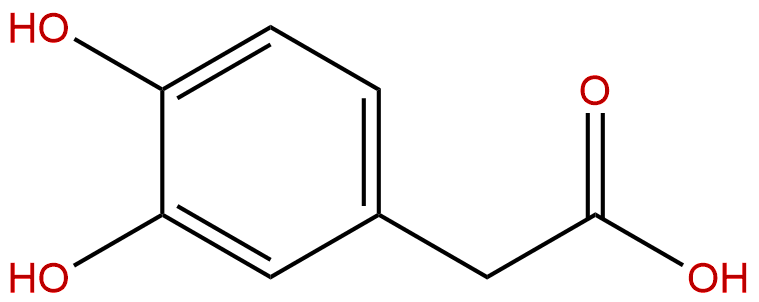
The chemical name of DOPAC is (3,4-dihydroxyphenyl) acetic acid, with a CAS number of 102-32-9. Its molecular formula is C ₈ H ₈ O ₄, and its molecular weight is 168.15. Structurally, DOPAC consists of a benzene ring, an acetic acid side chain, and two hydroxyl groups located at positions 3 and 4 of the benzene ring. These two adjacent hydroxyl groups form a typical catechol structure, which is the key pharmacophore for its antioxidant activity. The acetic acid side chain increases the water solubility and polarity of the molecule.
Its physical and chemical properties are closely related to its structure. The calculated lipid water partition coefficient (LogP) is approximately 0.64, indicating that the compound has a certain degree of lipophilicity, but overall leans towards hydrophilicity. The topological polar surface area (TPSA) is 77.76 Å ², reflecting its strong polarity characteristics. These data are consistent with the measured water solubility (approximately 11.27 mg/mL), indicating that DOPAC has good solubility in water, which is beneficial for its absorption and distribution in organisms. However, its high polarity and TPSA also lead to its ability to cross the blood-brain barrier (BBB) being predicted as "low", which to some extent limits its direct intervention in central nervous system diseases, but also suggests that its peripheral effects may be more significant. In addition, preliminary pharmacological risk assessment showed negative hERG inhibition risk and Ames mutagenicity risk, providing preliminary positive signals for its safety.
Plant sources and extraction methods
DOPAC is not only the main product of dopamine metabolism in animals through monoamine oxidase (MAO) and aldehyde dehydrogenase, but also widely distributed in various plants in nature. It is commonly found in olives, certain legumes, citrus fruits, and various medicinal plants. For example, olive oil and its processing by-products have higher levels, which may be one of the active ingredients with health benefits in the Mediterranean diet. In addition, some traditional medicinal plants such as Ciwujia、licorice The presence of DOPAC was also detected in the extracts of these herbs, suggesting that it may contribute to some of their pharmacological effects.
The extraction of DOPAC from natural raw materials usually uses solvent extraction method. Due to its good water solubility and certain lipophilicity, water, methanol, ethanol, or alcohol water mixed solvents with different ratios are often used for extraction. For example, using 70% ethanol for ultrasound assisted extraction or hot reflux extraction of plant materials is a common method. After filtration and concentration, the extract can be further enriched and purified by macroporous adsorption resin column chromatography. By utilizing the adsorption characteristics of the resin for polar aromatic compounds, gradient elution can be carried out with ethanol water solutions of different concentrations. For obtaining higher purity, it is necessary to combine techniques such as silica gel column chromatography and preparative high-performance liquid chromatography (HPLC). In recent years, green extraction technologies such as supercritical CO ₂ extraction have also been explored, but their extraction efficiency for DOPAC with strong polarity needs to be optimized by adding entrainers.
Pharmacological activity research
The pharmacological activity research of DOPAC mainly focuses on its core antioxidant capacity and extends to multiple related fields.
-
Antioxidant and anti-inflammatory activities The catechol structure of DOPAC can effectively scavenge free radicals (such as DPPH, ABTS ⁺ free radicals) and exhibit strong metal ion chelating ability. In cell models, DOPAC can significantly alleviate oxidative stress induced by stimuli such as hydrogen peroxide (H ₂ O ₂), lipopolysaccharide (LPS), or ultraviolet radiation, reduce reactive oxygen species (ROS) levels, and inhibit the production of inflammatory factors such as tumor necrosis factor - α (TNF - α), interleukin-6 (IL-6), and nitric oxide (NO). The synergistic effect of antioxidant and anti-inflammatory is the basis for its subsequent protective effects.
-
Neuroprotective effect Despite its limited BBB permeability, DOPAC still exhibits indirect neuroprotective potential. In Parkinson's disease cell models, DOPAC can protect dopaminergic neurons from neurotoxins (such as 6-hydroxydopamine, MPP ⁺) - induced apoptosis. The mechanism may be related to reducing oxidative damage, regulating the expression of neurotrophic factors, and affecting neuroinflammation through peripheral effects. In addition, as a metabolite of dopamine, it may have a feedback regulatory effect on the homeostasis of the dopaminergic system.
-
Skin protection and anti photoaging DOPAC has attracted much attention in the field of skin pharmacology. Research has confirmed that it can effectively inhibit skin fibroblast damage induced by ultraviolet B (UVB), reduce the expression of matrix metalloproteinases (such as MMP-1, MMP-3), and thus protect collagen from degradation. Meanwhile, it can upregulate the antioxidant defense system of skin cells themselves. These characteristics make it a potential candidate ingredient for preventing and treating skin photoaging.
-
Cardiovascular protection and metabolic regulation Preliminary studies have shown that DOPAC has a protective effect on vascular endothelial cells and can improve endothelial dysfunction caused by oxidized low-density lipoprotein (ox LDL). In terms of metabolism, studies suggest that it may improve insulin sensitivity by activating pathways such as AMPK, but its specific role still needs further exploration.
-
Antitumor potential Some in vitro studies have shown that DOPAC can selectively inhibit the growth and promote apoptosis of some cancer cell lines (such as colon cancer and breast cancer cells), and its mechanism may be related to the induction of cell cycle arrest, mitochondrial dysfunction and activation of apoptosis pathway. However, these activities are mostly observed at higher concentrations, and their in vivo anti-tumor efficacy and specificity still require extensive research verification.
Mechanism of action and molecular targets
The biological effects of DOPAC are mainly achieved through its direct chemical antioxidant activity and indirect regulation of cellular signaling pathways, involving multiple molecular targets.
-
Direct antioxidant and enzyme inhibition DOPAC, as an electron donor, can directly neutralize ROS. Its catechol structure can effectively chelate transition metal ions such as iron and copper, block the Fenton reaction, and reduce the generation of hydroxyl radicals from the source. In addition, it can directly inhibit the activity of certain oxidative stress-related enzymes, such as Tyrosinase (TYR)This is related to its skin whitening potential; It can also inhibit the degradation of extracellular matrix Matrix metalloproteinase-1 and MMP-3 (MMP-1, MMP-3)。
-
Activate Nrf2/ARE antioxidant defense pathway This is the core molecular mechanism by which DOPAC exerts its cell protective effect. DOPAC can promote transcription factors Nuclear factor E2 related factor 2 (Nrf2, encoded by NFE2L2 gene) Dissect from the cytoplasm and translocate to the nucleus. In the nucleus, Nrf2 binds to antioxidant response elements (ARE), initiating the transcriptional expression of a series of downstream phase II detoxifying enzymes and antioxidant proteins. The key target genes include:
- Heme oxygenase-1 (HMOX1)Has powerful anti-inflammatory and antioxidant functions.
- Superoxide dismutase (SOD1, SOD2)Catalytic conversion of superoxide anions into hydrogen peroxide.
- Catalase (CAT) and Glutathione peroxidase 1 (GPX1)Responsible for removing hydrogen peroxide.
Through this pathway, DOPAC enhances the intracellular antioxidant capacity and achieves long-lasting protection.
-
Regulating inflammation and apoptosis related pathways DOPAC can reduce the expression of pro-inflammatory cytokines by inhibiting the activation of the nuclear factor kappa B (NF - κ B) signaling pathway. In terms of apoptosis, it can regulate the Bcl-2/Bax protein ratio, inhibit the activation of caspase-3, and thus counteract cell apoptosis.
-
Other potential targets There are studies suggesting that DOPAC may act as a weak agonist or regulator of certain G protein coupled receptors, or affect the transport and metabolism of monoamine neurotransmitters, but these effects are still unclear.
Evaluation of drug properties and pharmacokinetics
Based on its physicochemical properties and preliminary biological data, a preliminary evaluation of the pharmacological properties of DOPAC is conducted
- Absorption and distribution Good water solubility is beneficial for its dissolution and absorption in the gastrointestinal tract. A moderate LogP value suggests that it may be partially absorbed through passive diffusion. But its polarity is high, and its absolute bioavailability may be limited, and BBB permeability is poor, mainly distributed in peripheral tissues and organs.
- Metabolism and excretion As an endogenous substance, the metabolic pathway of DOPAC in the body is relatively clear. It can be methylated by catechol-O-methyltransferase (COMT) to generate 3-methoxy-4-hydroxyphenylacetic acid (HVA), which is one of its main excretion forms in urine. Sulfation or glucuronidation binding reactions can also occur. The prototype drug and its metabolites are mainly rapidly excreted through the kidneys and urine, with a short half-life.
- safety Existing data (such as Ames test negative, no hERG inhibition) suggest a low risk of genetic and cardiac toxicity. As a naturally occurring metabolite, its overall safety is expected to be good. However, the long-term toxicity at high doses and the potential interference of its strong reducibility on the redox balance in the body still require systematic preclinical safety evaluation.
- Formulation Challenge Due to its fast metabolism and short half-life, if it is to be developed as a therapeutic drug, it may be necessary to consider sustained-release formulations, prodrug strategies (such as esterification modification to increase lipid solubility and BBB penetration), or combination with other ingredients to enhance efficacy and stability.
Clinical application prospects and prospects
The clinical application prospects of DOPAC are mainly based on its excellent antioxidant and anti-inflammatory properties, which can be expanded in the following directions:
- Functional foods and dietary supplements As a natural ingredient in plants such as olives and fruits, DOPAC can be used as an antioxidant dietary supplement to prevent chronic diseases related to oxidative stress, such as early prevention of cardiovascular disease and auxiliary management of metabolic syndrome.
- External preparations for dermatology The prospects are bright in the fields of cosmetics and skincare drugs. It can be developed into essence, lotion or ointment with anti-aging, sunscreen, light damage repair and whitening effects. Its multi-target inhibition (TYR, MMPs) and activation of the Nrf2 pathway provide a comprehensive skin protection plan.
- Adjuvant treatment strategies for neurodegenerative diseases Although BBB penetration is a barrier, its prodrug form can be explored, or its role in reducing systemic inflammation and oxidative stress in the periphery can be utilized to indirectly create a favorable microenvironment for the central nervous system as an adjuvant therapy for Parkinson's disease and Alzheimer's disease.
- As a lead compound for structural optimization Using its catechol structure as the core, chemical modifications (such as introducing protective groups and changing side chains) are expected to obtain new derivatives with stronger activity, higher stability, and better pharmacokinetic properties, especially for drug development targeting central nervous system targets.
The future research focus should include: using modern omics technology to comprehensively elucidate its functional network; Conduct high-quality in vivo pharmacological validation of animal models; Systematically evaluate the safety of long-term administration; And strengthen pharmaceutical research to overcome its pharmacokinetic shortcomings.
Conclusion
3,4-dihydroxyphenylacetic acid (DOPAC) has successfully transformed from a simple dopamine metabolic marker to a natural active molecule with multi-target and multifunctional potential. It has demonstrated clear application value in antioxidant, anti-inflammatory, neuroprotective, and skin protection through direct chemical antioxidant and activation of key cellular defense pathways such as Nrf2. Despite facing challenges in terms of bioavailability, blood-brain barrier permeability, and metabolic stability in drug development, these challenges also point the way for future research and technological development. With the continuous deepening of research on DOPAC and its derivatives, it is expected to move from the laboratory to practical applications in fields such as preventive medicine, skin health, neuroprotection, and tumor chemoprevention, providing important scientific basis for the development of new health products and treatment strategies based on natural products.