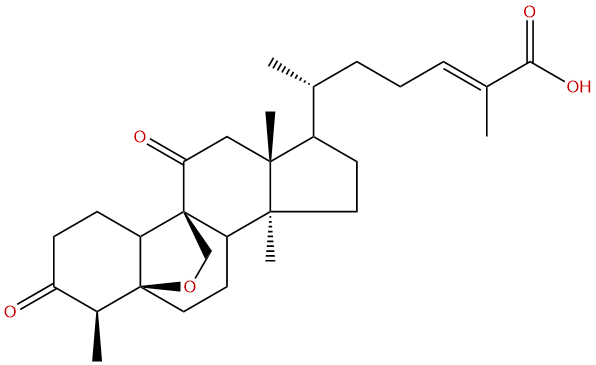


Product name: Siraitic acid B
Synonym name:
Catalogue No.: BP2037
Cas No.: 183374-16-5
Formula: C29H42O5
Mol Weight: 470.65
Botanical Source: Siraitiae Radix
Physical Description:
Type of Compound: Triterpenoids
Purity: 95%~99%
Analysis Method: HPLC-DAD or/and HPLC-ELSD
Identification Method: Mass, NMR
Packing: Brown vial or HDPE plastic bottle
Storage: Store in a well closed container, protected from air and light. Put into refrigerate or freeze for long term storage.
Whenever possible, you should prepare and use solutions on the same day. However, if you need to make up stock solutions in advance, we recommend that you store the solution as aliquots in tightly sealed vials at -20℃. Generally, these will be useable for up to two weeks.
The product could be supplied from milligrams to grams
Inquire for bulk scale.
For Reference Standard and R&D, Not for Human Use Directly.
Storage conditions:Short-term storage at 2~8℃, long-term storage at -20 ~ -80℃
80.6700
4.5117
1.8131
.0054
4.8379
13.8553
Low
90.3847
6.2916
No
No
Yes
No
No
No
0.0
No
No
No
No
Siraitic acid B is a cucurbitane triterpenoid compound extracted from the root of Siraitia grosvenorii. In recent years, it has attracted extensive attention due to its significant biological activity, especially its potential application in the field of anti diabetes. As a metabolic disease with high incidence worldwide, diabetes seriously threatens human health. Developing safe and effective natural product drugs has become an important direction of current research. With its unique chemical structure and multi-target regulation ability, Arhat B has shown multiple pharmacological effects such as regulating blood glucose metabolism and improving insulin sensitivity, and has become a hot spot in the research of natural anti diabetes drugs.
This article will systematically review the chemical structure, physical and chemical properties, plant sources and extraction methods of Arhat fruit acid B, focus on its pharmacological activity and mechanism of action, analyze its pharmacokinetic characteristics in combination with pharmaceutical parameters, and finally explore its clinical application prospects and future research directions, providing theoretical support and research reference for natural product pharmacology and diabetes treatment.
Arhat fruit acid B belongs to cucurbitane triterpene with molecular formula of C_30H_46O_5 and molecular weight of 470.65. Its structural core is a typical pentacyclic cucurbitane skeleton, containing multiple hydroxyl and carboxyl functional groups, endowing it with strong polarity and biological activity. According to the database information of CAS No. 183374-16-5, the LogP value of Arhat B is 4.5117, which shows that it has good fat solubility and is conducive to penetrating the cell membrane, but its water solubility is low (0.0054 mg/mL), which may limit its oral absorption and bioavailability.
The topological polar surface area (TPSA) is 80.67 Å ², indicating that the molecule has moderate polarity, which may affect its binding affinity with biological targets. The low permeability of the blood-brain barrier suggests its limited role in the central nervous system, reducing potential central side effects. The hERG channel inhibition test was negative, indicating that the heart toxicity risk of Arhat fruit acid B was low. The Ames mutagenicity test result is 0, indicating that it has no significant genotoxicity and meets the basic requirements for safe drug use.
Arhat B is mainly extracted from the root of Momordica grosvenorii. Momordica grosvenorii is the fruit of the gourd plant Siraitia grosvenorii, which is widely used in traditional Chinese medicine to moisten the lung, relieve cough, clear heat, detoxify and reduce sugar. Although the fruit is the main medicinal part, the root contains abundant triterpenes, especially cucurbitane triterpenes such as Arhat fruit acid ethyl, which are the important source of its active ingredients.
The extraction process usually uses organic solvent extraction combined with column chromatography separation. The specific steps include:
In recent years, the application of ultrasonic assisted extraction and microwave assisted extraction technology has improved the extraction efficiency and purity of Arhat B, and promoted its large-scale production and in-depth research.
The pharmacological activity of Arhat fruit acid B mainly focuses on the anti diabetes effect, in addition, it also shows certain anti-inflammatory, antioxidant and other auxiliary effects, and the comprehensive effect is helpful to improve diabetes and its complications.
Many in vitro and in vivo studies have confirmed that siraite b can significantly reduce blood glucose levels and improve insulin resistance. Its main manifestations are:
Arhat B also has antioxidant activity, which can clear free radicals and reduce the damage of oxidative stress to islet cells. In addition, its anti-inflammatory effect alleviates chronic inflammation related to diabetes by inhibiting the release of inflammatory factors.
The anti diabetes effect of Arhat fruit acid B involves multiple signaling pathways and key targets, which reflects the characteristics of multi target and multi pathway coordinated regulation.
5 'AMP activated protein kinase (AMPK) is a core regulatory factor in cellular energy metabolism. B siraite can activate AMPK (including PRKAA1 subunit), promote glucose uptake and lipid metabolism, inhibit gluconeogenesis, and improve insulin sensitivity.
Sodium glucose cotransporter 2 (SGLT2) is a key target for renal glucose reabsorption. Arhat B showed inhibitory effect on SGLT2, promoted urine glucose excretion and reduced blood glucose level.
By regulating insulin receptor substrate 1 (IRS1), protein kinase B (AKT1) and PI3K regulatory subunit (PIK3R1), Arhat B enhances insulin signal transduction, promotes the translocation of glucose transporter 4 (SLC2A4) to the cell membrane, and improves the glucose uptake of cells.
Peroxisome proliferator activated receptor gamma (PPARG) is involved in regulating lipid and glucose metabolism. Arhat B can improve insulin resistance and regulate the balance of lipid metabolism by activating PPARG.
Dipeptidyl peptidase 4 (DPP4) participates in the degradation of glucagon like peptide-1 (GLP-1) and affects insulin secretion. Arhat fruit acid B inhibits DPP4 activity, prolongs the action time of GLP-1, and promotes insulin secretion.
To sum up, Arhat B fructate can regulate glucose metabolism and insulin function through multi target and multi pathway synergy, and exert its anti diabetes effect.
The pharmaceutical evaluation of Arhat B is based on its physicochemical properties and pharmacokinetics in vivo.
At present, the pharmacokinetic study on Arhat B is relatively limited, but based on its structure and physical and chemical properties, it is speculated that:
In the future, systematic pharmacokinetic and toxicological studies need to be conducted to clarify its in vivo behavior and safe dose range, laying the foundation for clinical development.
As a natural cucurbitane triterpene, Arhat fruit acid B has a multi-target anti diabetes activity, showing good clinical application potential. Its advantages lie in:
However, at present, Arhat B is still in the basic research stage, and the data of preclinical research and clinical trials are still lacking. Future research directions should include:
In addition, in view of its anti-inflammatory and antioxidant properties, the application of Arhat B in diabetes complications such as diabetes nephropathy and neuropathy is also worth further exploration.
As a natural product of cucurbitane triterpenoids extracted from the root of Arhat grosvenorii, Momordica acid B shows a broad application prospect in the field of anti diabetes due to its unique chemical structure and multi-target regulatory ability. It comprehensively improves glucose metabolism disorders through multiple mechanisms such as activating AMPK, inhibiting SGLT2, regulating insulin signaling pathway, and PPAR γ, and has good safety and potential for drug development.
Although most of the current studies focus on in vitro and animal models, the clinical transformation of Arhat B still faces challenges such as low bioavailability and unclear pharmacokinetics. In the future, it is necessary to strengthen the optimization of pharmaceutical preparations, systematic pharmacokinetic research and clinical verification, so as to promote it to become a safe and effective natural anti diabetes drug.
In conclusion, Arhat B not only enriches the research scope of diabetes natural drugs, but also provides an important molecular basis for the development of multi-target treatment strategies, which has important scientific value and application prospects.
Batch can search by a CAS number,one per line
