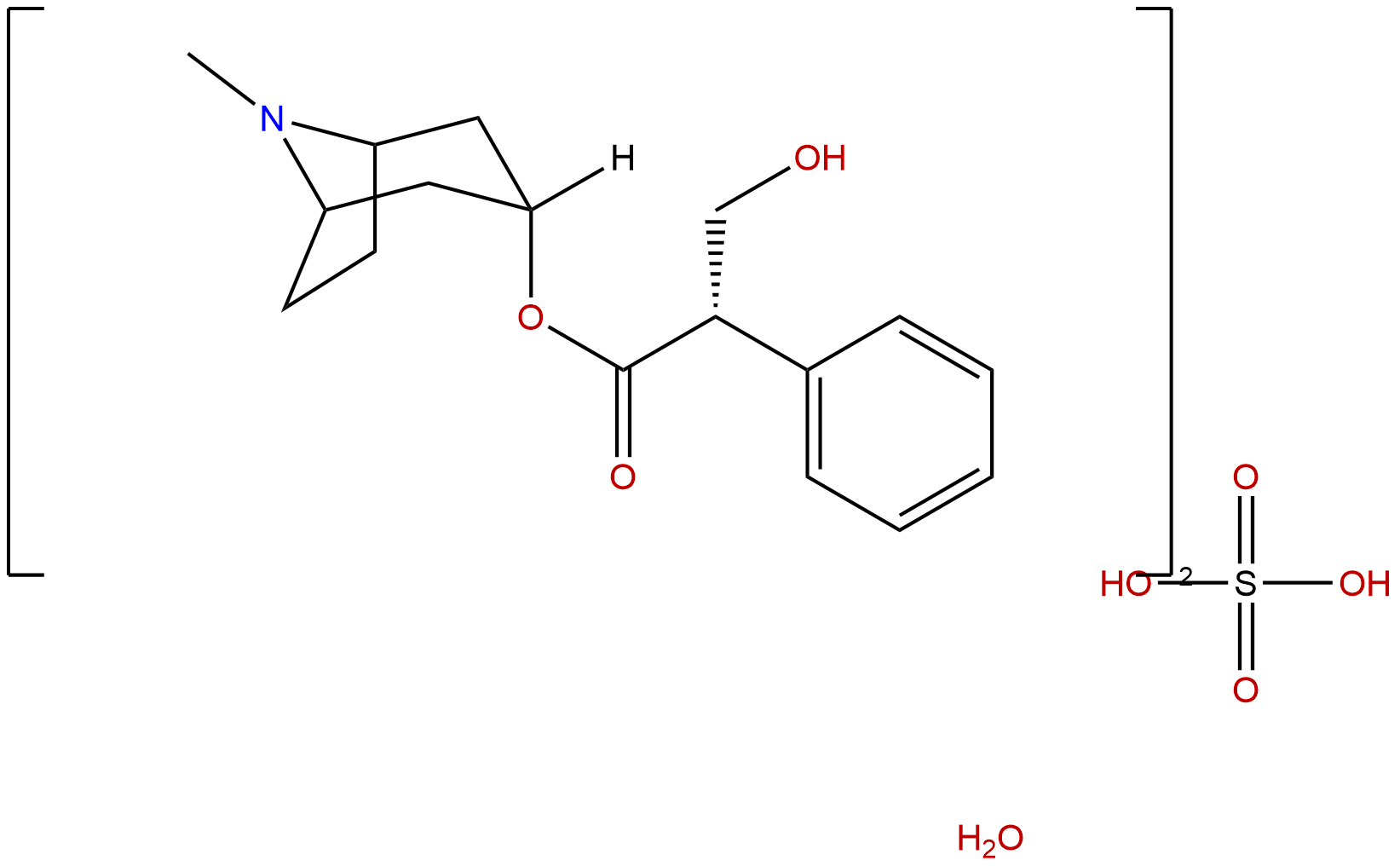


Product name: Hyoscyamine sulfate hydrate
Synonym name:
Catalogue No.: BP3198
Cas No.: 620-61-1
Formula: C34H50N2O11S
Mol Weight: 694.837
Botanical Source:
Physical Description: Powder
Type of Compound: Alkaloids
Purity: 95%~99%
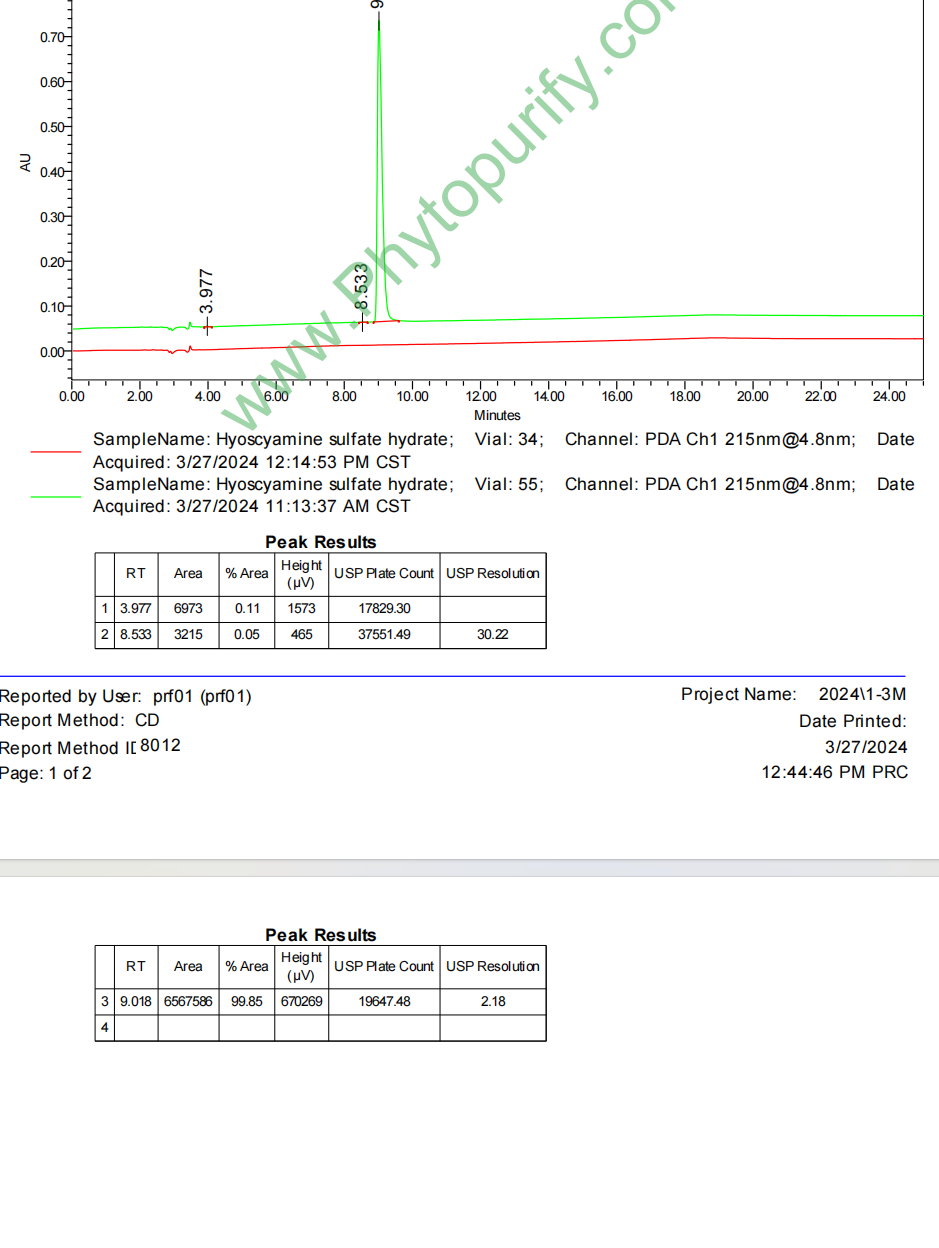
Analysis Method: HPLC-DAD or/and HPLC-ELSD
Identification Method: Mass, NMR
Packing: Brown vial or HDPE plastic bottle
The product could be supplied from milligrams to grams. Inquire for bulk scale.
We provide solution to improve the water-solubility of compounds, thereby facilitating the variety of activity tests and clinic uses.
For Reference Standard and R&D, Not for Human Use Directly.
HPLC of Hyoscyamine sulfate hydrate
Storage conditions:Short-term storage at 2~8℃, long-term storage at -20 ~ -80℃
49.7700
1.7583
.2382
6.4341
1.9613
19.1972
High
37.1092
5.4161
No
No
No
No
No
Yes
0.0
No
No
Yes
No
Hyoscylamine sulfate hydrate, as a representative member of tropane alkaloids, is one of the core compounds in the anticholinergic drug family. Its CAS number is 620-61-1, and it is the sulfate monohydrate form of scopolamine (L-isomer) with a clear stereochemical configuration, which is closely related to its pharmacological activity. Since its isolation and identification from Solanaceae plants in the 19th century, this compound and its derivatives (such as atropine) have played a crucial role in the history of medicine. From the initial dilators and antispasmodics, to modern pre anesthetic administration and organophosphate detoxification agents, its application has been present throughout the development of modern pharmacology. Its core pharmacological effects stem from highly selective and competitive antagonism of muscarinic acetylcholine receptors (mAChRs), which widely affect the smooth muscle, exocrine glands, heart, and central nervous system functions innervated by the parasympathetic nervous system. In recent years, with the rapid development of molecular pharmacology and structural biology, the understanding of the mechanism of action of scopolamine sulfate has deepened to the atomic level. The subtle differences in its interactions with different subtypes of mAChRs, the complex effects in the central nervous system, and its therapeutic potential in specific disease states have once again become research hotspots. This article aims to systematically review the chemical properties, plant sources, pharmacological activities, molecular mechanisms of action, pharmacological characteristics, and clinical application prospects of scopolamine sulfate, in order to provide a comprehensive scientific perspective for the in-depth research and rational application of this classic drug.
The chemical essence of hyoscyamine sulfate is the sulfate monohydrate of (S) - hyoscyamine. The molecular formula of its free alkaloid scopolamine is C17H23NO3, with a molecular weight of 289.38. The core of its structure is the tropane (tropane) skeleton, which is composed of a tropane ring (nitrogen-containing heterocyclic ring) and a tropane acid moiety connected by ester bonds. The key stereochemical feature is that the α - carbon atom in the tryptophan moiety is in the S configuration, which is the determining factor for its high anticholinergic activity. The activity of its right-handed enantiomer (scopolamine) is much lower than that of its left-handed enantiomer. After the formation of sulfate, its water solubility significantly increases, making it more suitable for making injection and other dosage forms.
From the analysis of drug parameters, the LogP value is 1.76, indicating that the compound has moderate lipophilicity, which facilitates its penetration of cell membranes (including the blood-brain barrier) and interaction with membrane-bound receptors. The topologically polar surface area (TPSA) is 49.77 Å ², which is relatively low and further supports its good membrane permeability. The calculated water solubility value (6.43 mg/L) suggests that it is slightly soluble, but the solubility of the actual formulation significantly improves after salt formation. Of particular importance is that its blood-brain barrier permeability is predicted to be "high", which explains why scopolamine sulfate can produce central nervous system effects (such as sedation and anti dizziness) at therapeutic doses, and is also the structural basis for central anticholinergic syndrome (delirium, hallucinations) caused by its overdose. In terms of safety, its hERG inhibition prediction is "no", indicating a low risk of cardiac toxicity (inducing apical torsion ventricular tachycardia); The Ames test predicted a value of 0.0, indicating no direct genetic toxicity risk. These physicochemical and preliminary safety properties lay the foundation for its clinical application.
Scopolamine sulfate mainly comes from various medicinal plants in the Solanaceae family, which have been distributed and cultivated around the world. The most famous sources include belladonna(Atropa belladonna)Mandala(Datura stramonium)Scopola(Hyoscyamus niger)And the Western Gold Flower(Datura metel)Wait. In these plants, scopolamine often coexists with its stereoisomer scopolamine, and the ratio of the two varies depending on the plant species, location, growth stage, and geographical environment. For example, belladonna leaves are rich in scopolamine, while mandala and goldenrod may have higher levels of scopolamine. Alkaloids mainly accumulate in the roots, leaves, and seeds of plants.
The traditional extraction method begins with the drying and crushing of plant materials, followed by extraction or percolation using polar solvents such as methanol, ethanol, or dilute acid aqueous solutions to convert alkaloids into soluble salts. After concentration of the extraction solution, alkaloids are released by adjusting the pH value, and then extracted with organic solvents such as chloroform and dichloromethane. Due to the similarity in structure between hyoscyamine and scopolamine, separation and purification are key steps. Classic methods include fractional crystallization, pH gradient extraction, or utilizing their differences in solubility after salt formation. For example, the solubility of scopolamine oxalate in water is lower than that of scopolamine oxalate, and this property can be used for preliminary separation. Modern technology often uses techniques such as high-performance liquid chromatography (HPLC) or high-speed countercurrent chromatography (HSCCC) for high-purity preparation. After obtaining the free base of hyoscyamine, salt it with sulfuric acid and crystallize it to obtain hyoscyamine sulfate monohydrate. In recent years, the development of plant tissue culture and metabolic engineering has provided a new pathway for the sustainable and controllable production of these precious alkaloids. By regulating key enzymes in the biosynthetic pathway, such as hyoscyamine 6 β - hydroxylase, it is expected to increase the yield of the target product in a targeted manner.
The pharmacological effects of scopolamine sulfate are extensive, covering almost all peripheral and central cholinergic nervous systems.
1. Peripheral anticholinergic effect:
* Smooth muscle antispasmodic effect: It has a significant relaxing effect on the smooth muscles of the gastrointestinal tract, biliary tract, ureter, and bronchus, and can effectively inhibit their excessive contraction or spasm. This is the basis for its clinical use in treating visceral colic (such as renal colic, biliary colic), gastrointestinal spasms, and as a pre anesthesia drug to inhibit respiratory secretion.
* Inhibit glandular secretion: It has a strong inhibitory effect on salivary glands, sweat glands, bronchial glands, and gastric juice glands. Especially used for pre anesthesia administration to reduce respiratory secretions and prevent intraoperative complications.
* Cardiovascular system function: At therapeutic doses, blocking the M2 receptor in the sinoatrial node can cause mild and transient heart rate increase (relieving the inhibitory effect of the vagus nerve on the heart). At high doses, it can dilate skin blood vessels and cause symptoms such as flushing and fever.
* Eye function: Local eye drops can block the cholinergic innervation of the iris sphincter (M3 receptor) and ciliary muscle (M3 receptor), leading to pupil dilation (mydriasis), increased intraocular pressure, and regulatory paralysis. This characteristic makes it suitable for ophthalmic examination and treatment of iridocyclitis.
2. Central nervous system function:
Thanks to its high blood-brain barrier permeability, scopolamine sulfate has a dual effect on the central nervous system. At therapeutic doses, it can produce a certain sedative effect and have inhibitory effects on the vestibular system, used for the prevention and treatment of motion sickness (but less effective than scopolamine). However, when overdosed, it typically manifests as central anticholinergic syndrome: first excitation (manifested as restlessness, delirium, hallucinations, and disorientation), then inhibition (coma, respiratory failure), and in severe cases, it can be life-threatening.
3. Detoxification effect:
As one of the effective antidotes for organophosphate pesticides or nerve agents poisoning (often used in combination with cholinesterase activators such as chlorpromazine). Its mechanism is to competitively block mAChRs that are overly excited due to the accumulation of acetylcholine (ACh), counteract M-like toxic symptoms such as bronchospasm, salivation, urinary and fecal incontinence, bradycardia, etc., and save lives.
The core mechanism of action of scopolamine sulfate is as a competitive antagonist, acting on muscarinic acetylcholine receptors (mAChRs). ACh is a cholinergic neurotransmitter whose effects are mediated by two types of receptors: nicotinic acetylcholine receptors (nAChRs, ion channel type) and muscarinic acetylcholine receptors (mAChRs, G protein coupled receptor type). Scopolamine sulfate specifically targets the latter.
1. Main molecular targets:
There are five subtypes of mAChR (M1-M5) in humans, and scopolamine sulfate has antagonistic activity against them, but with slight differences in affinity. Its antagonistic effect blocks the binding of ACh to the receptor, thereby inhibiting downstream signal transduction after receptor activation.
* M1, M3, M5 receptors: Mainly through coupling with Gq/11 protein, phospholipase C (PLC) is activated to produce inositol triphosphate (IP3) and diacylglycerol (DAG), leading to intracellular calcium ion release and protein kinase C (PKC) activation. Scopolamine sulfate antagonizes these receptors and mediates Inhibition of glandular secretion (such as M3 in salivary glands and bronchial glands), smooth muscle relaxation (M3 in gastrointestinal, bronchial, and bladder detrusor muscles), dilated pupils (M3 in iris sphincter) Equivalent peripheral effects. Central M1 receptor antagonism is closely related to cognitive side effects such as memory impairment and delirium.
* M2 and M4 receptors: Mainly through coupling with Gi/o protein, it inhibits adenylate cyclase (AC), reduces intracellular cAMP levels, and activates inward rectifying potassium channels. Scopolamine sulfate antagonizes the sinoatrial node in the heart M2 receptor, relieving Gi mediated inhibition of pacing current, thus Accelerate heart rate The central M2/M4 receptor antagonism also participates in regulating neurotransmitter release and neuronal excitability.
2. Target association with related diseases:
In Anticholinergic syndrome In the context of this, the effect of scopolamine sulfate is precisely the result of over antagonizing all mAChR subtypes mentioned above. In addition, acetylcholinesterase (ACHE) among the listed targets is not its direct target of action, but toxicity caused by ACHE inhibitors (such as organophosphates) is its treatment target. The vesicular acetylcholine transporter (SLC18A3 or VAChT) is responsible for loading ACh into synaptic vesicles. Scopolamine sulfate does not directly act on this target, but its overall effect is to counteract the postsynaptic effects of ACh by blocking receptors.
From the perspective of structural biology, recent crystallographic and cryo electron microscopy studies have revealed the binding mode of tropane alkaloids to mAChRs. They bind to the positive binding pocket of the receptor, which is the binding site of the endogenous ligand ACh. Through their positively charged tertiary amine nitrogen atom, they form a critical salt bridge with the conserved aspartic acid residue of the receptor. Their large ester moiety interacts with the hydrophobic region in the pocket, firmly occupying the pocket and preventing ACh binding and receptor activation.
As a long used drug, the pharmacological characteristics and pharmacokinetic behavior of scopolamine sulfate have been extensively studied.
Pharmacodynamics:
* Absorption: After oral administration, it is rapidly but incompletely absorbed from the gastrointestinal tract, with a significant first pass effect and a bioavailability of about 30-50%. Injecting medication (subcutaneously, intramuscularly, intravenously) can avoid first pass effects and have a faster onset of action.
* Distribution: The distribution volume is large and can be widely distributed throughout the body tissues. Its moderate lipophilicity allows it to smoothly pass through the blood-brain barrier and placental barrier, and can also be secreted into breast milk.
* Metabolism: It is mainly metabolized by enzymatic hydrolysis in the liver, where ester bonds are broken to produce trophinol and trophinic acid, which further participate in in in vivo metabolism. The metabolic process involves non-specific esterases and possible cytochrome P450 enzyme systems.
* Excretion: Metabolites and small amounts of prototype drugs are mainly excreted through the kidneys and urine. The half-life of elimination is about 2-4 hours, and the duration of action varies depending on the route and dosage of administration. Oral administration can last for 4-6 hours, while topical ophthalmic use can last for several days.
Drug Evaluation:
* Advantage: Fast acting and widely effective, it is a classic antispasmodic and anticholinergic tool and antidote. The sulfate form improves water solubility and formulation stability. The mechanism of action is clear, and its value cannot be replaced in emergency situations such as organophosphate poisoning.
* limitations: The treatment window is narrow, and the effective dose is close to the toxic dose. Lack of subtype selectivity in action, often accompanied by unavoidable side effects such as dry mouth, blurred vision, palpitations, constipation, and difficulty urinating while producing therapeutic effects (such as spasmolysis). Central permeability is a double-edged sword, beneficial in situations where central action is needed (such as anti motion sickness), but may lead to unnecessary drowsiness, memory loss, or delirium during peripheral treatment (especially in elderly people who are sensitive).
* Drug interactions: The combination with other anticholinergic drugs (such as antihistamines, tricyclic antidepressants, and phenothiazine antipsychotics) can produce overlapping effects and increase the risk of poisoning. Antagonistic interaction with gastrointestinal motility promoting drugs (such as domperidone).
Although scopolamine sulfate is an "old medicine", its clinical application and research value have not faded, and it has shown potential development directions from a new perspective.
1. Optimization of existing clinical applications:
* Formulation innovation: Develop new delivery systems, such as transdermal patches, sustained-release microspheres, targeted nano formulations, etc., to achieve smoother blood drug concentrations, prolonged action time, reduced dosing frequency, and systemic side effects. For example, transdermal drug delivery systems used for motion sickness can avoid first pass effects and gastrointestinal side effects of oral administration.
* Precision medication: Individualized dosing regimens based on pharmacokinetic/pharmacodynamic (PK/PD) models and therapeutic drug monitoring (TDM), especially in the treatment of critically ill patients (such as organophosphate poisoning), can help minimize the risk of poisoning while achieving optimal efficacy.
2. Exploration of new therapeutic fields:
* Gastrointestinal diseases: In diseases such as refractory irritable bowel syndrome (IBS) and chronic pseudo intestinal obstruction, its potent antispasmodic effect still plays an important role. Studying its combination with other drugs, such as smooth muscle calcium channel blockers, may improve therapeutic efficacy.
* Urinary system diseases: Used for urinary urgency and frequency caused by overactive bladder (OAS), but its side effects limit long-term use. One direction is to develop analogs or prodrugs with higher selectivity for bladder M3 receptors.
* Neurological disorders: The pivotal role has been re examined. There are studies exploring the use of low-dose adjunctive therapy for excessive salivation or tremors in Parkinson's disease patients, but it is necessary to strictly balance it with cognitive side effects. The historical application in depression and neurological and psychiatric disorders also suggests that they may affect emotional circuits, and it is worth exploring cautiously on the basis of clear mechanisms.
* Expansion in the field of detoxification: In addition to organophosphates, scopolamine sulfate is still a part of the basic detoxification regimen for other toxins that are toxic through excessive cholinergic excitation, such as certain mushroom toxins and nerve agents.
3. Insights from Basic Research:
* Lead compounds for the development of subtype selective antagonists: The non selectivity of scopolamine sulfate is the root cause of its side effects. Using it as a molecular skeleton and structural modification, designing highly selective antagonists for specific mAChR subtypes (such as M3 mainly distributed in smooth muscles) is an important strategy for developing a new generation of antispasmodic and anti OAB drugs with fewer side effects. Structural biology research provides a precise blueprint for this.
* Signal pathway research tools: In basic scientific research, it is still a classic tool for studying the function of cholinergic nervous system and the physiological and pathological effects of mAChRs.
Scopolamine sulfate, originating from ancient Solanaceae plants, has undergone over a century of medical practice and scientific research, evolving from a mysterious plant component to a classic drug with clear mechanisms and applications. As a competitive antagonist of mAChRs, its broad pharmacological effects are both a source of therapeutic value and a cause of its side effects and toxicity risks. In terms of pharmacological properties, it exhibits good membrane permeability and central activity, but its narrow therapeutic window and lack of receptor subtype selectivity are its main clinical application limitations. Currently, its value is not only reflected in continuing to serve traditional fields such as clinical emergency (such as organophosphate poisoning), anesthesia, and spasmolysis, but also in serving as a molecular probe and lead compound, continuously promoting the development of mAChRs in biology, neuroscience, and medicinal chemistry. In the future, through dosage form engineering technology, personalized drug delivery strategies, and rational drug design based on structure, it is expected to inherit its core pharmacological values while overcoming its inherent shortcomings, thus unleashing new vitality in safer and more precise medical practices. The in-depth study of scopolamine sulfate has always been a vivid example connecting traditional natural medicine with modern precision medicine.
