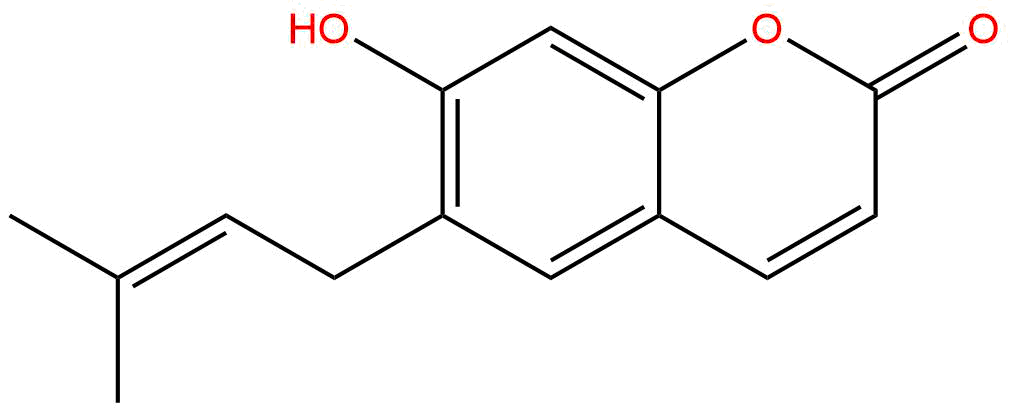


Product name: 7-Demethylsuberosin
Synonym name: Demethylsuberosin
Catalogue No.: BP3977
Cas No.: 21422-04-8
Formula: C14H14O3
Mol Weight: 230.263
Botanical Source: Feronia limonia
Physical Description:
Type of Compound:
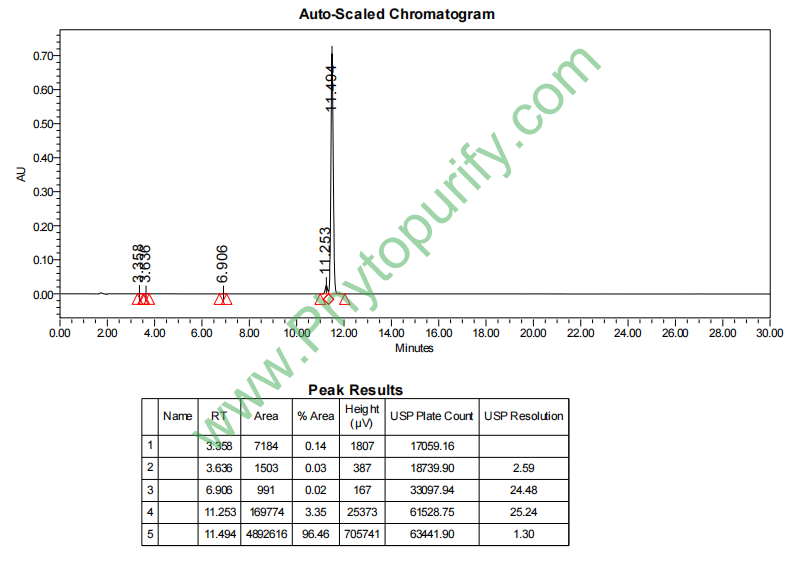
Purity: 95%~99%
Analysis Method: HPLC-DAD or/and HPLC-ELSD
Identification Method: Mass, NMR
Packing: Brown vial or HDPE plastic bottle
Storage: Store in a well closed container, protected from air and light. Put into refrigerate or freeze for long term storage.
Whenever possible, you should prepare and use solutions on the same day. However, if you need to make up stock solutions in advance, we recommend that you store the solution as aliquots in tightly sealed vials at -20℃. Generally, these will be useable for up to two weeks.
The product could be supplied from milligrams to grams
Inquire for bulk scale.
For Reference Standard and R&D, Not for Human Use Directly.
HPLC of 7-Demethylsuberosin
Storage conditions:Short-term storage at 2~8℃, long-term storage at -20 ~ -80℃
50.4400
3.3524
3.3302
.0655
2.8654
19.9566
High
87.8922
2.4689
Yes
Yes
Yes
No
Yes
Yes
0.9
Yes
Yes
Yes
Yes
Natural products, as an important source of drug discovery, play an irreplaceable role in the long history of human fight against diseases. Coumarin compounds, as a class of benzopyranone derivatives widely present in plants, have always been a hot topic in natural product chemistry and pharmacology research due to their structural diversity and significant biological activity. Among them, prenylated coumarins exhibit more complex and powerful pharmacological activities than simple coumarins due to their unique prenylated side chain modification, such as anti-inflammatory, anti-tumor, antioxidant, and neuroprotective effects. 7-Demethylsuberosin (7-DMS), as a typical isopentenyl hydroxycoumarin, has gradually attracted widespread attention from researchers in recent years.
7-demethylated cork pepper extract, chemical name 7-hydroxy-6- (3-methyl-2-buten-1-yl) coumarin, is a 7-hydroxycoumarin with an isopentenyl group (3-methylbut-2-en-1-yl) attached at the C-6 position. It originally originated from Rutaceae plants such as African cherry oranges(Citropsis articulata)It was isolated and identified, and subsequently discovered in various plants such as Apiaceae. Its unique chemical structure, namely the presence of both phenolic hydroxyl and isopentenyl side chains on the coumarin parent nucleus, endows it with unique physicochemical properties and diverse biological activities. From the perspective of Structure Activity Relationship (SAR), the phenolic hydroxyl group at position C-7 is an important active group that can participate in hydrogen bonding, redox reactions, and other reactions. The isopentenyl side chain enhances the lipophilicity of the molecule, which is beneficial for its binding to biofilms and hydrophobic target proteins, and may affect its pharmacokinetic properties and pharmacological effects.
In recent years, significant progress has been made in the pharmacological activity research of 7-demethylated cork pepper extract. Research has shown that this compound has potential application value in multiple fields such as anti-inflammatory, analgesic, neuroprotective, and anti-tumor. Especially its anti-inflammatory activity involves the regulation of multiple key inflammatory mediators and signaling pathways, such as inhibiting the expression of interleukin-6 (IL-6) and tumor necrosis factor (TNF), as well as regulating signaling pathways such as STAT3 and NF - κ B. These findings not only reveal its potential as a novel anti-inflammatory lead compound, but also provide molecular level explanations for understanding its pleiotropic pharmacological effects. Although research on 7-demethylated cork pepper extract is still in its early stages, its clear chemical structure, significant biological activity, and preliminary pharmacological evaluation make it a highly promising natural product molecule. This article aims to systematically review the chemical structure, plant origin, pharmacological activity, mechanism of action, and medicinal characteristics of 7-demethylated cork pepper extract, in order to provide comprehensive references for the in-depth research and development of this compound.
The chemical structure of 7-Demethylsuberosin belongs to the simple coumarin class, and its core skeleton is benzo [a] - pyranone. The specific structural features are as follows:
- parent nucleus 7-hydroxycoumarin, also known as umbelliferone.
- substituent There is an isopentenyl side chain attached to the C-6 position of the parent nucleus, namely 3-methylbut-2-en-1-yl.
- Molecular formula:C₁₄H₁₄O₃
- molecular weight:230.2630 g/mol
- IUPAC Name:7-hydroxy-6-(3-methylbut-2-enyl)chromen-2-one
- CAS number:21422-04-8
The key features of this structure are the free phenolic hydroxyl group at the C-7 position and the isopentenyl group at the C-6 position. Phenolic hydroxyl groups endow molecules with certain polarity and the ability to form hydrogen bonds, making them key sites for many biological activities such as antioxidant activity and binding to target proteins. Isopentenyl is a hydrophobic group that can significantly enhance the lipophilicity of molecules, helping them penetrate cell membranes and the blood-brain barrier, and may enhance binding affinity by interacting with the hydrophobic pockets of target proteins. This structural feature of "polar head+hydrophobic tail" may exhibit unique distribution and activity patterns in organisms.
According to theoretical calculations and experimental data, the main physicochemical properties of 7-demethylated cork pepper extract are as follows:
- LogP (Fat Water Partition Coefficient): 3.3524. This value indicates that the compound has moderate to high lipid solubility, meeting the requirement of LogP ≤ 5 in Lipinski's "Five Rules". A higher LogP value is beneficial for its passive diffusion through biofilms, but it may also affect its solubility in aqueous media.
- TPSA (Topological Polarity Surface Area): 50.44 Å ². TPSA is an indicator of molecular polarity and hydrogen bonding ability, and molecules with TPSA<140 Å ² are generally considered to have good oral absorption and membrane permeability. The TPSA value of 7-DMS is moderate, mainly derived from the oxygen atoms on the phenolic hydroxyl and lactone rings, which is consistent with its good prediction of blood-brain barrier permeability.
- Water solubility 0.0655 mg/mL (approximately 0.28 mM). This compound has low solubility in water and belongs to poorly soluble drugs. This is consistent with its higher LogP value and is a typical characteristic of fat soluble natural products. Low water solubility may limit its oral bioavailability, which is a key concern and issue that needs to be addressed in subsequent drug development (such as through formulation techniques or structural modifications).
- Blood-brain barrier (BBB) permeability Predicted as high. Combined with its high LogP and moderate TPSA, 7-DMS has the potential to penetrate the blood-brain barrier. This property is of great significance for the development of therapeutic drugs for central nervous system (CNS) diseases, such as neuroinflammation and pain.
- HERG inhibition: No. HERG (human Ether - à - go Related Gene) potassium channel inhibition is one of the main causes of drug cardiac toxicity. The predicted results show that 7-DMS does not have hERG inhibitory activity, indicating a low risk of cardiac toxicity, which is a positive indication of drug efficacy.
- Ames test The predicted result is 0.9 (positive probability). The Ames test is used to evaluate the mutagenicity of compounds. The predicted value of 0.9 suggests that the compound has a certain genetic toxicity risk, which needs to be validated and evaluated through experiments in subsequent studies.
7-demethylated cork pepper extract was initially discovered in plants of the Rutaceae family, but has since been reported in multiple families and genera, indicating its wide distribution in the plant kingdom. The main sources of plants include:
Rutaceae family:
Apiaceae family:
Other families and genera:
It is worth noting that the content of 7-DMS varies greatly in different plants and often coexists with structurally similar coumarins, such as suberosin (7-methoxy-6-isoprentenyl coumarin). The selection and optimization of plant sources are crucial for the large-scale acquisition of this compound.
Given that the content of 7-demethylated cork pepper extract in plants is usually low and often coexists with a large number of other lipophilic components, its extraction, separation, and purification require a series of chromatographic techniques. The typical process is as follows:
In recent years, the pharmacological activity of 7-demethylated cork pepper extract has been increasingly studied, revealing its potential therapeutic effects in multiple disease models.
Anti inflammation is the most concentrated area of research on 7-demethylated cork pepper extract. Multiple in vitro and in vivo experiments have confirmed its significant anti-inflammatory effect.
- In vitro research In the lipopolysaccharide (LPS) - stimulated macrophage model (such as RAW 264.7 cells), 7-DMS can significantly inhibit the production of pro-inflammatory cytokines such as nitric oxide (NO), prostaglandin E2 (PGE2), tumor necrosis factor - α (TNF - α), interleukin-6 (IL-6), and interleukin-1 β (IL-1 β). At the same time, it can also downregulate the expression of inducible nitric oxide synthase (iNOS/NOS2) and cyclooxygenase-2 (COX-2/PTGS2).
- In vivo research In the rat foot swelling model induced by carrageenan, the mouse torsion reaction model induced by acetic acid, and the mouse ear swelling model induced by phorbol ester (TPA), 7-DMS showed dose-dependent anti-inflammatory and analgesic effects. Its effect is comparable to positive control drugs (such as indomethacin) and shows lower gastrointestinal side effects in some models.
Due to its excellent blood-brain barrier permeability, the potential of 7-demethylated cork pepper extract in neurological diseases has attracted much attention.
- Analgesic effect In addition to exhibiting analgesic effects in inflammation models, studies have also found that 7-DMS may exert analgesic effects by acting on the transient receptor potential (TRP) channel family. Especially, it has been reported as an antagonist of TRPV1 (capsaicin receptor) and TRPA1 (mustard oil receptor). TRPV1 and TRPA1 are key ion channels mediating pain signaling, and their antagonists are important directions for developing novel non opioid analgesics. 7-DMS can inhibit TRPV1 and TRPA1 currents activated by capsaicin or mustard oil, thereby reducing pain.
- neuroprotection In neuroinflammatory models (such as LPS activated microglia), 7-DMS can inhibit excessive activation of microglia and reduce the release of neurotoxic substances (such as TNF - α, NO), thereby protecting neurons from damage. In addition, it may also exert neuroprotective effects through antioxidant stress and anti apoptotic mechanisms, indicating its potential application value in neurodegenerative diseases such as Alzheimer's disease and Parkinson's disease.
Preliminary studies have shown that 7-demethylated cork pepper extract has cytotoxicity against certain tumor cell lines.
- cytotoxic activity: In vitro experiments, 7-DMS showed certain inhibitory effect on proliferation of many cancer cell lines, such as human hepatoma cell line (HepG2), human breast cancer cell line (MCF-7), human colon cancer cell line (HT-29), and its IC50 value is usually in the micromolar level. Its mechanism of action may be related to inducing cell apoptosis and cell cycle arrest.
- Angiogenesis inhibition There are studies suggesting that 7-DMS may indirectly exert anti-tumor effects by inhibiting the expression of vascular endothelial growth factor (VEGF) or interfering with its signaling pathway to suppress the formation of tumor neovascularization.
The various pharmacological activities of 7-demethylated cork pepper extract stem from its regulation of multiple molecular targets and signaling pathways. Its mechanism of action exhibits the characteristics of multi-target and multi pathway.
Summary 7-demethylated cork pepper extract is a typical multi-target natural product. The core targets of its anti-inflammatory and analgesic effects include IKBKB, RELA, STAT3, CASP1, TRPV1, TRPA1, PTGS1/2, NOS2, and TNF. This multi-target mode of action is the basis for its comprehensive pharmacological effects, but it also poses challenges to elucidating its exact mechanism.
To develop natural products into clinical drugs, a systematic evaluation of their drug like and pharmacokinetic (ADME) properties is necessary.
Based on computational predictions and preliminary experimental data, evaluate the pharmacological properties of 7-demethylated cork pepper extract:
- Complies with the Lipinski Five Rules The molecular weight (230.26<500), LogP (3.35<5), number of hydrogen bond donors (1 phenolic hydroxyl group<5), and number of hydrogen bond acceptors (3 oxygen atoms<10) fully meet the basic requirements for oral medication.
- Good membrane permeability High LogP and moderate TPSA indicate good passive diffusion permeability, including crossing the blood-brain barrier.
- Low risk of cardiac toxicity Predicting no hERG inhibitory activity is a significant advantage.
- Potential genetic toxicity risk The Ames test predicted a positive result (0.9), which is a signal that requires high vigilance. Verification must be conducted through in vitro (such as Ames test, micronucleus test) and in vivo (such as chromosome aberration test) experiments. If genetic toxicity is confirmed, it will seriously hinder its development as an oral drug and may require structural modification to eliminate this risk.
- Low water solubility This is the biggest weakness in the pharmacological properties of 7-DMS. The solubility of 0.0655 mg/mL is much lower than the ideal oral drug requirement (usually>0.1 mg/mL). Low solubility may lead to incomplete oral absorption, low bioavailability, and affect the efficacy of drugs in vivo.
At present, there are few experimental studies on the pharmacokinetics of 7-demethylated cork pepper extract in vivo, but it can be inferred based on its physicochemical properties and studies of similar compounds:
- absorb Due to its high lipid solubility and low water solubility, oral absorption may be limited by dissolution rate. It is expected to have good absorption, but its bioavailability may be lower due to first pass metabolism. It may be necessary to use formulation techniques such as solid dispersions, liposomes, cyclodextrin inclusion complexes, etc. to improve their solubility and bioavailability.
- distribution High LogP and BBB permeability suggest a wide tissue distribution, especially the ability to enter the central nervous system. The plasma protein binding rate may be high.
- Metabolism Coumarin compounds are mainly metabolized by the cytochrome P450 enzyme system (especially CYP2A6, CYP3A4, etc.) in the liver. The metabolic pathways of 7-DMS may include:
- Oxidation of Isopentenyl Side Chain Such as epoxidation, hydroxylation, to generate diols or carboxylic acid derivatives.
- Ring opening of coumarin lactone ring Generate corresponding cis ortho hydroxycinnamic acid derivatives and further metabolize them.
- Glucuronidation or sulfation of phenolic hydroxyl groups This is a common phase II metabolic reaction that generates more water-soluble complexes, which facilitate excretion.
- excretion Metabolites are mainly excreted through urine and bile. The excretion of prototype drugs may be less.
7-demethylated cork pepper extract has shown broad application prospects due to its unique chemical structure and various pharmacological activities, but it also faces many challenges.
7-demethylated cork pepper extract, as a structurally unique isopentenyl hydroxycoumarin, originates from traditional medicinal plants and has a wide spectrum of pharmacological activities, particularly outstanding in anti-inflammatory, analgesic, and neuroprotective effects. Its mechanism of action involves the regulation of multiple key targets such as NF - κ B, STAT3, NLRP3 inflammasome, and TRPV1/TRPA1 ion channels, reflecting the multi-target and multi pathway nature of natural products. The preliminary pharmacological evaluation shows that it complies with Lipinski's rules, has good membrane permeability and low risk of cardiac toxicity, but its low water solubility and potential genetic toxicity are the shortcomings in its development as an oral drug.
Despite facing many challenges, 7-demethylated cork pepper extract is undoubtedly a natural product lead compound with great research value and development potential. Future research should focus on: 1) solving its solubility and toxicity problems through modern medicinal chemistry methods and formulation technologies; 2) Deeply elucidate its mechanism of action using systems pharmacology and chemical biology methods; 3) Conduct comprehensive preclinical pharmacological and toxicological evaluations. With the continuous deepening of research, 7-demethylated cork pepper extract and its derivatives are expected to provide new candidate drugs for the treatment of inflammatory diseases, chronic pain, and neurodegenerative diseases, contributing to human health.
