


Synonym name:
Catalogue No.: BP0105
Cas No.: 6926-14-3
Formula: C17H26O11
Mol Weight: 406.384
Botanical Source: Melittis melissophyllum and Ajuga reptans
Purity: 95%~99%
Analysis Method: HPLC-DAD or/and HPLC-ELSD
Identification Method: Mass, NMR
Packing: Brown vial or HDPE plastic bottle
Can be supplied from milligrams to grams.
For Reference Standard and R&D, Not for Human Use Directly.
Inquire for bulk scale.
HPLC of 8-Acetylharpagide
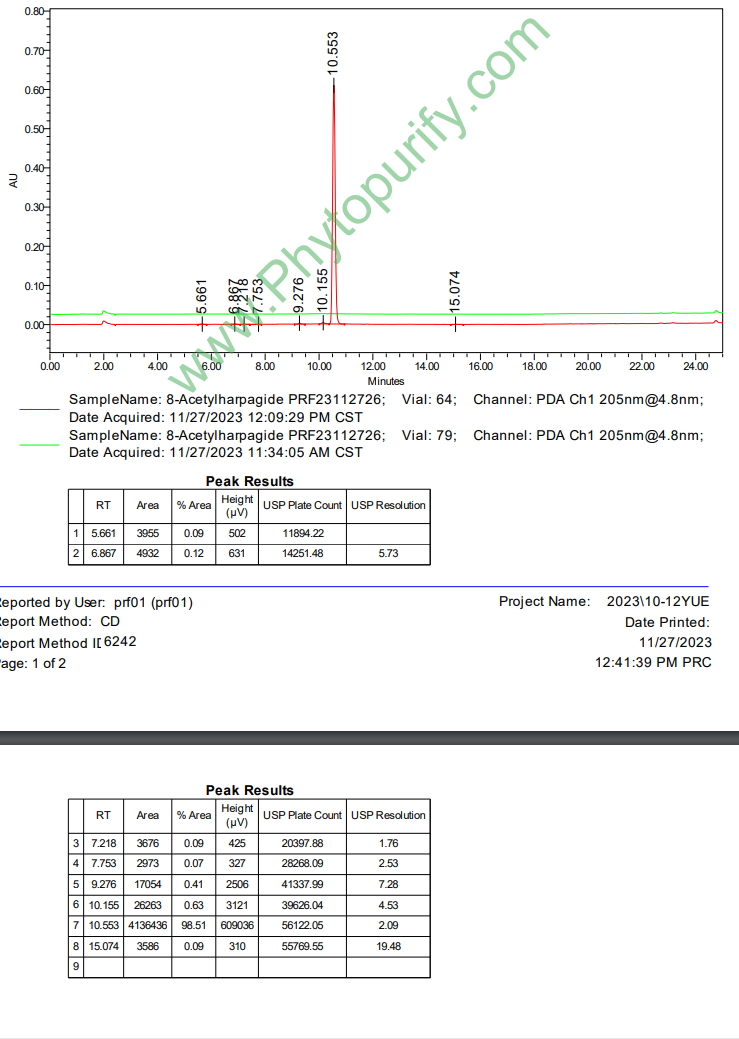
Storage conditions:Short-term storage at 2~8℃, long-term storage at -20 ~ -80℃
189.9800
-2.0000
-2.5000
Low
No
No
No
Unknown
No
Unknown
No
8-Acetylharpagide is a natural product with significant pharmacological activity, belonging to the glycoside and iridoid monoterpene compounds. As one of the representative members of cyclohexene ether terpenes, acetyl rhamnoside is widely present in traditional Chinese medicinal materials, especially in multiple plants with anti-inflammatory, analgesic, and immunomodulatory effects. In recent years, with the advancement of molecular biology and pharmacology techniques, acetyl rhamnoside has shown unique potential in the prevention and treatment of chronic kidney diseases such as glomerular diseases, and has become one of the hotspots in the field of natural medicine research.
Glomerular disease, as a type of disease characterized by abnormal structure and function of the glomerulus, involves the disruption of multiple molecular signaling pathways. Research has shown that acetyl rhamnoside exerts anti-inflammatory, anti fibrotic, and cell protective effects by regulating key molecular targets such as STAT3, SIRT1, SLC5A2, LGALS3, and OGA, providing new ideas and strategies for the treatment of kidney diseases. This article will provide a systematic review of the chemical structure, plant sources, extraction methods, pharmacological activities, and mechanisms of action of acetyl rhamnoside, with a focus on exploring its potential application value in glomerular diseases, and comprehensively evaluating its pharmacological properties and clinical prospects.
The chemical structure of acetyl rhamnoside belongs to the iridoid monoterpene glycoside class, with a molecular formula of C19H30O9 and a molecular weight of 390.38. The core of its structure is a terpenoid skeleton containing epoxy groups, connected by glycosidic moieties, and acetylated at the 8th position of the molecule. The introduction of this acetyl group not only affects the lipophilicity and stability of the molecule, but may also regulate its biological activity.
In terms of physical and chemical properties, the LogP value of acetyl rhamnoside is about -2.0, indicating its strong hydrophilicity, which is closely related to the multiple hydroxyl groups in its glycoside structure. Its topological polar surface area (TPSA) is as high as 189.98 Å ², and the number of hydrogen bond receptors is 11, indicating that the molecule has abundant hydrogen bonding ability, which is conducive to binding with protein targets, but also limits its ability to pass through the blood-brain barrier (low blood-brain barrier penetration). In addition, acetylhababinoid showed no significant hepatotoxicity or cardiotoxicity in vivo, and did not inhibit hERG channels, providing a good basis for its safety.
Acetyl rhamnoside is mainly present in multiple traditional Chinese medicinal herbs, especially in plants such as Harpagophytum spp. and other plants rich in cyclohexene ether terpenes, where its content is relatively high. Its main plant sources include:
The extraction method mainly adopts organic solvent extraction combined with column chromatography separation technology. Common processes include:
In recent years, supercritical CO ₂ extraction and membrane separation technologies have also been attempted to improve extraction efficiency and environmental friendliness.
The pharmacological activities of acetyl rhamnoside cover multiple aspects such as anti-inflammatory, antioxidant, immune regulation, and cell protection, especially in the prevention and treatment of glomerular diseases.
Multiple in vitro and in vivo studies have shown that acetyl rhamnoside can significantly inhibit the production of inflammatory mediators, such as tumor necrosis factor alpha (TNF - α), interleukin-6 (IL-6), and nitric oxide (NO). The mechanism mainly involves inhibiting the activation of the nuclear factor kappa B (NF - κ B) signaling pathway, reducing the expression of pro-inflammatory cytokines, and thus alleviating the inflammatory response.
Acetylgabargide can scavenge free radicals, enhance the activity of intracellular antioxidant enzymes such as superoxide dismutase (SOD) and glutathione peroxidase (GPx), and alleviate oxidative stress damage. Oxidative stress is one of the important pathological mechanisms in the progression of glomerular diseases, and the antioxidant effect of acetyl rhamnoside helps to protect glomerular cells from oxidative damage.
Acetylgabagoside can regulate immune cell function, promote the proliferation of regulatory T cells (Tregs), inhibit the activation of inflammatory T cell subsets, and maintain immune homeostasis. In addition, it regulates macrophage polarization, promotes M2 anti-inflammatory phenotype, and contributes to the resolution of inflammation and tissue repair.
In the renal fibrosis model, acetyl rhamnoside slows down the progression of glomerulosclerosis and interstitial fibrosis by inhibiting fibrosis related factors such as transforming growth factor beta 1 (TGF - β 1) and collagen deposition. Its cell protective effects include reducing apoptosis and promoting activation of cell survival signaling pathways.
The multi-target mechanism of action of acetyl rhamnoside is the basis of its pharmacological effects. For glomerular diseases, the following key molecular targets are mainly involved:
STAT3 plays a central regulatory role in inflammation and fibrosis processes. Acetylgabagoside inhibits the phosphorylation and nuclear translocation of STAT3, blocks the expression of downstream pro-inflammatory and pro fibrotic genes, and reduces the inflammatory response and fibrosis progression of glomerular cells.
SIRT1, as an NAD ⁺ - dependent deacetylase, is involved in regulating cellular metabolism, antioxidant, and anti-inflammatory responses. Acetylgabagoside can activate SIRT1, enhance cellular antioxidant capacity, inhibit inflammatory signaling pathways, and promote the survival and functional recovery of glomerular cells.
SLC5A2 plays an important role in renal tubular glucose reabsorption and regulates renal metabolic homeostasis. The regulation of SLC5A2 by acetyl rhamnoside may affect renal energy metabolism and glucose metabolism abnormalities, indirectly improving glomerular function.
LGALS3 is involved in cell adhesion, inflammation, and fibrosis processes. Acetylgabagoside reduces the expression of LGALS3, inhibits inflammatory cell infiltration and fibrosis response, and slows down glomerular lesions.
OGA regulates O-GlcNAc modification of proteins, affecting cellular signaling and metabolism. Acetylgabagoside may regulate OGA activity, affect the glycosylation status of glomerular cells, improve cellular function and stress resistance.
The synergistic regulation of these targets constitutes the molecular basis for the treatment of glomerular diseases with acetyl rhamnoside.
The pharmacological evaluation of acetyl rhamnoside shows that it has good safety and potential drug development value:
In terms of pharmacokinetics, existing research is relatively limited. Preliminary in vivo experiments have shown that oral administration of acetyl rhamnoside can achieve effective concentrations in plasma, and the metabolic pathway mainly involves liver esterase mediated deacetylation reactions, producing active metabolites. Its excretion is mainly completed through the kidneys, which is in line with its pharmacological characteristics of kidney targeting. Further systematic ADME (absorption, distribution, metabolism, excretion) research is needed in the future to optimize dosing regimens and dosage form design.
Acetyl rhamnoside, as a natural iridoid glycoside, has shown broad application prospects in the prevention and treatment of glomerular diseases due to its multi-target and multi mechanism pharmacological activities. Currently, there is a lack of effective specific therapeutic drugs for glomerular diseases, and clinical practice often relies on immunosuppressants and symptomatic treatment, resulting in limited efficacy and significant side effects. Acetylgabagoside provides a new strategy for the comprehensive treatment of glomerular diseases by regulating key pathological processes such as inflammation, oxidative stress, and fibrosis.
Future research directions include:
In addition, the potential of acetyl rhamnoside in other inflammatory diseases, metabolic diseases, and immune regulation fields is also worth further exploration.
Acetyl rhamnoside, as a structurally unique iridoid glycoside, has shown significant value in the treatment of glomerular diseases due to its remarkable anti-inflammatory, antioxidant, and anti fibrotic activities. Its multi-target mechanism of action provides a model for natural product pharmacology and opens up new paths for innovative drug development in kidney disease. Although there are still shortcomings in pharmacokinetics and clinical validation, with the deepening of research, acetyl rhamnoside is expected to become an important candidate drug for the treatment of glomerular diseases in the future. Continuous basic and translational research will drive it from the laboratory to clinical applications, benefiting a wide range of patients.
