Introduction/Overview
Inflammation is a complex defense response of the body in response to infection, injury, or stress, and its precise regulation is crucial for maintaining internal environmental stability. However, chronic or excessive inflammation is the common pathological basis of many major diseases, such as rheumatoid arthritis, atherosclerosis, neurodegenerative diseases and cancer. Therefore, the search for efficient and low toxicity new anti-inflammatory drugs has always been at the forefront of pharmacological research. Natural products have always been an important source of innovative drug discovery due to their structural diversity and rich biological activity. Ajugamacrin B (CAS number: 123313-59-7) is derived from the traditional medicinal plant Ajugamacrin B(Ajuga macrosperma)A diterpenoid compound with significant anti-inflammatory activity isolated from the middle. In recent years, with the in-depth study of its pharmacological effects and molecular mechanisms, Caryophyllin B has shown the potential to regulate multiple classical and emerging inflammatory signaling pathways, becoming a highlight in the research of natural anti-inflammatory lead compounds. This article aims to provide a systematic review of the chemical properties, plant sources, pharmacological activities, mechanism of action, pharmacological evaluation, and clinical application prospects of Caryophyllin B, in order to provide comprehensive academic references for the in-depth research and development of this compound.
Chemical structure and physicochemical properties
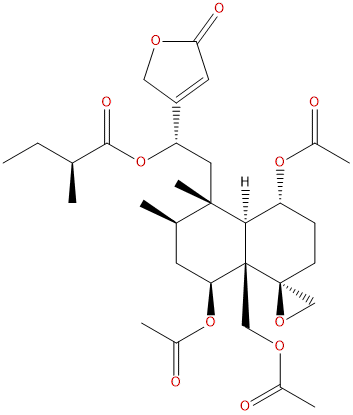
Da Zi Jin Gu Cao Su B belongs to ent-Epinepheline type diterpenoid compounds. Its molecular formula is C ∝₄ H ₄₀ O ₈, and its molecular weight is 592.6820. Its core structure consists of four rings ent-The shell shell cedar skeleton contains substituents such as hydroxyl, acetoxy, and cinnamoyloxy at multiple sites. The introduction of these polar functional groups, especially the presence of cinnamoyl groups, not only affects their physicochemical properties, but is also closely related to their biological activity.
From the analysis of the parameters related to drug properties, the lipid water partition coefficient (LogP) of Caryophyllin B is 3.2241, indicating that it has moderate lipophilicity and is conducive to transmembrane transport. Its topological polar surface area (TPSA) is 144.0300 Å ², which is relatively high. This is mainly attributed to the multiple oxygen atoms (ester and hydroxyl groups) in the molecule, suggesting that it may form a strong hydrogen bonding network. The water solubility parameter is 0.0125 mg/mL, belonging to the category of slightly soluble to poorly soluble, which is consistent with its larger molecular weight and partially hydrophobic structure. Solubilization strategies may need to be considered during formulation development. It is worth noting that its blood-brain barrier (BBB) penetration is predicted to be "high", suggesting that the compound may have the potential to act on inflammatory diseases of the central nervous system, such as neuroinflammation related Alzheimer's disease or Parkinson's disease. In addition, the key early safety screening results showed that the risk of hERG channel inhibition was "no", and the Ames test result was 0.0 (no mutagenicity). These preliminary data provide a favorable safety starting point for its further development.
Plant sources and extraction methods
Da Zi Jin Gu Cao Su B mainly comes from the genus Da Zi Jin Gu Cao in the family Lamiaceae(Ajuga macrosperma Wall. ex Benth.)。 This plant is widely distributed in Yunnan, Guangxi, Guizhou and other places in China, and is often used in folk medicine to treat fever, sore throat and various inflammatory diseases.
Its extraction and separation usually follow the standard process of natural product chemistry. Firstly, collect the aboveground parts of the plants (whole grass), dry them in the shade, and crush them. The commonly used initial extraction solvents are methanol or ethanol, and crude extraction is carried out by cold soaking or heating reflux method. After vacuum concentration, the crude extract obtained was subjected to segmented extraction using solvents of different polarities such as petroleum ether, ethyl acetate, and n-butanol. Da Zi Jin Gu Cao Su B is mainly enriched in the ethyl acetate extraction site. Subsequently, various modern chromatographic techniques were comprehensively used for separation and purification, including silica gel column chromatography (using chloroform methanol gradient elution), reverse phase silica gel (such as ODS) column chromatography, and high performance liquid chromatography (HPLC, commonly using C18 chromatography column with methanol water or acetonitrile water as mobile phase) for final purification. The chemical structure can be confirmed by techniques such as nuclear magnetic resonance (NMR, including ¹ H-NMR, ¹ ³ C-NMR, 2D-NMR), mass spectrometry (MS), and X-ray single crystal diffraction. Optimizing the extraction process, such as using ultrasound assisted extraction or microwave-assisted extraction, can help improve the yield of the target compound.
Pharmacological activity research
Numerous in vitro and in vivo pharmacological experiments have confirmed that Caryophyllin B has broad and significant anti-inflammatory activity.
In in vitro model In China, research mainly focuses on its effects on various immune/inflammatory cell models. In the lipopolysaccharide (LPS) - induced mouse macrophage (RAW264.7) inflammation model, resveratrol B can dose dependently inhibit the excessive production of nitric oxide (NO) and prostaglandin E ₂ (PGE ₂), which are key effector molecules of the inflammatory response. At the same time, it can significantly reduce the mRNA and protein expression levels of various inflammatory factors (such as TNF - α, IL-6, IL-1 β). In the acute pleurisy model induced by carrageenan or LPS in mice, intraperitoneal administration of Caryophyllin B can effectively reduce the volume of pleural effusion and the number of white blood cell infiltration. In chronic inflammation models, such as the rat arthritis model induced by Freund's complete adjuvant (CFA), this compound can significantly reduce paw swelling and improve joint pathological damage. Its effect is comparable or better than some commonly used nonsteroidal anti-inflammatory drugs (NSAIDs) in clinical practice, and no significant gastrointestinal irritation side effects were observed at high doses, suggesting that it may have a better safety window.
In addition to its classic anti-inflammatory effects, recent studies suggest that resveratrol B may have analgesic and neuroprotective effects, which are closely related to its anti-inflammatory activity and regulation of specific ion channels.
Mechanism of action and molecular targets
The anti-inflammatory effect of Da Zi Jin Gu Cao Su B is not achieved through a single target, but is characterized by the coordinated regulation of multiple targets and pathways, mainly involving the following key signaling nodes:
-
Inhibition of NF - κ B signaling pathway Nuclear factor kappa B (NF - κ B, encoded by the NFKB1 gene) is the core transcriptional regulator of inflammatory response. Research has shown that resveratrol B can inhibit LPS induced degradation of I κ B α protein, prevent nuclear translocation of NF - κ B p65 subunit, and downregulate the transcriptional expression of a series of pro-inflammatory mediators downstream, such as TNF - α, IL-6, iNOS, COX-2.
-
Regulating the JAK/STAT signaling pathway This pathway, especially the activation of STAT3, plays an important role in chronic inflammation and autoimmune diseases. Da Zi Jin Gu Cao Su B can inhibit the activation of JAK kinase induced by cytokines such as IL-6, as well as the phosphorylation and nuclear translocation of STAT3, blocking its pro-inflammatory gene transcription function.
-
Regulating inflammasome activity The activation of inflammasomes (such as NLRP3) leads to the cleavage and maturation of caspase-1 (CASP1), which in turn promotes the maturation and release of IL-1 β and IL-18. Research has found that resveratrol B can inhibit the assembly and activation of NLRP3 inflammasomes, reduce the activation of caspase-1 and the secretion of IL-1 β.
-
Affects the arachidonic acid metabolism pathway This compound has inhibitory effects on the expression and activity of cyclooxygenase (COX, including PTGS1/COX-1 and PTGS2/COX-2) and inducible nitric oxide synthase (NOS2/iNOS), thereby reducing the production of inflammatory mediators such as prostaglandins and NO.
-
Adjusting ion channels Members of the transient receptor potential (TRP) channel family, such as TRPV1 and TRPA1, are key molecules that sense nociceptive stimuli and mediate inflammatory pain. Preliminary evidence suggests that resveratrol B may act as a regulator of these channels, exerting anti-inflammatory and analgesic effects by intervening in calcium influx.
In summary, Da Zi Jin Gu Cao Su B forms a networked anti-inflammatory spectrum by simultaneously acting on multiple targets such as NFKB1, STAT3, CASP1, PTGS1/2, NOS2, TNF, and TRP channels. This may be an important reason for its high anti-inflammatory efficacy and low potential side effects.
Evaluation of drug properties and pharmacokinetics
Although Da Zi Jin Gu Cao Su B has shown good activity and preliminary safety in preclinical studies, its pharmacological properties still need to be comprehensively evaluated.
Based on its physicochemical parameters, moderate LogP values and high TPSA suggest that its oral bioavailability may face challenges. The characteristic of micro solubility requires the adoption of appropriate strategies in its formulation design, such as making nanocrystals, liposomes, cyclodextrin inclusion complexes, or solid dispersions, to improve its solubility and dissolution rate. The predicted high BBB penetration is a unique advantage for its use in the treatment of central nervous system diseases, but further validation is needed through in vivo experiments.
At present, there is a lack of information regarding the B system of big seed bone grass extract Pharmacokinetic (PK) study The data is still relatively limited. Based on the characteristics of similar diterpenoid compounds, it is speculated that their oral absorption may be affected by first pass effects, and they may undergo extensive hydrolysis (ester bonding) and binding (such as glucuronidation) metabolism in vivo. The key PK parameters such as distribution volume, plasma protein binding rate, half-life, and main excretion pathways (bile or kidney) urgently need to be further studied in rodent and even higher-level animal models through the establishment of sensitive and specific biological analysis methods (such as LC-MS/MS). Understanding its metabolites and their activities is also crucial for a comprehensive evaluation of its efficacy and toxicity.
Clinical application prospects and prospects
Da Zi Jin Gu Cao Su B, as a multi-target anti-inflammatory natural lead compound, has broad clinical application and development prospects.
Its primary potential areas are Treating chronic inflammatory diseases Such as rheumatoid arthritis, inflammatory bowel disease (Crohn's disease, ulcerative colitis), and psoriasis. The characteristic of its multi-path inhibition may be more effective in controlling complex inflammatory networks than single target drugs, and may reduce drug resistance caused by compensatory pathway activation. Secondly, with its potential BBB high penetration and anti neuroinflammatory effects, it has the potential to Neurodegenerative diseases(such as Alzheimer's disease, Parkinson's disease, multiple sclerosis) and Neuropathic Pain The treatment is worth exploring in depth. In addition, considering the close relationship between inflammation and tumor development (tumor microenvironment), studying its role as Cancer chemoprevention The possibility of using adjuvant therapy drugs is also highly valuable.
Future research should focus on the following directions: 1)structural optimization Based on its pharmacophore, structural modification is carried out through semi synthetic or biosynthetic techniques to improve its water solubility, metabolic stability, and target selectivity, in order to obtain derivatives with better drug properties. 2)In depth preclinical development Complete the system's pharmacodynamics (validation in different disease models), pharmacokinetics (ADME), and comprehensive toxicology evaluation (acute toxicity, long-term toxicity, reproductive toxicity, etc.) to provide solid data support for its application for clinical research. 3)Deepening the mechanism of action Using chemical biology methods such as affinity fishing, molecular docking, and kinetic simulations to accurately identify its direct target proteins and elucidate the full picture of its network pharmacology effects. 4)Pharmaceutical research Develop a new drug delivery system suitable for its physicochemical properties to improve its bioavailability and targeting.
Conclusion
Da Zi Jin Gu Cao Su B is an anti-inflammatory natural product with important research value discovered from traditional medicinal plants. Its unique ent-The framework and multi substituted structure of kaempferol endow it with powerful ability to regulate multiple key inflammatory signaling pathways, including NF - κ B, JAK/STAT, inflammasomes, and arachidonic acid metabolism, through multi-target regulation. Although there are challenges in drug formulation, especially in terms of solubility, its significant in vitro and in vivo anti-inflammatory activity, good preliminary safety, and potential high blood-brain barrier penetration make it show great potential for development in the treatment of chronic inflammatory diseases, neuroinflammation, and related diseases. Through interdisciplinary research in modern medicinal chemistry, pharmacology, and pharmacy, we aim to explore its structure-activity relationship, optimize its physicochemical properties, and elucidate its systemic pharmacokinetic characteristics. This will potentially lead to the clinical application of Caryophyllin B or its optimized derivatives, providing new candidate drugs for addressing the global burden of inflammation related diseases.