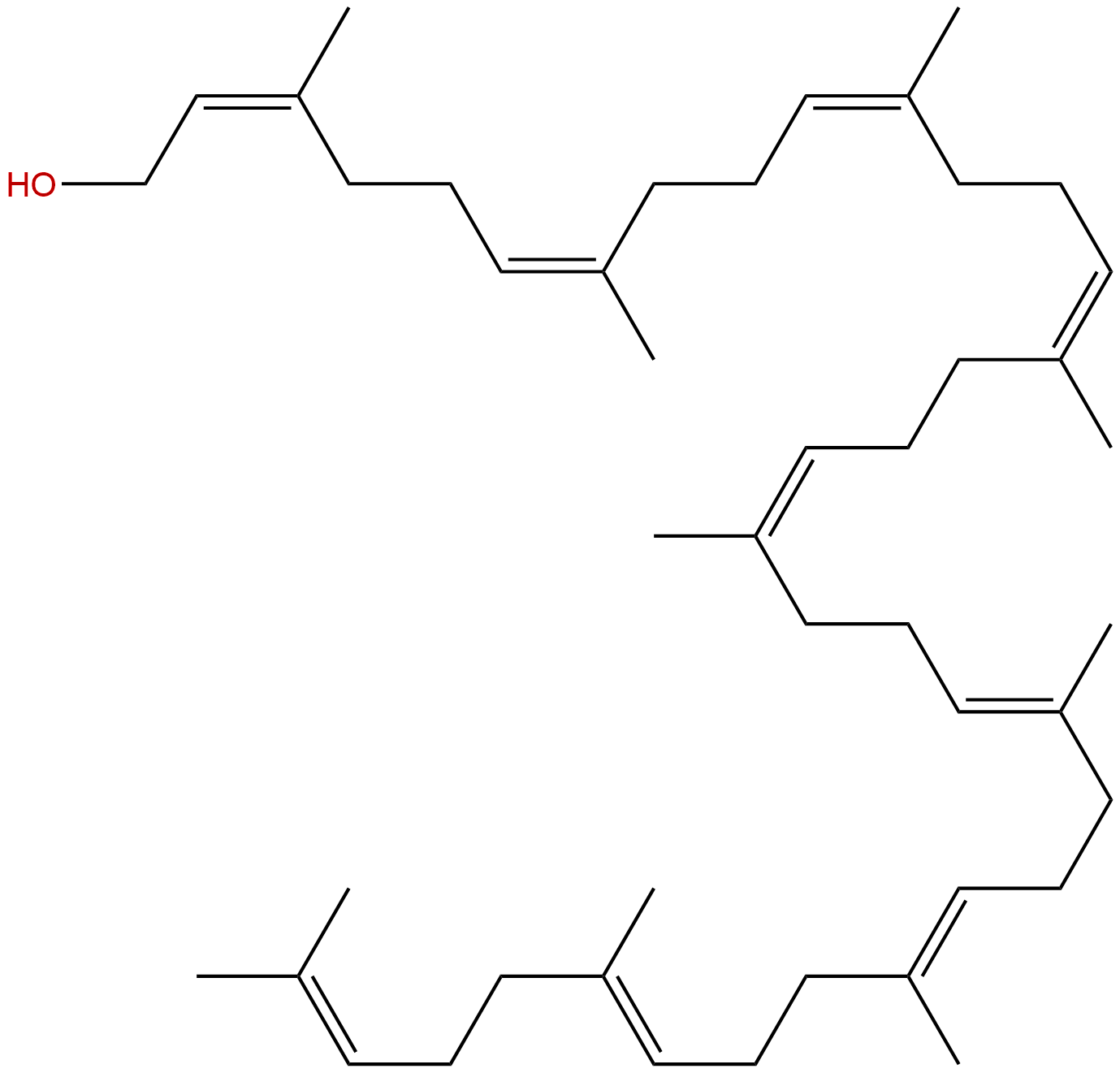


Synonym name: Betulanonaprenol; Nonaisoprenol; Betulaprenol
Catalogue No.: BP1321
Cas No.: 13190-97-1
Formula: C45H74O
Mol Weight: 631.086
Botanical Source: Also from Nicotiana tabacum (tobacco)
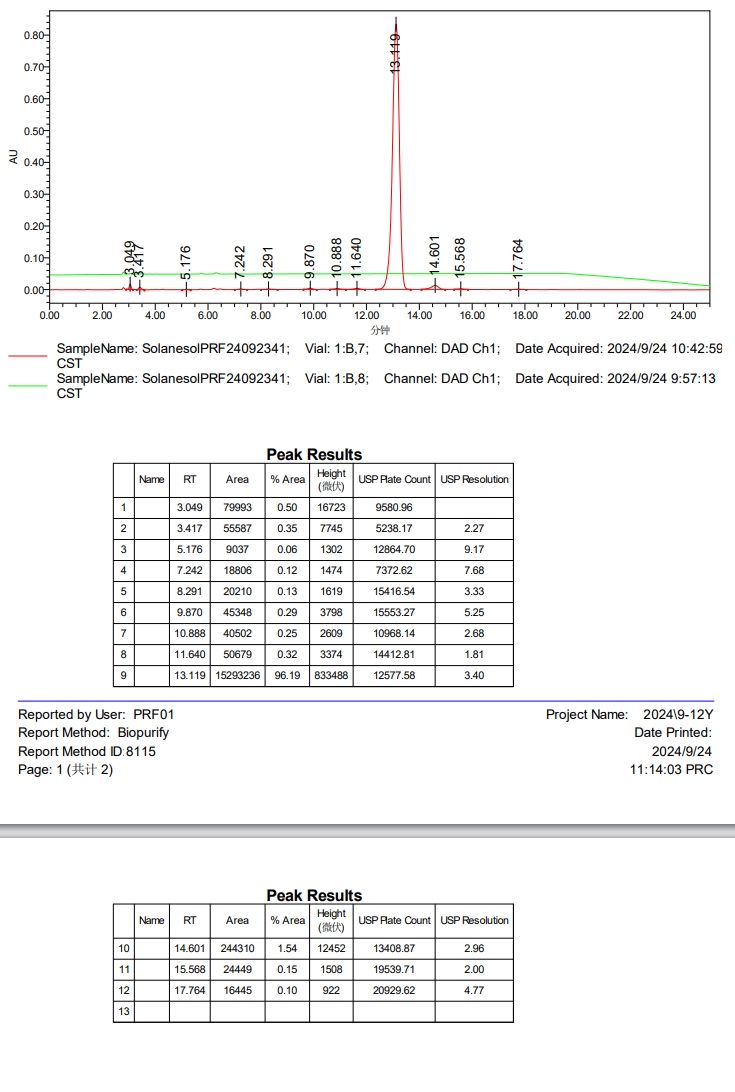
Purity: 95%~99%
Analysis Method: HPLC-DAD or/and HPLC-ELSD
Identification Method: Mass, NMR
Packing: Brown vial or HDPE plastic bottle
Can be supplied from milligrams to grams.
For Reference Standard and R&D, Not for Human Use Directly.
Inquire for bulk scale.
HPLC of Solanesol
Storage conditions:Short-term storage at 2~8℃, long-term storage at -20 ~ -80℃
Solanesol (CAS number: 13190-97-1) is a naturally occurring aliphatic terpenoid alcohol, mainly distributed in Solanaceae plants, with tobacco (Nicotiana tabacum) as the main source. As an orally active compound, solanesol has gradually become a hot topic in natural product pharmacology research in recent years due to its diverse biological activities and potential medicinal value. Its significant antioxidant, anti-inflammatory, and neuroprotective effects have shown broad application prospects in various fields such as neurodegenerative diseases, chronic inflammation, and metabolic diseases. This article will systematically review the chemical structure and physicochemical properties, plant sources and extraction processes, pharmacological activity and mechanism of action, drug evaluation, pharmacokinetic characteristics of solanesol, and explore its future clinical application potential in combination with current preclinical research results.
Solanol is a long-chain aliphatic terpenoid alcohol with a molecular formula of C45H74O and a molecular weight of 631.0860. Its structure consists of nine isoprene units connected by head and tail, belonging to non cyclic terpenoid alcohol compounds. The structural characteristics of solanesol are highly hydrophobic, with a LogP value of 12.9236, indicating its strong lipid solubility. Its extremely low polar surface area (TPSA of 20.23) and water solubility (almost zero) indicate that its solubility in water is extremely low, but it has strong cell membrane penetration ability.
The molecular structure of solanesol contains multiple double bonds and hydroxyl groups, which endow it with certain chemical reactivity, especially playing an important role in antioxidant reactions. Its high lipid solubility and good blood-brain barrier permeability (high BBB permeability) make it potentially advantageous in the treatment of central nervous system diseases. In addition, solanesol does not exhibit hERG channel inhibitory activity, and the Ames mutagenicity test result is negative, indicating its good safety and good pharmacological basis.
Solanesol is mainly found in Solanaceae plants, especially in tobacco leaves, with a rich content of up to 3% -5%. In addition, solanesol is also present in the leaves and stems of plants such as tomatoes, eggplants, and peppers, but the content is relatively low. Tobacco, as the main industrial source of solanesol, has become the preferred plant resource for extracting solanesol due to its short growth cycle and high yield.
The methods for extracting solanesol mainly include solvent extraction, supercritical CO2 extraction, and membrane separation technology. Traditional solvent extraction usually uses organic solvents such as ethanol and hexane to obtain crude extracts through leaching and concentration, which are then purified by silica gel column chromatography or high-performance liquid chromatography (HPLC). Supercritical CO2 extraction technology has been widely used in the extraction of solanesol in recent years due to its advantages of environmental protection, no solvent residue, and strong selectivity, which can effectively improve the extraction rate and purity. In addition, the combination of membrane separation technology and extraction process helps to achieve large-scale production and purification of solanesol.
Solanesol has various biological activities, covering antioxidant, anti-inflammatory, neuroprotective, anti apoptotic, and lipid-lowering aspects, demonstrating broad pharmacological potential.
Solanesol can significantly induce the expression of intracellular antioxidant enzymes, such as heme oxygenase-1 (HO-1) and heat shock protein 70 (Hsp70), thereby enhancing the antioxidant defense ability of cells. It activates the p38 MAPK and Akt signaling pathways, regulates oxidative stress response, reduces reactive oxygen species (ROS) production, and protects cells from oxidative damage.
Inflammatory response is the core pathological process of various chronic diseases. Solanesol exhibits significant anti-inflammatory effects by inhibiting the release of pro-inflammatory cytokines and activating signaling pathways. Research has shown that solanesol can downregulate the NF - κ B pathway, reduce the expression of inflammatory mediators such as TNF - α and IL-1 β, and alleviate chronic inflammation.
Solanesol exhibits neuroprotective effects in various neurodegenerative disease models. It delays the process of nerve damage by inhibiting neuronal apoptosis (reducing the breakdown of caspase-3 and PARP), alleviating oxidative stress and inflammatory response. Related studies have shown that solanesol has potential therapeutic value for diseases such as Huntington's disease, Alzheimer's disease, and bipolar disorder.
Solanesol protects cells from programmed cell death by activating cell survival signaling pathways such as Akt, inhibiting the activation of apoptosis related proteins, and reducing the levels of caspase-3 and PARP cleavage. This mechanism of action plays an important role in the protection of various tissues and the prevention and treatment of diseases.
Solanesol exhibits a positive effect in regulating lipid metabolism. Its targets include cholesterol ester transfer protein (CETP), 3-hydroxy-3-methylglutaryl-CoA reductase (HMGCR), low-density lipoprotein receptor (LDLR), apolipoprotein B (APOB), proprotein converting enzyme subtilisin 9 (PCSK9), apolipoprotein E (APOE), and peroxisome proliferator activated receptor alpha (PPARA). By regulating the above targets, solanesol helps to reduce plasma cholesterol and triglyceride levels, and improve blood lipid abnormalities.
The multiple pharmacological effects of solanesol are attributed to its regulation of multiple cellular signaling pathways and key molecules.
Solanesol significantly induces the expression of antioxidant defense enzyme HO-1 and cell protective protein Hsp70. HO-1, as an important enzyme in cellular stress response, can break down hemoglobin to produce products with antioxidant function, reducing oxidative damage. Hsp70 enhances cell stress tolerance by stabilizing protein structure and preventing misfolding.
Solanesol activates the p38 MAPK signaling pathway, promoting cellular adaptive responses to oxidative stress. Meanwhile, activation of the Akt pathway promotes cell survival and metabolic regulation, inhibits apoptotic signaling, and maintains cellular homeostasis. The synergistic effect of these two pathways is the key to the antioxidant and anti apoptotic effects of solanesol.
By inhibiting the cleavage of caspase-3 and PARP, solanesol blocks the execution phase of cell apoptosis, protecting cells from damage caused by programmed cell death. This mechanism is particularly important in neuroprotection and liver protection.
Solanesol affects cholesterol synthesis, transport, and metabolism by regulating key targets such as CETP, HMGCR, LDLR, APOB, PCSK9, APOE, and PPARA. For example, inhibiting HMGCR activity reduces cholesterol synthesis, activating LDLR promotes cholesterol clearance, regulating PCSK9 reduces LDL receptor degradation, and thus overall regulates blood lipid levels.
The pharmacological evaluation of solanesol shows that it has good safety and drug compatibility. Its high lipid solubility and extremely low water solubility determine its distribution characteristics in the body, especially its ability to effectively penetrate the blood-brain barrier, making it suitable for the treatment of central nervous system diseases. The hERG channel inhibition experiment was negative, indicating a low risk of cardiac toxicity; The Ames test results showed no mutagenicity and high safety.
However, the high LogP value of solanesol also poses challenges in terms of bioavailability and solubility, limiting its oral absorption efficiency. To overcome this problem, researchers have attempted to improve its solubility and bioavailability through pharmaceutical strategies such as nanocarriers, liposome encapsulation, and solid dispersions.
At present, pharmacokinetic studies of solanesol have shown that it has a long half-life in vivo and is mainly metabolized by the liver, with some excreted through bile. Its plasma protein binding rate is high, indicating widespread distribution in the body, especially significant accumulation in adipose tissue and brain tissue.
Due to its multi-target and multi mechanism pharmacological activity, solanesol has shown broad potential for application in the treatment of various diseases.
Solanesol exhibits neuroprotective and anti-inflammatory effects in neurodegenerative diseases such as Alzheimer's disease, Huntington's disease, and bipolar disorder, which can slow down disease progression and improve neurological dysfunction. Its excellent blood-brain barrier penetration provides important advantages for the development of central nervous system drugs.
Solanesol has a protective effect on alcoholic liver disease, reducing liver cell damage and promoting liver function recovery through antioxidant and anti-inflammatory mechanisms, and has potential liver protective value.
Solanesol can alleviate chronic inflammatory pain by regulating inflammatory factors and signaling pathways, and may become an adjuvant treatment option for chronic pain syndrome.
In animal models of anxiety disorders and bipolar disorder, solanesol has shown certain anti anxiety and emotional stabilization effects, suggesting its potential application in the treatment of mental illnesses.
By regulating a variety of lipid metabolism related targets, solanesol is expected to become a new type of lipid-lowering drug, assist in controlling dyslipidemia, and prevent atherosclerosis and cardiovascular events.
Although clinical research on solanesol is still in its early stages, it is necessary to strengthen systematic studies on its pharmacokinetics, toxicology, and clinical trials in the future, optimize dosage forms and administration regimens, and promote its clinical translation.
Solanesol, as a natural aliphatic terpenoid alcohol with multiple biological activities, has become a research hotspot in the field of natural product pharmacology due to its significant antioxidant, anti-inflammatory, neuroprotective, and lipid-lowering effects. Its unique chemical structure and excellent blood-brain barrier penetration endow it with broad application prospects in neurodegenerative and metabolic diseases. Despite the challenges of poor water solubility and low bioavailability, the development of modern pharmaceutical technology provides strong support for the clinical application of solanesol. In the future, through in-depth exploration of its mechanism of action, optimization of formulation technology, and systematic clinical evaluation, solanesol is expected to become a new natural medicine for the treatment of various diseases, promoting the innovative development of natural product pharmacology.
