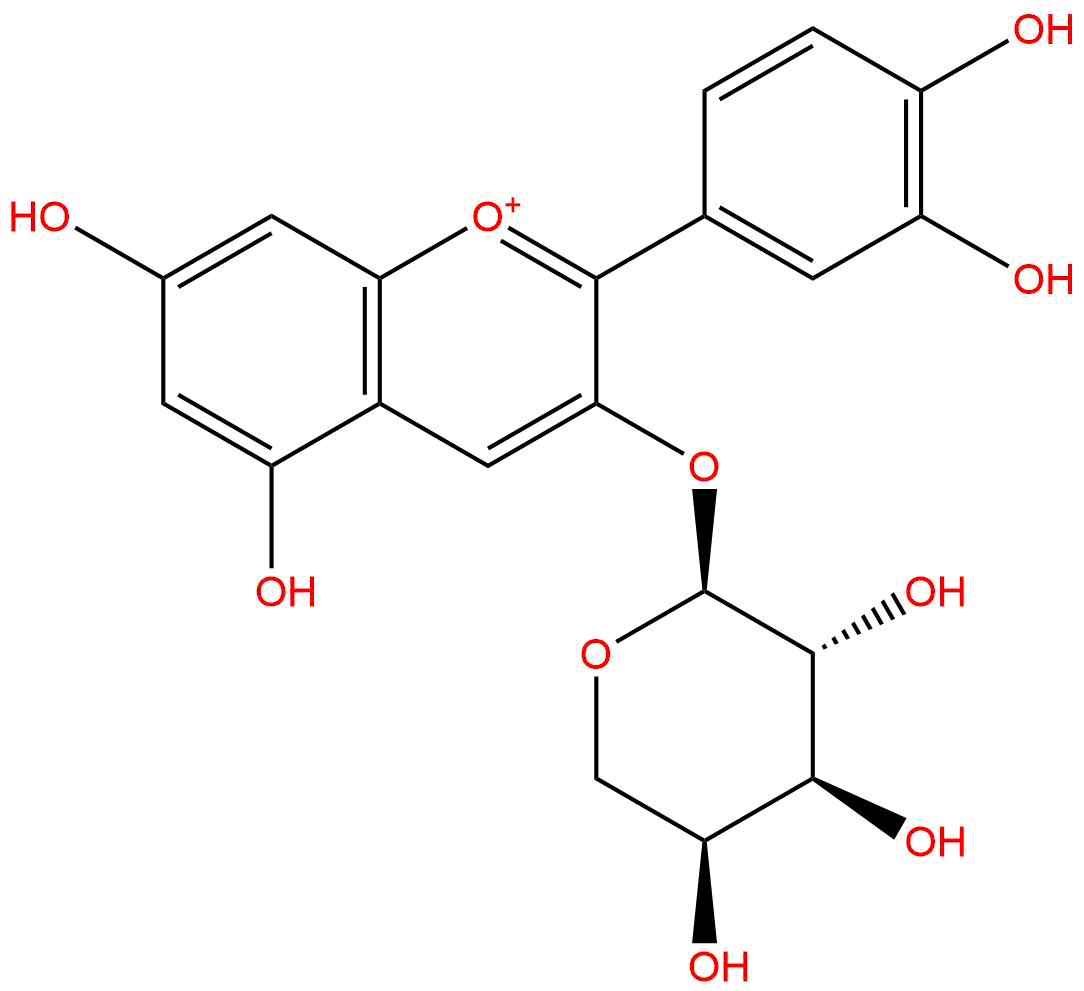


Product Name: Cyanidin 3-Arabinoside
Synonym name: Chrolide, 27214-72-8
Catalogue No.: BP0426
Cas No.: 792868-19-0
Formula: C20H19O10+
Mol Weight: 419.361
Botanical Source: numerous plant spp. including red pears and apples and other fruits
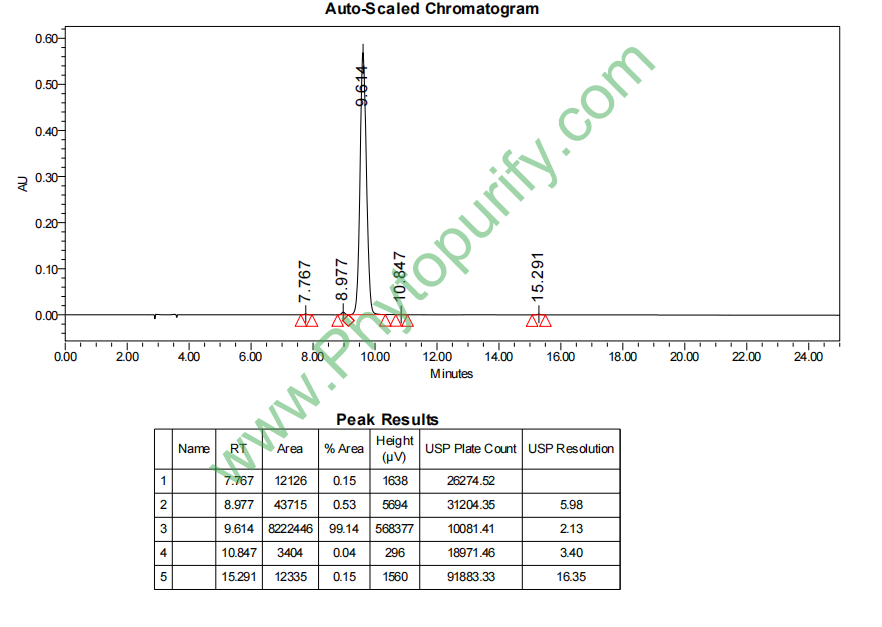
Purity: 95%~99%
Analysis Method: HPLC-DAD or/and HPLC-ELSD
Identification Method: Mass, NMR
Packing: Brown vial or HDPE plastic bottle
Can be supplied from milligrams to grams.
For Reference Standard and R&D, Not for Human Use Directly.
Inquire for bulk scale.
HPLC of Cyanidin 3-Arabinoside
Storage conditions:Short-term storage at 2~8℃, long-term storage at -20 ~ -80℃
Cyanidin 3-Arabinoside (CAS number: 792868-19-0), as a natural anthocyanin compound, has attracted widespread attention in the field of natural product pharmacology in recent years. Its unique biological activity, especially its role as a selective and reversible inhibitor of protein tyrosine phosphatase 1B (PTP1B), makes it show significant potential in the research of metabolic diseases such as type 2 diabetes. In addition, cyanidin arabinoside also exhibits good antioxidant capacity, which can regulate various antioxidant related targets, alleviate oxidative stress damage, and further enrich its pharmacological value. This article provides a systematic review of the chemical structure and physicochemical properties, plant sources and extraction methods, pharmacological activity, mechanism of action, pharmacological evaluation, and clinical application prospects of cyanidin arabinoside, aiming to provide theoretical basis and reference for its subsequent drug development and clinical research.
Cyanidin arabinoside belongs to the anthocyanin family and is a natural product formed by the combination of cyanidin and arabinose through glycosidic bonds. Its molecular formula is C21H19O11 and its molecular weight is 419.36 g/mol. Structurally, cyanidin arabinoside contains a typical anthocyanin core - the 3-hydroxyl group is replaced by arabinose to form a 3-actanoside bond.
In terms of physicochemical properties, cyanidin arabinoside exhibits high polarity with a LogP value of approximately -1.5, indicating good water solubility and weak hydrophobicity. The extremely high polarity is also reflected in its large topological polar surface area (TPSA) of 189.79 Å ² and 10 hydrogen bond acceptors, which facilitate stable hydrogen bond interactions with target proteins. Its molecular structure contains multiple phenolic hydroxyl groups, endowing it with excellent antioxidant activity. The compound has low blood-brain barrier permeability, indicating its limited distribution in the central nervous system. Toxicological evaluation shows that the acute toxicity of cyanidin arabinoside is relatively low (LD50 of about 2000 mg/kg), and there is no significant hepatotoxicity, cardiotoxicity, or hERG channel inhibition. The Ames mutagenicity test result is negative, indicating its high safety.
Cyanidin arabinoside is mainly present in the fruits, petals, and leaves of various plants, especially in Centaurea spp., where it is abundant. It has a wide range of natural sources and is commonly found in blueberries, blackberries, purple cabbage, cherries, and some red fruits and vegetables. Due to the significant influence of pH, temperature, and light on its stability, the extraction and purification processes require strict control of conditions to ensure the integrity of the active ingredients.
Common extraction methods include solvent extraction, ultrasound assisted extraction, and high-performance liquid chromatography (HPLC) purification. Generally, acidic methanol or ethanol is used as the extraction solvent, and the pH is adjusted to around 3 to stabilize the anthocyanin structure. Ultrasound assisted extraction can improve extraction efficiency and purity, and reduce the degradation of thermosensitive components. After rotary evaporation concentration, the extract was separated and purified using silica gel column chromatography or C18 reverse phase column. Finally, the structure and purity of cyanidin arabinoside were confirmed by HPLC-MS.
As a selective and reversible inhibitor of PTP1B, cyanidin arabinoside exhibits significant enzyme inhibitory activity with an IC50 of approximately 8.91 μ M. PTP1B is an important negative regulator of insulin signaling pathway, and its overexpression is closely related to insulin resistance and the pathogenesis of type 2 diabetes. By inhibiting PTP1B, cyanidin arabinoside can enhance the phosphorylation level of insulin receptor, promote downstream signal transduction, improve insulin sensitivity, and has potential anti diabetes effect.
Yakin arabinoside contains abundant phenolic hydroxyl structures and has strong free radical scavenging ability. In vitro experiments have shown that it can significantly increase the activity of intracellular antioxidant enzymes (such as SOD1, SOD2, CAT, GPX1), activate the NFE2L2/NRF2 signaling pathway, and enhance the cell's defense against oxidative stress. In addition, the compound can induce the expression of HMOX1 and exert a cell protective effect. Its antioxidant properties make it widely applicable in the prevention and treatment of chronic diseases caused by oxidative damage.
Preliminary studies also suggest that cyanidin arabinoside may have certain anti-tumor, neuroprotective, and cardiovascular protective effects, but the relevant mechanisms still need to be further explored.
The main mechanism of action of cyanidin arabinoside is focused on its inhibition of PTP1B and regulation of the antioxidant signaling pathway.
PTP1B, as an intracellular protein tyrosine phosphatase, mainly regulates the insulin signaling pathway negatively by dephosphorylating insulin receptors and their substrates. Cyanine arabinoside binds to the active site of PTP1B to form a stable reversible complex, blocking its enzymatic activity and promoting the enhancement of insulin signaling. Molecular docking and dynamic simulations show that the multi hydroxyl structure of cyanidin arabinoside forms multiple hydrogen bonds and hydrophobic interactions with the catalytic pocket of PTP1B, ensuring its high selectivity and inhibitory efficacy.
Yakin arabinoside activates NFE2L2/NRF2 transcription factors, induces downstream antioxidant enzyme genes (SOD1, SOD2, CAT, GPX1, HMOX1) expression, enhances cell clearance of reactive oxygen species (ROS), and reduces oxidative stress-induced cell damage. This mechanism not only helps to protect the function of pancreatic islet β cells, but also may delay the development of complications of diabetes.
Some studies suggest that cyanidin arabinoside may affect the expression of inflammatory factors and signaling pathways, such as NF - κ B and MAPK, but the specific molecular mechanisms still need further validation.
The pharmacological evaluation of cyanidin arabinoside shows that it has good safety and pharmacological potential.
Due to its high polarity and large TPSA, the oral bioavailability of cyanidin arabinoside may be limited, and its blood-brain barrier permeability is low, indicating that it mainly acts on peripheral tissues. In vivo metabolic studies have shown that this compound is easily metabolized by gut microbiota and liver enzyme systems, forming multiple metabolic products that may affect its efficacy duration. In the future, its pharmacokinetic properties need to be improved through structural modification or nanocarrier technology.
The acute toxicity test showed that the LD50 is about 2000 mg/kg, which belongs to low toxicity compounds. The liver toxicity, cardiac toxicity, and hERG channel inhibition tests were all negative, and the Ames mutagenicity test did not show genetic toxicity, indicating its high safety and suitability for further development as a therapeutic drug.
Yakin arabinoside may compete with other drugs through metabolic enzymes or interact with transport proteins in vivo, and further research is needed to investigate its drug interaction profile. In addition, its chemical structure is sensitive to pH and temperature, and stability needs to be optimized during formulation development.
As a natural PTP1B inhibitor, cyanidin arabinoside has significant anti diabetes potential. It provides a new idea for the treatment of type 2 diabetes through the dual mechanism of enhancing insulin signal transduction and antioxidant protection. In the future, based on its good safety and multi-target regulatory characteristics, cyanidin arabinoside is expected to be developed as an oral anti diabetes adjuvant or functional food ingredient.
In addition, in view of its antioxidant and potential anti-inflammatory activities, the application of cyanidin arabinoside in the prevention and treatment of diabetes complications (such as cardiovascular disease, neuropathy) and other oxidative stress related diseases is also worthy of in-depth research. Combining modern drug delivery technologies such as nanocarriers and sustained-release formulations is expected to overcome their bioavailability limitations and improve clinical efficacy.
Future research should focus on:
As a natural anthocyanidin compound, cyanidin arabinoside shows a broad prospect in the treatment of type 2 diabetes and related metabolic diseases by virtue of its selective PTP1B inhibitory activity and significant antioxidant capacity. Its excellent safety and multiple pharmacological mechanisms provide a solid foundation for the development of new natural medicines. Although there are still challenges such as bioavailability and stability, with the continuous progress of molecular pharmacology and drug delivery technology, cyanidin arabinoside is expected to become an important member of the field of natural product medicine in the future, contributing new strength to the prevention and treatment of diabetes and oxidative stress related diseases.
