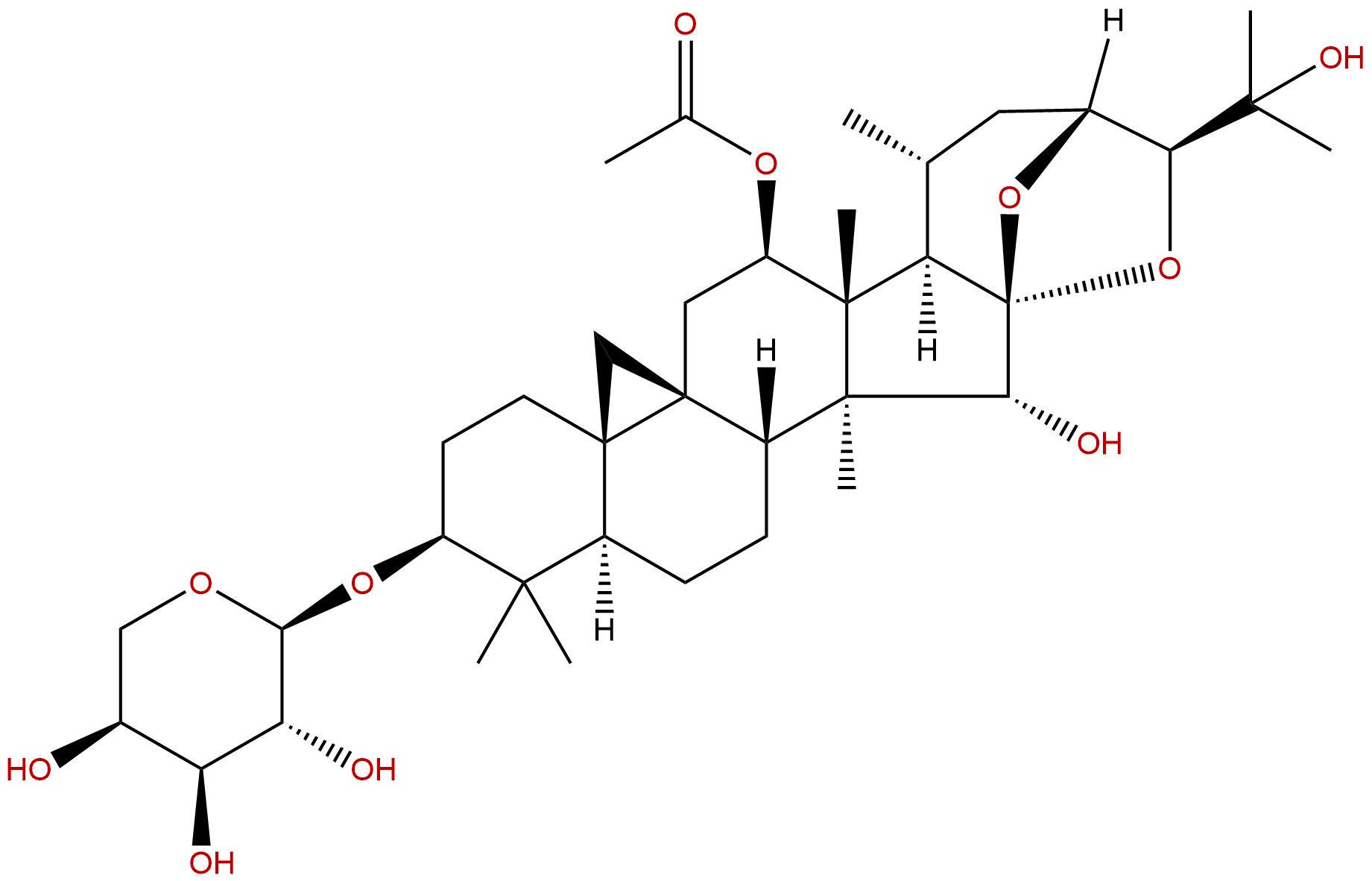


Product name: Cimiracemoside D
Synonym name: 12-beta-acetoxycimigenol-3-O-alpha-L-arabinopyranside
Catalogue No.: BP1565
Cas No.: 290821-39-5
Formula: C37H58O11
Mol Weight: 678.86
Botanical Source: Constit. of Cimicifuga racemosa
Physical Description: Powder
Type of Compound: Triterpenoids
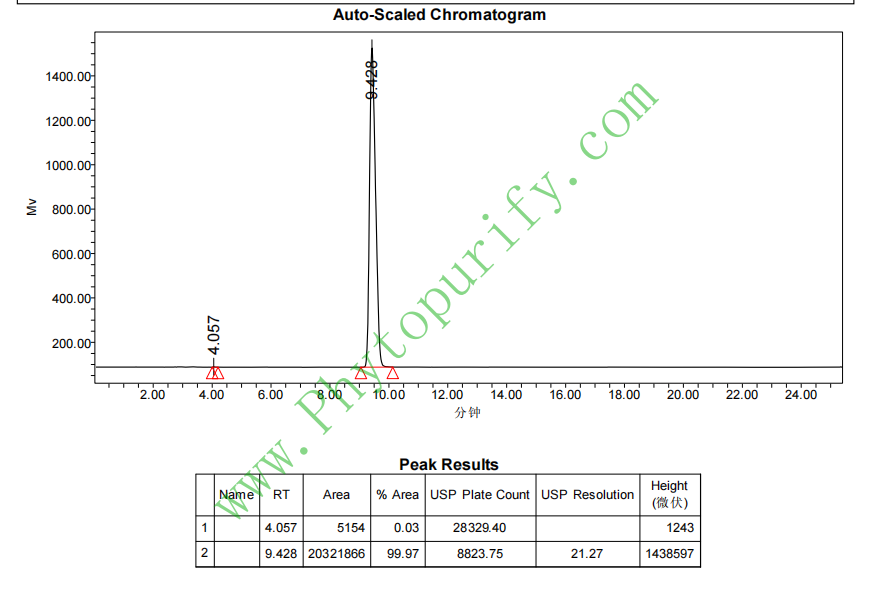
Purity: 95%~99%
Analysis Method: HPLC-DAD or/and HPLC-ELSD
Identification Method: Mass, NMR
Packing: Brown vial or HDPE plastic bottle
The product could be supplied from milligrams to grams. Inquire for bulk scale.
We provide solution to improve the water-solubility of compounds, thereby facilitating the variety of activity tests and clinic uses.
For Reference Standard and R&D, Not for Human Use Directly.
HPLC of Cimiracemoside D
Storage conditions:Short-term storage at 2~8℃, long-term storage at -20 ~ -80℃
164.3700
2.8930
2.8930
.0117
.6286
1.1876
Low
76.0561
7.5372
No
No
No
No
No
No
0.0
Yes
No
No
Yes
Natural products have always been an important source of innovative drug discovery, and their structural diversity and biological activity provide unique molecular frameworks and lead compounds for the treatment of various complex diseases. Black cohosh(Cimicifuga racemosa As a traditional medicinal plant, it has long been used in North America and Asia to treat menopausal syndrome, rheumatic pain, and inflammatory diseases in women. Modern pharmacological studies reveal that its active ingredients are complex and diverse, mainly including triterpene saponins, phenolic acids and other components, among which cyclo jackfruit alkyl triterpene saponins are considered as the key material basis for its multiple pharmacological effects.
Cimiracemoside D (CAS No. 290821-39-5) is a cyclic jackfruit alkyl triterpene saponin isolated from black cohosh in recent years. Although the specific background of its activity is not yet clear in early research, based on its parent nucleus structural analogues (such as coumarin compounds), it has been reported to have anti-inflammatory, anti osteoporosis, neuroprotective, and potential anti-tumor activities, which has attracted the attention of researchers. It is particularly worth exploring in depth that preliminary bioinformatics and target prediction analysis suggest that Cimiracemoside D may interact with multiple key targets closely related to tumor occurrence and development, such as apoptosis regulatory proteins (MCL1, BCL2), signal transduction and transcriptional activation factors (STAT3), matrix metalloproteinases (MMP2), and topoisomerases (TOP1, TOP2A). This provides important theoretical clues for its potential application value in the field of anti-tumor.
This article aims to provide a systematic review of Cimiracemoside D, including its chemical structure, plant origin and extraction, pharmacological activity, mechanism of action, drug evaluation, and clinical application prospects, in order to provide comprehensive scientific references for the in-depth research and development of this natural product.
Acetylcohoshenol-3-arabinoside is a cyclic jackfruit alkyl triterpene saponin. Its molecular formula is C ∝₅ H ₅₈ O ₁₂, and its molecular weight is 678.8600. Its basic structural skeleton is a cyclic jackfruit alkane triterpene with four rings, and a arabinose group is connected to the C-3 hydroxyl group to form a glycosidic bond. The characteristic of this compound is the presence of acetylation modification on its sugar moiety or glycoside backbone ("Acetyl Cimicinolol" suggests the presence of acetyl groups), which may significantly affect its lipid solubility, cell membrane permeability, and interaction mode with target proteins.
According to the provided pharmacological parameters, its lipid water partition coefficient (LogP) is 2.8930, indicating that the compound has moderate lipophilicity, which theoretically facilitates its penetration into cell membranes. Its topological polar surface area (TPSA) is 164.3700 Å ², which is relatively high. This is mainly attributed to the presence of multiple hydroxyl groups and oxygen atoms on the sugar ring in the molecule, which are potential hydrogen bond donors and acceptors. Higher TPSA typically affects the membrane permeability of compounds. Its water solubility parameter is 0.0117 mg/mL, belonging to the category of slightly soluble or poorly soluble in water, which is consistent with the properties of most triterpenoid saponins. Solubilization strategies may need to be considered in formulation development.
In addition, the prediction shows that its ability to cross the blood-brain barrier is relatively low, which suggests that it may not be suitable for the treatment of primary central nervous system tumors, but it may also mean that peripheral side effects are relatively small. HERG inhibition prediction is negative, indicating a low potential risk of cardiac toxicity, which is a favorable pharmacological feature. The Ames test predicted a value of 0.0, indicating that it may not be mutagenic, but further experimental verification is needed.
Cimiracemoside D is mainly derived from the black cohosh plant in the Ranunculaceae family(Cimicifuga racemosa The rhizome of (L.) Nutt. Black cohosh is mainly distributed in the eastern part of North America, and its dry rhizome is a traditional medicinal part. Apart from black cohosh, other plants belonging to the same genus such as Xing'an cohosh(C. dahurica)Da San Ye Sheng Ma(C. heracleifolia)It may also contain saponin components with similar structures, but the specific composition spectrum varies among species.
The extraction and separation of Cimiracemoside D from plant materials typically follow the conventional process of natural product chemistry:
1. Extract Usually, methanol, ethanol, or ethanol water mixed solvents are used for reflux extraction or ultrasound assisted extraction of dried and crushed black cohosphae rhizomes to maximize the extraction of triterpenoid saponins with a wide range of polarities.
2. Rough classification The extract obtained by vacuum concentration of the extract is often subjected to gradient extraction using organic solvents such as petroleum ether, ethyl acetate, n-butanol, etc. Cimiracemoside D is usually enriched in the highly polar n-butanol extraction site due to its glycosidic structure.
3. Separation and Purification The n-butanol fraction is further separated and purified using various chromatographic techniques. Silica gel column chromatography is commonly used for preliminary separation, with gradient elution using chloroform methanol or dichloromethane methanol systems in different ratios. Then, the target stream was repeatedly purified until the monomer compound was obtained by combining reverse phase silica gel column chromatography (such as C18 packing, methanol water or acetonitrile water as mobile phase), dextran gel column chromatography (such as Sephadex LH-20) and high performance liquid chromatography (HPLC, especially preparative HPLC). Structural identification involves the comprehensive use of spectroscopic techniques such as nuclear magnetic resonance (NMR, including ¹ H, ¹ ³ C, 2D-NMR), mass spectrometry (MS), and infrared spectroscopy (IR).
At present, there are few reports on the optimization of the extraction process and large-scale preparation of Cimiracemoside D. If its pharmacological activity is confirmed in the future, the development of efficient and environmentally friendly extraction and separation processes will be the key to its sustainable resource utilization.
Although the direct pharmacological activity experimental data of Cimiracemoside D is not yet abundant in public literature, based on its structural category (black cohosphaceae triterpenoid saponins) and preliminary target prediction information, the core pharmacological activity research focus is on antitumor field The prediction of relevant targets strongly suggests their potential intervention ability in various tumor related pathways and processes.
In addition to anti-tumor effects, the anti-inflammatory, antioxidant, neuroprotective, and anti osteoporosis activities of the extract of total saponins from black cohosphae have been widely studied, which may also be partially attributed to the contribution of monomeric components such as Cimiracetamide D, but this needs to be directly verified by subsequent experiments.
Based on existing target predictions, Cimiracemoside D may exert anti-tumor effects through synergistic effects of multiple targets and pathways. The potential mechanism network can be preliminarily outlined as follows:
It should be emphasized that the above mechanism network is mainly based on bioinformatics prediction and analogy speculation of similar compounds. The exact mechanism of action of Cimiracemoside D, including whether it directly binds to these targets, its binding affinity, and how it affects downstream signaling networks, needs to be further validated and elucidated through modern molecular pharmacology techniques such as molecular docking, surface plasmon resonance (SPR), enzyme activity inhibition experiments, reporter gene detection, gene knockout/overexpression, and proteomics.
Based on the provided calculated chemical parameters, a preliminary analysis is conducted on the pharmacological properties of Cimiracemoside D
Overall, Cimiracemoside D exhibits certain potential for drug development (such as moderate lipid solubility and no hERG inhibition warning), but also faces common challenges from natural product drugs, such as poor solubility, potential poor oral absorption, and metabolic instability. Future pharmacokinetic research needs to focus on its absolute bioavailability, identification of metabolites in vivo, major excretion pathways, and tissue distribution characteristics.
The clinical application prospects of Cimiracemoside D mainly depend on the depth of experimental verification of its anti-tumor activity and subsequent translational research progress.
However, there are still many challenges in its clinical application: a large number of preclinical studies are needed to verify its effectiveness and safety; The problem of limited natural sources needs to be addressed, and sustainable supply may be achieved through plant cell culture, synthetic biology, or total chemical synthesis; A deep understanding of its complex mechanism of action network is needed to clarify its optimal indications and potential biomarkers.
As a cyclic jackfruit alkyl triterpenoid saponin isolated from the traditional medicinal plant Cimicifuga nigricana, acetyl cohosheol-3-arabinoside D has become a natural product molecule with considerable research value due to its unique chemical structure and preliminarily predicted association with multiple key tumor targets. Although direct biological experimental data is currently scarce, its multi-target intervention potential in inducing apoptosis, inhibiting metastasis, interfering with DNA metabolism, and regulating signaling pathways has drawn an exciting blueprint for its application in the field of anti-tumor drug development.
The current research is still in its early stages, and the focus of future work should be on: using modern pharmacological models and techniques to systematically validate its anti-tumor and other pharmacological activities at the cellular and animal levels; Comprehensively utilizing molecular biology, structural biology, and computational chemistry methods to elucidate its precise molecular mechanism of action and direct target of action; Systematically evaluate its pharmacokinetic characteristics and safety, and conduct rational formulation design and structural optimization research for its drug defects. Through interdisciplinary and in-depth research, Cimiracemoside D is expected to gradually develop from a potential natural lead compound into an important component of new drugs or drug combinations that can be used for clinical treatment, contributing its natural value to human health.
