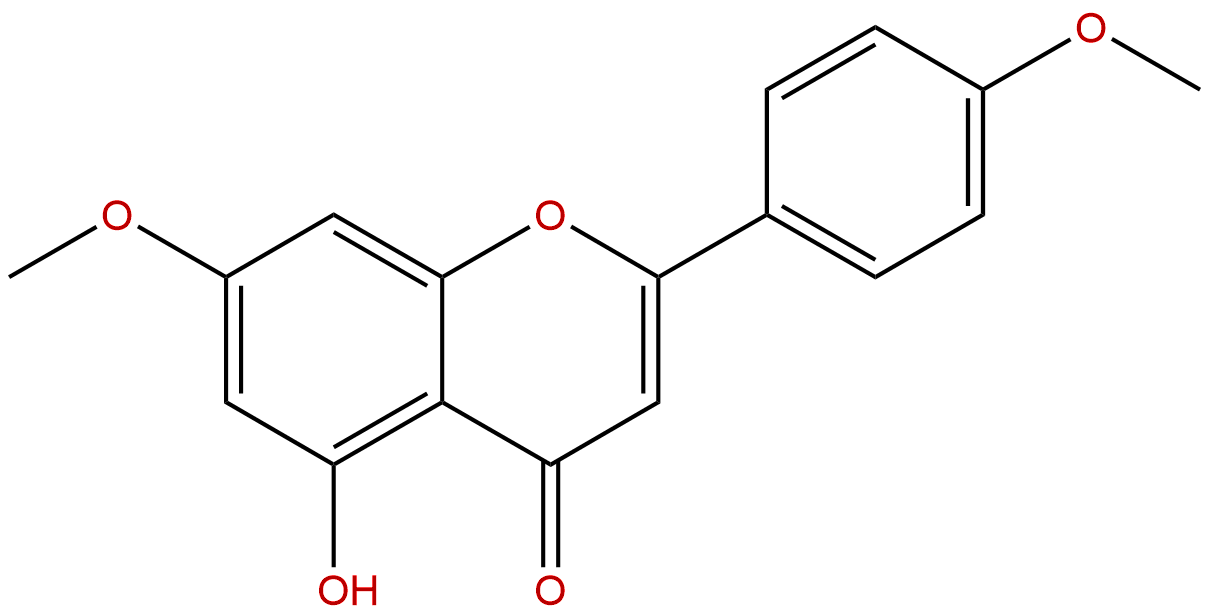


Product name: 7,4'-Di-O-methylapigenin
Synonym name: Dimethoxyigenin; Acacetin 7-O-methyl ether; 4',7-Dimethoxy-5-Hydroxyflavone
Catalogue No.: BP3043
Cas No.: 5128-44-9
Formula: C17H14O5
Mol Weight: 298.294
Botanical Source:
Physical Description: Yellow powder
Type of Compound: Flavonoids
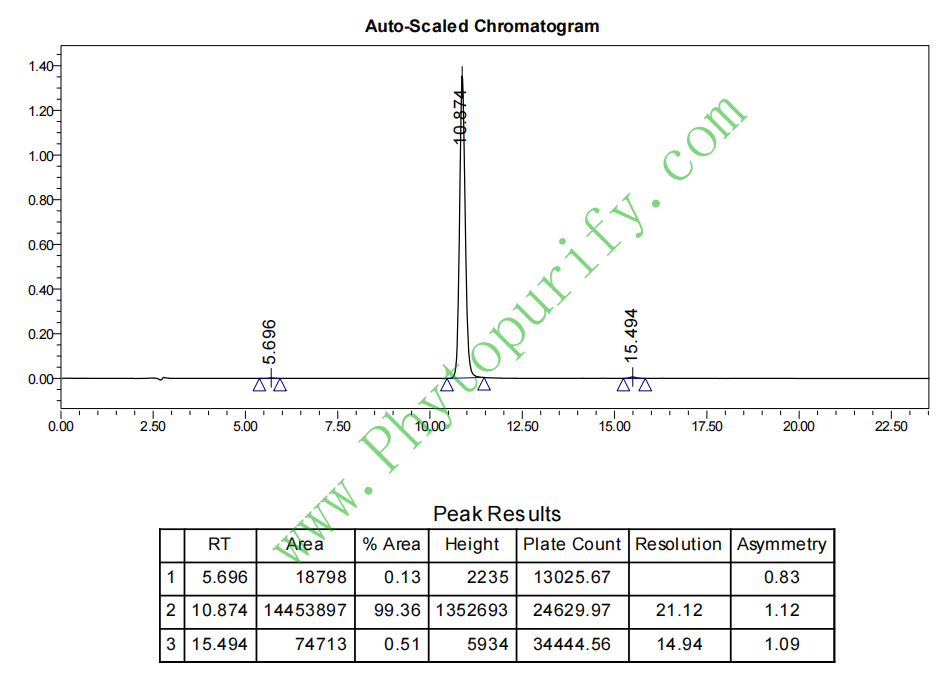
Purity: 95%~99%
Analysis Method: HPLC-DAD or/and HPLC-ELSD
Identification Method: Mass, NMR
Packing: Brown vial or HDPE plastic bottle
The product could be supplied from milligrams to grams. Inquire for bulk scale.
We provide solution to improve the water-solubility of compounds, thereby facilitating the variety of activity tests and clinic uses.
For Reference Standard and R&D, Not for Human Use Directly.
HPLC of 7,4'-Di-O-methylapigenin
Storage conditions:Short-term storage at 2~8℃, long-term storage at -20 ~ -80℃
68.9000
2.9376
2.9294
.0288
4.5049
22.3027
Low
92.1041
2.0592
Yes
No
Yes
No
Yes
No
0.6
No
No
Yes
No
Flavonoids, as a widely distributed class of secondary metabolites in nature, have attracted much attention in pharmacological research due to their diverse biological activities. Apigenin, as a classic member of the flavonoid family, has been widely reported for its anti-inflammatory, antioxidant, and anti-tumor pharmacological effects. However, its low bioavailability to some extent limits its potential as a drug. Structural modification of flavonoid mother nucleus is one of the effective strategies to improve its physicochemical properties and biological activity. Dimethoxylapigenin, also known as apigenin 7,4 '- dimethyl ether, is a derivative of apigenin in which the hydroxyl groups at the 7th and 4th positions of the C and B rings are replaced by methoxy groups. This structural change not only alters its polarity, lipid solubility, and metabolic stability, but may also endow it with a unique pharmacological spectrum distinct from the parent compound. In recent years, studies have shown that this compound has potential value in regulating inflammation related diseases, especially respiratory diseases such as rhinitis. The purpose of this article is to systematically review the chemical properties, plant sources, pharmacological activities, molecular mechanisms of action, and medicinal properties of apigenin dimethyl ether, and to prospect its clinical application prospects, in order to provide scientific basis for the deep development of this natural product.
The chemical name of apigenin dimethyl ether (CAS number: 5128-44-9) is 5-hydroxy-7,4 '- dimethoxyflavone, with a molecular formula of C17H14O5 and a molecular weight of 298.29 g/mol. Its core structure is the classic flavonoid nucleus (2-phenylchromenone), with specific modification sites where the hydroxyl group at position 7 of the A ring and the hydroxyl group at position 4 'of the B ring are both replaced by methoxy (- OCH3). This structural feature classifies it as a dimethoxyflavonoid.
From the analysis of physical and chemical properties, the introduction of methoxy groups significantly changes the polarity of the molecule. Its topological polar surface area (TPSA) is 68.90 Å ², which is lower than that of apigenin (TPSA~90 Å ²), indicating a weakening of its polarity. The calculated lipid water partition coefficient (LogP) is 2.94, indicating that the compound has moderate lipophilicity, which is beneficial for its penetration into cell membranes. The water solubility data (approximately 0.0288 mg/mL) confirms that it is a poorly soluble compound, which may be a limiting factor for its oral absorption. Based on its moderate molecular weight, LogP value within the ideal range (usually considered to be 1-3), and acceptable TPSA value, it is preliminarily judged that it has a certain drug like basis. However, its low water solubility and predicted low blood-brain barrier permeability suggest that solubilization strategies need to be considered in formulation development, and its main target of action may be located in the peripheral system.
Celery extract dimethyl ether, as a plant metabolite, is relatively widely distributed in nature and mainly exists in various Asteraceae, Lamiaceae, and Umbelliferae plants. Common sources include wild chrysanthemum(Chrysanthemum indicum L.)、mugwort leaf(Artemisia argyi)、mint(Mentha haplocalyx)And some celery(Apium graveolens)The closely related species. In these plants, it usually coexists with other flavonoids, terpenes, and phenolic compounds.
The extraction and separation method follows the conventional process of natural product chemistry. Firstly, organic solvents such as methanol, ethanol, or acetone are used for reflux extraction or ultrasound assisted extraction of dried plant materials to maximize the extraction of components with a wide range of polarities. Subsequently, crude extract was obtained by vacuum concentration. Crude extracts are often extracted by solvent fractionation (such as petroleum ether, ethyl acetate, n-butanol), and apigenin dimethyl ether is often enriched in the ethyl acetate fraction due to its equipolarity. Further purification depends on column chromatography technology. Silica gel, polyamide or sephadex gel (Sephadex LH-20) is often used as the stationary phase, and chloroform methanol or petroleum ether ethyl acetate mixed solvents of different proportions are used for gradient elution. High performance liquid chromatography (HPLC) or preparative thin layer chromatography (PTLC) is the final key step in obtaining high-purity monomers. Modern technologies such as high-speed countercurrent chromatography (HSCCC) are increasingly being used for the separation and purification of such compounds due to their advantages of not requiring solid carriers and high recovery rates. The optimization of extraction process requires comprehensive consideration of solvent type, temperature, time, and solid-liquid ratio to achieve the best yield.
Existing pharmacological research, especially experiments based on cell and animal models, has revealed the multifaceted biological activities of apigenin dimethyl ether, with its core advantages concentrated in the fields of anti-inflammatory and immune regulation.
Anti inflammatory and anti allergic activity This is currently the most extensively studied pharmacological effect of the compound. In animal models of allergic rhinitis, apigenin dimethyl ether can significantly alleviate typical symptoms such as nasal scratching, sneezing, and increased nasal secretions. Histopathological analysis shows that it can inhibit the infiltration of inflammatory cells (especially eosinophils) in the nasal mucosa, alleviate mucosal edema and epithelial damage. Its anti-inflammatory efficacy has been validated in multiple in vitro experiments, manifested by its ability to significantly inhibit the excessive production of key inflammatory mediators such as nitric oxide (NO) and prostaglandin E2 (PGE2) in macrophages and epithelial cells stimulated by lipopolysaccharides (LPS) or inflammatory cytokines.
antioxidant activity Although it has fewer hydroxyl groups than apigenin, apigenin dimethyl ether still retains some free radical scavenging ability. It can directly eliminate free radicals such as DPPH and ABTS, enhance the activity of intracellular antioxidant enzymes (such as superoxide dismutase (SOD) and glutathione peroxidase (GSH Px)), reduce the level of lipid peroxidation products such as malondialdehyde (MDA), and alleviate the damage caused by oxidative stress to cells. This antioxidant effect complements its anti-inflammatory effect.
Other potential activities Preliminary research also suggests the potential of apigenin dimethyl ether in other areas. For example, some studies have reported that it has a proliferative inhibitory effect on certain tumor cell lines (such as lung cancer and colon cancer cells), and its mechanism may be related to inducing cell cycle arrest and apoptosis. In addition, there have been studies on its neuroprotective and cardiovascular protective effects, but the relevant evidence chain is still incomplete and needs further exploration.
The anti-inflammatory, especially anti rhinitis activity of apigenin dimethyl ether is not achieved through a single pathway, but through a complex multi-target network. Existing research has preliminarily outlined its key targets and signaling pathways:
Core transcription factor: NF - κ B pathway Nuclear factor kappa B (NF - κ B) is the core regulator of inflammatory response. Celery extract dimethyl ether has been proven to effectively inhibit the nuclear translocation of NF - κ B p65 subunit and its binding activity with DNA. It inhibits the transcription of various pro-inflammatory cytokine genes downstream by blocking the degradation of I κ B α protein and retaining NF - κ B complexes in the cytoplasm. This is one of the fundamental mechanisms by which it regulates the production of key cytokines such as TNF - α, IL-6, IL-1 β, etc.
Key enzyme target: cyclooxygenase-2 (COX-2/PTGS2)COX-2 is the rate limiting enzyme for the synthesis of prostaglandin inflammatory mediators. Celery extract dimethyl ether can significantly downregulate COX-2 overexpression induced by LPS and other stimuli at the mRNA and protein levels, while inhibiting its enzyme activity, directly reducing the production of PGE2, which is directly related to its ability to alleviate inflammatory pain and vascular dilation.
Inflammatory cytokine network This compound can dose dependently inhibit the production of TNF - α, IL-6, and IL-1 β. These cytokines form a malignant amplification loop in the pathogenesis of rhinitis: TNF - α activates endothelial cells and promotes leukocyte adhesion; IL-6 drives Th2 immune response and B cell differentiation; IL-1 β directly participates in fever and tissue destruction. The comprehensive inhibition of this network by apigenin dimethyl ether is the basis for its therapeutic effect.
Histamine and leukotriene receptors In response to the rapid onset phase of rhinitis, apigenin dimethyl ether exhibits antagonistic potential against histamine H1 receptor (HRH1), which may alleviate nasal itching, sneezing, and increased secretion directly caused by histamine. More importantly, research suggests that it can antagonize cysteine leukotriene receptor 1 (CysLT1/CYSLTR1). Leukotriene is a potent pro-inflammatory and spasmogenic mediator, playing a key role in allergic rhinitis, especially nasal congestion symptoms. Dual intervention of histamine and leukotriene pathways may result in synergistic inhibitory effects on different symptomatic components of rhinitis.
Transient receptor potential channel: TRPM8 TRPM8 is an ion channel that senses coldness and coolness such as menthol. It is often abnormally activated in patients with rhinitis, causing nasal discomfort and neurogenic inflammation. Preliminary evidence suggests that apigenin dimethyl ether may regulate the activity of TRPM8 channels, providing a new molecular perspective for explaining its ability to alleviate nasal irritation.
In summary, apigenin dimethyl ether intervenes in the inflammatory cascade reaction from multiple levels such as signal transcription, mediator synthesis, and receptor activation through a synergistic action mode of "multi-target, multi pathway", laying a solid mechanistic foundation for its treatment of complex inflammatory diseases represented by rhinitis.
Based on computational predictions and limited preliminary experimental data, a preliminary evaluation of the pharmacological properties of apigenin dimethyl ether is conducted
Celery extract dimethyl ether exhibits clear anti-inflammatory and anti allergic pharmacological activities, especially its multi-target mechanism of action against the pathological network of rhinitis, making it an attractive development prospect in the following fields:
However, pushing it from the laboratory to clinical practice still faces a series of challenges:① Insufficient validation of system pharmacology Current research is mostly focused on rhinitis models, and its efficacy needs to be validated in other related disease models.② Pharmacokinetic and formulation research gaps It is necessary to comprehensively elucidate its ADME (absorption, distribution, metabolism, excretion) characteristics and develop dosage forms suitable for clinical administration.③ The safety evaluation system urgently needs to be improved Complete a full set of preclinical safety evaluations that meet the requirements for drug registration.④ The mechanism of action needs to be more accurately explained For example, whether it directly antagonizes or indirectly regulates targets such as CysLT1 and TRPM8 requires confirmation through techniques such as molecular docking and surface plasmon resonance (SPR).
Future research should focus on: conducting systematic preclinical development studies (PK/PD, toxicology); Using chemical biology methods to elucidate its direct interaction with key targets; Explore its synergistic effects with other drugs; And ultimately promote high-quality clinical trials to verify its effectiveness and safety in the human body.
As a natural methoxylated derivative of apigenin, apigenin dimethyl ether exhibits a unique chemical structure that preserves the basic activity of flavonoids while demonstrating characteristic pharmacological effects centered on multi-target anti-inflammatory effects, especially in the intervention of diseases such as allergic rhinitis. Its mechanism of action involves inhibition of the NF - κ B signaling pathway, regulation of the expression of key enzymes such as COX-2, and intervention of multiple targets such as histamine and leukotriene receptors, forming a synergistic network. Despite facing challenges such as low water solubility and missing systematic pharmacokinetic data in drug development, its clear activity, moderate drug like parameters, and preliminary good safety predictions make it a natural product lead compound worth further development. Through subsequent system drug chemistry optimization, formulation improvement, and complete preclinical and clinical research, apigenin dimethyl ether is expected to be successfully transformed from a plant metabolite into an innovative drug for treating inflammatory diseases, providing new treatment options for relevant patients.
