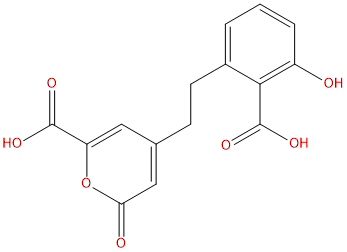


Product name: Moldapyranone A
Synonym name:
Catalogue No.: BP2104
Cas No.: BP2104
Formula: C15H12O7
Mol Weight: 304.254
Botanical Source: Dracocephalum moldavica L.
Type of Compound:
Purity: 95%~99%
Analysis Method: HPLC-DAD or/and HPLC-ELSD
Identification Method: Mass, NMR
Packing: Brown vial or HDPE plastic bottle
Storage: Store in a well closed container, protected from air and light. Put into refrigerate or freeze for long term storage.
Whenever possible, you should prepare and use solutions on the same day. However, if you need to make up stock solutions in advance, we recommend that you store the solution as aliquots in tightly sealed vials at -20℃. Generally, these will be useable for up to two weeks.
The product could be supplied from milligrams to grams
Inquire for bulk scale.
For Reference Standard and R&D, Not for Human Use Directly.
Storage conditions:Short-term storage at 2~8℃, long-term storage at -20 ~ -80℃
null
null
null
Moldapyranone A is a traditional medicinal plant Fragrant Blue Orchid(Dracocephalum moldavica)Natural compounds isolated and identified. This compound belongs to pyranone derivatives and is an emerging research object in the field of natural product chemistry and drug discovery in recent years. As a plant of the Lamiaceae family, Xiangqinglan is widely distributed in Central Asia, Eastern Europe, and Xinjiang, China. It is commonly used in folk medicine to treat cardiovascular diseases, inflammation, and neurological discomfort. However, its specific active ingredients and mechanism of action have not been fully elucidated for a long time.
With the advancement of natural product separation and identification technology, especially the development of high-performance liquid chromatography-mass spectrometry (HPLC-MS) and nuclear magnetic resonance (NMR) technology, researchers have been able to isolate various structurally novel compounds from Phalaenopsis, and Phalaenopsis pyranoside A is one of them. Although the complete molecular formula, molecular weight, and CAS number of the compound have not yet been disclosed, its preliminary biological activity screening has shown certain research value. As a type of naturally occurring pyranone with unique structure, Xiangqinglan pyranone A may have pharmacological activities such as antioxidant, anti-inflammatory, and neuroprotective effects, laying the foundation for its further development as a candidate drug molecule.
This article will systematically introduce the current research progress of vanillin A from the aspects of chemical structure, plant origin, traditional applications, pharmacological activity, pharmacological evaluation, and research prospects. Combined with the general laws of natural product drug development, it will scientifically prospect its potential applications.
Xiangqinglan pyranose ketone A belongs to Pyranone compounds Pyranone is a class of oxygen-containing heterocyclic compounds with a basic structure of a six membered ring containing one oxygen atom and one ketone group. This type of structure is widely present in natural products and is often associated with biological activities such as anti-inflammatory, antioxidant, and antibacterial. Although the exact molecular formula and molecular weight of the compound have not been disclosed, based on its name "pyranone" and the secondary metabolic characteristics of the source plant, it can be inferred that it may have moderate polarity and contain substituents such as hydroxyl and methoxy groups, which can affect its solubility, stability, and bioavailability.
Based on the physicochemical properties, it is speculated that vanillin A may appear as colorless or pale yellow crystals or powders, and may exhibit characteristic fluorescence under ultraviolet light. Its solubility may be between lipid solubility and water solubility, depending on the number and position of substituents. Generally speaking, the logP value (lipid water partition coefficient) of pyranone compounds is mostly between 2-4, indicating that they have a certain membrane permeability. However, if they contain too many hydroxyl groups, the logP may decrease, affecting their transmembrane transport.
Future research needs to clarify its molecular formula and stereoconfiguration through techniques such as high-resolution mass spectrometry (HR-MS) and two-dimensional nuclear magnetic resonance (2D-NMR). In addition, its stability, degradation behavior under different pH conditions, and photosensitivity are also key physicochemical parameters that need to be examined in the evaluation of drug properties.
Xiangqinglan pyranose ketone A is derived from plants in the family Lamiaceae Fragrant Blue Orchid(Dracocephalum moldavica L.)。 This plant is an annual herbaceous plant that widely grows in Central Asia, Mongolia, Russia, as well as Xinjiang and Gansu provinces in China. It is commonly found on mountain slopes, grasslands, or roadsides. Xiangqinglan has a long history of application in folk medicine, and its dried aboveground parts are often used for medicinal purposes.
In the traditional medical system, Xiangqinglan is considered to have Clearing heat and relieving symptoms, calming the liver and calming the wind, promoting blood circulation and relieving pain The efficacy. It is commonly used in Uyghur medicine to treat symptoms such as colds, fever, headaches, palpitations, insomnia, and hypertension. Modern pharmacological research has also preliminarily confirmed that Xiangqinglan extract has antioxidant, anti myocardial ischemia, anti arrhythmic, sedative, and antibacterial effects. These traditional applications suggest that Xiangqinglan contains multiple active ingredients that may exert therapeutic effects through multiple targets and pathways.
The chemical composition of Xiangqinglan is complex, mainly including flavonoids, terpenes, phenylpropanoids, and volatile oils. The discovery of vanillin A enriched the chemical composition spectrum of the plant and provided a new material basis for explaining its traditional medicinal effects. From the perspective of plant chemical taxonomy, pyranone compounds are not uncommon in the family Lamiaceae, but the discovery of each new structure may lead to new biological activity clues.
At present, the content of vanillin A is Specific target information and disease-related data have not been made public yet This to some extent limits a deeper understanding of its mechanism of action. However, we can make reasonable scientific speculations based on the known pharmacological activities of its structurally similar compounds and source plants.
First,Pyranone compounds It is often closely related to antioxidant activity in nature. Many natural pyranose ketones can exert cell protective effects by clearing free radicals and activating the Nrf2/ARE antioxidant pathway. Therefore, vanillin A is likely to have significant antioxidant capacity, which may be related to the presence of enol or phenolic hydroxyl groups in its structure. Antioxidant activity is usually the basis for anti-inflammatory, anti-aging, neuroprotective, and cardiovascular protective effects.
Secondly, the extract of Xiangqinglan has been shown to be effective in research anti-inflammatory effect Inflammatory response involves multiple signaling pathways such as NF - κ B, MAPK, COX-2, etc. If Xiangqinglan pyranoside A can inhibit key proteins in these pathways, it may become a potential anti-inflammatory agent. Inflammation is the common pathological basis of many chronic diseases (such as arthritis, atherosclerosis, neurodegenerative diseases), so the anti-inflammatory potential of this compound deserves attention.
Furthermore, Xiangqinglan is traditionally used for cardiovascular diseases and Neurological disorders The treatment. Modern research has also shown that its extract has effects such as dilating blood vessels, improving myocardial blood supply, and sedation. Xiangqinglan pyranoside A may produce cardiovascular or neuroprotective effects by regulating ion channels (such as calcium and potassium channels), affecting the neurotransmitter system, or protecting vascular endothelial cells. For example, certain pyranone derivatives have been reported to have acetylcholinesterase inhibitory activity, which may be related to improving memory and cognitive function.
Although there is currently a lack of direct target data, preliminary target predictions for this compound can be made based on computational biology methods such as molecular docking and network pharmacology. For example, its three-dimensional structure can be compared with known drug databases to predict potential protein targets it may bind to, such as kinases, G protein coupled receptors (GPCRs), or nuclear receptors. These predictions can provide direction for subsequent in vitro target validation experiments.
Drug efficacy evaluation is a crucial step in determining whether a compound can become a drug candidate molecule, mainly involving Absorption, distribution, metabolism, excretion, and toxicity ADMET properties. Due to the incomplete physicochemical parameters of Xiangqinglan pyranone A not yet being disclosed, we can only conduct preliminary analysis based on the general characteristics of pyranone compounds and pharmaceutical chemistry experience.
Firstly, refer to Lipinski's Five Rules(Rule of Five), An oral active drug should typically meet the following criteria: molecular weight ≤ 500, logP ≤ 5, The number of hydrogen bond donors is ≤ 5, and the number of hydrogen bond acceptors is ≤ 10. The core structure of pyranone has a relatively small molecular weight. If the substituents of vanillin pyranone A are not too complex, its molecular weight is likely to meet the requirements. The LogP value needs to be determined through experiments or computational chemistry (such as ClogP), and the ideal value should be between 1-3 to balance solubility and permeability.
Topological polarity surface area TPSA is an important parameter for predicting the membrane permeability and oral bioavailability of compounds. Generally, drug molecules with TPSA<140 Å ² have good intestinal absorption and blood-brain barrier (BBB) penetration potential. Pyranone itself has low polarity. If Xiangqinglan Pyranone A only contains a few polar groups, its TPSA may be low, which is beneficial for penetrating biological membranes and may even have a certain BBB penetration ability. This is particularly important for the development of central nervous system drugs.
In Metabolic stability In terms of stability, the pyranone ring is relatively stable, but attention should be paid to whether it is easily metabolized by the cytochrome P450 enzyme system. If metabolized too quickly in the body, it can lead to a short half-life and low bioavailability. In addition, it is necessary to evaluate its potential toxicity Including cytotoxicity, genotoxicity, and hepatotoxicity. Although natural products originate from plants, they are not absolutely safe and require systematic evaluation through in vitro cytotoxicity experiments (such as MTT assay) and in vivo acute toxicity experiments.
In summary, Xiangqinglan pyranoside A has a preliminary structural basis for development as an oral drug, but its specific pharmacological properties still need to be accurately determined through experiments to obtain relevant parameters such as solubility, permeability, metabolic stability, etc. In the early stage of drug discovery, its ADMET properties can be optimized through structural modification.
At present, the research on vanillin A is still in progress Early detection stage The existing literature mainly focuses on the separation, purification, and structural identification of compounds, while in-depth pharmacological activity, mechanism of action, and preclinical research data are extremely lacking. This is both a challenge and a vast research space.
Future research directions can revolve around the following aspects:
Structural Confirmation and Synthesis Research Firstly, its chemical structure, including absolute configuration, should be thoroughly analyzed through modern spectroscopic techniques. On this basis, conducting fully synthetic or semi synthetic research can not only solve the problem of limited natural sources, but also obtain derivatives through structural modification, conduct structure-activity relationship (SAR) studies, optimize their activity and drug properties.
Systematic pharmacological activity screening Using high-throughput screening technology, systematically evaluate its antioxidant, anti-inflammatory, neuroprotective, cardiovascular protective, antibacterial, anti-tumor and other activities at the cellular and molecular levels. By combining network pharmacology and molecular docking technology, potential targets of action are predicted and validated through methods such as gene knockout, reporter gene experiments, and proteomics.
In depth exploration of the mechanism of action Explore its mechanism of action in depth based on its most promising active direction. For example, if it has neuroprotective effects, its effects on neuronal apoptosis, mitochondrial function, synaptic plasticity, and related signaling pathways can be studied.
Preclinical development On the basis of clarifying its core pharmacological activity, conduct standardized preclinical studies, including pharmacokinetics, toxicology, and formulation studies, to provide data support for its application for clinical trials.
Application Prospects In terms of development, vanillin A is expected to be used for therapeutic purposes Oxidative stress-related diseases(such as neurodegenerative diseases, cardiovascular diseases)Chronic inflammatory diseases or infectious diseases Innovative drugs from natural sources. In addition, it can also serve as a lead compound to develop a new generation of drugs with stronger activity, higher selectivity, and better pharmacokinetic properties through rational drug chemical modification.
With the deepening of interdisciplinary integration, especially the combination of natural product chemistry, computational biology, molecular pharmacology, and synthetic biology, the research progress of natural small molecules such as vanillin A will be greatly accelerated. It may not only provide new treatment options for specific diseases, but also further reveal the scientific value of traditional medicinal plants, promote the modernization of traditional Chinese medicine and the development and utilization of ethnic medicine resources.
Disclaimers This article is based on limited existing data and contains scientific speculation. The actual properties, activities, and applications of Xiangqinglan pyranoside A should be based on authoritative research data published in the future. Before using it for any therapeutic purpose, it must undergo rigorous and complete preclinical and clinical research validation.
Batch can search by a CAS number,one per line
