


Product name: Sesamolin
Synonym name:
Catalogue No.: BP1298
Cas No.: 526-07-8
Formula: C20H18O7
Mol Weight: 370.357
Botanical Source: sesame oil and Justicia orbiculata
Physical Description: White powder
Type of Compound: Lignans
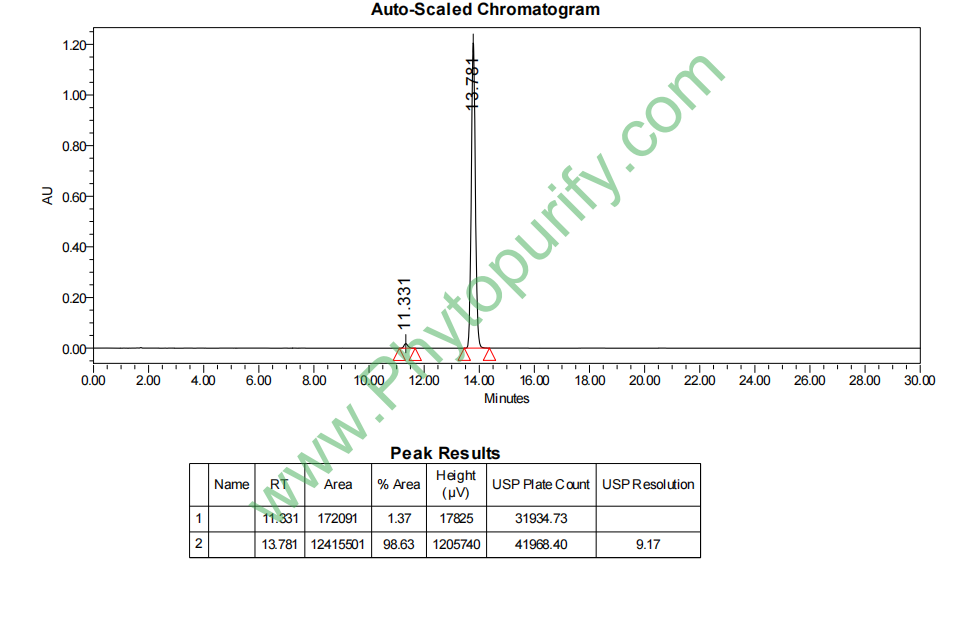
Purity: 95%~99%
Analysis Method: HPLC-DAD or/and HPLC-ELSD
Identification Method: Mass, NMR
Packing: Brown vial or HDPE plastic bottle
Storage: Store in a well closed container, protected from air and light. Put into refrigerate or freeze for long term storage.
Whenever possible, you should prepare and use solutions on the same day. However, if you need to make up stock solutions in advance, we recommend that you store the solution as aliquots in tightly sealed vials at -20℃. Generally, these will be useable for up to two weeks.
The product could be supplied from milligrams to grams, up to kilograms
Inquire for bulk scale.
Descriptions:
Sesaminol possesses antioxidative activity, can inhibit lipid peroxidation in rat liver and kidney.[1]
Sesamolin has protective effect on hypoxic neuronal and PC12 cells, it might be related to suppression of ROS generation and MAPK activation.[2]
Sesamolin can inhibit proliferation by inducing apoptosis in human lymphoid leukemia Molt 4B cells. [3]
Sesamolin has protective effects on murine BV-2 microglia cell line under hypoxia, the mechanism involves inhibition of MAPK pathways and apoptosis through scavenging of ROS in hypoxia-stressed BV-2 cells.[4]
Sesamolin exerts effective neuroprotection against cerbral ischemia.[5]
References:
[1] Kang M H, Naito M, Tsujihara N, et al. J Nut, 1998, 128(6):1018-22.
[2] Hou C W, Huang H M, Tzen J T C, et al. J Neurosci Res, 2003, 74(1):123–33.
[3] Miyahara Y, Hibasami H, Katsuzaki H, et al. Int J Mol Med, 2001, 7(7):369-71.
[4] Hou C W, Wu C C, Yang C H, et al. Neurosci Lett, 2004, 367(1):10-3.
[5] Cheng F C, Jinn T R, Hou R C W, et al. Int J Biomed Sci Ljbs, 2006, 2(3):284-8.
[6] Huang J. Journal of the Chinese Cereals & Oils Association, 2011, 26(01):120-3.
HPLC of Sesamolin
Storage conditions:Short-term storage at 2~8℃, long-term storage at -20 ~ -80℃
Sesamolin is a substance derived from sesame seeds(Sesamum indicum)The natural lignans isolated from seeds have attracted widespread attention in the field of natural product pharmacology in recent years due to their unique biological activity and potential medicinal value. Sesame extract not only has significant antioxidant activity, but also exhibits inhibitory effects on lipid peroxidation, thereby exerting neuroprotective effects. With the in-depth study of its mechanism of action, sesamin has been found to regulate multiple cellular signaling pathways, especially by inhibiting the phosphorylation of JNK, p38 MAPKs, and caspase-3, blocking the MAPK cascade reaction, thereby reducing cell damage and inflammatory response. In addition, sesamin has good oral bioavailability and blood-brain barrier penetration ability, demonstrating good potential as a drug.
This article provides a systematic review of the chemical structure and physicochemical properties, plant sources and extraction methods, pharmacological activity and mechanism of action, pharmacological evaluation and pharmacokinetic characteristics of sesamin, and explores its prospects and challenges in clinical applications, aiming to provide comprehensive reference materials for researchers in related fields.
The chemical structure of sesamin belongs to the lignan class compounds, with a molecular formula of C20H18O7 and a molecular weight of 370.3570. Its structural features mainly include two benzene rings connected by an oxygen bridge, forming a typical diphenylpropane skeleton, and containing multiple methoxy and hydroxyl substituents, endowing it with strong antioxidant capacity. The LogP value of sesamin is 2.2579, indicating moderate lipid solubility that facilitates its penetration through cell membranes and the blood-brain barrier. Its polar surface area (TPSA) is 64.6100, indicating that it has a certain polarity and is conducive to binding with biomolecules.
The water solubility of sesamin is relatively low (0.0045 mg/mL), which to some extent limits its solubility in aqueous media. However, its good lipid solubility and molecular structure are beneficial for oral absorption and in vivo distribution. Toxicological evaluation shows that sesamin does not inhibit hERG channels, indicating a low risk of cardiac toxicity; The Ames test result is 2.1, indicating a low risk of genotoxicity.
In summary, the physicochemical properties of sesamin support its potential for development as an oral medication, especially in the treatment of central nervous system diseases.
Sesamin mainly exists in sesame seeds(Sesamum indicum)Seeds and their oils are important components of the sesame lignans group. Sesame, as an ancient oil crop, is widely distributed in parts of Asia, Africa, and the Americas. Its seeds are rich in various bioactive components, including sesamin, sesamin, and sesamin.
The extraction of sesamin is usually carried out using solvent extraction method. Common solvents include ethanol, methanol, ethyl acetate, and hexane. The extraction process generally includes the following steps:
In recent years, supercritical CO2 extraction technology and microwave-assisted extraction technology have also been applied to the extraction of sesamin, which has the advantages of high extraction efficiency and environmental friendliness, and has gradually become a research hotspot.
The pharmacological activities of sesamin mainly focus on its antioxidant, anti-inflammatory, and neuroprotective effects. Relevant studies include in vitro cell models, animal experiments, and partial in vivo mechanism exploration.
As a natural antioxidant, sesamin can effectively eliminate free radicals, inhibit lipid peroxidation, and protect cells from oxidative stress damage. Multiple in vitro experiments have shown that sesamin can enhance the activity of intracellular antioxidant enzymes such as superoxide dismutase (SOD), catalase (CAT), and glutathione peroxidase (GPX), and promote the expression of heme oxygenase-1 (HMOX1), overall enhancing cellular antioxidant defense capacity.
Oxidative stress is an important pathological mechanism in various neurodegenerative diseases. Sesame extract exhibits good neuroprotective effects by inhibiting lipid peroxidation and inflammatory reactions, reducing neuronal damage. Animal model studies have shown that sesamin can significantly improve neurological dysfunction, reduce neuronal apoptosis, and delay the process of neurodegeneration.
Sesamin inhibits the inflammatory signaling pathway, reduces the release of pro-inflammatory factors such as TNF - α, IL-1 β, and IL-6, and alleviates the inflammatory response. Its anti-inflammatory effect is closely related to its regulation of the MAPK signaling pathway.
Some studies have also found that sesamin has the potential to anti-tumor, anti fatty liver, and regulate lipid metabolism, but the relevant mechanisms still need further clarification.
The biological activity of sesamin is closely related to its regulation of multiple cellular signaling pathways, especially the molecular mechanisms of antioxidant and neuroprotective effects, which have been systematically elucidated.
Sesame extract activates the nuclear factor erythroid associated factor 2 (NFE2L2/NRF2) signaling pathway, promotes the expression of antioxidant enzyme genes, and enhances the antioxidant capacity of cells. As the main intracellular antioxidant transcription factor, NRF2 activation can upregulate key antioxidant enzymes such as SOD1, SOD2, CAT, GPX1, and HMOX1, effectively clearing reactive oxygen species (ROS) and reducing oxidative damage.
Sesamin can inhibit the phosphorylation of c-Jun N-terminal kinase (JNK) and p38 mitogen activated protein kinase (p38 MAPKs), blocking the MAPK cascade reaction. This mechanism plays a key role in reducing cell apoptosis, inflammatory response, and oxidative stress. By inhibiting the activation of caspase-3, sesamin further blocks cell apoptosis signals and protects neuronal survival.
In addition to MAPK and NRF2, sesamin may also be involved in regulating signaling pathways such as NF - κ B and PI3K/Akt, participating in the regulation of cell survival, inflammation, and metabolic processes. However, relevant research is not yet sufficient and further in-depth exploration is needed.
The pharmacological evaluation of sesamin shows that it has good potential for drug development.
Sesame extract has good oral activity and can be effectively absorbed by the gastrointestinal tract. Its moderate lipid solubility (LogP 2.2579) and polar surface area (TPSA 64.6100) are beneficial for penetrating biological membranes, especially the blood-brain barrier, supporting its application in central nervous system diseases. Animal experiments have shown that sesamin is widely distributed in the body, especially at high concentrations in brain tissue, indicating its pharmacological basis for neuroprotection.
Sesamin does not inhibit hERG channels and reduces the risk of cardiac toxicity. The Ames test result is 2.1, indicating a low risk of genotoxicity and good safety. In addition, further long-term toxicology research is needed to comprehensively evaluate its safety.
At present, there is limited research on the drug metabolizing enzyme activity and drug interactions of sesamin. In the future, it is necessary to focus on its impact on the cytochrome P450 enzyme system and potential drug interaction risks.
As a natural product with significant antioxidant and neuroprotective effects, sesamin has broad clinical application prospects. Its potential therapeutic effects in neurodegenerative diseases such as Alzheimer's disease, Parkinson's disease, cerebral ischemia-reperfusion injury, and other oxidative stress-related diseases have been validated in multiple preclinical studies.
The excellent oral activity and blood-brain barrier penetration ability of sesamin make it an ideal candidate molecule for central nervous system drug development. In addition, its low toxicity and good safety provide a foundation for clinical translation.
Future research should focus on the following aspects:
In summary, sesamin, as a natural product with multiple biological activities, has the potential to become a novel neuroprotective and antioxidant drug, and deserves further in-depth research and development.
As an important lignan compound in sesame seeds, sesamin has become a research hotspot in the field of natural product pharmacology due to its significant antioxidant, anti-inflammatory, and neuroprotective effects. It exerts multiple protective effects by activating the NRF2 signaling pathway, inhibiting the MAPK cascade reaction and cell apoptosis pathway, demonstrating good pharmacological and clinical application potential.
In the future, with the continuous deepening of pharmacological mechanisms and systematic research on pharmacokinetic characteristics of sesamin, its application in neurodegenerative diseases and oxidative stress-related diseases is expected to make breakthroughs. Combining modern drug development technology, sesamin is expected to become an important representative of natural product drug development, providing new treatment strategies and drug candidate molecules for the prevention and treatment of related diseases.
