


Product name: Genkwanin
Synonym name: Apigenin 7-methyl ether; Puddumetin
Catalogue No.: BP0636
Cas No.: 437-64-9
Formula: C16H12O5
Mol Weight: 284.267
Botanical Source: Daphne genkwa Sieb. et Zucc.
Physical Description:
Type of Compound: Flavonoids
Purity: 95%~99%
Analysis Method: HPLC-DAD or/and HPLC-ELSD
Identification Method: Mass, NMR
Packing: Brown vial or HDPE plastic bottle
Storage: Store in a well closed container, protected from air and light. Put into refrigerate or freeze for long term storage.
Whenever possible, you should prepare and use solutions on the same day. However, if you need to make up stock solutions in advance, we recommend that you store the solution as aliquots in tightly sealed vials at -20℃. Generally, these will be useable for up to two weeks.
The product could be supplied from milligrams to grams
Inquire for bulk scale.
Description:
Genkwanin has antitumor, and anti-inflammatory activities, it enhances host immunity, decreases the inflammatory cytokine levels, and regulates the miR-101/MKP-1/MAPK pathway.Genkwanin may have anti-skin ageing activity, it can up-regulate the transcriptional activation of human type vii collagen gene promoter, stimulating the formation of anchoring fibrils at the basement membrane zone in skin contributed to preventing skin ageing; it also induces a decrease of melanin synthesis by inhibiting tyrosinase activity, it could as skin whitening agent in cosmetic preparations.
References:
PLoS One. 2014 May 6;9(5):e96741.
Genkwanin inhibits proinflammatory mediators mainly through the regulation of miR-101/MKP-1/MAPK pathway in LPS-activated macrophages.
Genkwanin is one of the major non-glycosylated flavonoids in many herbs with anti-inflammatory activities. Although its anti-inflammatory activity in vivo has been reported, the potential molecular mechanisms remain obscure.
METHODS AND RESULTS:
In this study, by pharmacological and genetic approaches, we explore the anti-inflammatory effects of Genkwanin in LPS-activated RAW264.7 macrophages. Genkwanin potently decreases the proinflammatory mediators, such as iNOS, TNF-α, IL-1β and IL-6, at the transcriptional and translational levels without cytotoxicity, indicating the excellent anti-inflammatory potency of Genkwaninin vitro. Mechanism study shows that Genkwanin significantly suppresses the p38- and JNK-mediated AP-1 signaling pathway and increases the mitogen-activated protein kinase (MAPK) phosphatase 1 (MKP-1) expression at the posttranscriptional level. We also confirmed that microRNA-101 (miR-101) is a negative regulator of MKP-1 expression. Moreover, regardless of miR-101-deficient cells or miR-101-abundant cells, the suppression effects of Genkwanin on supernatant proinflammatory mediators' levels are far less than that in respective negative control cells, suggesting that Genkwanin exerts anti-inflammatory effect mainly through reducing miR-101 production. However, Genkwanin can't affect the level of phospho-Akt (p-Akt), indicating that the phosphorylation of Akt may be not responsible for the effect of Genkwanin on miR-101 production.
CONCLUSIONS:
We conclude that Genkwanin exerts its anti-inflammatory effect mainly through the regulation of the miR-101/MKP-1/MAPK pathway.
Int. J.Cosmetic Sci., 2007, 29(4):332- 3.
Genkwanin up-regulates the transcriptional activation of human type vii collagen gene promoter.
METHODS AND RESULTS:
In a recent study, stimulating the formation of anchoring fibrils at the basement membrane zone in skin contributed to preventing skin ageing, such as wrinkle formation. Expression of the type VII collagen gene induces the formation of anchoring fibrils composed mainly of collagen type VII. We therefore transiently transfected a keratinocyte cell line with the plasmids containing type VII collagen gene promoter located upstream of the luciferase gene.
CONCLUSIONS:
We investigated the promoter activity under the presence of flavonoids and we found that Genkwanin up-regulates the transcriptional activation of human type VII collagen gene promoter.
Int Immunopharmacol. 2015 Dec;29(2):701-707.
Antitumor and immunomodulatory activity of genkwanin on colorectal cancer in the APC(Min/+) mice.
Colorectal cancer is the third most common malignant tumor with high morbidity and mortality.
METHODS AND RESULTS:
To evaluate the antitumor effect of Genkwanin on colorectal cancer enhanced by western high-fat diet, we investigated the activity of Genkwanin on HT-29 and SW-480 human colorectal cancer lines in vitro and on the APC(Min/+) mice in vivo. In a cell culture system, six different inflammatory cytokines obviously stimulated two cancer cells growth in a concentration-dependent manner, while Genkwanin significantly inhibited HT-29 and SW-480 human colorectal cancer cells proliferation and inflammatory cytokine IL-8 secretion. In the APC(Min/+) mice, the body weights, spleen and thymus indexes and immunity cytokine secretions were significantly improved after oral administration 12.5 and 25mg/kg/day of Genkwanin. Besides, the tumor multiplicity changes and inflammatory cytokine levels were markedly reduced in two Genkwanin-treated groups. The dysplastic adenomatous changes were also obviously ameliorated in gut histopathology.
CONCLUSIONS:
Taken together, our results indicated that Genkwanin had a better antitumor activity partly via enhancing host immunity and decreasing the inflammatory cytokine levels. Genkwanin may be an effective chemotherapeutic agent for the treatment of colorectal cancer.
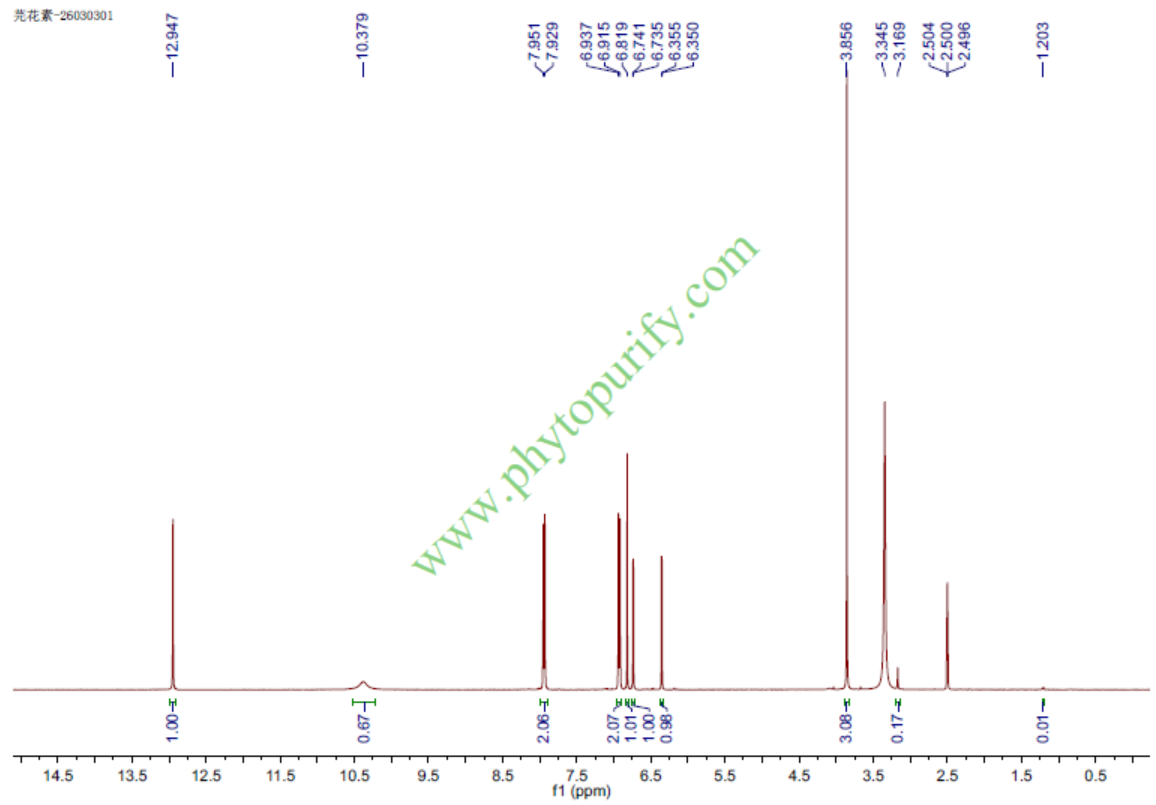
HNMR of Genkwanin
Storage conditions:Short-term storage at 2~8℃, long-term storage at -20 ~ -80℃
79.9000
2.5132
2.4836
.0517
3.1447
18.3701
Low
91.7576
2.1677
Yes
No
Yes
No
Yes
No
0.6
No
No
Yes
No
Genkwanin, CAS number 437-64-9, is a naturally occurring O-methylated flavonoid compound belonging to the monomethoxyflavonoid family. Its structure is a derivative of apigenin, in which the 7-hydroxyl group is methylated. Due to its unique chemical structure and diverse biological activities, it has attracted much attention in the field of natural product pharmacology in recent years. Yuanhuasu not only exhibits significant anti-inflammatory effects, but also shows potential in various pharmacological activities such as anti-tumor, antioxidant, and neuroprotective effects, especially in the treatment research of malignant tumors such as lung cancer. This article aims to systematically review the chemical structure and physicochemical properties, plant sources and extraction methods, pharmacological activity, mechanism of action and molecular targets, pharmacological evaluation and pharmacokinetic characteristics of naringenin, and explore its clinical application prospects. It is expected to provide theoretical basis and reference for the in-depth research and drug development of this natural product.
The chemical name of yuanhuasu is 5,7-dihydroxy-4 '- methoxyflavone, with a molecular formula of C16H12O5 and a molecular weight of 284.2670. Its structural feature is that the 7-hydroxyl group on the flavonoid skeleton is methylated to form O-methylated flavonoids, which have good chemical stability and lipid solubility. Its LogP value is 2.5132, indicating that naringenin has moderate lipid solubility, which is beneficial for cell membrane penetration. The topological polar surface area (TPSA) is 79.9 Å ², reflecting its moderate molecular polarity, which may affect its bioavailability and penetration ability.
The low water solubility (0.0517 mg/mL) suggests that the solubility of naringenin in the aqueous phase is limited, which may limit its oral absorption efficiency. The low permeability of the blood-brain barrier indicates limited distribution in the central nervous system. The hERG channel inhibition experiment result was negative, indicating that naringenin has a low risk of cardiac toxicity. The Ames test value is 0.6, indicating a low risk of genotoxicity and a good safety basis.
In summary, the physicochemical properties of naringenin support its development as a potential drug molecule, but improving its water solubility and bioavailability remains a key focus of future research.
Yuanhuasu is widely present in various traditional Chinese medicinal materials and plants, mainly sourced from the Daphne spp., flavonoid rich plants such as celery (Apium graveolens), and some Chinese herbal medicines. Yuanhuasu, as a secondary metabolite of flavonoids, often coexists with other flavonoids and polyphenolic compounds.
Traditional extraction methods mainly use techniques such as solvent extraction, reflux extraction, and ultrasound assisted extraction. Common solvents include organic solvents such as methanol, ethanol, and ethyl acetate, which can effectively dissolve flavonoids. Modern extraction techniques such as supercritical CO2 extraction, microwave-assisted extraction, and membrane separation are gradually being applied to the efficient extraction of naringenin, which can improve extraction efficiency and purity, and reduce solvent residue.
After extraction, column chromatography (silica gel, reverse phase C18), high performance liquid chromatography (HPLC), and preparative liquid chromatography are usually used for separation and purification to ensure the high purity of genkwa extract for subsequent pharmacological research.
The pharmacological activity research of yuanhuasu covers multiple aspects such as anti-inflammatory, anti-tumor, antioxidant, neuroprotective, etc., especially showing outstanding inhibitory effects on malignant tumors such as lung cancer.
Yuanhuasu exerts significant anti-inflammatory effects by inhibiting the production and release of inflammatory mediators. In vitro cell models have shown that naringenin can inhibit the expression of pro-inflammatory cytokines such as TNF - α, IL-6, and NO in macrophages, thereby reducing inflammatory responses. The mechanism involves inhibition of the NF - κ B signaling pathway, which reduces the transcriptional activity of inflammation related genes.
Yuanhuasu has shown inhibitory effects on proliferation, induction of apoptosis, and inhibition of migration in various tumor cell lines. Especially in lung cancer cells, naringenin can promote tumor cell apoptosis, inhibit cell invasion and metastasis by regulating key molecules such as BCL2, STAT3, MMP2, etc. Animal model studies have also confirmed its inhibitory effect on lung cancer growth, demonstrating good anti-cancer potential.
Yuanhua extract has the ability to eliminate free radicals and alleviate oxidative stress, which helps protect nerve cells from damage. Its antioxidant effect is achieved by enhancing endogenous antioxidant enzyme activity and directly clearing reactive oxygen species, demonstrating potential protective effects against neurodegenerative diseases.
Yuanhuasu also exhibits antibacterial, antiviral, and metabolic regulating activities, indicating its potential applications in various disease fields.
The biological activity of yuanhuasu is mainly achieved by regulating multiple cellular signaling pathways and key molecules, especially in the treatment of lung cancer involving multiple targets.
Yuanhuasu achieves its pharmacological effects such as anti-inflammatory and anti-tumor through multi-target and multi pathway synergistic regulation. Its main mechanism of action includes:
The pharmacological parameters of yuanhuasu indicate that it has certain potential for drug development, but there are still certain challenges.
At present, there is limited in vivo pharmacokinetic data on naringenin. Previous studies have shown that the absorption of yuanhuasu is slow after oral administration, and its bioavailability is limited. It is mainly metabolized through liver metabolic enzymes, and the metabolites may include demethylation and sulfate complexes. Its half-life is moderate, mainly excreted through the kidneys and bile.
Strategies such as nanocarriers, liposome encapsulation, and structural modification are currently being studied to enhance the pharmacokinetic properties of yuanhuasu, in order to improve its water solubility, bioavailability, and targeting.
Yuanhuasu, as a natural flavonoid compound, has shown broad clinical application prospects due to its multi-target and multi mechanism pharmacological activities, especially its potential value in the treatment of tumors such as lung cancer.
Lung cancer, as one of the malignant tumors with the highest incidence rate and mortality in the world, is in urgent need of new highly effective and low toxic therapeutic drugs. Yuanhuasu has shown good anti lung cancer activity by regulating tumor cell apoptosis, inhibiting invasion and metastasis, and regulating the tumor microenvironment, and is expected to be used as an adjuvant therapy or combination drug ingredient.
The anti-inflammatory effect of naringenin endows it with potential in chronic inflammatory diseases, immune regulation, and other fields, and can be expanded to treat autoimmune diseases, inflammatory lung diseases, and other conditions in the future.
Based on its antioxidant and neuroprotective effects, naringenin is expected to be applied in the prevention and treatment of neurodegenerative diseases, such as Alzheimer's disease, Parkinson's disease, etc.
Yuanhuasu, as a natural O-methylated flavonoid with multiple biological activities, has shown great potential for drug development due to its anti-inflammatory, anti-tumor, and antioxidant pharmacological effects. Its multi-target regulatory mechanism in the treatment of malignant tumors such as lung cancer provides an important direction for the development of new natural drugs. Although there are certain limitations in the water solubility and bioavailability of yuanhuasu at present, through the optimization of modern medicinal chemistry and formulation technology, yuanhuasu is expected to become a safe and effective natural drug candidate molecule in clinical practice. In the future, it is necessary to strengthen its pharmacokinetics, toxicology, and preclinical research, promote the transition of naringenin from laboratory to clinical application, and benefit more patients.
