Introduction/Overview
Ursodeoxycholic acid (UDCA), CAS number 128-13-2, is a hydrophilic bile acid with important physiological and pharmacological activities. Since its discovery from bear bile, UDCA has gradually evolved from a traditional choleretic and litholytic drug to a cornerstone drug for treating various liver and gallbladder diseases, and has shown potential in a wider range of metabolic diseases. Its core pharmacological effects lie in regulating bile acid metabolism, antagonizing bile stasis, protecting liver cells, and exerting anti-inflammatory and antioxidant effects through multi-target and multi pathway mechanisms. With the deepening of molecular pharmacology research, the mechanism of action of UDCA has surpassed the simple theory of "bile acid substitution" and involves precise regulation of nuclear receptors, signaling pathways, and organelle functions. This article aims to systematically review the chemical properties, sources, pharmacological activities, molecular mechanisms of action, pharmacological characteristics, and clinical application prospects of UDCA, in order to provide a comprehensive academic perspective for the in-depth research and development of this important natural product.
Chemical structure and physicochemical properties
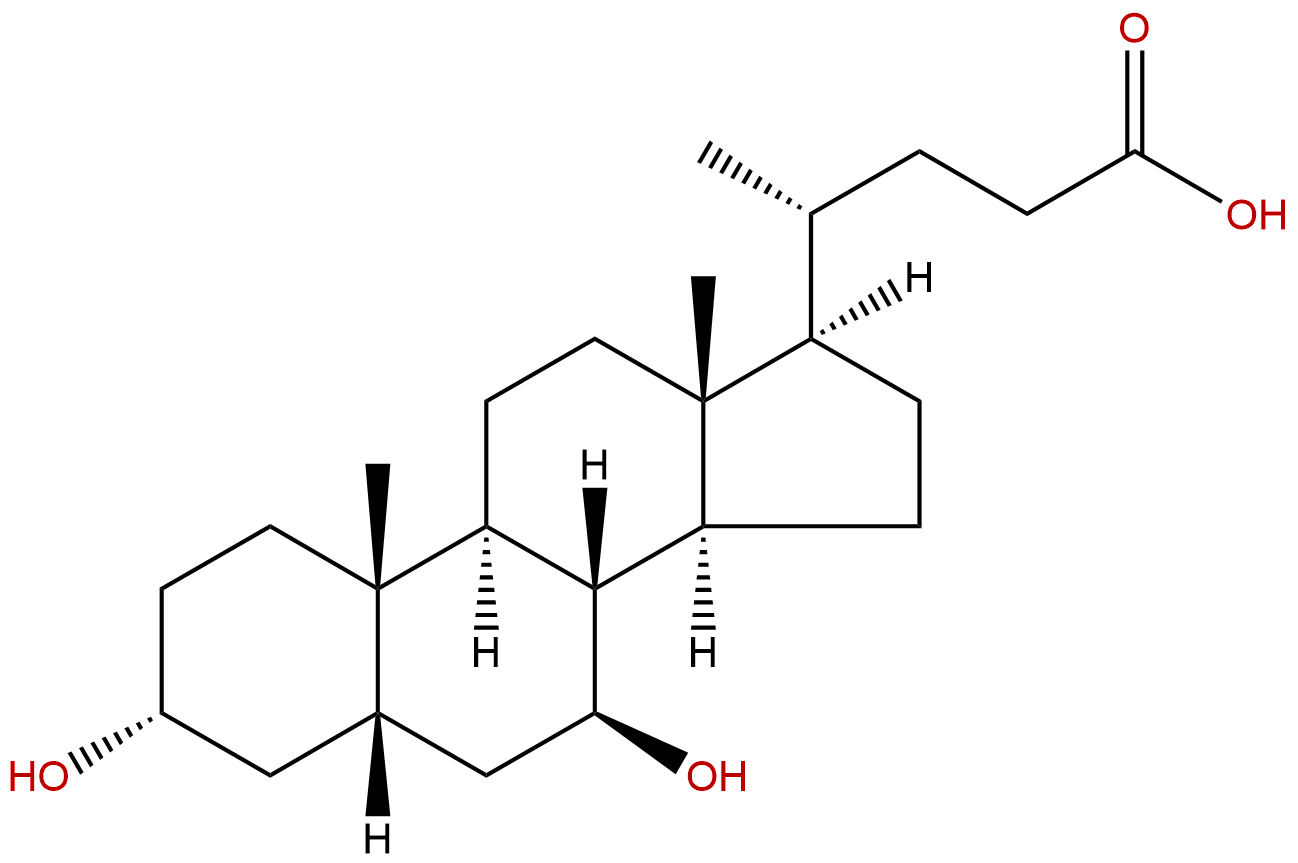
Ursodeoxycholic acid is a C24 steroid with the chemical name 3 α, 7 β - dihydroxy-5 β - choline-24-acid, belonging to the dihydroxy-5 β - cholic acid family. Its molecular formula is C ₂₄ H ₄₀ O ₄, and its molecular weight is 392.5800. Compared with the main hydrophobic bile acids in the human body, such as chenodeoxycholic acid CDCA and deoxycholic acid DCA, the key structural feature of UDCA is that its 7-hydroxyl group is in the beta configuration (7 β - OH). This stereochemical difference greatly alters its physicochemical properties.
The LogP value of UDCA is 4.0578, and the theoretical polar surface area (TPSA) is 77.7600 Å ², indicating amphiphilicity, but overall hydrophilicity is better than most endogenous hydrophobic bile acids. Its water solubility is relatively low, about 0.0529 mg/mL, which affects its absorption form in the gastrointestinal tract. At physiological pH, UDCA mainly exists in anionic form and can bind with taurine or glycine to form conjugated bile acids (such as taurodeoxycholic acid TUDCA), which have different solubility and membrane permeability characteristics. The crystal morphology, solubility, and stability of UDCA are significantly influenced by pH, temperature, and coexisting ions, which form the basis for its formulation development and pharmacokinetic behavior.
Plant sources and extraction methods
Although UDCA is named for its high content in bear bile, especially in black and brown bears, modern commercial production no longer relies on animal sources, mainly due to animal protection and ethical considerations, as well as the maturity of synthetic technology. At present, the main source of UDCA is the semi synthetic method.
- Traditional animal sources Early UDCA was extracted directly from bear bile or bile powder. The main bile acid in bear bile is the combination of ursodeoxycholic acid and taurine (TUDCA). The extraction process involves multi-step purification of bile, including saponification, defatting, acidification, and recrystallization. The process is complex and the yield is low, making it difficult to meet large-scale demand.
- Semi synthetic method (mainstream process)The core method of current industrial production is to use the abundant and low-cost bovine bile extract, chenodeoxycholic acid (CDCA), as the starting material. CDCA is the main bile acid in the bile of ruminant animals such as cattle and sheep. By using chemical or enzymatic methods to stereoisomerize the 7 α - hydroxyl group of CDCA and convert it into 7 β - hydroxyl group, UDCA is obtained. This process route is mature, with high purity, and is the main source of UDCA raw materials in the market.
- Microbial transformation method As a potential green alternative process, selective 7-site isomerization of bile acid substrates is performed using enzyme systems from specific strains such as Clostridium and Bacteroides. This method has mild conditions and good stereo selectivity, but still needs to be optimized in terms of yield, cost, and scale.
Pharmacological activity research
UDCA has a wide range of pharmacological activities, with its core centered around protecting the liver and gallbladder system and extending to systemic effects.
- Hepatoprotective and anti cholestatic effects This is the most classic and confirmed function of UDCA. It can promote bile secretion, increase the content of phospholipids and bicarbonate in bile, form a bile flow rich in hydrophilic bile acids, thereby flushing the bile ducts, diluting and replacing toxic hydrophobic bile acids, directly protecting bile duct epithelial cells and liver cells from damage.
- Anti inflammatory and immune regulatory effects UDCA can inhibit the infiltration of inflammatory cells in the liver and downregulate the expression of pro-inflammatory factors such as TNF - α, IL-1 β, IL-6. In autoimmune liver diseases such as primary biliary cholangitis (PBC), UDCA may exert immunomodulatory effects by regulating the antigen presentation function of liver cells and bile duct epithelial cells.
- Antioxidant and anti apoptotic effects UDCA and its binding form TUDCA are effective cell protectants. They can stabilize the mitochondrial membrane, inhibit the opening of the mitochondrial permeability transition pore (mPTP), prevent the release of cytochrome C, and thus suppress liver cell apoptosis triggered by toxic bile acids, ethanol, or oxidative stress.
- Regulating lipid metabolism and anti atherosclerosis potential UDCA can inhibit the absorption of intestinal cholesterol, promote the excretion of cholesterol from feces, and regulate the expression of cholesterol metabolism related enzymes in the liver, with the potential to reduce serum cholesterol. Its anti-inflammatory and antioxidant properties also suggest that it may be beneficial to the prevention and treatment of atherosclerosis.
- Anti fibrotic effect Long term UDCA treatment can delay the progression of liver fibrosis in patients with chronic liver diseases such as PBC. The mechanism may be related to reducing liver cell damage, inhibiting hepatic stellate cell (HSC) activation, and reducing extracellular matrix deposition.
Mechanism of action and molecular targets
The mechanism of action of UDCA is complex, involving direct and indirect, genomic and non genomic effects. Its key molecular targets and signaling pathways are as follows:
- Regulation of farnesol X receptor (FXR)FXR is a key nuclear receptor for bile acid homeostasis. UDCA itself is a weak agonist of FXR, but one of its main metabolites, taurodeoxycholic acid (TUDCA), is an effective FXR ligand. By activating FXR, small heterodimeric chaperone (SHP) is upregulated, thereby inhibiting the expression of cholesterol 7 α - hydroxylase (CYP7A1) and reducing the synthesis of endogenous bile acids (especially toxic bile acids). Meanwhile, FXR activation also induces the expression of bile acid efflux pump (BSEP/ABCB11) and multidrug resistance associated protein 2 (MRP2/ABCC2), promoting the excretion of bile acids and toxins.
- Activation of the NRF2 system in the antioxidant stress pathway UDCA can activate transcription factor NRF2 (NF-E2-related factor 2), causing it to dissociate from cytoplasmic chaperone protein KEAP1 and translocate into the nucleus. NRF2 binds to antioxidant response elements (ARE) to drive the transcription of a series of phase II detoxifying enzymes and antioxidant proteins, including glutathione S-transferase A1 (GSTA1), GSTP1, heme oxygenase-1 (HO-1), NAD (P) H quinone oxidoreductase 1 (NQO1), etc. Meanwhile, UDCA can also upregulate the activity of classic antioxidant enzymes such as superoxide dismutase 1 (SOD1), catalase (CAT), and glutathione peroxidase 1 (GPX1), synergistically enhancing the antioxidant defense ability of cells.
- The impact on drug metabolizing enzymes UDCA can regulate the cytochrome P450 enzyme system. For example, it can inhibit the activity of CYP2E1 (an enzyme involved in ethanol and various prodrug metabolism) and reduce the production of reactive oxygen species (ROS). Meanwhile, it may induce the expression of CYP3A4, promoting the metabolism of other drugs and endogenous substances.
- Membrane stability and signal regulation As an amphiphilic molecule, UDCA can integrate into the cell membrane and mitochondrial membrane, alter their fluidity, stabilize membrane structure, and thereby inhibit apoptosis signaling mediated by death receptors such as Fas. It can also activate ERK1/2 in the epidermal growth factor receptor (EGFR) and mitogen activated protein kinase (MAPK) pathways, transmitting pro survival signals.
- Regulation of cholesterol transporters UDCA may promote cholesterol reverse transport and excretion by affecting the function of ABCG5/ABCG8 heterodimers (responsible for pumping cholesterol into bile and limiting intestinal absorption).
- Relief of endoplasmic reticulum stress TUDCA has been proven to be an effective chemical chaperone that can help misfolded proteins fold correctly and alleviate endoplasmic reticulum stress (ERS), which is of great significance in neurodegenerative and metabolic disease models.
Evaluation of drug properties and pharmacokinetics
Based on the provided pharmacological parameters and existing research, the evaluation of UDCA is as follows:
- absorb UDCA is a weak acid that is absorbed by passive diffusion in the duodenum and jejunum after oral administration, with a high absorption rate (about 90%). Its low water solubility may affect the dissolution rate and is a consideration factor in formulation design.
- distribution After absorption, it mainly binds and transports albumin in the portal vein blood, with a significant first pass effect, and is efficiently taken up by the liver. Its blood-brain barrier permeability is low, indicating limited direct effects on the central nervous system, but its binding form TUDCA has been shown to have better neuroprotective potential.
- Metabolism In liver cells, UDCA mainly binds with glycine or taurine to form glycoursodeoxycholic acid (GUDCA) or TUDCA, which is then secreted into bile. Partial UDCA can be dissociated and converted into lithocholic acid (LCA) or CDCA through 7-position isomerization by gut microbiota, but the amount is relatively small.
- excretion Mainly excreted through feces (>90%), forming enterohepatic circulation. A small amount is excreted through the kidneys.
- safety evaluation:
- HERG inhibition The data shows' no ', indicating that UDCA has a very low risk of causing QT interval prolongation and apical torsion ventricular tachycardia at therapeutic doses, and has good cardiovascular safety.
- Ames test The data is 0.0, indicating that no mutagenicity was observed under the conditions of this experiment, and the risk of genetic toxicity is low.
- Overall, UDCA has good tolerance, with common adverse reactions being diarrhea, which is usually mild and reversible. Rare and severe allergic reactions.
Clinical application prospects and prospects
At present, UDCA is the first-line drug for the treatment of primary biliary cholangitis (PBC), which can significantly improve biochemical indicators, delay histological progression, and increase transplant free survival rate. In addition, it is also used for the dissolution treatment of cholesterol gallstones, palliative treatment of primary sclerosing cholangitis (PSC), and intrahepatic cholestasis of pregnancy.
Future prospects and research directions include:
- Combination therapy strategy For PBC patients with poor UDCA response, the combination of peroxisome proliferator activated receptor delta (PPAR delta) agonists (such as beta drugs) and FXR strong agonists (such as obeticolic acid OCA) is currently a hot clinical research topic, aiming to achieve multi pathway synergistic enhancement.
- Indications expansion:
- Non alcoholic fatty liver disease (NAFLD)/metabolic associated fatty liver disease (MAFLD)Based on its regulation of lipid metabolism, anti-inflammatory and anti fibrotic properties, UDCA's position in the treatment of NAFLD is being re evaluated, especially when combined with other drugs.
- Liver ischemia-reperfusion injury (IRI)In liver transplantation and liver resection surgery, pre-treatment or infusion of UDCA/TUDCA may protect the donor liver through anti apoptotic and antioxidant mechanisms.
- Neurological disorders TUDCA has shown neuroprotective potential in clinical trials of Huntington's disease, amyotrophic lateral sclerosis (ALS), Alzheimer's disease, and stroke, and its mechanism is closely related to alleviating endoplasmic reticulum stress and inhibiting apoptosis.
- Intestinal diseases and metabolic syndrome UDCA may have beneficial effects on inflammatory bowel disease, insulin resistance, and obesity by regulating the intestinal bile acid pool, affecting the FXR-FGF15/19 axis, and gut microbiota.
- New delivery system Develop novel formulations based on nanotechnology or phospholipid complexes to enhance the solubility, targeting (such as specific delivery to hepatic stellate cells or inflammatory sites), and bioavailability of UDCA.
- Deep exploration of the mechanism of action Using omics technologies (proteomics, metabolomics) and gene editing tools, further elucidate the novel mechanisms of UDCA in organelle communication (such as mitochondrial endoplasmic reticulum interaction), epigenetic regulation, and gut microbiota regulation.
Conclusion
Ursodeoxycholic acid, as a naturally derived drug molecule, has undergone decades of research and clinical application. It has evolved from a traditional choleretic drug to a multifunctional cell protectant with a rich mechanism of action and continuously expanding application fields. It has established a cornerstone position in the treatment of liver and gallbladder diseases by regulating FXR, activating the NRF2 antioxidant pathway, stabilizing biofilms, and alleviating endoplasmic reticulum stress through multiple molecular mechanisms. The pharmacokinetic parameters indicate that it has good safety and pharmacokinetic properties. Facing the future, UDCA's exploration in new fields such as metabolic diseases and neurodegenerative diseases, as well as the development of new derivatives based on its core structure and optimization of combination therapy strategies, will continue to promote the revitalization of this classic natural product and contribute more value to human health.