Introduction/Overview
Coniferyl alcohol, also known as 4-hydroxy-3-methoxycinnamyl alcohol, is a natural phenylpropanoid compound widely present in the xylem of higher plants. As one of the crucial monomer precursors in the lignin biosynthesis pathway, paclitaxel plays a central role in the formation of plant cell walls, mechanical support, and defense reactions. For a long time, its research has mainly focused on the fields of plant physiology and biochemistry. However, with the deepening development of natural product pharmacology, the biological activities exhibited by pine bark alcohol that exceed its plant physiological functions have gradually entered the research field. Modern pharmacological research has shown that pine bark alcohol not only has significant antifungal activity, but also exhibits potential therapeutic value in cardiovascular system, inflammation regulation, and other aspects. Especially its improvement effect on cardiac dysfunction and inflammation caused by renal vascular hypertension suggests its novel application prospects in the field of cardiovascular disease treatment. In addition, its oral activity and relatively good medicinal properties make it an attractive molecule for connecting plant chemistry with innovative drug development. This article aims to provide a systematic review of the chemical properties, plant sources, pharmacological activities, mechanisms of action, and medicinal properties of pine bark alcohol, in order to provide comprehensive scientific references for the deep development and clinical application of this natural product.
Chemical structure and physicochemical properties
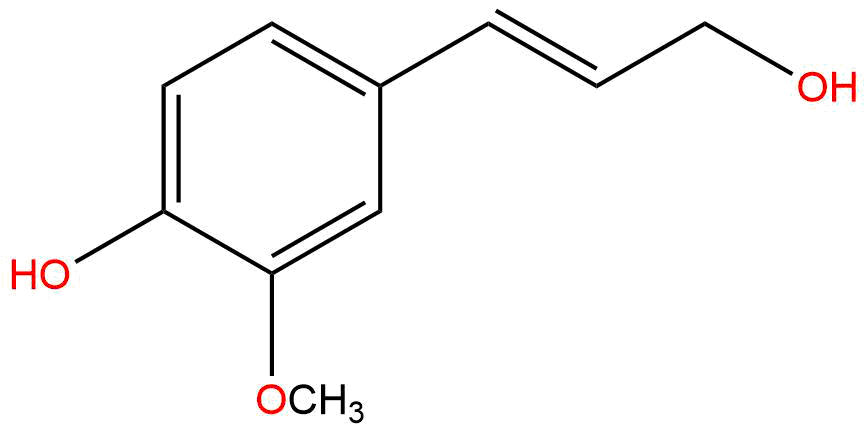
The molecular formula of pine bark alcohol is C ₁₀ H ₁₂ O3, the CAS number is 458-35-5, and the molecular weight is 180.2030. Its chemical structure belongs to the phenylpropanoid class, with a basic skeleton consisting of a benzene ring connected to a three carbon side chain (C6-C3). Specifically, the 3rd position of its benzene ring is substituted with methoxy (- OCH ∝), and the 4th position is substituted with hydroxyl (- OH), forming the guaiacyl structural unit. The side chain is an unsaturated acrylic alcohol structure, where the benzene ring is connected to a primary alcohol (- CH ₂ OH) through an ethylene bridge (- CH=CH -). This structure combines the antioxidant properties of phenolic compounds with the reactivity of unsaturated alcohols.
Its physical and chemical properties directly affect its bioavailability and biological activity. The lipid water partition coefficient (LogP) of pine bark alcohol is 1.60, indicating that it has a certain lipophilicity, but not highly hydrophobic, which is beneficial for its penetration of cell membranes. The theoretical polar surface area (TPSA) is 49.69 Å ², which reflects the surface area occupied by polar groups (hydroxyl, methoxy) in the molecule, and the value is moderate. Its water solubility is about 4.71 mg/mL, belonging to the range of slightly soluble to soluble, which provides a basis for its dissolution and distribution in organisms. It is worth noting that the predictive model shows that paclitaxel has a high blood-brain barrier permeability, which suggests that it may have an impact on central nervous system related targets, although there is currently limited research on this topic. In terms of preliminary safety evaluation, existing data shows that it has no hERG potassium channel inhibitory activity (hERG inhibition: no), reducing the risk of inducing QT interval prolongation in the heart; The Ames test result is 0.0, indicating no mutagenicity in this testing system, providing preliminary safety support for its further development.
Plant sources and extraction methods
Pine bark alcohol is a key intermediate in the lignin biosynthesis network. In the plant body, it is mainly synthesized from phenylalanine through the phenylpropane metabolic pathway: phenylalanine is converted to cinnamic acid by phenylalanine ammonia lyase (PAL), and then undergoes a series of hydroxylation, methylation, and reduction reactions. Finally, it is catalyzed by cinnamoyl CoA reductase (CCR) and cinnamyl alcohol dehydrogenase (CAD) to produce paclitaxel. Therefore, pine bark alcohol is widely present in all vascular plants, especially in the cambium, xylem, and tissues that are injured or infected by pathogens, with higher levels.
The sources of plants rich in pine and cypress alcohol are diverse, including but not limited to pine and spruce plants (such as pine and spruce), dicotyledonous plants (such as poplar and Arabidopsis), and various medicinal plants. For example, in the lignin of gymnosperms, the structural units derived from pine bark alcohol dominate. In addition, the presence of paclitaxel can often be detected in the water decoction or alcohol extract of some resins, tree roots, and traditional herbs.
The extraction of paclitaxel from plant materials is usually carried out using organic solvent extraction method. Common processes include: Soxhlet extraction or ultrasound assisted extraction of dried and crushed plant materials (such as wood, bark) using polar solvents (such as methanol, ethanol, acetone, or their mixed aqueous solutions). After filtration and concentration, the crude extract can be separated and purified through a series of chromatographic techniques, such as silica gel column chromatography, high-performance liquid chromatography (HPLC), etc. Due to the presence of pine bark alcohol in the form of glycosides (such as pine bark glycosides) in plants, it is sometimes necessary to first undergo acid or enzyme hydrolysis to release the glycosides before extraction. With the development of green chemistry technology, modern methods such as supercritical CO ₂ extraction have also been explored for the extraction of such plant monomers due to their high efficiency and low residue advantages. Industrial production may rely on chemical synthesis or biosynthetic pathways, such as using microbial cell factories to heterologous express plant derived enzyme systems to produce paclitaxel, but it is still in the research stage.
Pharmacological activity research
The pharmacological activity research of pine bark alcohol has expanded from its initial role as a plant antitoxin to multiple biomedical effects.
-
Antifungal activity This is one of the earliest recognized biological activities of pine bark alcohol. Research has confirmed that pine bark alcohol can specifically inhibit the growth of various plant pathogenic fungi, such as Verticillium longisporum(Fusarium oxysporum) has a significant inhibitory effect. Its function is manifested as interfering with the integrity of fungal cell walls or affecting their metabolic processes. It is interesting that this defensive molecule may also have a regulatory effect on the plant itself, for example, there have been reports that pine bark alcohol can inhibit Nicotiana benthamiana The growth of (Nicotiana benthamiana) seedlings may be related to their role as signaling molecules in the plant or their cytotoxicity at high concentrations.
-
Cardiovascular protective effect This is the pharmacological activity of pine bark alcohol that has received the most attention in recent years. In animal models of renal vascular hypertension (RVH), paclitaxel exhibits clear cardioprotective effects. Research has shown that oral administration of paclitaxel can significantly improve RVH induced cardiac dysfunction, including enhancing cardiac contraction and relaxation abilities, and reducing myocardial hypertrophy. Meanwhile, it can effectively inhibit the inflammatory response in cardiac tissue, reduce the expression of pro-inflammatory cytokines such as tumor necrosis factor - α (TNF - α) and interleukin-6 (IL-6), and decrease the infiltration of inflammatory cells. These effects collectively promote the recovery of cardiac structure and function under hypertension.
-
Anti inflammatory and antioxidant activity As a phenolic compound, pine bark alcohol has the ability to scavenge free radicals and exhibits antioxidant activity. Its anti-inflammatory effect is not only reflected in cardiac tissue, but also observed in other inflammatory models, which can inhibit the production of inflammatory mediators such as nitric oxide (NO) and prostaglandin E2 (PGE2). Its mechanism may be related to the inhibition of inflammatory signaling pathways such as nuclear factor kappa B (NF - κ B).
-
Other potential activities Preliminary studies also suggest that paclitaxel may have antibacterial (targeting certain bacteria), anti-tumor (inducing apoptosis of certain cancer cells), and neuroprotective activities, but research in these areas is still in its infancy and requires more evidence to support it.
Mechanism of action and molecular targets
The molecular mechanisms underlying the diverse pharmacological activities of pine bark alcohol are gradually being revealed, involving multiple potential targets and signaling pathways.
-
Mechanism of antifungal action Regarding its antifungal activity, research suggests that it may act on multiple key targets of fungi. According to the provided target information, in the context of oral (possibly referring to oral pathogenic fungi or analogy studies), paclitaxel may interfere with:
- DNA replication: By acting on GYRA The A subunit of DNA gyrase inhibits the unwinding of DNA supercoils.
- folate metabolism By inhibiting DHFR(Dihydrofolate reductase) and FOLA(possibly referring to enzymes related to folate synthesis), blocking nucleotide synthesis.
- Cell wall synthesis Possible through collaboration with PBP2 The interaction of penicillin binding protein 2 affects the synthesis of cell wall peptidoglycan.
- steroid synthesis By inhibiting ERG(Wool sterol demethylase, key enzyme for ergosterol synthesis) disrupts the integrity of fungal cell membranes.
These multi-target effects may collectively lead to fungal growth arrest or death, and also reduce the risk of fungi developing single target resistance.
-
Mechanisms of cardiovascular protection For the core activity of improving hypertensive heart disease, its mechanism is more complex and may be the result of multiple pathway integration
- Inhibition of inflammatory signaling pathway Pine bark alcohol is likely to alleviate myocardial inflammatory damage by inhibiting the activation of NF - κ B, downregulating the expression of downstream pro-inflammatory cytokines (TNF - α, IL-1 β, IL-6) and chemokines.
- Regulating oxidative stress Its antioxidant properties help to eliminate excess reactive oxygen species (ROS) in the myocardium, alleviate oxidative stress damage to myocardial cells and mitochondria, and improve energy metabolism.
- Affects fibrosis process It is possible to combat myocardial fibrosis by inhibiting the TGF - β/Smad signaling pathway, reducing the activation of cardiac fibroblasts and excessive deposition of extracellular matrix.
- Possible direct cardiomyocyte protection The specific target is not yet clear, but it may involve regulating cell apoptosis (such as affecting the Bcl-2/Bax ratio) and autophagy related pathways.
-
The role of signaling molecules In plant and animal systems, pineol and its oxidative polymerization products may act as signaling molecules themselves, participating in intercellular communication and stress response.
Evaluation of drug properties and pharmacokinetics
Based on its physicochemical properties and preliminary biological data, pine bark alcohol has shown certain potential as a drug.
- drug-likeness The molecular weight (180) meets the small molecule standard in the "Five Rules for Classified Drugs". Moderate LogP values (~1.6) and TPSA values (~50 Å ²) indicate good membrane permeability and oral absorption potential. The water solubility is still acceptable, which is beneficial for the development of formulations. The absence of hERG inhibition and Ames mutagenicity negativity are important early safety advantages.
- Pharmacokinetics (PK)Currently, there are relatively limited research reports on the pharmacokinetics of the pine bark alcohol system. It is known to have oral activity, indicating that it can be absorbed in the gastrointestinal tract. The phenolic and alcohol hydroxyl groups in its structure may undergo extensive metabolic transformations in the body, including glucuronidation, sulfation, methylation, and other II combination reactions. The prediction of its high blood-brain barrier permeability suggests that it may be distributed to the central system, but this requires in vivo experimental verification. The main pathways of excretion may be through the kidneys and bile. Future research needs to clarify its absolute bioavailability, plasma half-life, tissue distribution characteristics, and major metabolites.
- Preparation considerations Due to its phenolic hydroxyl group being easily oxidized, antioxidant protection needs to be considered in the formulation. It can be developed into oral solid preparations such as tablets, capsules, or soft capsules, and may also explore its injectable precursor drugs to improve bioavailability.
- potential challenges As a plant defense molecule, it may exhibit certain toxicity to host cells at high doses (as indicated by the inhibition of plant seedling growth). Its multi-target nature is both advantageous (pleiotropy) and may bring risks of off target effects and complex side effects, which need to be carefully evaluated in preclinical studies.
Clinical application prospects and prospects
The clinical application prospects of pine bark alcohol are mainly based on the two pillars of cardiovascular protection and antifungal activity, and may expand to broader fields.
- Cardiovascular disease adjuvant therapy Based on its significant cardioprotective effect in the RVH model, paclitaxel is the most promising candidate for development Adjuvant therapeutic drugs or dietary supplements for diseases such as hypertensive heart disease, myocarditis, and myocardial fibrosis Its multi mechanism characteristics of anti-inflammatory, antioxidant, and anti fibrotic make it very suitable for intervening in multiple pathological stages of chronic cardiovascular disease. It can be used in combination with existing antihypertensive drugs and anti heart failure drugs to achieve synergistic effects and reduce cardiac remodeling.
- Antifungal infection treatment Especially for:Fungal infections of plant origin or in the environment, as well as possible oral fungal infections (such as candidiasis), coniferol or its derivatives can be developed as topical drugs (such as mouthwash, gel, cream) or systemic antifungal drugs. Its possible multi-target mechanism of action can help address the increasingly severe problem of drug-resistant fungi.
- Exploring other fields Its potential role in neuroinflammation, metabolic disease-related inflammation, and even certain cancers has pointed out new directions for future research. For example, its high BBB permeability makes it Neurodegenerative diseases (such as Alzheimer's disease) The candidate molecules for drug development must have their safety and efficacy confirmed within the nervous system.
Future research priorities should include:
* In depth mechanism research Using chemical biology methods such as affinity fishing, molecular docking, gene knockout/knockdown to identify its precise molecular targets in animal bodies.
* Systematic pharmacokinetic/toxicological evaluation Complete standardized preclinical ADME (absorption, distribution, metabolism, excretion) and long-term toxicity studies to clarify their safety window.
* structural optimization Structural modification of pine bark alcohol through medicinal chemical methods to enhance its activity, selectivity, metabolic stability, and oral bioavailability, while reducing potential toxicity.
* clinical research After obtaining sufficient preclinical data support, gradually promote human clinical trials to verify the effectiveness and safety of its treatment for specific indications (such as chronic heart failure and fungal keratitis).
Conclusion
Pine bark alcohol, a simple molecule derived from the lignin synthesis pathway in plants, is moving from the background of plant physiology to the center stage of natural product pharmacology. It not only serves as a defense guard for plants, but has also been revealed to have multiple pharmacological activities such as improving heart function, resisting fungal invasion, and regulating inflammatory responses. Its clear oral activity, good drug like characteristics, and preliminary safety data have laid a solid foundation for its drug development. Although there are still many challenges in terms of precise mechanism of action, systemic pharmacokinetics, and clinical translation, paclitaxel is undoubtedly a natural lead compound with great research value and development potential. With the continuous deepening of interdisciplinary research, paclitaxel is expected to provide new strategies and weapons for the prevention and treatment of major health problems such as cardiovascular disease and fungal infections in the future, fully demonstrating the enduring vitality of the drug development concept of seeking inspiration from nature.