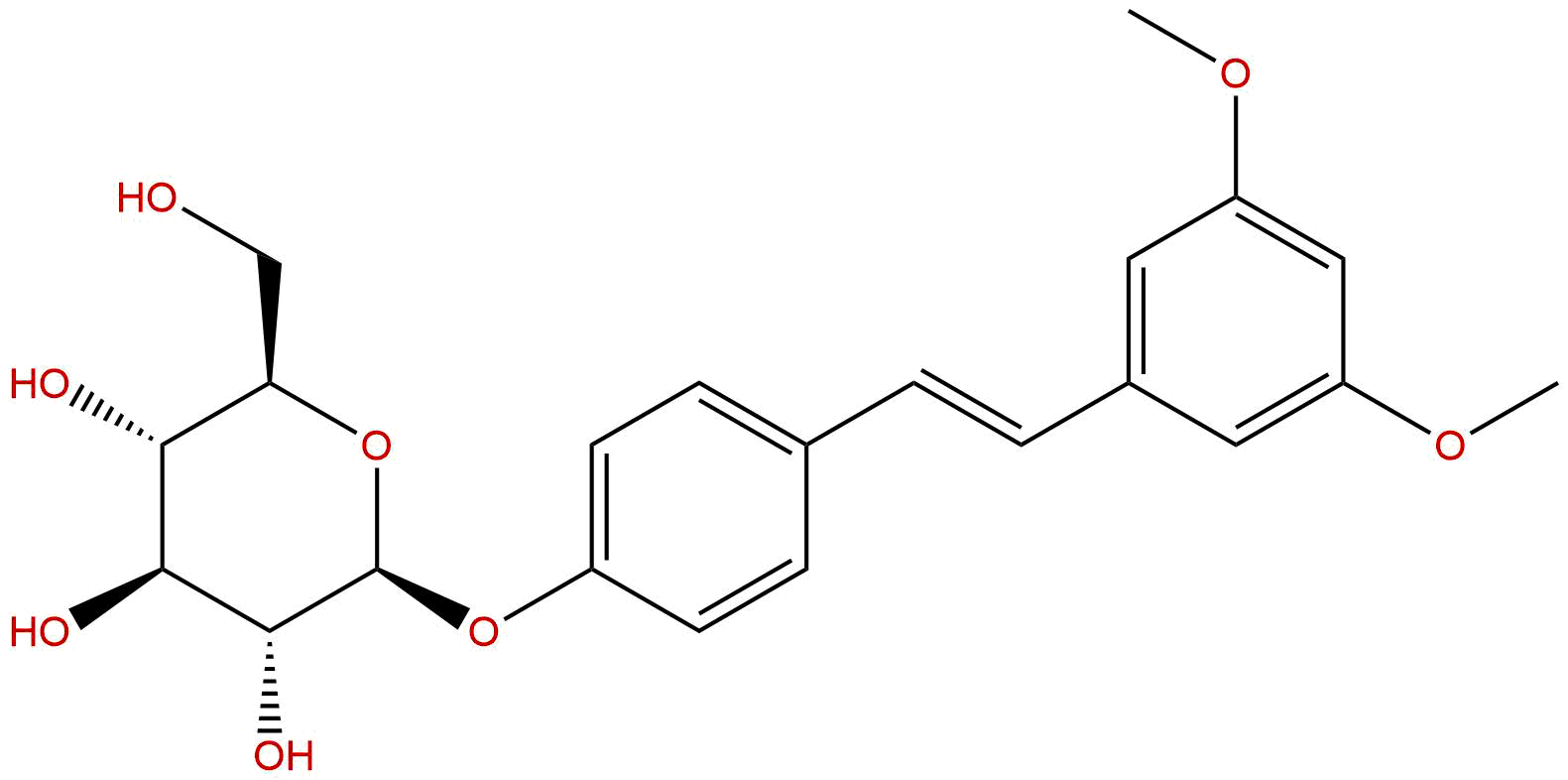


Product name: Pterostilbene glucoside
Synonym name:
Catalogue No.: BP4775
Cas No.: 38967-99-6
Formula: C22H26O8
Mol Weight: 418.442
Botanical Source:
Type of Compound:
Purity: 95%~99%
Analysis Method: HPLC-DAD or/and HPLC-ELSD
Identification Method: Mass, NMR
Packing: Brown vial or HDPE plastic bottle
Storage: Store in a well closed container, protected from air and light. Put into refrigerate or freeze for long term storage.
Whenever possible, you should prepare and use solutions on the same day. However, if you need to make up stock solutions in advance, we recommend that you store the solution as aliquots in tightly sealed vials at -20℃. Generally, these will be useable for up to two weeks.
The product could be supplied from milligrams to grams
Inquire for bulk scale.
For Reference Standard and R&D, Not for Human Use Directly.
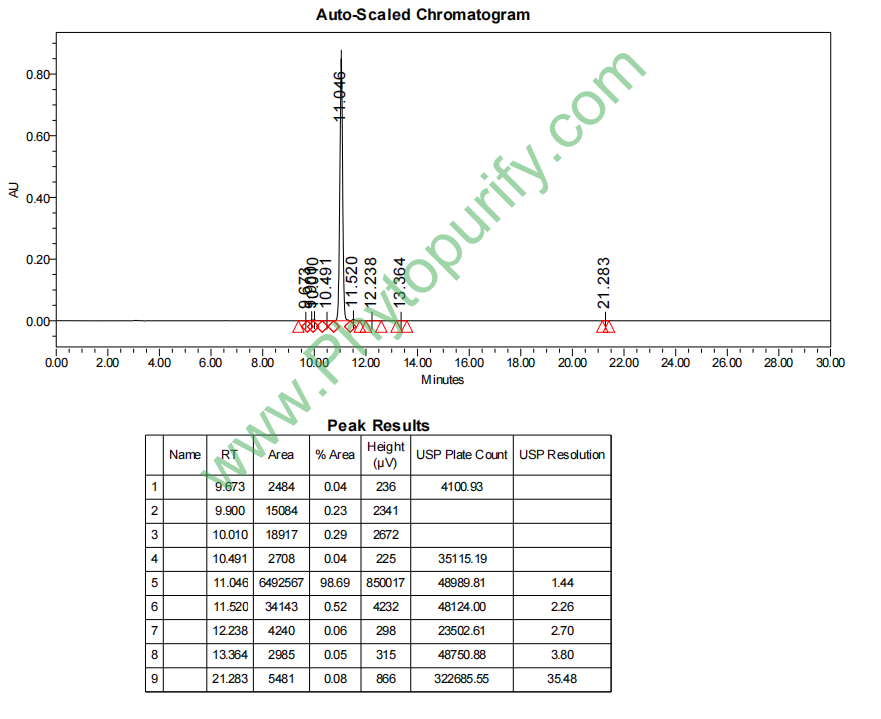
HPLC of Pterostilbene glucoside
Storage conditions:Short-term storage at 2~8℃, long-term storage at -20 ~ -80℃
117.8400
1.3788
1.3787
.4261
.8994
.1884
Low
81.6010
3.5358
Yes
No
No
No
No
No
0.0
Yes
Yes
Yes
Yes
As an important treasure trove for drug discovery and development, natural products continue to provide structurally diverse and biologically active lead compounds for human health. Stilbene compounds have attracted much attention due to their extensive pharmacological activities, among which resveratrol, as a star molecule, has been widely studied for its anti-aging, cardiovascular protection, and anti-tumor effects. Pterostilbene glycoside (CAS number: 38967-99-6), as a methylated derivative of resveratrol and a product of glucose binding, not only inherits the core biological activity of the stilbene nucleus, but also exhibits potential advantages in stability, bioavailability, and targeting due to its unique structural modification. This compound has been reported to have potent antioxidant stress protection and can effectively protect specific cell models from dopamine induced calcium clearance deficiency, indicating its value in the prevention and treatment of neurodegenerative diseases. Meanwhile, its anti-tumor activity involves multiple key targets, making it a potential candidate molecule for the development of multi-target anti-tumor drugs. The purpose of this article is to systematically review the chemical structure, plant origin, pharmacological activity, mechanism of action, medicinal properties, and clinical application prospects of rosewood glycoside, in order to provide comprehensive scientific references for the in-depth research and development of this compound.
The chemical name of purple sandalwood glycoside is (E) -5- [2- (3,5-dimethoxyphenyl) vinyl] -2-methoxyphenyl - β - D-glucopyranoside. Its molecular formula is C23H28O8 and its molecular weight is 418.4420. Structurally, it is linked to a β - glucose group on the 4 '- hydroxyl group of Pterostilbene (3', 5 '- dimethoxyresveratrol). This glycosylation modification significantly altered its physicochemical properties.
Compared with the parent compounds resveratrol and rosewood, glycosylation usually increases the water solubility of the molecule. The calculated water solubility parameter is 0.4261, and the TPSA (topological polar surface area) is 117.84 Å ², both higher than its glycoside form, which is beneficial for its dissolution and distribution in biological fluids. However, its lipid water partition coefficient (LogP) is 1.3788, indicating that it still has a certain degree of lipophilicity, and this amphiphilic balance may have complex effects on its transmembrane transport and bioavailability. Preliminary pharmacological predictions indicate that its blood-brain barrier permeability is low, which may limit its direct efficacy in central nervous system diseases, but may also reduce potential neurological side effects. In addition, its hERG inhibition risk is negative, and the Ames test result is 0.0, indicating a low potential risk of arrhythmia and genetic toxicity, providing preliminary positive signals for its safety.
As a secondary metabolite of plants, rosewood glycoside is mainly found in grapes (Vitis vinifera), blueberries (Vaccinium spp.), Pterocarpus plants, and some traditional medicinal plants. In these plants, it often coexists with resveratrol and other stilbene compounds, and is one of the defense substances for plants to cope with biotic and abiotic stress.
The extraction method follows the conventional process of natural product chemistry. Firstly, dry plant materials such as grape skins, blueberry pomace, or rosewood heartwood are crushed and extracted using organic solvents (such as methanol, ethanol, or acetone water mixed solutions) or ultrasound assisted extraction to maximize the acquisition of phenolic compounds with a wide range of polarities. Subsequently, crude extract was obtained by vacuum concentration. Further separation and purification usually rely on column chromatography techniques, often using silica gel, reverse phase C18 or macroporous adsorption resin as the stationary phase, with different ratios of chloroform methanol or water methanol gradient elution. High performance liquid chromatography (HPLC) or preparative thin layer chromatography (PTLC) is a key step in obtaining high-purity rosewood glycoside monomers. Modern green extraction technologies, such as supercritical CO2 extraction (which requires the addition of entrainers to improve the dissolution of polar components) and microwave-assisted extraction, have also been explored and applied due to their high efficiency and low solvent consumption. The optimization of extraction process needs to comprehensively consider the yield, cost, and environmental friendliness of the target compound.
The pharmacological activity research of purple sandalwood glycoside has revealed its outstanding potential in multiple disease fields, especially in neuroprotection and anti-tumor.
1. Neuroprotective activity:
One of its core pharmacological activities is its potent antioxidant stress protection. Research has shown that rosewood glycoside can effectively protect COS-7 cells transfected with M1 muscarinic receptors from dopamine (DA) - induced calcium clearance deficiency. The reactive oxygen species (ROS) and quinones produced during dopamine metabolism can cause an imbalance in intracellular calcium homeostasis, leading to cell apoptosis, which is closely related to the pathological processes of neurodegenerative diseases such as Parkinson's disease. Purple sandalwood glycoside protects neurons from oxidative damage by clearing ROS, inhibiting lipid peroxidation, and maintaining mitochondrial function. Animal model studies further support its potential to reduce age-related neurological and behavioral damage effects, suggesting its therapeutic value in Alzheimer's disease, Parkinson's disease, and cerebral ischemia-reperfusion injury.
2. Antitumor activity:
Purple sandalwood glycoside exhibits broad-spectrum anti-tumor activity. In vitro experiments show that it can inhibit the proliferation and induce apoptosis of many cancer cell lines, such as breast cancer, lung cancer, liver cancer, colon cancer, etc. Its activity intensity is usually superior to resveratrol, which may be attributed to the higher metabolic stability and cell membrane permeability brought about by its methoxy substitution. Its anti-tumor effect is not achieved through a single pathway, but involves multiple processes such as cell cycle arrest, induction of apoptosis, inhibition of invasion and metastasis, and angiogenesis.
3. Other activities:
In addition, the study also suggested that sandalwood astragaloside may have anti-inflammatory, cardiovascular protection (such as anti atherosclerosis), improving insulin resistance and liver protection activities. These multifaceted pharmacological effects together form the basis for its use as a multifunctional health product or drug lead compound.
The multiple pharmacological activities of purple sandalwood glycoside stem from its interactions with multiple key signaling pathways and molecular targets within cells, forming a complex regulatory network.
In terms of anti-tumor effects, its target network is particularly prominent:
* Regulation of apoptosis pathway: Purple sandalwood glycoside can downregulate the expression of anti apoptotic proteins Bcl-2 and Mcl-1, and may also affect pro apoptotic proteins, thereby inducing cell apoptosis through the mitochondrial pathway. This is one of the core mechanisms by which it directly kills tumor cells.
* Inhibition of signal transduction pathways: It can inhibit the phosphorylation and activation of STAT3. STAT3 is an important oncogenic transcription factor, and sustained activation can promote cell proliferation, survival, and immune escape. Purple sandalwood glycoside exerts anticancer effects by blocking the JAK/STAT3 pathway. Meanwhile, it can also affect the MAPK/ERK pathway (such as inhibiting MAPK1/ERK2), which regulates cell growth and differentiation.
* Target points related to invasion and metastasis: This compound can inhibit the expression and activity of matrix metalloproteinase MMP-2. MMP-2 is a key enzyme that degrades the extracellular matrix, and inhibition of its activity can effectively hinder the invasion and metastasis ability of tumor cells.
* Nuclear targets and hormone regulation: Purple sandalwood glycoside has been reported to inhibit the activity of topoisomerases I and II α (TOP1, TOP2A), interfere with DNA replication and repair, leading to DNA damage and cell death. In addition, it can also interfere with the growth signal of estrogen dependent tumors (such as some breast cancer) by acting on estrogen receptor alpha (ESR1) and aromatase (CYP19A1).
* Tumor microenvironment regulation: By inhibiting the stability and activation of hypoxia inducible factor HIF-1 α, rosewood glycoside can weaken the adaptability of tumor cells under hypoxic conditions and inhibit its mediated angiogenesis (VEGF expression, etc.).
In terms of neuroprotection, its mechanism mainly revolves around antioxidant and maintaining calcium homeostasis:
In addition to its direct free radical scavenging ability, rosewood glycoside may upregulate the expression of antioxidant enzymes such as superoxide dismutase (SOD) and glutathione peroxidase (GPx) by activating endogenous antioxidant defense pathways such as Nrf2/ARE. In a cell model of M1 receptor overexpression, it maintains stable intracellular calcium ion concentration by repairing calcium clearance defects caused by dopamine toxicity, thereby protecting neuronal function. These effects may also involve regulation of mitochondrial function and endoplasmic reticulum stress.
Although rosewood glycoside has shown excellent biological activity in vitro and some animal models, its successful development as a drug highly depends on its drug like and pharmacokinetic (PK) properties.
According to its physical and chemical parameters, it is predicted that Pterostilbene glycoside has a medium molecular weight, suitable LogP value, and high TPSA, which basically conforms to the Rule of Five, indicating that it has good oral absorption potential. However, the presence of glycosidic bonds makes it susceptible to hydrolysis by gut microbiota and β - glucosidase on the brush edges of epithelial cells in vivo, resulting in the formation of aglycone rosewood. Although this process may increase its lipophilicity and membrane permeability, it also leads to extremely low concentrations of the prototype drug in the bloodstream, and its pharmacological effects may be largely attributed to its metabolites.
Existing pharmacokinetic studies (mainly based on its glycoside, Pterostilbene) have shown that Pterostilbene is rapidly absorbed after oral administration, but has a significant first pass effect and moderate bioavailability (about 20% -30%). Glycoside forms may serve as prodrugs, prolonging the duration of action or altering distribution characteristics. Purple sandalwood is widely metabolized in the body, mainly undergoing glucuronidation and sulfation binding reactions, and is excreted through urine and feces. The predicted blood-brain barrier permeability is' low ', which is consistent with the low distribution of brain tissue measured, and is a key bottleneck that needs to be overcome in the development of central nervous system drugs. However, under conditions of neuroinflammation, the permeability of the blood-brain barrier increases, or drug delivery systems such as nano formulations can be modified to improve its delivery within the brain.
In terms of safety, preliminary computer predictions (hERG negative, Ames negative) and animal experiments based on rosewood indicate low toxicity. However, as a new chemical entity, the acute toxicity, long-term toxicity, and reproductive toxicity of rosewood glycosides still need to be evaluated through complete preclinical studies.
The clinical application prospects of purple sandalwood glycoside are broad, but it faces both challenges and opportunities on the road.
Potential application directions:
1. Prevention and treatment of neurodegenerative diseases: As a dietary supplement or prescription drug, it is used for early intervention or adjuvant treatment of Parkinson's disease and Alzheimer's disease, especially for subgroups of patients with oxidative stress and calcium homeostasis imbalance as the main pathological processes.
2. Tumor adjuvant therapy and chemoprevention: With the characteristics of multi target and low toxicity, it can be used as a sensitizer or disinfectant for traditional radiotherapy and chemotherapy, or for cancer chemoprevention of high-risk people (such as the prevention of breast cancer and colon cancer).
3. Management of chronic metabolic diseases: It plays a comprehensive role in diabetes and its complications, non-alcoholic fatty liver, atherosclerosis and other diseases closely related to oxidative stress and chronic inflammation.
4. Functional foods and health products: Directly enriching and extracting from foods such as blueberries and grapes to develop health products with antioxidant, anti-aging, and cognitive enhancing functions is currently the closest application form to the market.
Challenges and Future Prospects:
1. Bioaccumulation and delivery system: Improving its oral bioavailability and brain targeting is the core challenge of transformation. Future research should focus on developing novel drug delivery systems, such as liposomes, nanoparticles, polymer micelles, prodrug strategies (such as designing glycosidic bonds sensitive to specific enzymes), or forming inclusion complexes with molecules such as cyclodextrin to protect them from premature metabolism and enhance target tissue accumulation.
2. In depth study of the mechanism of action: At present, the understanding of its mechanism of action, especially the direct action of the glycoside form itself, is still incomplete. It is necessary to use chemical biology methods such as affinity fishing and molecular probes to more accurately identify its direct target and elucidate its systemic pharmacological mechanisms in complex biological networks.
3. Structure performance relationship and structural optimization: Based on the structure of rosewood glycoside, systematic chemical modifications (such as modifying the sugar moiety and modifying the substituents on the benzene ring) are expected to obtain derivatives with stronger activity, more stable metabolism, and higher targeting.
4. High quality clinical research: At present, there is a lack of human clinical trial data on rosewood glycoside. Promoting standardized Phase I-III clinical trials to evaluate their effectiveness, safety, and optimal dosing regimen in specific disease populations is a necessary step in transitioning them from the laboratory to clinical practice.
As an important member of the resveratrol family, rosewood glycoside has become a highlight in natural product pharmacology research due to its unique chemical structure and significant multiple pharmacological activities. From potent antioxidant stress and neuroprotection to multi-target synergistic anti-tumor effects, its demonstrated biological potential is remarkable. Although there are challenges in drug development, especially in terms of bioavailability and blood-brain barrier penetration, the development of modern medicinal chemistry and pharmaceutical technology provides powerful tools to overcome these bottlenecks. In the future, by delving into its molecular mechanism, optimizing its structure and delivery strategy, and advancing rigorous clinical validation, rosewood glycoside is expected to transform from a promising natural active ingredient into an innovative drug or highly effective functional ingredient for the prevention and treatment of neurodegenerative diseases, tumors, and various chronic diseases, contributing its unique value to human health.
