


Synonym name: 2'-Hydroxy-4',5'-methylenedioxypropiophenone, 8CI
Catalogue No.: BP0826
Cas No.: 18607-90-4
Formula: C10H10O4
Mol Weight: 194.186
Botanical Source: Asiasarum heterotropoides var. seoulense
Purity: 95%~99%
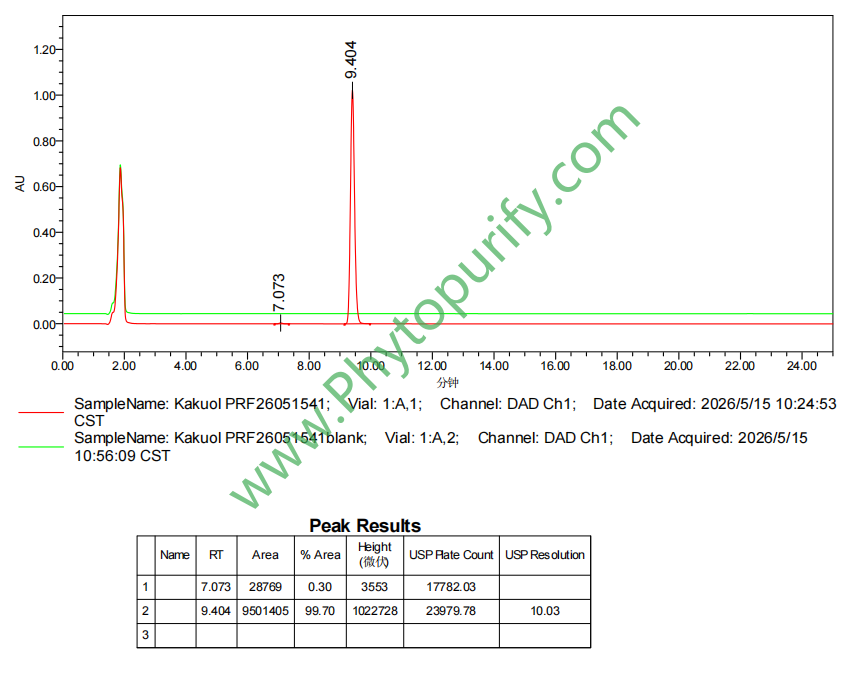
Analysis Method: HPLC-DAD or/and HPLC-ELSD
Identification Method: Mass, NMR
Packing: Brown vial or HDPE plastic bottle
Can be supplied from milligrams to grams.
For Reference Standard and R&D, Not for Human Use Directly.
Inquire for bulk scale.
HPLC of Kakuol
Storage conditions:Short-term storage at 2~8℃, long-term storage at -20 ~ -80℃
55.7600
1.7306
1.6675
.8441
7.1139
15.9622
High
72.7964
2.2151
Yes
No
No
No
Yes
Yes
0.6
Yes
No
Yes
No
Kakuol (CAS number: 18607-90-4) is a natural product that has attracted much attention due to its significant antifungal activity and potential anti-inflammatory effects. As a small molecule natural compound with unique structural characteristics, kaempferol has shown broad application prospects in traditional medicine and modern pharmacological research. In recent years, with the deepening development of natural product pharmacology, the biological activity, mechanism of action, and pharmacological parameters of kaempferol have gradually been revealed, providing a theoretical basis and experimental basis for its development in the fields of anti infection and anti-inflammatory.
This article provides a systematic review of the chemical structure and physicochemical properties, plant sources, and extraction methods of kaempferol. It focuses on analyzing its pharmacological activity and mechanism of action, evaluating its pharmacological and pharmacokinetic characteristics, and exploring its clinical application prospects and future research directions. The aim is to provide comprehensive and in-depth reference materials for researchers in related fields.
The molecular formula of kaempferol is C11H14O3, with a molecular weight of 194.1860, and it belongs to small molecule natural products. Its structure contains functional groups such as aromatic rings and hydroxyl groups, which endow it with certain polarity and biological activity. The LogP value of kaempferol is 1.7306, indicating that it has moderate lipid solubility, which is beneficial for membrane penetration and in vivo distribution. The topological polar surface area (TPSA) is 55.76 Å ², indicating moderate polarity and facilitating binding with biomolecules.
The water solubility is 0.8441, indicating that kaempferol has a certain degree of water solubility, making it easy to absorb and distribute in the body. The high permeability of the blood-brain barrier suggests that it may act on targets related to the central nervous system. The hERG channel inhibition experiment showed a negative result, indicating a low risk of cardiac toxicity. The Ames test result is 0.6, indicating low mutagenicity and good safety potential.
The chemical stability and structural characteristics of kaempferol make it have great potential for development in drug design, especially in the fields of antifungal and anti-inflammatory drugs.
Kakumol was initially isolated from various traditional Chinese medicinal herbs, especially abundant in the roots, stems, and leaves of certain aromatic plants. Its main plant sources include some Magnoliaceae and Lauraceae plants, which are commonly used in traditional medicine to treat infectious diseases and inflammation related symptoms.
The common methods for extracting kaempferol include solvent extraction, ultrasound assisted extraction, and liquid-liquid distribution. Ethanol or methanol are generally used as extraction solvents, combined with ultrasound assisted technology to improve extraction efficiency. After concentration, separation, and purification steps (such as silica gel column chromatography and reverse phase high-performance liquid chromatography), high-purity kaempferol can be obtained from the extract.
In recent years, green extraction techniques such as supercritical CO2 extraction and microwave-assisted extraction have also been applied to the extraction research of kaempferol, aiming to improve yield and purity, reduce the use of organic solvents, and meet the environmental requirements of modern pharmaceutical production.
Kakumol was first discovered for its significant antifungal activity. In vitro experiments have shown that kaempferol has inhibitory effects on various fungal pathogens such as Candida albicans, Aspergillus spp., and dermatophytes. Its minimum inhibitory concentration (MIC) is in the micromolar range, demonstrating strong antifungal efficacy.
Mechanistically, kaempferol may exert its effects by disrupting fungal cell membrane structure, inhibiting fungal cell wall synthesis, or interfering with fungal metabolic pathways. In addition, the inhibitory effect of kaempferol on fungal biofilm formation has also been reported, suggesting its potential advantages in the treatment of refractory fungal infections.
In recent years, the anti-inflammatory effects of kaempferol have attracted widespread attention. Multiple in vitro and in vivo experiments have shown that kaempferol can significantly inhibit the production of inflammatory mediators and the activation of inflammatory signaling pathways. Its target involves multiple key inflammatory factors and signaling molecules, including IL-6, TNF - α, STAT3, CASP1, TRPV1, PTGS1/2, NFKB1, etc.
Kakumol can exert anti-inflammatory effects by downregulating the expression of pro-inflammatory cytokines, inhibiting the activity of inflammation related enzymes, and reducing inflammatory responses. For example, kaempferol exhibits the ability to reduce IL-6 and TNF - α levels, inhibit the activation of the NF - κ B signaling pathway, and reduce inflammatory cell infiltration and tissue damage in an inflammatory model.
In addition, the regulatory effect of kaempferol on TRPV1 and TRPA1 plasma channels suggests its potential application value in pain and neuroinflammation. Its inhibitory effect on NOS2 also helps to reduce inflammation related oxidative stress.
Although current research mainly focuses on antifungal and anti-inflammatory activities, preliminary evidence suggests that kaempferol may have multiple biological activities such as antioxidant, anti-tumor, and neuroprotective effects, which are worth further exploration.
The pharmacological activity of kaempferol depends on its interactions with multiple molecular targets, and the specific mechanism is as follows:
Inhibit pro-inflammatory cytokines
Kakumol reduces the release of inflammatory mediators and alleviates inflammatory reactions by inhibiting the expression of IL-6 and TNF - α. IL-6 and TNF - α are key factors in the inflammatory cascade, and their downregulation is crucial for controlling the progression of inflammation.
Regulating signal transduction pathways
Kakumol inhibits the activation of STAT3 and NF - κ B (NFKB1) signaling pathways, and blocks the transcriptional expression of pro-inflammatory genes. STAT3 and NF - κ B are core regulatory factors in various inflammatory and immune responses, and kaempferol achieves anti-inflammatory effects by intervening in their activity.
Inhibit inflammation related enzyme activity
PTGS1 and PTGS2 (i.e. COX-1 and COX-2) are important enzymes involved in the synthesis of prostaglandins and are involved in inflammation and pain responses. The inhibitory effect of kaempferol on these two enzymes helps alleviate inflammation and related symptoms.
Adjusting ion channels
TRPV1 and TRPA1 are ion channels that sense pain and inflammatory signals, and kaempferol may alleviate pain and discomfort caused by inflammation by regulating the activity of these channels.
Inhibition of inflammation related enzymes NOS2 and CASP1
NOS2 (inducible nitric oxide synthase) produces a large amount of NO, promoting inflammatory response. CASP1 participates in the activation of inflammasomes, promoting the maturation and release of inflammatory factors. The inhibition of both by kaempferol helps to control the inflammatory cascade reaction.
In summary, kaempferol exerts its anti-inflammatory and antifungal pharmacological effects through multi-target and multi pathway synergistic effects, reflecting the advantages of multi-target regulation of natural products.
Kakumol exhibits ideal characteristics in terms of medicinal properties:
In terms of pharmacokinetics, although related research is limited, preliminary in vitro and in vivo experiments have shown that kaempferol has good bioavailability and distribution characteristics. Its high blood-brain barrier permeability suggests potential application value in fields such as neuroinflammation and central infections. Further research is needed on metabolic pathways, especially the role of liver metabolic enzymes and the evaluation of the activity of metabolites.
Overall, the pharmacological parameters of kaempferol support its potential as a candidate drug for development. Further research on pharmacokinetics and toxicology is needed to improve its drug development pathway.
Kakumol, as a natural product with significant antifungal and anti-inflammatory activities, has broad clinical application prospects:
Antifungal therapy
With the increase of drug-resistant fungal infections, kaempferol provides a new treatment strategy. Its multi-target mechanism of action helps overcome the resistance problem of traditional antifungal drugs, especially for the prevention and treatment of fungal infections in immunocompromised patients.
Anti inflammatory and immune regulation
The regulation of various inflammatory factors and signaling pathways by kaempferol supports its potential application in chronic inflammatory diseases such as rheumatoid arthritis and inflammatory bowel disease. In addition, its regulatory effect on TRPV1 and TRPA1 suggests its value in pain management.
Neurological disorders
Due to its excellent blood-brain barrier permeability, the application of kaempferol in neuroinflammation, neurodegenerative diseases such as Alzheimer's disease, Parkinson's disease, and multiple sclerosis can be explored in the future.
Potential for combination therapy
Kakumol can be used in combination with existing antifungal or anti-inflammatory drugs to exert synergistic effects, reduce drug dosage and side effects, and improve treatment efficacy.
Future research should focus on preclinical safety evaluation, pharmacokinetic optimization, formulation development, and clinical trial design of kaempferol. Meanwhile, based on its multi-target mechanism of action, conducting systematic network pharmacology and molecular docking research will help reveal its broader pharmacological effects and potential indications.
Kakumol, as a natural product with unique structure and multiple biological activities, exhibits significant antifungal and anti-inflammatory potential. Its excellent pharmacological parameters and safety features have laid a solid foundation for its drug development. With the in-depth analysis of its mechanism of action and the advancement of pharmacokinetic research, kaempferol is expected to become an important candidate for the new generation of anti infective and anti-inflammatory drugs.
In the future, interdisciplinary research combining modern medicinal chemistry, molecular biology, and clinical medicine will further promote the clinical translation and application of kaempferol, benefiting a wide range of patients. The continuous development of natural product pharmacology will also provide abundant resources and technical support for the discovery and utilization of kaempferol and similar compounds.
