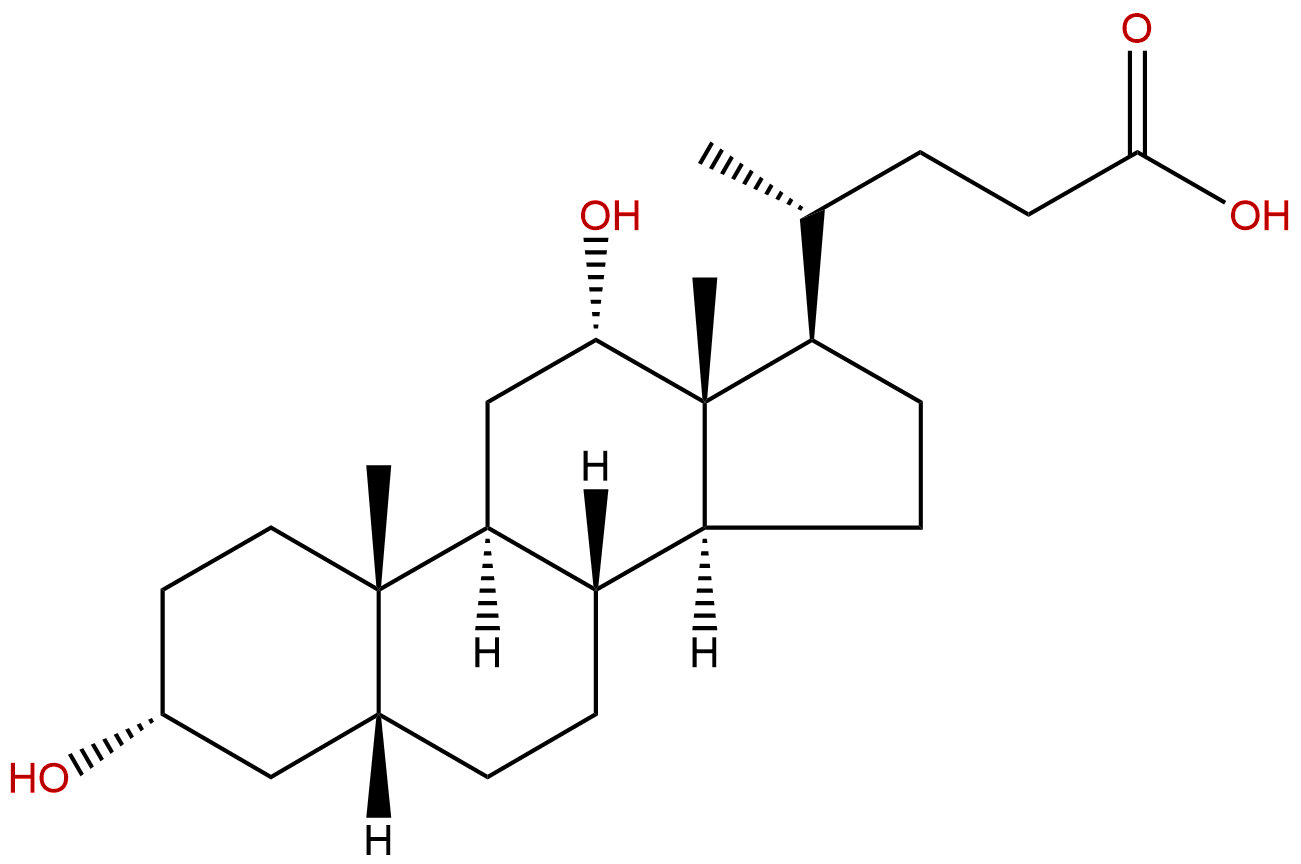


Product name: Deoxycholic acid
Synonym name:
Catalogue No.: SBP03885
Cas No.: 83-44-3
Formula: C24H40O4
Mol Weight: 392.58
Botanical Source:
Physical Description: White powder
Type of Compound: Steroids
Purity: 95%~99%
Analysis Method: HPLC-DAD or/and HPLC-ELSD
Identification Method: Mass, NMR
Packing: Brown vial or HDPE plastic bottle
The product could be supplied from milligrams to grams. Inquire for bulk scale.
We provide solution to improve the water-solubility of compounds, thereby facilitating the variety of activity tests and clinic uses.
For Reference Standard and R&D, Not for Human Use Directly.
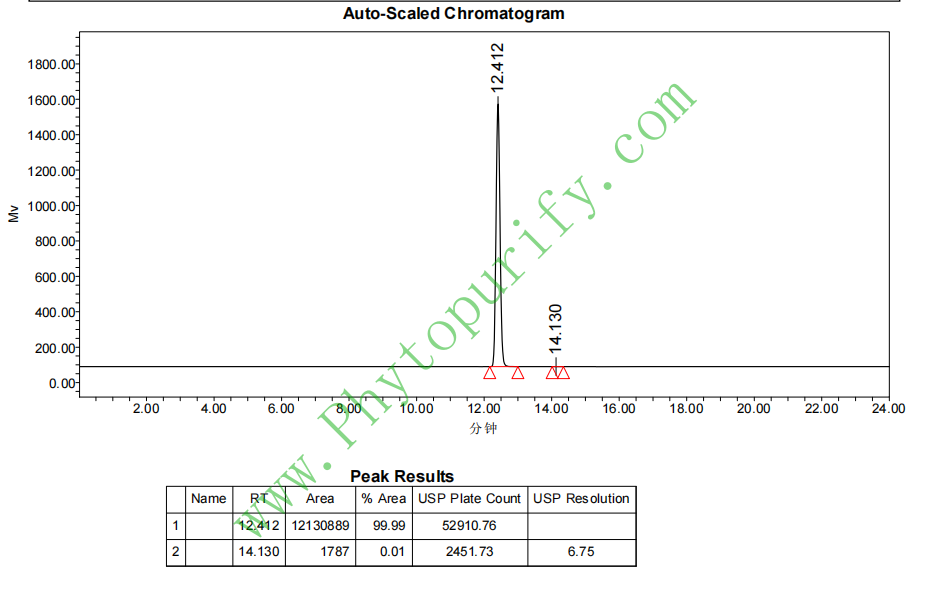
HPLC of Deoxycholic acid
Storage conditions:Short-term storage at 2~8℃, long-term storage at -20 ~ -80℃
77.7600
3.9524
1.7580
.0435
4.2188
6.0849
Low
90.0381
4.3653
No
No
No
No
No
No
0.0
Yes
No
No
No
Deoxycholic acid, as a secondary bile acid, is one of the key end products of cholesterol metabolism in the human and animal bodies. Its chemical essence is a derivative of bile acid, CAS number 83-44-3. For a long time, bile acids have been mainly regarded as "detergents" that promote lipid digestion and absorption. However, in the past two decades, with the deepening of molecular pharmacology research, the role of bile acids as an important signaling molecule has gradually been revealed. Deoxycholic acid is not only a byproduct of gut microbiota metabolism, but also a regulator of various physiological and pathological processes. It can specifically activate key receptors such as TGR5 (GPBAR1) and farnesol X receptors, thereby playing a core regulatory role in energy metabolism, glucose homeostasis, inflammatory response, and bile acid metabolism. Its traditional application in choleretic therapy has been interpreted by modern pharmacological targets, including ABCG5, FXR, TGR5, SLC10A2, and ABCB11. This article aims to systematically review the chemical properties, sources, pharmacological activities, molecular mechanisms of action, pharmacological characteristics, and potential application prospects of deoxycholic acid in disease treatment, in order to provide a comprehensive academic perspective for the deep development and clinical application of this natural product.
The chemical name of deoxycholic acid is 3 α, 12 α - dihydroxy-5 β - cholic acid, with a molecular formula of C ₂₄ H ₄₀ O ₄ and a molecular weight of 392.5800. Its structural skeleton is the steroid parent nucleus (cyclopentane dihydrophenanthrene), which belongs to the 5 β - series of bile acids. Compared with primary bile acids such as bile acids, deoxycholic acid lacks one hydroxyl group at the C-7 position and only retains two alpha configured hydroxyl groups at the C-3 and C-12 positions. This structural difference significantly affects its physicochemical properties and biological activity.
It has strong hydrophobicity, with a calculated LogP value of about 3.95, indicating high lipid solubility. The theoretical polar surface area (TPSA) is 77.76 Å ². It has poor water solubility, approximately 0.0435 mg/mL, which is consistent with its hydrophobic steroid nucleus structure. At physiological pH, deoxycholic acid usually exists in the form of deprotonated bile acid salts, and the water solubility and surface activity of its sodium or potassium salt are significantly enhanced, which is the basis for its emulsifying fat function. The presence of carboxyl and hydroxyl groups in deoxycholic acid molecules enables them to form complexes with metal ions and has a certain acidity. Its crystals are usually white or off white powder. These physicochemical properties determine its distribution, metabolism, and patterns of interaction with targets in the body.
Strictly speaking, deoxycholic acid is not a typical natural product of plant origin, but mainly exists in the bile of vertebrates, especially in animals such as cows, sheep, and pigs with high bile content. In animal bodies, it is converted from primary bile acids (mainly bile acids) through 7 α - dehydroxylation by intestinal anaerobic bacteria (such as Clostridium bacteria). Therefore, commercial deoxycholic acid is mainly extracted from animal bile and is one of the active ingredients in animal medicinal materials such as bezoar and bear bile. It is also an important intermediate in the preparation of bile acid drugs.
The traditional extraction method is mainly based on the difference in solubility of bile acids in different solvents. The general process includes: 1) Raw material processing: collecting animal bile, concentrating and drying it to obtain bile paste or powder; 2) Saponification hydrolysis: Heating hydrolysis under alkaline conditions to hydrolyze bound bile acids (such as glycocholic acid, taurocholic acid, etc.) into free bile acids; 3) Acidic precipitation: Adjust the pH to acidity with inorganic acids to precipitate free bile acids; 4) Separation and purification: Using organic solvents (such as ethanol, acetone, ethyl acetate) for repeated extraction, crystallization, or column chromatography (such as silica gel column, reverse phase C18 column) to separate deoxycholic acid from other bile acids (such as cholic acid, chenodeoxycholic acid). Modern industrial production increasingly adopts efficient preparation chromatography, crystallization separation technology, as well as enzymatic or microbial transformation methods (using bile acid as a substrate and specific strains for 7 α - dehydroxylation) to obtain high-purity deoxycholic acid. These methods ensure a stable supply as research reagents and pharmaceutical raw materials.
Deoxycholic acid exhibits a wide and complex pharmacological activity, far exceeding its traditional digestive function.
The pharmacological effects of deoxycholic acid are mainly mediated by acting on specific membrane receptors and nuclear receptors, with the following core targets:
These targets form a complex network that enables deoxycholic acid to integrate and regulate bile acid metabolism, lipid metabolism, glucose homeostasis, and inflammatory response.
Based on the provided pharmacological parameters, deoxycholic acid exhibits the following characteristics:
* Molecular weight (392.58)Meets the general range of small molecule drugs (<500).
* Fat solubility (LogP~3.95)A higher LogP value indicates good membrane permeability, but may lead to poor water solubility (0.0435 mg/mL), affecting oral absorption and formulation development. Usually, it needs to be made in salt form (such as sodium salt) to improve bioavailability.
* Polar surface area (TPSA 77.76 Å ²)This value is at a moderate level and has a certain impact on membrane permeability, but it is not the main limiting factor.
* Blood-brain barrier permeability Predicted as' low ', which is consistent with most bile acid characteristics and has a lower risk of central nervous system side effects.
* Preliminary safety warning HERG inhibition is' no ', indicating a low risk of potential cardiac toxicity (inducing long QT syndrome). The Ames test result is 0.0, indicating no mutagenicity and low genetic toxicity risk in this testing system.
Pharmacokinetic aspects Deoxycholic acid is mainly actively absorbed through ASBT in the ileum after oral administration, with a high absorption rate. After absorption, it binds with albumin and enters the liver through the portal vein. In the liver, the majority (>90%) is rapidly taken up and combined with glycine or taurine to form conjugated deoxycholic acid, which is then secreted into bile and enters the enterohepatic circulation. A small amount enters the systemic circulation. In addition to binding reactions, its metabolism can also undergo differential isomerization and other transformations under the action of intestinal microbiota. Mainly excreted through feces (via bile), with a very small amount excreted through the kidneys. Its pharmacokinetics are significantly influenced by gut hepatic circulation, gut microbiota status, and liver function. As an endogenous substance, the immunogenicity risk of exogenous administration is extremely low.
Deoxycholic acid currently has clear clinical applications and shows broad prospects for expansion.
Existing and traditional applications:
Potential therapeutic areas:
Challenges and Prospects:
Deoxycholic acid, a natural molecule derived from cholesterol metabolism and gut microbiota, has evolved from a simple digestive cofactor to a multifunctional signaling regulatory hub. It precisely acts on key receptors such as TGR5 and FXR, and is widely involved in core physiological and pathological processes such as choleretic, metabolic, immune, and inflammatory processes. Although its high lipid solubility and complex biological effects pose challenges in drug development, the success of existing clinical applications (such as lipid solubilization) and its enormous potential as a lead compound for the treatment of metabolic diseases fully demonstrate its important pharmaceutical value. Future research needs to focus on in-depth analysis of its specific signaling network in different tissues and concentrations, and optimize its pharmacokinetic properties and targeting through medicinal chemistry and formulation methods, in order to develop safer and more effective new therapeutic drugs based on deoxycholic acid structure, benefiting patients in the fields of metabolic syndrome, liver disease, and inflammatory diseases. The continuous exploration of deoxycholic acid will also deepen our understanding of the complex interaction network of "host metabolite microbiota" in health and disease.
