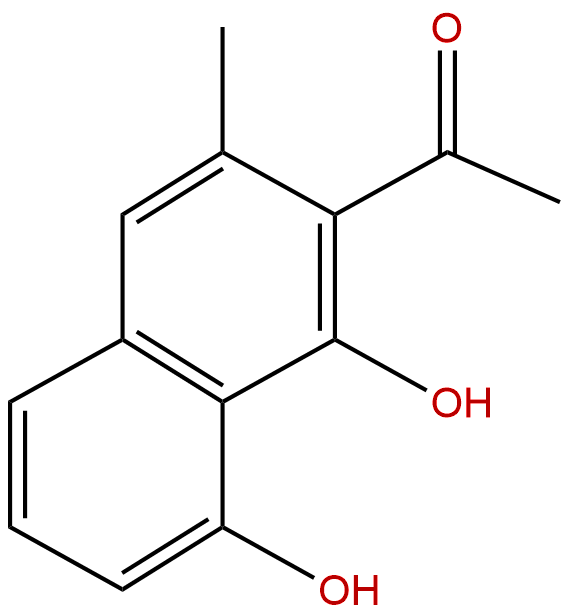


Product name: Nepodin
Synonym name: Musizin; Dianellidin
Catalogue No.: BP1609
Cas No.: 3785-24-8
Formula: C13H12O3
Mol Weight: 216.236
Botanical Source: "Constit. of the heartwood of Maesopsis eminii, of the roots of Dianella laevis and Dianella nigra and of several Rumex spp."
Physical Description:
Type of Compound:
Purity: 95%~99%
Analysis Method: HPLC-DAD or/and HPLC-ELSD
Identification Method: Mass, NMR
Packing: Brown vial or HDPE plastic bottle
The product could be supplied from milligrams to grams. Inquire for bulk scale.
We provide solution to improve the water-solubility of compounds, thereby facilitating the variety of activity tests and clinic uses.
For Reference Standard and R&D, Not for Human Use Directly.
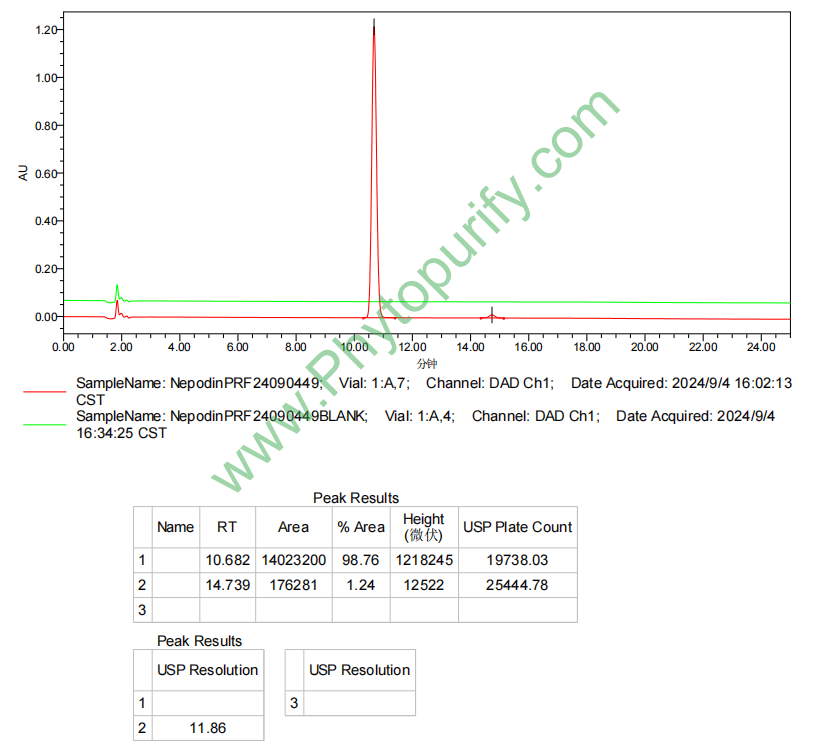
HPLC of Nepodin
Storage conditions:Short-term storage at 2~8℃, long-term storage at -20 ~ -80℃
57.5300
2.9901
2.6846
.1497
7.5762
24.3818
High
86.8125
2.2504
Yes
No
Yes
No
Yes
Yes
1.2
No
No
Yes
No
Natural products, as an important source of drug discovery, have always played a crucial role in the long history of human fight against diseases. Among them, anthraquinones have attracted much attention of pharmacology researchers due to their extensive biological activities, such as anti-inflammatory, antibacterial, anti-tumor and anti diabetes. Emodin, also known as Musizin or Nepodin, CAS number: 3785-24-8, is an anthraquinone derivative with unique pharmacological activity isolated from traditional medicinal plants. It was originally derived from the Polygonaceae acid mold plant, the wrinkled leaf acid mold(Rumex crispus)The plant is commonly used in multiple traditional medical systems to treat skin diseases, inflammation, and intestinal infections.
In recent years, with the deepening of modern pharmacological research, the biological activity spectrum of Rumex has been continuously expanded, and its core pharmacological effects focus on two major areas: metabolic diseases and infectious diseases. Research shows that Rumex can not only promote the translocation of glucose transporter 4 (GLUT4) to cell membrane by activating AMPK pathway, thus playing a potential anti diabetes role; Meanwhile, it has also been identified as an effective inhibitor of Plasmodium falciparum mitochondrial quinone oxidoreductase 2 (PfNDH2), demonstrating significant anti malarial potential. In addition, its broad-spectrum antibacterial activity involves the action on multiple key targets such as bacterial DNA gyrase, cell division protein, fatty acid synthase, and fungal sterol synthase, making it of research value in addressing the increasingly severe problem of antibiotic resistance.
This article aims to provide a systematic review of the chemical structure, plant origin, pharmacological activity, mechanism of action, medicinal properties, and clinical application prospects of berberine, in order to provide comprehensive scientific references for the deep development and utilization of this natural product.
The chemical name of Musizin is 2-acetyl-1,8-dihydroxy-3-methylnaphthalene, with a molecular formula of C13H12O3 and a molecular weight of 216.2360 g/mol. Structurally, it belongs to the naphthalene class of compounds, rather than the atypical linear tricyclic anthraquinone. However, its 1,8-dihydroxy substitution pattern is similar to many biologically active anthraquinone compounds, such as emodin, which may be the structural basis for its various pharmacological activities. The acetyl (- COCH3) and methyl (- CH3) groups in its structure are important functional groups that affect the electronic distribution, hydrophobicity, and interaction with target proteins of the compound.
Based on its chemical structure calculation, the drug properties related parameters show that the lipid water partition coefficient (LogP) of berberine is 2.99, indicating its moderate lipophilicity, which is conducive to transmembrane transport and absorption. The topologically polar surface area (TPSA) is 57.53 Å ², which is relatively small and usually indicates good membrane permeability. The predicted value of its water solubility is 0.1497 mg/mL, which belongs to the category of slight solubility, indicating that solubilization strategies may need to be considered in formulation development. It is worth noting that berberine is predicted to have a high blood-brain barrier permeability, which provides the possibility for its potential central nervous system related applications, such as certain parasitic infections or metabolic complications. In terms of early safety indicators, the hERG inhibition of berberine was predicted to be negative, reducing its risk of inducing QT interval prolongation in the heart; The Ames test predicted a value of 1.2, indicating a low risk of mutagenicity and laying a preliminary safety foundation for subsequent development.
Emodin mainly exists in the Polygonaceae family and the genus Emodin(Rumex)Among various plants, the wrinkled leaf acid mold(Rumex crispus)And sheep hooves(Rumex japonicus)It is its main source. These plants are distributed in many regions around the world and have a long history of application in folk medicine. They are commonly used for clearing heat and detoxifying, cooling blood and stopping bleeding, and killing insects and treating ringworm.
The extraction of acid residues from plant materials is usually carried out using organic solvent extraction method. The common process involves crushing dried plant roots or whole plants, followed by degreasing treatment with petroleum ether or n-hexane to remove weakly polar impurities such as chlorophyll and oil. Subsequently, medium polarity organic solvents such as chloroform, ethyl acetate, or acetone are used for repeated leaching or hot reflux extraction. Ethyl acetate is often chosen due to its good selectivity towards anthraquinone components. After being concentrated, the crude extract can be separated and purified by various chromatographic techniques, such as silica gel column chromatography, gel column chromatography (Sephadex LH-20) and high performance liquid chromatography (HPLC). The use of preparative HPLC combined with a UV detector (usually with characteristic absorption around 254 nm or 280 nm) is an effective means of obtaining high-purity berberine monomers. In recent years, green extraction techniques such as ultrasound assisted extraction and microwave-assisted extraction have also been applied to improve extraction efficiency and reduce solvent usage.
Rumex shows a variety of pharmacological activities, mainly including anti diabetes, anti malaria and antibacterial.
1. Anti diabetes activity:
In vitro and in vivo studies have confirmed that berberine has the potential to improve insulin resistance and promote glucose uptake. In cell models of insulin resistance, such as L6 myotubes or 3T3-L1 adipocytes, berberine can dose dependently increase glucose uptake. Its function does not depend on insulin, but is achieved by activating the intracellular energy receptor AMPK pathway. Animal experiments show that the administration of Rumex can significantly reduce the fasting blood glucose level of diabetes model mice and improve oral glucose tolerance, which is equivalent to or partially better than the classic drug metformin. This provides experimental evidence for its development as a novel insulin sensitizer or AMPK agonist.
2. Anti malaria activity:
Malaria, especially malaria caused by Plasmodium falciparum, remains a major global public health problem. Emodin has been identified as a specific inhibitor of the mitochondrial quinone oxidoreductase PfNDH2 in Plasmodium falciparum. PfNDH2 is a key enzyme in the electron transport chain of malaria parasites and has a different structure from human mitochondrial complex I, making it an ideal target for antimalarial drugs. Emodin inhibits PfNDH2, blocks the mitochondrial respiratory chain of malaria parasites, leading to energy metabolism breakdown and accumulation of reactive oxygen species, thereby efficiently killing malaria parasites, including strains resistant to existing drugs such as chloroquine. Its half maximal inhibitory concentration (IC50) against malaria parasites is at the micromolar or even nanomolar level, demonstrating strong anti malarial potential.
3. Antibacterial activity:
Emodin exhibits inhibitory activity against various bacteria and fungi, with a broad spectrum of antibacterial activity and multiple targets involved in its mechanism of action
- antibacterial Research has shown that berberine may interfere with DNA replication by inhibiting bacterial DNA gyrases (GYRA, GYPB); Inhibiting cell division key protein FtsZ and hindering bacterial division; Inhibit acyl carrier protein reductase (FabI) and block bacterial fatty acid synthesis; And inhibit dihydrofolate reductase (DHFR), affecting nucleotide synthesis. In addition, it also showed inhibitory effects on methicillin-resistant Staphylococcus aureus (MRSA, target MECA) and penicillin resistant bacteria (target PENA), suggesting that it may be used to overcome certain resistance mechanisms.
- antifungal Emodin has inhibitory effects on pathogenic fungi such as Candida albicans, and its mechanism may be related to the inhibition of key enzymes in the ergosterol synthesis pathway of fungal cell membranes, such as lanosterol 14 α - demethylase (ERG11, CYP51A1). At the same time, it may also affect fungal efflux pumps (such as CDR1), potentially reversing fungal drug resistance.
4. Other activities:
In addition, studies have reported that berberine has anti-inflammatory, antioxidant, and mild cytotoxicity (against certain tumor cell lines), but the research on these activities is still in the preliminary stage, and its specific mechanism and in vivo effectiveness need to be further confirmed.
The multiple pharmacological activities of berberine stem from its specific interactions with key molecular targets in different organisms.
1. Anti diabetes core mechanism: AMPK/GLUT4 pathway activation
The core molecular mechanism of the anti diabetes effect of Rumex is to activate AMPK. AMPK is the main switch for cellular energy metabolism. Emodin may increase the intracellular AMP/ATP ratio by affecting mitochondrial function or directly conformational activation, thereby promoting AMPK phosphorylation and activation. Activated AMPK initiates a series of downstream events, with the most important being the promotion of GLUT4 translocation. GLUT4 is the main transporter for glucose uptake by muscles and adipocytes. In insulin resistance, the transport of GLUT4 to the cell membrane is obstructed. Emodin promotes the movement and fusion of GLUT4 storage vesicles towards the cell membrane through the AMPK signaling pathway, increasing the amount of GLUT4 on the membrane surface and directly enhancing the uptake and utilization of glucose by cells without relying on insulin.
2. Core mechanism of anti malaria: PfNDH2 enzyme inhibition
PfNDH2 is a replacement enzyme for Plasmodium mitochondrial respiratory chain complex I, responsible for transferring electrons from NADH to ubiquinone, which is crucial for maintaining oxidative phosphorylation and survival of Plasmodium. As a quinone analogue, berberine can competitively bind to the active site of PfNDH2, block electron transfer, cause mitochondrial membrane potential collapse, halt ATP synthesis, and generate a large amount of reactive oxygen species (ROS), ultimately leading to programmed death of malaria parasites. This target does not have homologous substances in the human body, so it has high selectivity and low potential side effects.
3. Multi target mechanism of antibacterial activity
The antibacterial activity of berberine exhibits multi-target characteristics, which may be its advantage in not easily inducing single drug resistance:
- DNA replication and topological structure By inhibiting DNA gyrase (GYRA/B), it interferes with the supercoiling and unrolling of bacterial DNA, hindering replication and transcription.
- cell division By inhibiting the GTPase activity and polymerization of FtsZ protein (a bacterial microtubule protein homolog), the formation of Z-rings is disrupted, thereby inhibiting bacterial division.
- metabolic pathway Inhibit FabI (key enzyme in fatty acid synthesis type II pathway) and DHFR (key enzyme in folate metabolism), respectively, to block the synthesis of bacterial cell membrane components and nucleic acid precursors.
- Fungal cell membrane synthesis Inhibiting CYP51A1 (ERG11), preventing ergosterol synthesis, and disrupting fungal cell membrane integrity and function.
- efflux pump May inhibit or evade fungal ABC transporters (such as CDR1), reduce drug excretion from cells, and enhance antifungal efficacy.
Based on its physicochemical parameters and preliminary biological data, berberine has shown certain potential as a drug, but its comprehensive pharmacokinetic and toxicological characteristics still require systematic research.
Pharmaceutical advantages:
1. Moderate molecular weight(216), meets the basic requirements of the Rule of Five for generic drugs.
2. Good membrane permeability Moderate LogP values and small TPSA, combined with predictions of high blood-brain barrier penetration, indicate its excellent ability to penetrate cell membranes and biological barriers.
3. Preliminary safety is good Predicting the absence of hERG inhibition and mutagenic risk (Ames negative) provides a positive signal for its safety assessment.
4. Clear mechanism of action: Especially in anti malaria and anti diabetes, the targets are clear, which lays the foundation for rational drug design.
Potential challenges and unknowns:
1. Poor water solubility The micro solubility characteristics may affect its oral bioavailability and the development of formulations for intravenous administration, which need to be optimized through methods such as salt formation, preparation into nano formulations, cyclodextrin inclusion complexes, or prodrugs.
2. Lack of pharmacokinetic data At present, research on the absorption, distribution, metabolism, and excretion (ADME) process of berberine in the body is very limited. Key information such as oral absorption, plasma protein binding rate, major metabolic organs (such as liver CYP450 enzyme metabolism), metabolite activity and toxicity, half-life, and excretion pathways urgently need to be elucidated through animal experiments.
3. In vivo efficacy verification needs to be strengthened: The existing anti diabetes and anti malaria activities are mostly verified in cell and preliminary animal models, and more strict preclinical disease models (such as primate malaria models, type 2 diabetes long-term models) are needed to confirm their efficacy and dosage.
4. Potential toxicity Although initially predicted to be safe, natural anthraquinone compounds may have hepatotoxicity, nephrotoxicity, or phototoxicity, requiring systematic preclinical safety evaluations such as acute toxicity, long-term toxicity, and reproductive toxicity.
5. The double-edged sword effect of multi-target action The wide range of antibacterial targets is both an advantage and a potential side effect, such as disruption of gut microbiota, which needs to be weighed.
As a natural lead compound with multiple targets and activities, berberine has broad development prospects in various therapeutic fields, but also faces many challenges.
Application prospects:
1. Development of new antimalarial drugs Inhibitors targeting the PfNDH2 target are a new hotspot in the development of antimalarial drugs. Formicin has a novel structure and is effective against drug-resistant malaria parasites. It can be used as a lead compound for structural optimization to improve its activity, selectivity, and pharmacokinetic properties. It is expected to develop new antimalarial drugs with novel mechanisms of action, especially for the treatment of multidrug-resistant malignant malaria.
2. Adjuvant or new drugs for treatment of type 2 diabetes As a direct activator of AMPK, berberine provides a new approach for the development of insulin independent hypoglycemic drugs. It can be combined with existing drugs to improve insulin resistance, or used to develop new therapies for specific patient populations, such as those with severe insulin resistance.
3. Treatment strategies for multidrug-resistant bacterial infections Its multi-target antibacterial mechanism makes it difficult for bacteria to develop resistance through a single mutation. Emodin or its derivatives may be developed as candidate drugs for combating MRSA, drug-resistant Gram negative bacteria, and drug-resistant fungal infections, or used as antibiotic sensitizers.
4. Components of combination therapy Given their different mechanisms of action, berberine may be used in combination with existing antimalarial drugs, hypoglycemic drugs, or antibiotics to produce synergistic effects, reduce their respective dosages and side effects, and delay the development of drug resistance.
Future research directions and challenges:
1. Research on Structural Optimization and Structure Activity Relationship (SAR)Systematically modify the parent nucleus of berberine (such as modifying acetyl, hydroxyl, and methyl groups), study the changes in antimalarial, hypoglycemic, antibacterial activity, and pharmacokinetic properties of its different derivatives, and search for candidate compounds with stronger activity, lower toxicity, and better physicochemical properties.
2. In depth pharmacokinetic and toxicological research This is an indispensable step in promoting its clinical translation. It is necessary to comprehensively evaluate its ADME process in animal bodies and conduct standardized GLP toxicology experiments.
3. Fine analysis of the mechanism of action Especially its multi-target contribution weight for antibacterial activity, precise binding mode with target proteins (analyzed by X-ray crystallography or cryo electron microscopy for eutectic structure), and upstream signaling events that activate AMPK.
4. Pharmaceutical research Develop suitable drug delivery systems, such as solid dispersions, liposomes, nanoparticles, etc., to address the issue of poor water solubility and improve their bioavailability.
5. Explore new indications Based on its AMPK activation and antioxidant properties, we can explore its role in non-alcoholic fatty liver disease (NAFLD), atherosclerosis and other metabolic related diseases.
Emodin (sheep hoof extract) is a natural product with unique chemical structure and diverse biological activities discovered from traditional medicinal plants. Like a polyhedron, it casts a remarkable pharmacological light in many important therapeutic fields, such as anti diabetes, anti malaria and antibacterial. Its clear mechanism of action, especially as a PfNDH2 inhibitor and AMPK activator, provides valuable lead compound templates for innovative drug development targeting these targets. Although there are still many unknown areas to explore in terms of drug properties, pharmacokinetics, and systemic toxicity evaluation, its demonstrated potential is sufficient to support it as an important object in the study of natural product medicinal chemistry and pharmacology. In the future, through interdisciplinary cooperation, combined with modern pharmaceutical chemistry, structural biology, pharmacology and pharmaceutics, the in-depth development and transformation of rumex is expected to transform it from an ancient plant ingredient into a new weapon to cope with contemporary global health challenges (such as malaria resistance, diabetes prevalence, bacterial resistance), and continue the brilliant chapter of natural products in the history of drug discovery.
