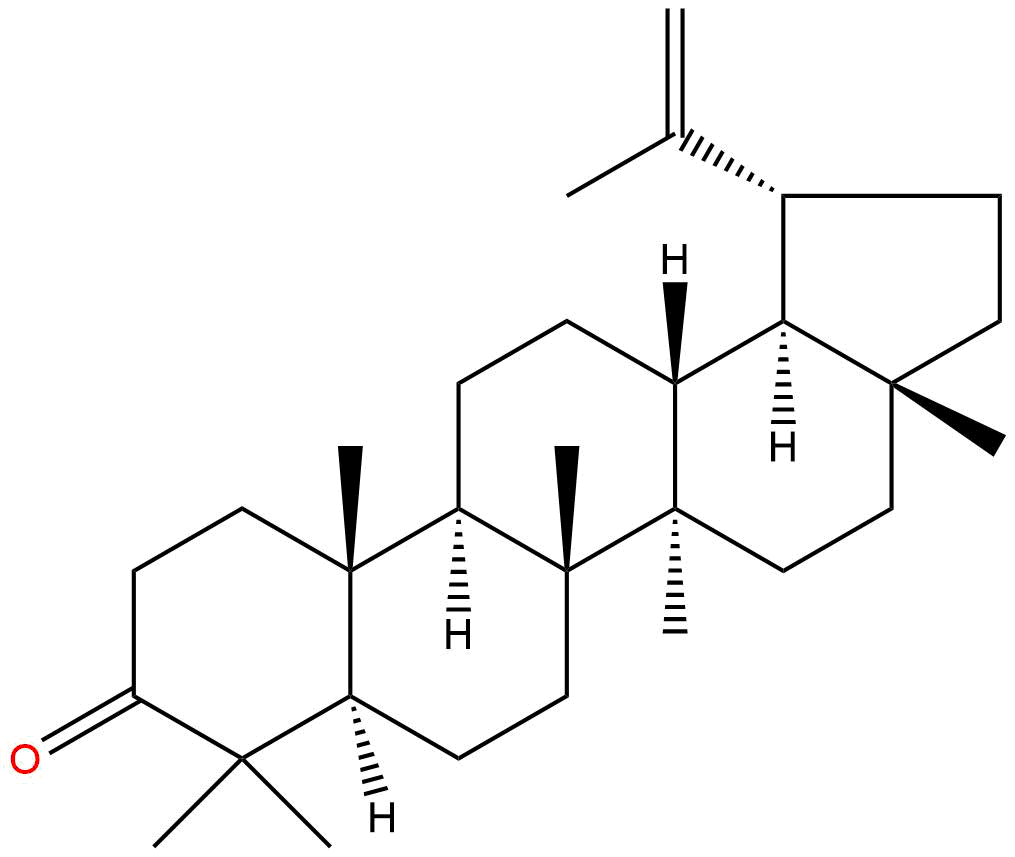


Product name: Lupenone
Synonym name:
Catalogue No.: SBP00690
Cas No.: 1617-70-5
Formula: C30H48O
Mol Weight: 424.713
Botanical Source:
Physical Description: White powder
Type of Compound: Triterpenoids
Purity: 95%~99%
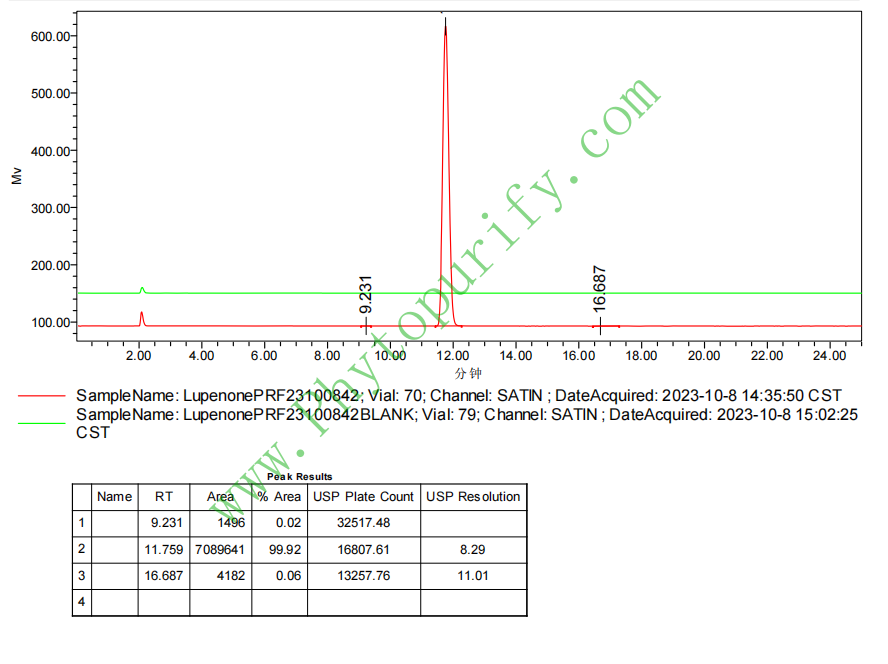
Analysis Method: HPLC-DAD or/and HPLC-ELSD
Identification Method: Mass, NMR
Packing: Brown vial or HDPE plastic bottle
Storage: Store in a well closed container, protected from air and light. Put into refrigerate or freeze for long term storage.
Whenever possible, you should prepare and use solutions on the same day. However, if you need to make up stock solutions in advance, we recommend that you store the solution as aliquots in tightly sealed vials at -20℃. Generally, these will be useable for up to two weeks.
The product could be supplied from milligrams to grams
Inquire for bulk scale.
For Reference Standard and R&D, Not for Human Use Directly.
HPLC of Lupenone
Storage conditions:Short-term storage at 2~8℃, long-term storage at -20 ~ -80℃
17.0700
8.0835
8.0835
.0001
10.7413
19.1570
High
91.3310
4.6433
No
Yes
No
No
No
No
0.0
No
No
No
No
Natural products have always been an important source of drug discovery and development, especially in the fields of anti-inflammatory, anti-tumor, and metabolic disease treatment. Plant derived triterpenoids have attracted much attention due to their structural diversity and significant biological activity. Lupenone (CAS number: 1617-70-5) is a naturally occurring lupine type pentacyclic triterpenoid compound, widely distributed in various medicinal plants, especially from the small fruited wild banana in the banana family(Musa basjoo)Obtained through separation. In recent years, with the in-depth exploration of the pharmacological activities of natural products, lupine has gradually become a research hotspot in the field of natural product pharmacology due to its multiple pharmacological effects, including anti-inflammatory, antiviral, anti diabetes and anti-cancer activities.
The chemical structural characteristics of lupenone endow it with unique physicochemical properties, such as high lipid solubility (LogP=8.0835) and extremely low water solubility (0.0001 mg/mL), which not only determine its unique pharmacokinetic behavior in vivo, but also pose challenges for its formulation development. It is worth noting that fisetin can exert its biological effects by regulating the two key signaling pathways of PI3K/Akt/mTOR and NF - κ B, and this multi-target mode of action presents potential advantages in the treatment of complex diseases. In addition, its blood-brain barrier penetration ability is high, indicating that it may have practical value in central nervous system diseases.
This article will systematically review the research progress of lupenone from the aspects of chemical structure and physicochemical properties, plant sources and extraction methods, pharmacological activity research, mechanism of action and molecular targets, drug evaluation and pharmacokinetics, clinical application prospects and prospects, aiming to provide reference for the in-depth research and development of this natural product.
Fenenone belongs to the pentacyclic triterpenoid class, and its basic skeleton is lupane type, consisting of five rings (A, B, C, D, E). The key features of its chemical structure include the presence of a ketone group (=O) at the C-3 position on the A ring, and the uncommon hydroxyl (- OH) structure, which distinguishes it from analogues such as lupenol; The E ring is a five membered ring, and the C-20 position is connected to an isopropylidene side chain (- CH (CH3) ₂), which is a typical structural marker of lupine triterpenoids. The molecular formula is C ∝₀ H ₄₈ O, and the molecular weight is 424.7130 Da.
The physicochemical properties of lupenone have a decisive impact on its pharmacological behavior. Its lipid water partition coefficient (LogP) is as high as 8.0835, indicating that the compound has strong lipid solubility, which is consistent with its hydrophobic skeleton of pentacyclic triterpenes. The extremely low topological polarity surface area (TPSA=17.0700 Å ²) further confirms its non-polar characteristics. Very low water solubility (0.0001 mg/mL), which may lead to limited oral bioavailability in practical applications. However, high lipid solubility also endows it with good membrane permeability, allowing it to easily cross biological membrane barriers.
It is worth noting that the blood-brain barrier (BBB) penetration ability of lupenone has been evaluated as "high", a characteristic that is relatively rare among natural triterpenoids. High BBB penetration suggests that the compound may exert pharmacological effects in central nervous system diseases such as neuroinflammation and neurodegenerative diseases, while also suggesting the need to pay attention to its potential central nervous system side effects.
The C-3 ketone group of lupenone is a key structural feature that distinguishes it from other lupine triterpenoids, such as lupenol. Research has shown that the type of C-3 functional group significantly affects its biological activity. For example, the anti-inflammatory activity of coumarin (with a hydroxyl group at C-3) differs from that of lupenone, suggesting that the ketone group may regulate its pharmacological effects by affecting the hydrogen bonding interaction between the molecule and the target protein or changing the molecular conformation. In addition, the presence of isopropylidene side chains may participate in hydrophobic interactions, which are crucial for the binding of molecules to cell membranes or protein hydrophobic pockets.
Fenenone is widely distributed in nature and mainly exists in various higher plants. One of its most famous sources is the small fruited wild banana, a plant in the banana family(Musa basjoo)This plant is commonly used in traditional medicine in East Asia to treat inflammatory diseases. In addition, lupenone is also present in leguminous plants such as Lupinus Genus), Birch family plants (such as Betula Genus), Muridae plants (such as Ziziphus Genus), as well as certain plants in the Asteraceae and Lamiaceae families. The content of lupenone varies greatly among different plant sources, and is usually closely related to factors such as plant parts (roots, stems, leaves, bark), growth environment, and harvest season.
The extraction of lupenone is usually carried out using organic solvent extraction method. Due to its high lipid solubility, non-polar or moderately polar solvents such as n-hexane, petroleum ether, chloroform, ethyl acetate, etc. are commonly used extraction solvents. The classic extraction process includes crushing dried plant materials, leaching or Soxhlet extraction with n-hexane or petroleum ether at room temperature or heating conditions, and crude extraction obtained by vacuum concentration of the extraction solution. Subsequently, preliminary separation was carried out by silica gel column chromatography, and gradient elution (such as n-hexane ethyl acetate system) was used to obtain a fraction rich in lupenone. Further purification can be achieved by preparative thin-layer chromatography or high performance liquid chromatography (HPLC) using a reverse phase C18 column and acetonitrile water or methanol water mobile phase system to obtain high-purity lupenone monomers.
In recent years, green extraction techniques such as supercritical fluid extraction (SFE) and microwave-assisted extraction (MAE) have also been applied to the extraction of lupenone. Supercritical CO ₂ extraction has advantages in extracting thermosensitive natural products due to its solvent-free residue and adjustable selectivity. Research has shown that using supercritical CO ₂ extraction technology, under appropriate pressure (20-30 MPa) and temperature (40-50 ℃) conditions, can significantly improve the extraction efficiency of lupenone and shorten the extraction time.
The determination of the content of lupenone mainly relies on chromatographic techniques. High performance liquid chromatography ultraviolet detection (HPLC-UV) is the most commonly used method, with a detection wavelength typically set at 205-210 nm (end absorption of triterpenoids). Liquid chromatography-mass spectrometry (LC-MS) is suitable for quantitative analysis of lupenone in complex matrices due to its high sensitivity and selectivity, especially for trace detection in pharmacokinetic studies. In addition, gas chromatography-mass spectrometry (GC-MS) can also be used for the analysis of lupenone, but derivatization treatment is required to increase volatility.
The anti-inflammatory activity of fisetin is one of its most closely studied pharmacological effects. Multiple in vitro and in vivo studies have confirmed that fisetin can effectively inhibit inflammatory responses in various inflammatory models. In a macrophage model stimulated by lipopolysaccharide (LPS), fisetin can significantly reduce the production of pro-inflammatory cytokines such as tumor necrosis factor - α (TNF - α), interleukin-6 (IL-6), and interleukin-1 β (IL-1 β). In addition, fisetin can inhibit the expression of inducible nitric oxide synthase (iNOS/NOS2) and cyclooxygenase-2 (COX-2/PTGS2), thereby reducing the release of inflammatory mediators such as nitric oxide (NO) and prostaglandin E ₂ (PGE ₂).
In animal models, oral administration of fisetin can alleviate carrageenan induced paw swelling in rats, increase intra-abdominal capillary permeability induced by acetic acid in mice, and alleviate joint inflammation in a complete Freund's adjuvant induced arthritis model. It is worth noting that the anti-inflammatory mechanism of lupenone involves the regulation of multiple key inflammatory signaling pathways, including the inhibition of NF - κ B and STAT3 pathways, as well as the regulation of NLRP3 inflammasome activity.
Fenenone exhibits broad-spectrum antiviral activity. Research has shown that lupenone has inhibitory effects on various viruses, including herpes simplex virus (HSV), influenza virus, and certain enteroviruses. Its antiviral mechanism may involve multiple steps: directly inhibiting virus replication, interfering with virus host cell binding, and regulating host immune response. For example, lupenone can reduce the production of pro-inflammatory cytokines induced by viruses by inhibiting the NF - κ B signaling pathway, thereby alleviating the inflammatory damage caused by viral infection. In addition, lupenone has an inhibitory effect on the neuraminidase activity of certain viruses, providing a theoretical basis for its use as a candidate drug for anti influenza viruses.
Lupine shows potential in the treatment of diabetes and its complications. In vitro experiments have shown that fisetin can promote insulin stimulated glucose uptake and enhance insulin sensitivity. In the streptozotocin (STZ) - induced diabetes rat model, oral administration of lupine can significantly reduce fasting blood glucose levels, improve glucose tolerance, and increase serum insulin levels. Its anti diabetes mechanism may be related to activating PI3K/Akt signaling pathway and promoting the translocation of glucose transporter 4 (GLUT4) to cell membrane. In addition, lupenone can inhibit the activity of alpha glucosidase, delay the digestion and absorption of carbohydrates, and thus exert a hypoglycemic effect.
The anticancer activity of lupine has been confirmed in many cancer cell lines, including breast cancer, lung cancer, liver cancer, colon cancer and melanoma cells. Fenenone can inhibit cancer cell proliferation, induce apoptosis, and inhibit metastasis through various mechanisms. In breast cancer cells, lupine leads to cell cycle arrest at G0/G1 phase and induces caspase dependent apoptosis by inhibiting PI3K/Akt/mTOR signaling pathway. In liver cancer cells, lupenone can activate endogenous apoptotic pathways, upregulate Bax/Bcl-2 ratio, release cytochrome c, and activate caspase-9 and caspase-3. In addition, fisetin can also inhibit the nuclear translocation of NF - κ B, downregulate the expression of anti apoptotic proteins (such as Bcl-2, Survivor), thereby enhancing the chemotherapy sensitivity of cancer cells.
It is worth noting that lupenone has relatively low toxicity to normal cells and exhibits a certain degree of selective cytotoxicity, which provides a safety basis for its use as an anti-cancer candidate drug.
The PI3K/Akt/mTOR signaling pathway is a key pathway that regulates cell growth, proliferation, metabolism, and survival, and is abnormally activated in various diseases, especially cancer and metabolic disorders. Fenenone can inhibit the activity of PI3K, reduce the generation of PIP3, and thus inhibit the phosphorylation activation of Akt. The decrease in Akt activity leads to the inhibition of downstream mTORC1 complex activity, thereby reducing protein synthesis and cell proliferation. In cancer cells, inhibition of this pathway can lead to cell cycle arrest and induction of apoptosis. In the diabetes model, lupine can regulate PI3K/Akt pathway by enhancing insulin signal transduction and promoting glucose uptake.
NF - κ B is the core transcription factor of inflammatory response, regulating the expression of various pro-inflammatory genes. Fenenone can effectively inhibit the activation of NF - κ B. Its mechanism of action includes inhibiting the activity of I κ B kinase (IKK/IKBKB), preventing the phosphorylation and degradation of I κ B α, thereby maintaining the inactive state of NF - κ B in the cytoplasm. In addition, lupenone can directly interact with the p65 subunit of NF - κ B (RELA), interfering with its nuclear translocation and DNA binding abilities. By inhibiting the NF - κ B pathway, fisetin downregulates the expression of various inflammation related genes, including TNF - α, IL-6, COX-2, iNOS, etc.
In addition to the two core pathways mentioned above, lupenone also acts on multiple other molecular targets:
The pharmacological activity of lupenone is not the result of a single target action, but rather achieved through the regulation of a complex signaling network. There is extensive cross-talk between the PI3K/Akt/mTOR and NF - κ B pathways. For example, activation of Akt can phosphorylate and activate IKK, thereby promoting NF - κ B signaling; And the activation of NF - κ B can upregulate the expression of the PI3K regulatory subunit p85. Fenenone inhibits both pathways simultaneously, which may produce a synergistic effect and enhance its anti-inflammatory and anticancer activities. This multi-target mode of action is in line with the concept of "multi-target therapy for complex diseases" in modern drug discovery, but it also increases the complexity of mechanism research.
According to Lipinski's "Rule of Five", the molecular weight of lupenone (424.71 Da) is less than 500 Da, the number of hydrogen bond donors (0) is less than 5, and the number of hydrogen bond acceptors (1) is less than 10, but the LogP value (8.0835) is much greater than 5, which violates the requirements of lipid solubility in the "Five Rules". A high LogP value suggests that lupenone may have poor solubility, low oral bioavailability, and metabolic instability. In addition, its extremely low water solubility (0.0001 mg/mL) is a key bottleneck that restricts its medicinal properties.
However, lupenone has shown certain advantages in toxicology: the Ames test result is 0.0, indicating that it is non mutagenic; The hERG inhibition assessment is' no ', indicating a low risk of cardiac toxicity. These security data provide favorable conditions for its further development.
At present, there is insufficient systematic research on the pharmacokinetics of lupenone, but reasonable speculation can be made based on its physicochemical properties. After oral administration, the dissolution rate of fisetin may be limited due to poor water solubility, resulting in incomplete absorption. Its high lipid solubility is beneficial for penetrating the intestinal epithelial cell membrane, but may affect absorption due to the formation of micelles or binding with food components. After absorption, lupenone may highly bind to plasma proteins (such as albumin), resulting in lower free drug concentrations. Its high BBB penetration ability suggests that drugs can enter the central nervous system, which is both an advantage (for treating central diseases) and a risk (potential neurotoxicity).
In terms of metabolism, lupenone, as a triterpenoid compound, may mainly undergo oxidative metabolism through the liver cytochrome P450 enzyme system (especially CYP3A4), generating hydroxylated or carboxylated metabolites. These metabolites may be further metabolized through glucuronic acid or sulfuric acid binding reactions and excreted through bile or urine.
To overcome the problems of low water solubility and low oral bioavailability of lupenone, the following formulation strategies can be considered:
- Liposome preparation Using liposomes to encapsulate lupenone and improve its water dispersibility and bioavailability.
- Solid dispersion Disperse lupenone in hydrophilic polymers such as polyvinylpyrrolidone and hydroxypropyl methylcellulose to increase its dissolution rate.
- Nanoemulsion or self microemulsifying drug delivery system By forming O/W nanoemulsions, the solubility and oral absorption of drugs can be improved.
- Phospholipid complex Fenenone forms a complex with phospholipids, which can improve the absorption characteristics of its lipophilic drugs.
Given the significant anti-inflammatory activity and multi-target mechanism of action of lupenone, it has potential application value in the treatment of chronic inflammatory diseases such as rheumatoid arthritis, inflammatory bowel disease, and psoriasis. Compared to traditional nonsteroidal anti-inflammatory drugs (NSAIDs), fisetin may have a lower risk of gastrointestinal and cardiovascular side effects. However, its high lipid solubility and low water solubility may limit the development of oral formulations, and local administration (such as topical formulations) may be a more feasible development direction.
The potential of fisetin as an anticancer adjuvant therapy drug deserves attention. Its ability to enhance sensitivity to chemotherapy drugs makes it a potential candidate for combination therapy. For example, the combination of fisetin with chemotherapy drugs such as cisplatin and paclitaxel may enhance anti-cancer effects by inhibiting the NF - κ B pathway and reducing the expression of anti apoptotic proteins. In addition, lupine inhibits the PI3K/Akt/mTOR pathway, making it a potential target therapy in PI3K mutant cancers (such as breast cancer and endometrial cancer).
The anti diabetes activity of lupine provides a basis for its application in the treatment of type 2 diabetes. It may become the lead compound of new anti diabetes drugs by enhancing insulin sensitivity and inhibiting α - glucosidase activity. However, the improvement of its pharmacokinetic properties is a key issue that needs to be addressed before clinical application.
The high BBB penetration ability and anti-inflammatory activity of fisetin make it potentially applicable in neurodegenerative diseases (such as Alzheimer's disease, Parkinson's disease) and neuroinflammatory diseases. Research has shown that fisetin can alleviate nerve damage by inhibiting microglial activation and neuroinflammatory responses. The research in this field is still in its early stages, but the prospects are broad.
Despite exhibiting various pharmacological activities, the development of lupenone still faces many challenges. Firstly, pharmacokinetic issues caused by low water solubility and high lipid solubility need to be addressed through formulation techniques or structural modifications. Secondly, although its multi-target mode of action is beneficial for the treatment of complex diseases, it also increases the risk of off target effects and toxic side effects. In addition, there is currently insufficient in vivo pharmacological and toxicological research on lupenone, and more systematic preclinical studies are needed to evaluate its safety and efficacy.
Future research directions should include: improving its solubility and pharmacokinetic properties through structural modifications such as prodrug design and introduction of polar groups; Developing new drug delivery systems using nanotechnology; Conduct systematic in vivo pharmacological and toxicological evaluations; Explore its potential application in central nervous system diseases; And further elucidate its multi-target mechanism of action through omics techniques such as proteomics and metabolomics.
As a natural lupine triterpenoid, lupine has become a research hotspot in the field of natural product pharmacology due to its anti-inflammatory, antiviral, anti diabetes, anti-cancer and other pharmacological activities. Its characteristic of exerting multi-target effects by regulating key signaling pathways such as PI3K/Akt/mTOR and NF - κ B is in line with the concept of "multi-target therapy for complex diseases" in modern drug discovery. However, the pharmacokinetic issues caused by high lipid solubility and low water solubility are the main bottlenecks restricting its drug development. In the future, through rational structural modification and advanced formulation technology, it is expected to overcome these obstacles and transform this natural product into clinically available therapeutic drugs. The in-depth study of lupenone not only helps to reveal the pharmacological mechanisms of natural triterpenoids, but also provides valuable lead compounds for the development of novel multi-target drugs.
