
| Catalog No | Package | Original Price | Price | Inventory | Quantity | Operating |
|---|---|---|---|---|---|---|
| BP0309-20mg | 20mg | $36.00 | Sign in |
|


Product name: Cantharidin
Synonym name: Cantharides camphor; Cantharone
Catalogue No.: BP0309
Cas No.: 56-25-7
Formula: C10H12O4
Mol Weight: 196.202
Botanical Source: Lytta vesicatoria
Physical Description:
Type of Compound: Monoterpenoids
Purity: 95%~99%
Analysis Method: HPLC-DAD or/and HPLC-ELSD
Identification Method: Mass, NMR
Packing: Brown vial or HDPE plastic bottle
Storage: Store in a well closed container, protected from air and light. Put into refrigerate or freeze for long term storage.
Whenever possible, you should prepare and use solutions on the same day. However, if you need to make up stock solutions in advance, we recommend that you store the solution as aliquots in tightly sealed vials at -20℃. Generally, these will be useable for up to two weeks.
The product could be supplied from milligrams to grams
Inquire for bulk scale.
Description:
Cantharidin, a natural toxicant of blister beetles, is a strong inhibitor of protein phosphatases types 1 (PP1) and 2A (PP2A), and is a novel and potent multidrug resistance (MDR) reversal agent. Cantharidin has anti-tumor activity, it causes oxidative stress that provokes DNA damage and p53-dependent apoptosis, it impairs cell migration and invasion by suppressing MMP-2 and -9 through PI3K/NF-κB signaling pathways.
References:
Anticancer Res. 2015 Feb;35(2):795-804.
Cantharidin induces DNA damage and inhibits DNA repair-associated protein expressions in TSGH8301 human bladder cancer cell.
Cantharidin is an active component of mylabris, which has been used as a traditional Chinese medicine. Cantharidin has been shown to have antitumor activity against several types of human cancers in vitro and in animal models in vivo.
METHODS AND RESULTS:
We investigated whether Cantharidin induces DNA damage and affects DNA damage repair-associated protein levels in TSGH8301 human bladder cancer cells. Using flow cytometry to measure viable cells, Cantharidin was found to reduce the number of viable cells in a dose-dependent manner. Comet assay, 4',6-diamidino-2-phenylindole (DAPI) staining and DNA gel electrophoresis were used to measure DNA damage and condensation; the results indicated that Cantharidin induced DNA damage (comet tail), DNA condensation (white DAPI staining) and DNA damage (DNA smear). Results from western blotting showed that Cantharidin inhibited the expression of DNA-dependent serine/threonine protein kinase, poly-ADP ribose polymerase, phosphate-ataxia-telangiectasia and RAD3-related, O-6-methylguanine-DNA methyltransferase, breast cancer susceptibility protein 1, mediator of DNA damage checkpoint protein 1, phospho-histone H2A.X, but increased that of phosphorylated p53 following 6 and 24 h treatment. Confocal laser microscopy was used to examine the protein translocation; Cantharidin suppressed the levels of p-H2A.X and MDC1 but increased the levels of p-p53 in TSGH8301 cells.
CONCLUSIONS:
In conclusion, we found that Cantharidin-induced cell death may occur through the induction of DNA damage and suppression of DNA repair-associated protein expression in TSGH8301 cells.
Cancer Lett. 2008 Dec 8;272(1):102-9.
Cantharidin reverses multidrug resistance of human hepatoma HepG2/ADM cells via down-regulation of P-glycoprotein expression.
Multidrug resistance (MDR) is a serious obstacle encountered in cancer treatment.
METHODS AND RESULTS:
In this study, we established an in vitro multiple drug resistant HepG2 cell line (HepG2/ADM), and characterized its MDR. This model was used to screen potential candidate chemosensitisers from over 200 purified naturally occurring compounds extracted from plants and animals. Cantharidin was found to have a significant reversal on MDR in our model. Further, our results showed that Cantharidin could significantly inhibit P-gp (P-glycoprotein) expression, mRNA transcription, as well as MDR1 promoter activity.
CONCLUSIONS:
These results suggest that Cantharidin is a novel and potent MDR reversal agent and may be a potential adjunctive agent for tumor chemotherapy.
FEBS Lett. 1993 Sep 20;330(3):283-6.
Cantharidin, another natural toxin that inhibits the activity of serine/threonine protein phosphatases types 1 and 2A.
Cantharidin, a natural toxicant of blister beetles, is a strong inhibitor of protein phosphatases types 1 (PP1) and 2A (PP2A).
METHODS AND RESULTS:
Like okadaic acid, Cantharidin inhibits the activity of the purified catalytic subunit of PP2A (IC50 = 0.16 microM) at a lower concentration than that of PP1 (IC50 = 1.7 microM) and only inhibits the activity of protein phosphatase type 2B (PP2B) at high concentrations. Dose-inhibition studies conducted with whole cell homogenates indicate that Cantharidin also inhibits the native forms of these enzymes.
CONCLUSIONS:
Thus, Cantharidin, which is economical and readily available, may be useful as an additional probe for studying the functions of serine/threonine protein phosphatases.
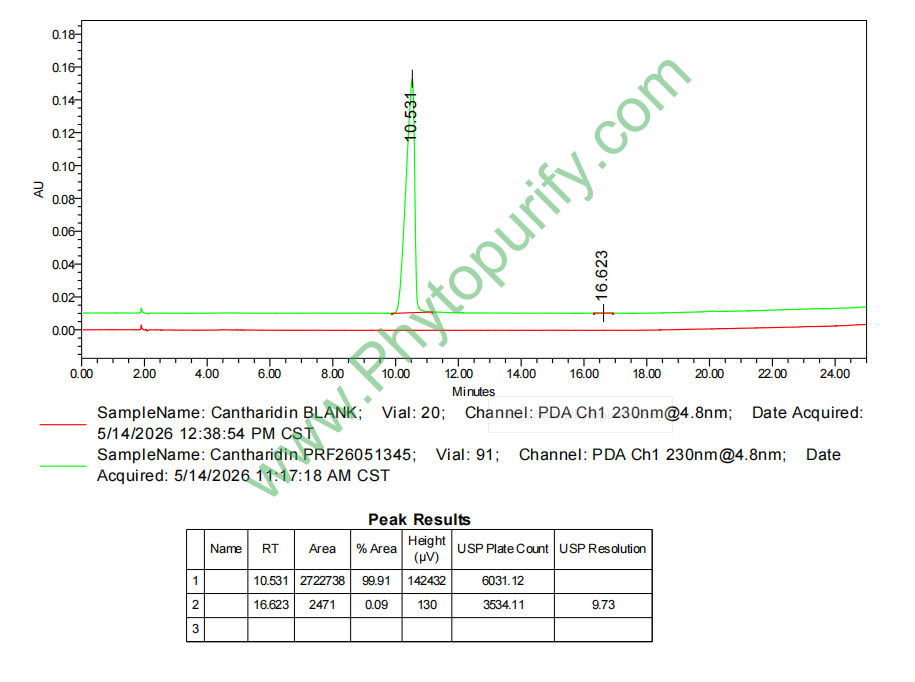
HPLC of Cantharidin
Storage conditions:Short-term storage at 2~8℃, long-term storage at -20 ~ -80℃
52.6000
.5283
.5283
2.6701
4.7571
6.1676
High
15.4631
5.2108
Yes
Yes
Yes
No
Yes
No
0.9
Yes
No
Yes
Yes
Cantharidin, also known as hexahydro-3a, 7a-dimethyl-4,7-epoxyisobenzofuran-1,3-dione, is a natural monoterpenoid compound with a long history and complex biological activities. Its CAS number is 56-25-7. Since ancient times, it has originated from insects in the family Ranunculaceae, such as the famous "Spanish fly"Lytta vesicatoria)The extract of bufotalin has been used in traditional medicine in both East and West, but its significant toxicity and foaming effect have always been accompanied by risks and controversies. Modern pharmacological research has revealed the core molecular mechanism of cantharidin as a potent selective inhibitor of protein phosphatases 1 (PP1) and 2A (PP2A), transforming it from an ancient toxin and folk aphrodisiac into an attractive chemical biology probe and lead compound for anti-tumor drugs. In recent years, with the deepening of the concept of molecular targeted therapy, bufotalin and its derivatives have demonstrated multi-target and multi pathway inhibitory activity in various malignant tumors, which has reignited the research enthusiasm of academia and industry for it. This article aims to systematically review the chemical properties, sources, pharmacological activities, molecular mechanisms of action, pharmacological evaluation, and clinical application prospects of bufotalin, in order to provide reference for further research in this field.
Cantharidin is a cyclic anhydride monoterpene with a unique rigid skeleton. Its molecular formula is C ₁₀ H ₁₂ O ₄, and its molecular weight is 196.2020. Its core structure is a bicyclic [2.2.1] heptane skeleton, containing a key epoxy bridge (4,7-epoxy) and a cis fused internal anhydride ring (isobenzofuran-1,3-dione). This rigid three-dimensional structure is the chemical basis for its specific binding to the active pocket of the target enzyme PP1/PP2A and its strong inhibitory effect.
In terms of physical and chemical properties, cantharidin is a colorless, odorless oblique square shaped crystalline form. Its lipid water partition coefficient (LogP) is 0.5283, indicating that it has a certain degree of lipophilicity but is not highly hydrophobic. The topological polar surface area (TPSA) is 52.6 Å ², which is relatively low and conducive to transmembrane permeation. Its water solubility data is 2.6701 (usually measured in mg/mL or log mol/L, indicating slight solubility in water), which to some extent limits its direct application in aqueous formulations. Cantharidin is soluble in various organic solvents, such as ethanol, acetone, chloroform, etc. The anhydride bonds in its structure are prone to hydrolysis and ring opening under alkaline conditions, generating the corresponding dicarboxylic acid (cantharidic acid). This process can lead to the loss of its biological activity, which is a key chemical characteristic that needs to be considered in drug formulations and in vivo metabolism.
Strictly speaking, cantharidin is not derived from plants, but mainly from insects in the Coleoptera order of the arthropod phylum Meloidae and Oedemiridae. Among them, the Spanish fly produced in southern Europe(Lytta vesicatoria)The most famous traditional Chinese medicine, "Bufalin", is mainly derived from the Southern Great Bufalin(Mylabris phalerata)Yellow and black spotted haws(Mylabris cichorii)Dry worms. Insects do not synthesize cantharidin themselves. Current research suggests that it is accumulated through the food chain or metabolized by symbiotic bacteria in the body, and stored in the hemolymph and reproductive glands as a chemical defense substance.
The traditional extraction method is mainly based on organic solvent method. The general process is to crush the dried body of the cantharidin and repeatedly extract or Soxhlet it with organic solvents such as chloroform, ethanol, or acetone. After merging the extracts, the crude extract was obtained by vacuum concentration. The crude extract can be preliminarily separated by silica gel column chromatography, using a gradient elution system of petroleum ether ethyl acetate and other solvents, and then combined with recrystallization (commonly used solvents are acetone or ethanol) to obtain high-purity cantharidin crystals. Modern separation techniques such as high-performance liquid chromatography (HPLC) and supercritical fluid extraction (SFE) have also been applied to the purification of bufotalin to improve yield and purity. Due to the extremely high toxicity of bufotalin, strict protective measures must be taken during the extraction and purification process. In addition, due to the limitations of insect sources and ethical issues, chemical total synthesis and semi synthesis routes (such as the Diels Alder reaction route starting from furan) have also matured, providing reliable pathways for the large-scale acquisition of bufotalin and its structurally modified derivatives.
The pharmacological activity research of bufotalin mainly focuses on the field of anti-tumor, and extends to anti angiogenesis, induction of cell apoptosis, and autophagy.
1. Antitumor activity:
A large number of in vitro and in vivo studies have confirmed that cantharidin has broad-spectrum and strong inhibition of proliferation and induction of apoptosis in a variety of human malignant tumor cells, including liver cancer, gastric cancer, lung cancer, breast cancer, colon cancer, leukemia, bladder cancer cancer, pancreatic cancer, etc. Its effect is concentration - and time-dependent, with a half maximal inhibitory concentration (IC ₅₀) typically at the micromolar or even nanomolar level, exhibiting strong cytotoxicity.
2. Anti angiogenesis:
The growth and metastasis of tumors depend on the formation of new blood vessels. Cantharidin can effectively inhibit the proliferation, migration, and tubular formation ability of human umbilical vein endothelial cells (HUVECs), and can also significantly inhibit angiogenesis in chicken embryo chorioallantoic membrane (CAM) models and mouse in vivo models. This effect is closely related to its downregulation of the expression of vascular endothelial growth factor (VEGF) and its receptor (VEGFR).
3. Inducing cell apoptosis and autophagy:
Cantharidin is a potent inducer of cell apoptosis. It can cause a decrease in mitochondrial membrane potential, upregulation of pro apoptotic proteins (such as Bax, Bid) expression, and downregulation of anti apoptotic proteins (such as Bcl-2, Bcl xL, MCL1) expression, leading to the release of cytochrome C and ultimately activating the caspase cascade reaction. Meanwhile, bufotalin can also induce protective autophagy, but in most cases, it co leads to cell death with the apoptotic pathway.
4. Inhibit invasion and metastasis:
Cantharidin can significantly reduce the migration and invasion ability of various cancer cells (such as liver cancer and breast cancer). The mechanism involves downregulating the expression and activity of matrix metalloproteinases such as MMP2 and MMP9, thereby inhibiting the degradation of extracellular matrix and hindering the infiltration and metastasis of tumor cells.
The most core and clear mechanism of action of bufotalin is as a potent and selective inhibitor of PP1 and PP2A. PP1 and PP2A are important members of the serine/threonine protein phosphatase family, responsible for regulating the dephosphorylation process of numerous signaling pathways within cells, and are crucial for cell cycle, proliferation, apoptosis, metabolism, and other processes. Cantharidin irreversibly inhibits the enzymatic activity of PP1/PP2A by binding to specific amino acid residues near the catalytic subunit active site, leading to an abnormal increase in the phosphorylation level of its substrate protein and disrupting normal cellular signal transduction.
Based on the inhibition of PP1/PP2A, cantharidin exerts its anti-tumor effect by affecting multiple downstream signaling pathways and molecular targets:
Although bufotalin has significant pharmacological activity, its pharmacological development faces severe challenges, mainly due to its strong toxicity and unsatisfactory pharmacokinetic properties.
Analysis of pharmacological parameters:
According to the provided parameters, the molecular weight of bufotalin is small (196.2), which complies with the rules of drug likeness. A LogP value of 0.53 indicates moderate lipophilicity. The TPSA value of 52.6 Å ² indicates that its membrane permeability is still acceptable. Its blood-brain barrier permeability is predicted to be 'high', which means it may have therapeutic potential for central nervous system tumors, but also increases the risk of neurotoxicity. HERG inhibition is' no ', which is a positive signal indicating a lower risk of causing QT interval prolongation in the heart. The Ames test value is 0.9 (usually<1.0 is considered negative), which suggests that its mutagenic risk may be low, but more in vitro and in vivo genetic toxicity experiments are needed for verification.
Pharmacokinetics (PK) and toxicity:
The in vivo PK study of bufotalin showed that its oral absorption is fast but incomplete, widely distributed, and has high concentrations in the liver, kidneys, and gastrointestinal tract. Its main metabolic pathway is the hydrolysis of anhydride bonds in the body (especially in the blood and liver) to inactive bufotalin acid, which then binds with glucuronic acid and is excreted through the kidneys. Its half-life is short and the systemic exposure is limited.
The biggest challenge lies in its narrow treatment window. Cantharidin has strong irritant and toxic effects on normal tissues, especially the urinary system (kidneys, bladder) and digestive system (gastrointestinal tract, liver), and can cause severe inflammation, bleeding, necrosis, and even acute renal failure. The use of trace preparations (such as for treating warts) or local injection of tumors in clinical practice has been limited due to systemic toxicity.
Structural modification and dosage form improvement:
To improve its pharmacological properties, researchers mainly focus on two aspects: one is to modify the structure of cantharidin molecules and synthesize a series of derivatives (such as norcantharidin, cantharidic acid derivatives, amide derivatives, etc.), aiming to reduce toxicity, improve selectivity or water solubility. Among them, Norcantharidin has been approved for the treatment of liver cancer and other diseases in China, with reduced toxicity but correspondingly weakened efficacy. The second is to develop new drug delivery systems, such as liposomes, nanoparticles, polymer micelles, active targeting agents, etc., by enhancing tumor site targeted accumulation (EPR effect or active targeting) and controlling drug release, in order to significantly reduce systemic toxicity while improving efficacy.
The clinical application prospects of bufotalin are directly related to the degree to which its safety issues are resolved. At present, its direct application is very limited.
Current Status:
Norcantharidin and its sodium salt injection are approved for the treatment of primary liver cancer in China and are often used in combination with other chemotherapy drugs, but their monotherapy efficacy is limited. Cantharidin ointment or solution was once used topically to treat common warts and genital warts, utilizing its corrosive and foaming effects, but has gradually been replaced by other therapies due to pain and scar risks.
Future prospects:
1. Precision therapy based on target PP1/PP2A: Future research can focus on identifying tumor subtypes that are particularly sensitive to bufotalin and its derivatives (such as certain tumors that rely on specific PP2A substrate phosphorylation states), in order to achieve precise drug use. Combining bufotalin with drugs targeting other pathways may produce synergistic effects and overcome drug resistance.
2. Development of innovative drug delivery systems: This is the most promising direction. Designing tumor microenvironment responsive (such as pH responsive, enzyme responsive) nano delivery systems, or surface modified tumor specific ligands (such as folate, RGD peptides, antibodies) targeted nano formulations, is expected to efficiently and specifically deliver bufotalin to tumor cells, maximizing chemotherapy efficacy and minimizing off target toxicity.
3. Exploration of new derivatives: Continue to synthesize prodrug derivatives with higher PP1/PP2A inhibition selectivity, better water solubility, or specific activation through rational drug chemistry design. Computer assisted drug design and high-throughput screening will accelerate this process.
4. New use of old drugs and combination therapy: Explore the potential application of bufotalin in non tumor fields such as anti fibrosis and anti parasitic effects. Meanwhile, in-depth research on its combined application strategies with existing therapies such as immune checkpoint inhibitors and radiotherapy may open up new treatment models.
Cantharidin, a natural toxin derived from ancient insects, occupies a special and important position in modern oncology pharmacology due to its unique molecular mechanism as a potent inhibitor of PP1/PP2A. It is like a sharp double-edged sword, exhibiting broad-spectrum and potent anti-tumor activity, while its inherent severe toxicity also constitutes a major obstacle to clinical translation. The current research has gone from simple activity evaluation to in-depth analysis of multi-target mechanisms, optimization of drug formulation systems, and development of innovative dosage forms. In the future, through interdisciplinary integration, especially breakthroughs in medicinal chemistry and nano delivery technology, it is expected to forge this "double-edged sword" into an "intelligent weapon" that can accurately attack tumors. The research process of bufotalin fully reflects the successful transformation paradigm from traditional natural products to modern targeted therapy lead compounds, and its future development deserves continuous attention and expectation.
