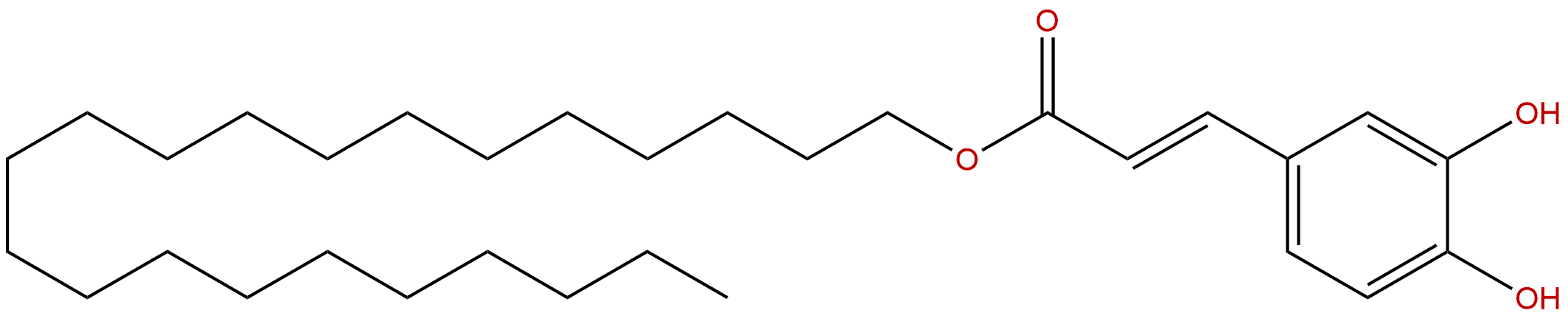


Product name: Docosyl caffeate
Synonym name:
Catalogue No.: SBP00091
Cas No.: 28593-92-2
Formula: C31H52O4
Mol Weight: 488.753
Botanical Source:
Physical Description: Powder
Type of Compound: Phenylpropanoids
Purity: 95%~99%
Analysis Method: HPLC-DAD or/and HPLC-ELSD
Identification Method: Mass, NMR
Packing: Brown vial or HDPE plastic bottle
The product could be supplied from milligrams to grams. Inquire for bulk scale.
We provide solution to improve the water-solubility of compounds, thereby facilitating the variety of activity tests and clinic uses.
For Reference Standard and R&D, Not for Human Use Directly.
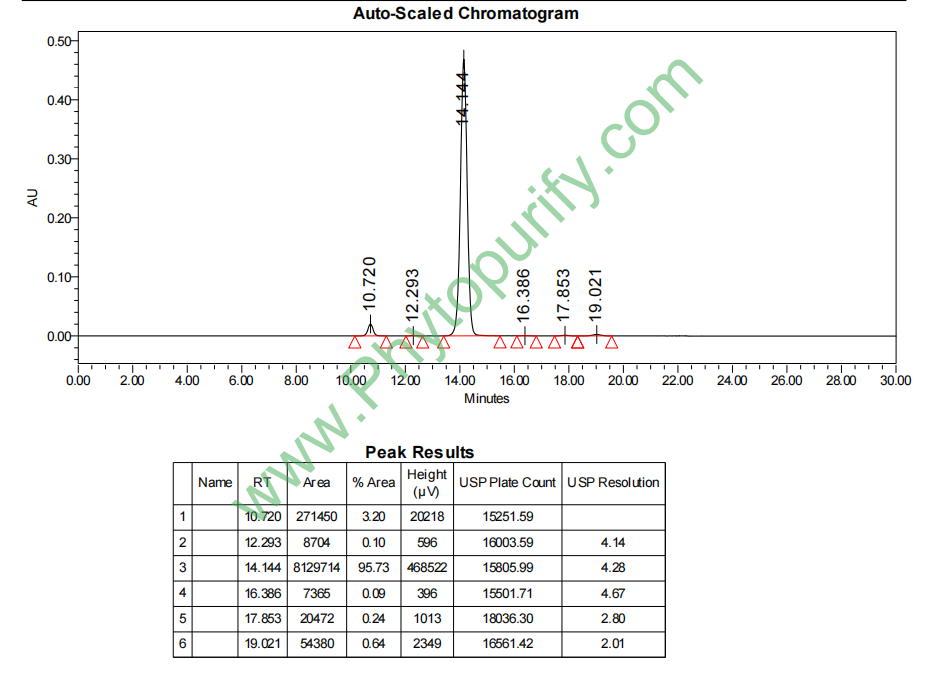
HPLC of Docosyl caffeate
Storage conditions:Short-term storage at 2~8℃, long-term storage at -20 ~ -80℃
66.7600
10.6073
10.6025
.0004
2.5862
2.7119
High
97.1691
2.3859
No
Yes
Yes
No
No
No
0.0
No
No
No
No
Docosyl Caffeate is a natural ester compound formed by esterification of caffeic acid with long-chain fatty alcohol docosyl, with a CAS number of 28593-92-2. As a typical ester derivative, docosanyl caffeic acid ester combines the biological activity of phenolic natural products with the lipid solubility characteristics of long-chain fatty alcohols, and has attracted widespread attention in the field of natural product pharmacology in recent years. Its unique chemical structure endows the compound with excellent biofilm penetration ability and potential multi-target pharmacological activity, especially showing significant research value in fields such as antioxidant, anti-inflammatory, neuroprotective, and anti-tumor.
With the increasing importance of natural products in new drug development, docosanyl caffeic acid ester, as a structurally unique and functionally diverse compound, has gradually become a hot topic in pharmacological activity and drug development research. This article will provide a systematic review of the chemical structure and physicochemical properties, plant sources and extraction methods, pharmacological activity and mechanism of action, pharmacological evaluation and pharmacokinetic characteristics of docosanyl caffeic acid ester. Combined with current research progress, it will explore its clinical application prospects and future development directions.
The molecular formula of docosanyl caffeic acid ester is C34H56O4, with a molecular weight of 488.7530. Its structure is formed by ester bonding between caffeic acid (3,4-dihydroxycinnamic acid) and docosanol, a 22 carbon long-chain fatty alcohol. The phenolic hydroxyl groups in the caffeic acid moiety endow it with strong antioxidant activity, while long-chain fatty alcohols significantly enhance the lipid solubility and membrane permeability of the molecule.
In terms of physicochemical properties, the LogP value of docosanyl caffeic acid ester is as high as 10.6073, indicating its strong hydrophobicity and lipophilicity, which is beneficial for its penetration through biological membranes, especially the blood-brain barrier (BBB). Its topological polar surface area (TPSA) is 66.7600, indicating that the molecule has moderate polarity and possesses both lipophilic and hydrophilic characteristics. The water solubility is extremely low (0.0004 mg/mL), which limits its solubility in aqueous media but facilitates its distribution in lipid environments.
Among the pharmacological parameters, docosanyl caffeic acid ester showed good safety indicators: hERG channel inhibition was negative, indicating a low risk of cardiac toxicity; The Ames test result is 0.0, indicating that it does not have genetic toxicity. In addition, the compound has a high blood-brain barrier permeability, indicating its potential advantages in the treatment of central nervous system diseases.
Caffeic acid docosanyl ester is mainly present in the lipid components of various plants, especially in the seeds, leaves, and resins of certain plants that are rich in long-chain fatty alcohols and phenolic acids. Typical plant sources include the bark, leaves, and seed oils of certain woody plants, such as certain Olea spp., Piper spp., and some aromatic plants.
The extraction method usually uses organic solvent extraction combined with chromatographic separation technology. Firstly, after drying and crushing the plant materials, polar or medium polar solvents such as ethanol, methanol, or ethyl acetate are used for extraction to extract a mixture containing phenolic esters. Subsequently, the target compound was purified using liquid-liquid partitioning, silica gel column chromatography, high-performance liquid chromatography (HPLC), and other methods. In recent years, supercritical CO2 extraction technology has gradually been applied to the extraction of docosanyl caffeic acid esters due to its green environmental protection and high selectivity.
In addition, enzymatic and chemical synthesis methods have also been used to prepare docosanyl caffeic acid esters, especially when large-scale preparation is required. By esterification reaction, high purity of the target product can be obtained by reacting caffeic acid with docosal fatty alcohol under acidic or alkaline conditions.
The pharmacological activity research of docosanyl caffeic acid ester is relatively rich, covering multiple aspects such as antioxidant, anti-inflammatory, anti-tumor, neuroprotective, and antibacterial.
As an ester derivative of caffeic acid, docosanyl caffeic acid ester retains the phenolic hydroxyl structure of caffeic acid, endowing it with significant free radical scavenging ability. In vitro DPPH, ABTS, and hydroxyl radical scavenging experiments all showed that it has strong antioxidant activity. Compared to caffeic acid, esterified molecules have higher lipid solubility and are more likely to penetrate cell membranes, enhancing the activation of intracellular antioxidant defense systems.
Multiple in vitro and in vivo experiments have shown that docosanyl caffeic acid can significantly inhibit the expression of inflammatory factors such as TNF - α, IL-1 β, and IL-6, and alleviate inflammatory reactions. Its anti-inflammatory mechanism is partially attributed to the inhibition of the NF - κ B signaling pathway, which blocks the transduction of inflammatory signals. In addition, the compound also has inhibitory effects on the expression of COX-2 and iNOS, further exerting anti-inflammatory effects.
Given the highly efficient penetration of the blood-brain barrier by docosanyl caffeic acid ester, researchers have shown strong interest in its application in neurodegenerative diseases. In vitro neural cell models have shown that the compound can alleviate neuronal damage caused by oxidative stress and promote neuronal survival. In animal models, it exhibits a certain cognitive function protective effect on Alzheimer's disease and Parkinson's disease models, which may slow down the process of nerve damage through antioxidant and anti-inflammatory mechanisms.
Caffeic acid and its derivatives exhibit the ability to inhibit proliferation and induce apoptosis in various tumor cells. Caffeic acid docosalkyl ester also showed inhibitory effect on the growth of a variety of cancer cell lines, such as breast cancer, lung cancer and colon cancer cells. The mechanism involves cell cycle arrest, upregulation of pro apoptotic protein expression, and regulation of antioxidant enzyme activity. In addition, the compound inhibits tumor cell migration and invasion by regulating the PI3K/Akt and MAPK signaling pathways.
Partial studies have shown that docosanyl caffeic acid ester exhibits certain inhibitory effects on both Gram positive and Gram negative bacteria, especially with potential activity against drug-resistant strains. Its antibacterial mechanism may be related to the destruction of bacterial membrane structure and inhibition of key enzyme activity. In terms of antiviral activity, preliminary in vitro experiments have shown that it has inhibitory effects on certain enveloped viruses, but related research is still in its early stages.
The multi-target mechanism of action of docosanyl caffeic acid ester is the basis for its diverse pharmacological activities. Its main targets and mechanisms include:
Antioxidant mechanism
By reacting phenolic hydroxyl groups with free radicals, ROS (reactive oxygen species) and RNS (reactive nitrogen species) are directly cleared, reducing oxidative stress damage. Simultaneously activating the Nrf2 ARE signaling pathway within cells, promoting the expression of antioxidant enzymes such as glutathione peroxidase (GPx) and superoxide dismutase (SOD), and enhancing the cell's own antioxidant capacity.
Anti inflammatory mechanism
Inhibit the activation of the NF - κ B signaling pathway, reduce the production of pro-inflammatory cytokines (TNF - α, IL-1 β, IL-6) and inflammatory mediators (PGE2, NO). Inhibiting the expression of COX-2 and iNOS and reducing the cascade amplification effect of inflammatory response.
Regulation of cell apoptosis
By regulating the expression ratio of Bcl-2 family proteins (upregulating pro apoptotic protein Bax and downregulating anti apoptotic protein Bcl-2), the mitochondrial pathway is activated to induce tumor cell apoptosis. It may also activate Caspase family enzymes and perform programmed cell death.
Signal pathway regulation
Inhibit the PI3K/Akt and MAPK signaling pathways, block tumor cell proliferation and migration signals. Activate the AMPK pathway, regulate energy metabolism, and promote cellular homeostasis.
Membrane structure and functional regulation
Due to its high lipid solubility, docosanyl caffeic acid ester can insert into the lipid bilayer of the cell membrane, affecting membrane fluidity and receptor function, regulating cell signaling and substance transport.
The pharmacological evaluation of docosanyl caffeic acid ester shows that it has certain advantages and challenges.
A high LogP value (10.6) indicates its extremely high lipid solubility, which is beneficial for penetrating cell membranes and the blood-brain barrier, making it suitable for the treatment of central nervous system diseases. However, its extremely low water solubility (0.0004 mg/mL) limits its oral absorption and bioavailability. Improving its solubility and bioavailability is a key focus of future pharmaceutical research.
At present, there is limited research on the in vivo metabolism of docosanyl caffeic acid ester. It is speculated that it may undergo ester bond hydrolysis through the liver CYP450 enzyme system, releasing caffeic acid and docosanol, which are further metabolized into fatty acids. Further research is needed on the pharmacological activity and safety of metabolites.
The hERG channel inhibition experiment was negative, indicating a low risk of cardiac toxicity. The Ames test result is 0, indicating no significant genetic toxicity. Further research is needed on acute and chronic toxicity, but current data supports its good safety.
Due to the lack of systematic pharmacokinetic (PK) data in vivo, the half-life, plasma protein binding rate, tissue distribution, and clearance pathway of docosanyl caffeic acid ester are still unclear. Given its high lipid solubility, it is expected to accumulate in adipose tissue and may have a longer half-life.
Due to its multi-target and multifunctional pharmacological activities, docosanyl caffeic acid ester has shown broad clinical application prospects.
Its excellent blood-brain barrier penetration ability and antioxidant and anti-inflammatory properties make it a potential candidate drug for neurodegenerative diseases such as Alzheimer's disease, Parkinson's disease, and neuroprotection after stroke. In the future, it is necessary to conduct systematic animal models and preclinical trials to verify their efficacy and safety.
Caffeic acid docosanyl ester exhibits inhibitory effects on various tumor cells and has the potential to be used as an adjuvant chemotherapy drug or a novel anti-tumor drug. Combining nanocarrier technology to improve its solubility and targeting will help enhance its clinical application value.
Its ability to inhibit the expression of inflammatory factors is suitable for the treatment of chronic inflammatory diseases such as rheumatoid arthritis and inflammatory bowel disease. Combining existing anti-inflammatory drugs may produce synergistic effects.
Given its extremely low water solubility, future research should focus on formulation optimization, such as liposomes, nanoparticles, solid dispersions, and other technologies, to enhance its bioavailability and in vivo stability. In addition, structural modifications to reduce LogP values and improve pharmacokinetic properties are also important directions.
The toxicological assessment and preclinical safety research of the system are key to promoting its clinical translation. With the deepening of research, docosanyl caffeic acid ester is expected to enter the clinical trial stage to verify its therapeutic effect and safety.
As a structurally unique natural ester compound, docosanyl caffeic acid combines the biological activity of caffeic acid with the lipid solubility characteristics of long-chain fatty alcohols, exhibiting a wide range of pharmacological activities and good safety. Its potential in antioxidant, anti-inflammatory, neuroprotective, and anti-tumor fields, especially its ability to efficiently penetrate the blood-brain barrier, makes it an important candidate molecule in natural product pharmacology research.
Although its extremely low water solubility and high lipid solubility pose certain pharmaceutical challenges, modern formulation technology and structural optimization are expected to overcome these limitations and promote its clinical application. In the future, combined with systematic pharmacokinetic, toxicological, and mechanistic studies, docosanyl caffeic acid ester is expected to become an important direction for the development of new natural medicines, providing new strategies and choices for the treatment of various diseases.
In summary, as a cutting-edge molecule in the pharmacological research of natural products, docosanyl caffeic acid ester deserves continuous and in-depth exploration. Its multi-target mechanism of action and potential as a drug will inject new vitality into the development of natural medicines.
