


Synonym name: 6,6'-Di-O-methyldauricoline
Catalogue No.: BP0452
Cas No.: 524-17-4
Formula: C38H44N2O6
Mol Weight: 624.778
Botanical Source: Alkaloid from the rhizomes of Menispermum dauricum, the subterranean parts of Menispermum canadense, and from Polyalthia nitidissima and Sinomenium acutum
Purity: 95%~99%
Analysis Method: HPLC-DAD or/and HPLC-ELSD
Identification Method: Mass, NMR
Packing: Brown vial or HDPE plastic bottle
Can be supplied from milligrams to grams.
For Reference Standard and R&D, Not for Human Use Directly.
Inquire for bulk scale.
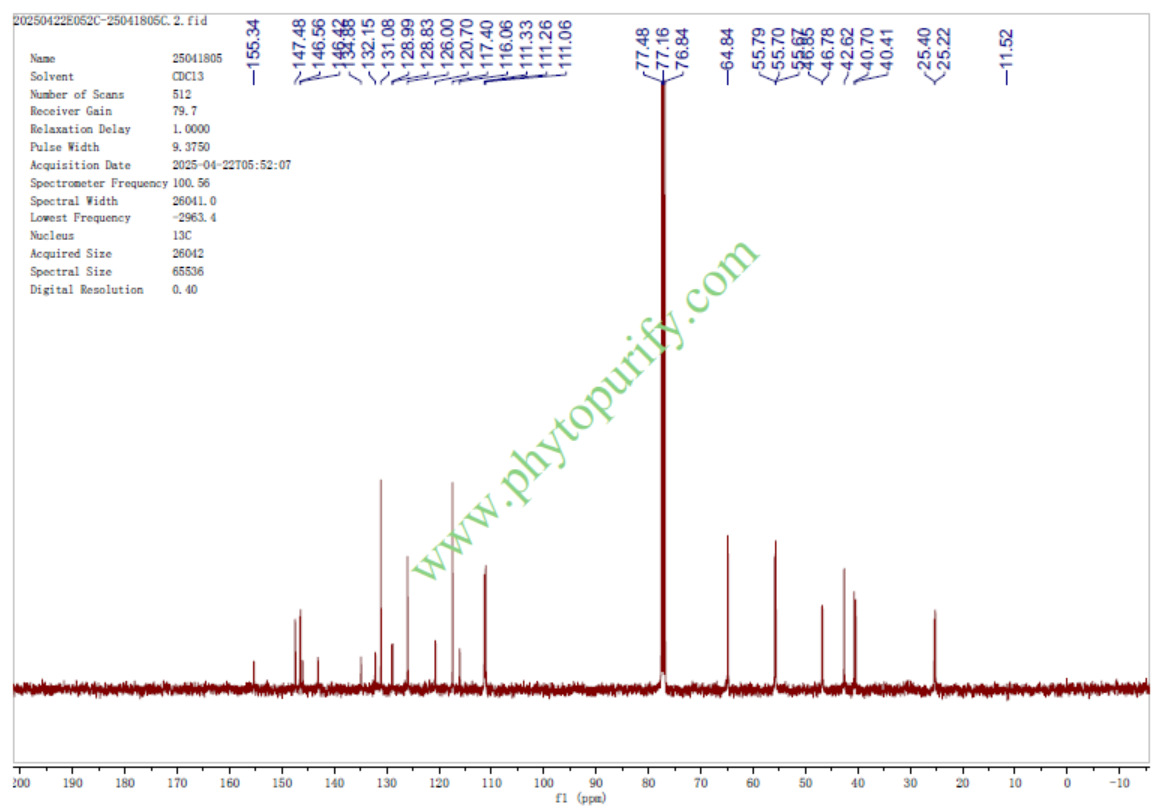
NMR of Dauricine
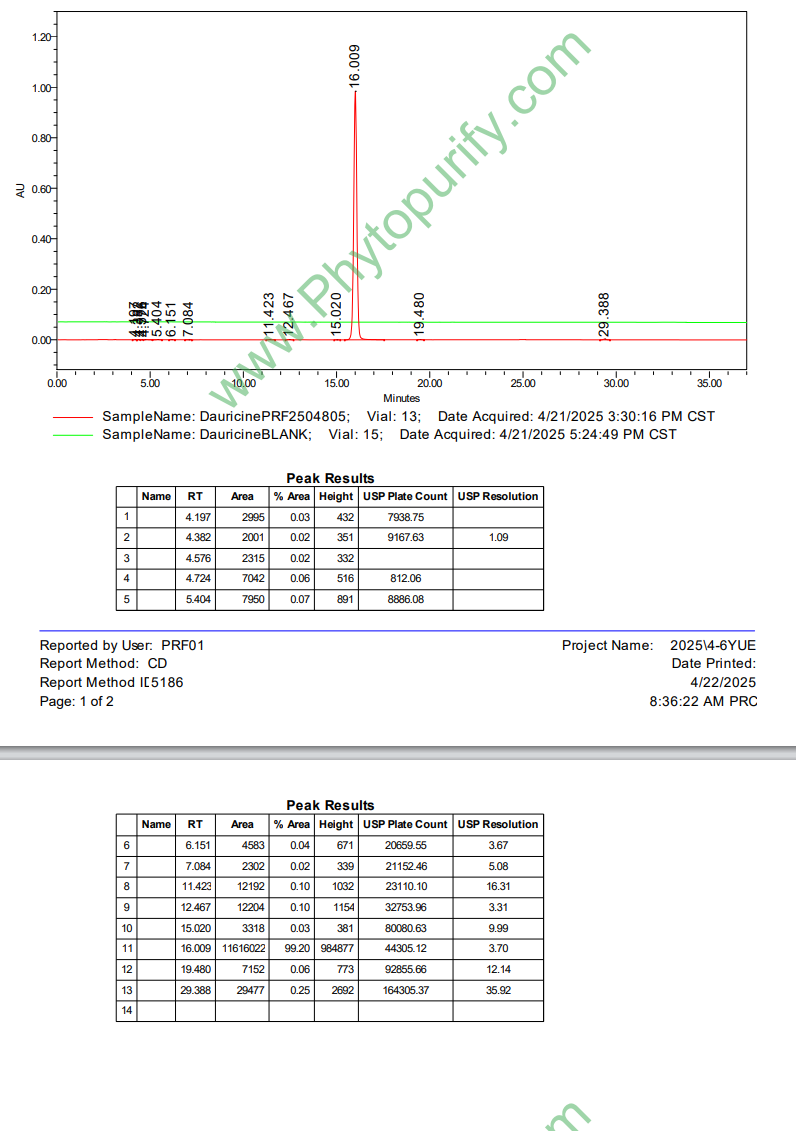
HPLC of Dauricine
Storage conditions:Short-term storage at 2~8℃, long-term storage at -20 ~ -80℃
Dauricine, also known as dauricine, is a typical dihydroquinoline alkaloid found mainly in the traditional Chinese medicine herb Menispermum dauricum DC. As an important active ingredient in traditional Chinese medicine, sophocarpine has received widespread attention due to its diverse pharmacological activities, especially in the fields of anti-inflammatory, anti-tumor, and antiarrhythmic effects, showing significant potential. In recent years, with the advancement of molecular biology and pharmacology techniques, the mechanism of action of Sophora alopecuroides alkaloids has gradually been elucidated, especially in the regulation of cell signaling pathways, ion channel functions, and cell cycle regulation, where significant progress has been made.
This article will provide a systematic review of the chemical structure and physicochemical properties, plant sources, and extraction methods of Sophora alopecuroides alkaloids, with a focus on their pharmacological activity and mechanism of action. Combined with pharmacological evaluation and pharmacokinetic data, it will explore their clinical application prospects and development directions, aiming to provide theoretical basis and reference for natural product pharmacology research and related new drug development.
Dauricine (CAS number: 524-17-4) belongs to the class of biphenylisoquinoline alkaloids, with a molecular formula of C38H44N2O6 and a molecular weight of 620.78. Its structural feature is that two isoquinoline units are connected by double bonds, forming a complex three-dimensional conformation. This structure gives it strong lipophilicity, with a LogP value of approximately 4.57, indicating that it has good lipid solubility, which is beneficial for penetrating cell membranes, but may also affect its water solubility and bioavailability.
The polar surface area (TPSA) of Sophora alopecuroides alkaloids is 88.38 Å ², with 8 hydrogen bond acceptors, indicating their hydrophilicity and binding ability in intermolecular interactions. Despite its large molecular weight, a reasonable polarity distribution facilitates its binding to biomolecule targets. According to existing data, sophocarpine is not easily able to penetrate the blood-brain barrier (BBB), which may limit its potential side effects on the central nervous system, but it may also limit its application in central nervous system diseases.
The main source of Sophora dauricum alkaloids is the plant Menispermum dauricum DC., a perennial vine widely distributed in Northeast Asia. This plant is used in traditional Chinese medicine as a detoxifying, anti-inflammatory, and anti rheumatic medicinal herb. As the main alkaloid component, Sophora flavescens alkaloids are usually concentrated in the rhizomes.
The methods for extracting Sophora alopecuroides alkaloids mainly include solvent extraction, liquid-liquid distribution, and column chromatography purification. Traditional extraction often uses ethanol or methanol as solvents to obtain crude extracts through reflux extraction, and then uses acid-base methods to adjust the pH value for alkaloid separation. Further purify commonly used techniques such as silica gel column chromatography and reverse phase high-performance liquid chromatography (RP-HPLC) to obtain high-purity Sophora flavescens alkaloids.
In recent years, emerging technologies such as ultrasound assisted extraction and microwave-assisted extraction have also been applied to the extraction of Sophora alopecuroides alkaloids, significantly improving extraction efficiency and purity. In addition, there have been reports on the synthesis method of sophocarpine, which provides the possibility for its large-scale production.
Sophora flavescens alkaloids exhibit significant anti-inflammatory effects. Both in vitro and in vivo studies have shown that Sophora flavescens alkaloids can significantly inhibit the expression of inflammatory factors such as TNF - α, IL-6, and IL-1 β. Its anti-inflammatory mechanism mainly involves inhibiting the activation of the nuclear factor kappa B (NF - κ B) signaling pathway, reducing the transcription of pro-inflammatory genes, and thus alleviating the inflammatory response.
In inflammatory disease models such as colitis, sophocarpine can reduce inflammatory cell infiltration, alleviate tissue damage, and demonstrate good protective effects. In addition, its antioxidant activity also helps alleviate oxidative stress-related inflammatory damage.
Shan Dou Gen alkaloid has shown the ability to inhibit cell proliferation and induce apoptosis in various tumor cell lines. Especially in colon cancer cells, sophocarpine exhibits dose-dependent anti-cancer effects by inhibiting NF - κ B activation, blocking cell cycle progression, and inhibiting cell invasion and migration.
Mechanism studies have shown that Sophora flavescens alkaloids can regulate multiple signaling pathways, including MAPK, PI3K/Akt, and mitochondrial pathways, promoting the expression of apoptosis related proteins such as upregulation of Bax, downregulation of Bcl-2, and activation of caspase family proteins. In addition, Sophora flavescens alkaloids can also inhibit tumor angiogenesis, block tumor nutrient supply, and further enhance anti-tumor effects.
As a potential antiarrhythmic drug, Sophora flavescens alkaloids mainly target various cardiac ion channels, including KCNH2 (hERG), KCNQ1, SCN5A, CACNA1C, KCNE1, KCNE2, and RYR2. By regulating the function of these ion channels, sophocarpine can stabilize the electrophysiological state of myocardial cells, prevent and correct arrhythmia.
In vitro electrophysiological experiments have shown that Sophora flavescens alkaloids have a regulatory effect on potassium and sodium channels, can prolong the duration of action potentials, inhibit abnormal autonomic discharges, and reduce the frequency of arrhythmia. Animal model studies further confirm its potential in the prevention and treatment of arrhythmia.
The multi-target mechanism of action of Sophora alopecuroides alkaloids is the basis for their diverse pharmacological activities. Its main mechanism of action includes:
Inhibition of NF - κ B signaling pathway NF - κ B is a key transcription factor that regulates inflammation and tumor development. Shan Dou Gen alkaloid exerts anti-inflammatory and anti-tumor effects by blocking the degradation of I κ B α, inhibiting the nuclear translocation of NF - κ B, reducing the expression of pro-inflammatory and anti apoptotic genes.
Adjust ion channel function Shan Dou Gen alkaloid regulates the action potential of myocardial cells and stabilizes heart rhythm by directly or indirectly acting on potassium channels (such as hERG/KCNH2, KCNQ1), sodium channels (SCN5A), and calcium channels (CACNA1C) in the heart.
Inducing cell apoptosis By regulating the expression of Bcl-2 family proteins and caspase cascade reactions, sophocarpine promotes tumor cell apoptosis, blocks cell cycle, and inhibits cell proliferation.
Antioxidant effect Sophora flavescens alkaloids can eliminate free radicals, alleviate oxidative stress, and protect cells from damage.
In addition, Sophora flavescens alkaloids may also affect other signaling pathways such as MAPK, PI3K/Akt, and regulate the balance of cell survival and death. Specific molecular targets and their interactions still need further in-depth research.
The pharmacological parameters of Sophora alopecuroides alkaloids show that their molecular weight is relatively high (620.78 Da), with a LogP value of 4.57, indicating good lipid solubility. However, there may be challenges in terms of bioavailability and solubility. The TPSA is 88.38 Å ² and the number of hydrogen bond acceptors is 8, indicating that its molecular polarity is moderate and conducive to binding with target proteins.
At present, the data on the hepatotoxicity, cardiotoxicity, and hERG channel inhibition of Sophora flavescens alkaloids are not clear, and a systematic safety evaluation is urgently needed to ensure their clinical safety. The Ames test results are unknown and further genetic toxicity assessment is required.
In terms of pharmacokinetics, the oral absorption of sophocarpine is relatively slow and its bioavailability is limited. It is mainly metabolized in the body through the liver, and the metabolic pathways and metabolites are not fully understood. Due to its difficulty in penetrating the blood-brain barrier, the distribution of sophocarpine in the central nervous system is limited, which may reduce the risk of central side effects.
Future research needs to focus on optimizing its pharmacokinetic properties, such as improving its solubility, bioavailability, and targeting through structural modifications, nanocarrier systems, and other means.
As a multifunctional natural product, sophocarpine has broad clinical application potential. Its anti-inflammatory and anti-tumor activities provide new ideas for the treatment of inflammatory diseases and tumors, especially in the application prospects of digestive system tumors such as colon cancer, which is worth looking forward to. Meanwhile, its ability to regulate cardiac ion channels gives it a unique advantage in the field of antiarrhythmic therapy.
However, the clinical translation of Sophora alopecuroides alkaloids still faces many challenges, including poor pharmacokinetic properties, lack of safety data, and dose optimization issues. In the future, in-depth research on its pharmacological mechanism should be strengthened, safety evaluation should be improved, and systematic preclinical and clinical studies should be conducted.
In addition, by combining modern drug design concepts, chemical modification, formulation improvement, and combination therapy strategies, the efficacy and safety of Sophora alopecuroides alkaloids can be enhanced, which will promote them to become a clinically valuable new drug.
As a typical biphenylisoquinoline alkaloid, Sophora flavescens alkaloids have shown broad application prospects in anti-inflammatory, anti-tumor, and antiarrhythmic fields due to their multi-target and multi mechanism pharmacological properties. Although there are still some shortcomings in drug development and safety at present, with the deepening of research and technological progress, Sophora flavescens alkaloids are expected to become important candidate molecules in the development of natural product drugs.
Future research should focus on the systematic elucidation of its molecular mechanism of action, optimization of pharmacokinetics, and scientific verification of clinical applications, laying a solid foundation for its transformation into safe and effective clinical drugs. The study of Sophora flavescens alkaloids not only enriches the theoretical system of natural product pharmacology, but also provides new strategies and ideas for the treatment of related diseases.
