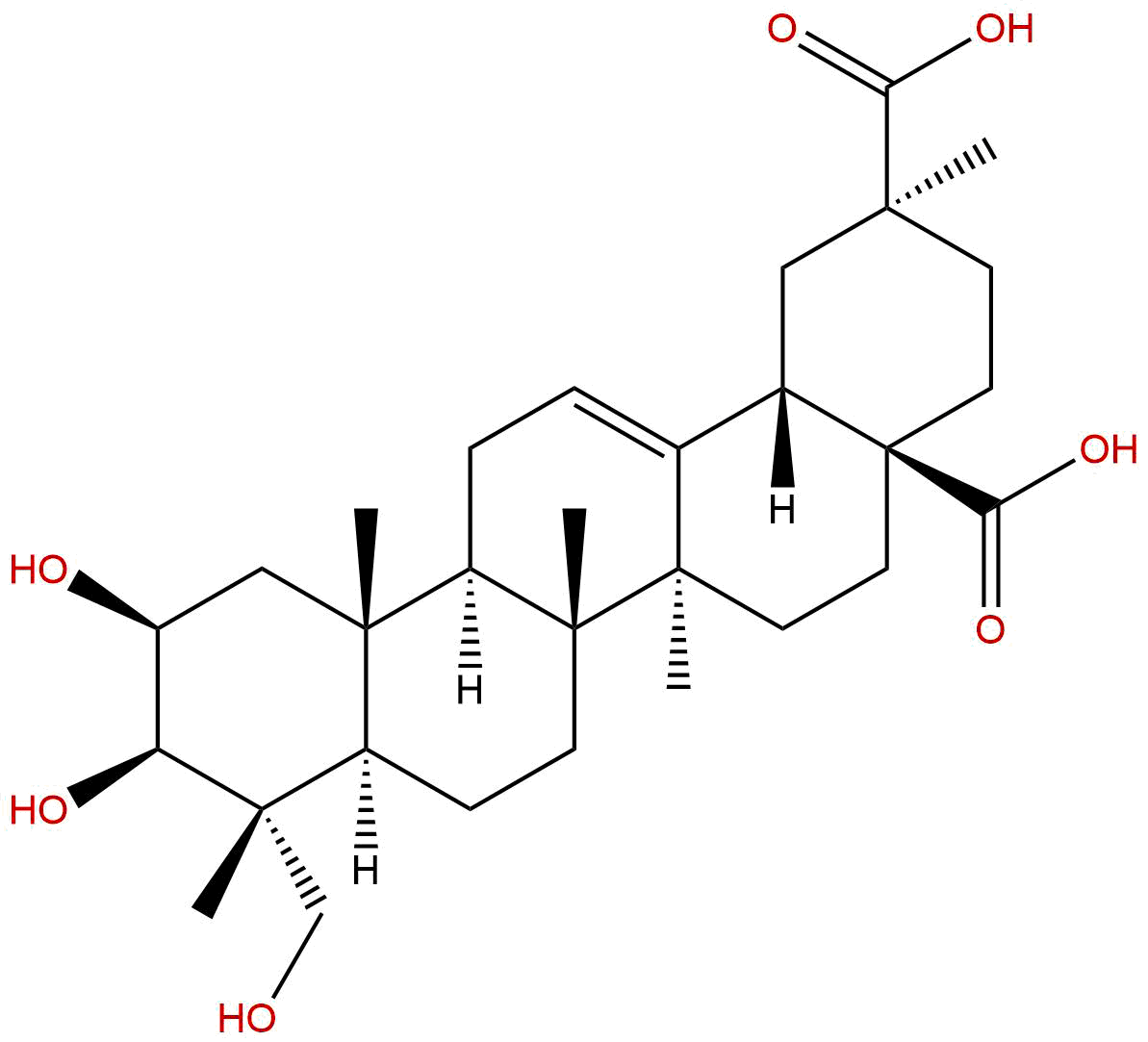


Product name: Jaligonic acid
Synonym name:
Catalogue No.: BP2288
Cas No.: 51776-39-7
Formula: C30H46O7
Mol Weight: 518.691
Botanical Source:
Type of Compound: Triterpenoids
Purity: 95%~99%
Analysis Method: HPLC-DAD or/and HPLC-ELSD
Identification Method: Mass, NMR
Packing: Brown vial or HDPE plastic bottle
Storage: Store in a well closed container, protected from air and light. Put into refrigerate or freeze for long term storage.
Whenever possible, you should prepare and use solutions on the same day. However, if you need to make up stock solutions in advance, we recommend that you store the solution as aliquots in tightly sealed vials at -20℃. Generally, these will be useable for up to two weeks.
The product could be supplied from milligrams to grams
Inquire for bulk scale.
For Reference Standard and R&D, Not for Human Use Directly.
Storage conditions:Short-term storage at 2~8℃, long-term storage at -20 ~ -80℃
Jaligonic acid (CAS number: 51776-39-7) is a natural product with significant biological activity, which has attracted widespread attention in the fields of natural medicinal chemistry and tumor pharmacology in recent years. As a type of natural triterpenoid compound with complex structures, gallic acid has been found in various plants and exhibits multi-target and multi pathway pharmacological activity, especially in the research of gastric cancer prevention and treatment, demonstrating potential application value. Gastric cancer is one of the malignant tumors with high incidence rate and mortality worldwide, and its treatment strategy urgently needs the support of innovative drugs. Gallic acid exhibits the ability to inhibit tumor cell proliferation, induce apoptosis, and block signaling pathways by regulating various key molecular targets such as BCL2, PIK3CA, EGFR, TP53, etc., making it an important candidate molecule for the development of natural anticancer drugs.
This article aims to systematically review the chemical structure and physicochemical properties, plant sources and extraction methods, pharmacological activity and mechanism of action, drug evaluation and pharmacokinetic characteristics of gallic acid, and explore its clinical application prospects in diseases such as gastric cancer based on current research progress. It is hoped to provide reference and inspiration for researchers in related fields.
The molecular formula of gallic acid is C30H46O8, with a molecular weight of 518.6910, and it belongs to the triterpenoid acidic natural product. Its structural characteristics include multiple hydroxyl substituents and carboxyl functional groups, which endow it with strong polarity and biological activity. The LogP value of gallic acid is 3.1790, indicating that it has moderate lipid solubility, which is conducive to penetrating cell membranes but not too hydrophobic, and is beneficial for in vivo distribution. Its topological polar surface area (TPSA) is 135.2900, indicating that the molecule has a high polarity region, which may affect its binding ability to target proteins and pharmacokinetic behavior.
The low water solubility (0.0325 mg/mL) suggests that the solubility of gallic acid in aqueous phase is limited, which poses certain challenges for its formulation development. The low penetration ability of the blood-brain barrier indicates limited distribution in the central nervous system, reducing the risk of central neurotoxicity. The hERG channel inhibition experiment result was negative, indicating a low risk of cardiac toxicity from gallic acid. The Ames mutagenicity test result was 0.0, indicating no significant genotoxicity and good safety.
Overall, the physicochemical properties of gallic acid are suitable as a candidate drug for oral or local administration, but its water solubility and bioavailability still need to be improved through drug design and formulation optimization.
Gallic acid was initially isolated from plants of the Gallium genus, which is widely distributed in tropical and subtropical regions and traditionally used as a folk herb to treat various diseases. The main source plants include the roots, stems, and leaves of Jaligo spp. The content of gallic acid in plants is relatively low, and the extraction and purification process is complex, which affects its large-scale application.
Common extraction methods include organic solvent extraction, ultrasound assisted extraction, and high-performance liquid chromatography (HPLC) separation and purification. Ethanol or methanol are generally used as extraction solvents, combined with ultrasonic or reflux extraction techniques to improve extraction efficiency. The crude extract was purified through multiple steps such as silica gel column chromatography and reverse phase HPLC to obtain high-purity gallic acid.
In recent years, green extraction technologies such as supercritical CO2 extraction and microwave-assisted extraction have gradually been applied to the extraction of gallic acid, which not only improves the extraction efficiency but also reduces the use of organic solvents, in line with the sustainable development concept of modern natural product development.
The pharmacological activity research of gallic acid mainly focuses on its anti-tumor effect, especially its inhibitory effect on gastric cancer cells. In vitro experiments have shown that gallic acid can significantly inhibit the proliferation of gastric cancer cell lines, induce cell cycle arrest and apoptosis. Its anti-tumor activity is closely related to the regulation of multiple signaling pathways.
In addition, gallic acid exhibits multiple biological activities such as anti-inflammatory, antioxidant, and immune regulation, providing multidimensional support for its anti-cancer effects. For example, in the inflammatory microenvironment, gallic acid indirectly inhibits the occurrence and development of tumors by suppressing pro-inflammatory cytokines and oxidative stress responses.
Animal model studies have further confirmed the anti-tumor potential of gallic acid. Oral or injection administration can significantly delay tumor growth, reduce metastasis rate, and have mild toxic side effects, laying the foundation for its clinical translation.
The study of the mechanism of action of gallic acid reveals its synergistic anti-cancer effect through multiple targets and pathways. The main targets include:
In summary, gallic acid demonstrates its potential as a multifunctional anticancer drug by regulating tumor cell proliferation, apoptosis, migration, and signal transduction through multiple targets.
From the perspective of medicinal properties, gallic acid has good potential as a drug. Its molecular weight (518.7) is slightly higher than the Lipinski rule recommendation of 500 or less, but still within an acceptable range. The LogP is 3.179, indicating moderate lipid solubility and facilitating cell membrane permeation. The TPSA is 135.29, slightly higher than the ideal range (<140 Å ²), which may affect oral bioavailability but does not constitute an absolute barrier.
Low water solubility is a major limitation for its medicinal properties, and it needs to be improved through chemical modification, carrier systems, or nano formulations to enhance solubility and absorption. The low penetration ability of the blood-brain barrier reduces the risk of central nervous system side effects, but limits its application in neurological diseases.
The negative inhibition of hERG channel and no mutagenicity in Ames test indicate that gallic acid has good safety and low risks of cardiac toxicity and genetic toxicity.
Pharmacokinetic studies are still in the preliminary stage, with limited data on in vivo half-life, metabolic pathways, and excretion modes. Animal experiments have shown that the blood concentration of gallic acid can reach an effective level after oral administration, and metabolism is mainly carried out through the liver enzyme system, without significant toxicity accumulation.
In the future, it is necessary to conduct systematic pharmacokinetic and toxicological studies, optimize dosing regimens, and enhance the possibility of clinical translation.
Gallic acid, as a multi-target natural anticancer active molecule, has shown broad application prospects in the field of gastric cancer treatment. It has the potential to inhibit tumor growth and reduce the risk of metastasis by regulating signaling pathways related to tumor cell proliferation, apoptosis, and metastasis. It is suitable as a candidate molecule for adjuvant therapy or combination chemotherapy.
In addition, the low toxicity and good safety of gallic acid provide favorable conditions for its clinical development. With the development of nanotechnology and drug delivery systems, it is expected to achieve better drug efficacy through formulation improvement to address the shortcomings of poor water solubility and low bioavailability.
Future research should focus on:
In summary, gallic acid is expected to become a model for the development of natural anti-cancer drugs, bringing new treatment options for gastric cancer patients.
Gallic acid, as a triterpenoid compound derived from natural plants, exhibits significant pharmacological activity and good safety in the prevention and treatment of malignant tumors such as gastric cancer due to its unique chemical structure and multi-target mechanism of action. Although its physical and chemical properties have certain limitations, with the assistance of modern drug design and formulation technology, it is expected to overcome the problem of insufficient bioavailability.
In the future, with the in-depth analysis of its mechanism of action and the improvement of pharmacokinetic research, gallic acid is expected to enter the clinical trial stage and become an innovative drug in the field of anti gastric cancer. As an important branch of natural product pharmacology research, the development of gallic acid not only enriches the anti-tumor drug library, but also provides valuable experience for the modern transformation of natural drugs.
Continuous efforts in basic research and clinical translation will drive the transition of gallic acid from laboratory to clinical use, benefiting patients and advancing the development of natural product pharmacology to a new level.
