| Catalog No | Package | Original Price | Price | Inventory | Quantity | Operating |
|---|---|---|---|---|---|---|
| BP4705-5mg | 5mg | $420.00 | Sign in |
|


Storage conditions:Short-term storage at 2~8℃, long-term storage at -20 ~ -80℃
Dracaenoside F is a natural steroid saponin product isolated for the first time from the Dracaena cochinchinensis plant in the Dracaena genus. As one of the important active ingredients in traditional Chinese medicine "Dragon Blood Dragon", Dragon Blood Tree Saponin F has received widespread attention in recent years due to its diverse biological activities. This compound exhibits significant pharmacological effects in hemostasis and blood system regulation, and its targets involve multiple key coagulation factors and regulatory proteins, such as SERPINE1, prothrombin (F2), coagulation factors F7, F9, F10, plasma fibrinogen binding protein (VWF), and protein C (PROC).
With the deepening development of natural product pharmacology and molecular pharmacology, the structural characteristics, pharmacological mechanisms, and pharmacological evaluation of Longxueshu saponin F have gradually become clear, laying the foundation for its development as a potential new hemostatic drug. This article provides a systematic review of the chemical structure and physicochemical properties, plant sources and extraction methods, pharmacological activity and mechanism of action, pharmacological evaluation, and clinical application prospects of Longxueshu saponin F. The aim is to provide comprehensive reference for related research.
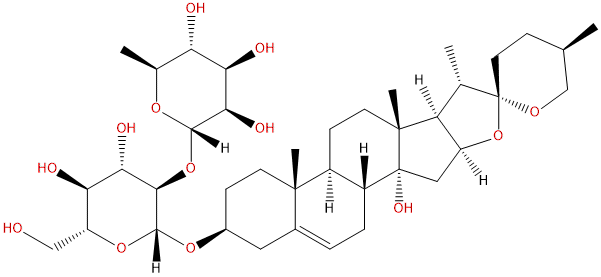
Dragon blood tree saponin F belongs to the steroid saponin class, with a molecular formula of C42H66O12 and a molecular weight of 738.9120. Its structural core is a typical steroid skeleton, connected by multiple glycosidic groups, endowing it with high polarity and biological activity. The LogP value of Dragon Blood Tree Saponin F is 2.1291, indicating that it has moderate lipophilicity and is conducive to cell membrane penetration. However, its polarity is high, with a TPSA (topological polar surface area) of 196.99 Å ², suggesting the presence of a large number of polar groups on its molecular surface, which affects its bioavailability and in vivo distribution.
The low water solubility (0.0355 mg/mL) limits its solubility in the aqueous phase, but moderate lipid solubility facilitates its interaction with the lipid environment. Dragon blood tree saponin F does not have the ability to penetrate the blood-brain barrier, indicating that its effects are mainly limited to the peripheral system. In terms of safety, the hERG channel inhibition experiment showed a negative result, indicating a low risk of cardiac toxicity; The Ames mutagenicity test result is 0.0, indicating no significant genetic toxicity risk.
From the perspective of chemical stability, steroidal saponin structures usually have good stability, but glycosidic bonds are easily affected by acid-base and enzymatic reactions. The extraction and preparation processes need to pay attention to condition control to ensure the integrity of the active ingredients.
Dragon blood tree saponin F is mainly isolated from Dracaena cochinchinensis, a plant of the Dragon blood tree genus. This plant is a perennial evergreen woody plant, distributed in Southeast Asia and southern China. Its resin like secretion "Dragon's Blood" is widely used in traditional medicine for hemostasis, anti-inflammatory, and promoting wound healing.
The common methods for extracting dragon blood tree saponin F include:
In recent years, the application of supercritical CO2 extraction and membrane separation technology has provided a new technological approach to improve extraction efficiency and purity, and is expected to achieve large-scale production of dragon blood tree saponin F.
Dragon blood tree saponin F exhibits multiple biological effects in pharmacological activity, especially in the fields of hemostasis and blood system regulation, showing significant potential.
Dragon blood tree saponin F promotes blood coagulation and exerts hemostatic effects by regulating various coagulation factors and blood related proteins. In vitro experiments have shown that the compound can enhance the shortening of prothrombin time (PT) and activated partial thromboplastin time (APTT), indicating its promotion of activation of both exogenous and endogenous coagulation pathways.
In traditional applications, 'Dragon Blood Dragon' has anti-inflammatory and wound healing effects. Dragon Blood Tree Saponin F, as the main active ingredient, also exhibits inhibitory effects on the release of inflammatory factors and regulates immune responses. In cell experiments, it can inhibit the expression of inflammatory mediators such as TNF - α and IL-6, and alleviate tissue inflammatory responses.
Some studies have shown that dragon blood tree saponin F may have antioxidant, anti-tumor, and blood lipid regulating potential, but the relevant mechanisms still need further clarification.
The hemostatic mechanism of dragon blood tree saponin F mainly involves the regulation of key factors in the blood coagulation cascade reaction. Its targets include:
Molecular docking and bioinformatics analysis showed that dragon blood tree saponin F can form stable binding with the active sites of the above-mentioned proteins, regulating their activity status. In addition, dragon blood tree saponin F may indirectly affect the homeostasis of the blood system by regulating signaling pathways such as NF - κ B and MAPK.
The pharmacological parameters of Dragon Blood Tree Saponin F show that it has certain development potential:
Pharmacokinetic studies are still in the preliminary stage, and further systematic evaluation is needed for in vivo absorption, distribution, metabolism, and excretion characteristics. Considering its high polarity and molecular weight, oral absorption may be limited. In the future, new drug delivery systems such as nanocarriers and liposomes can be used to enhance bioavailability.
Dragon blood tree saponin F, as a natural steroidal saponin, has the potential to become a new type of hemostatic drug due to its significant hemostatic activity and good safety. Its targets are diverse and can coordinate the coagulation and anticoagulation systems, making it suitable for surgical procedures, wound hemostasis, and adjuvant therapy for certain bleeding disorders.
The future clinical application prospects are mainly reflected in:
However, the clinical translation of Longxueshu saponin F still faces many challenges, including formulation optimization, pharmacokinetic improvement, toxicological safety system evaluation, and large-scale clinical trial validation. Future research should focus on breaking through its bioavailability limitations, clarifying its mechanism of action, conducting multi center clinical studies, and promoting its clinical application.
Dragon blood tree saponin F, as an important steroidal saponin active ingredient in Dracaena cochinchinensis, exhibits unique hemostatic and blood regulating functions. Its multi-target mechanism of action and good safety provide important basis for the development of new hemostatic drugs. Although there are still shortcomings in pharmacokinetics and clinical validation, with the development of natural product pharmacology and modern pharmaceutical technology, dragon blood tree saponin F is expected to become an innovative breakthrough in the field of natural source hemostatic drugs. The pharmacological mechanism research, formulation technology optimization, and clinical trials of future systems will be key links in promoting their clinical applications.
In summary, Dragon Blood Tree Saponin F not only enriches the research system of steroid saponin drugs, but also provides a valuable example for the translational application of natural product pharmacology, which deserves continuous attention and in-depth exploration in the fields of scientific research and pharmaceutical development.
