Introduction/Overview
Ferroptosis, as a novel programmed cell death mechanism, is characterized by iron dependent accumulation of lipid peroxides, ultimately leading to the breakdown of the cell membrane system. Since its official naming in 2012, the role of ferroptosis in neurodegenerative diseases, ischemia-reperfusion injury, tumor suppression, and inflammation related diseases has received increasing attention. Therefore, the search for efficient and specific iron death inhibitors has become one of the hotspots in pharmacological research. Isoeugenol acetate (CAS number: 93-29-8), as a simple derivative of the natural phenylpropanoid compound isoeugenol, has emerged in recent years due to its identification as an iron death inhibitor. In addition to this emerging role, its traditionally known broad anti-inflammatory activity has laid a solid foundation for its application in the treatment of inflammatory diseases by acting on multiple targets such as interleukin-6 (IL-6), signal transduction and transcription activator 3 (STAT3), key proteins in the nuclear factor kappa B (NF - κ B) pathway (such as RELA, IKBKB), and pain related ion pathways (such as TRPV1, TRPA1). This article aims to systematically review the chemical properties, plant sources, pharmacological activities, molecular mechanisms of action, pharmacological characteristics, and clinical application potential of isoeugenol acetate, in order to provide a comprehensive academic perspective for the in-depth research and development of this natural product derivative.
Chemical structure and physicochemical properties
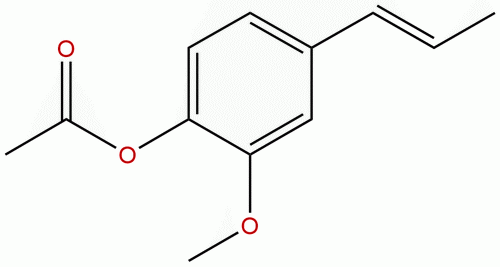
Isoeugenol acetate, chemical name 4-acryloyl-2-methoxyphenyl acetate, molecular formula C12H14O3, molecular weight 206.2410. Its structure can be regarded as the product of acetylation modification of the phenolic hydroxyl group of isoeugenol (4-acryloyl-2-methoxyphenol). This structural change significantly altered its physicochemical properties.
From a chemical perspective, the introduction of acetyl groups shields the active phenolic hydroxyl groups in the original isoeugenol molecule, resulting in relatively improved chemical stability and resistance to oxidation. Its lipid water partition coefficient (LogP) is 2.7427, indicating that the compound has moderate lipophilicity and is beneficial for penetrating cell membranes. The topologically polar surface area (TPSA) is 35.5300 Å ², which is a relatively small value, further indicating its good membrane permeability. The water solubility parameter shows 0.1117 mg/mL, which belongs to slightly soluble to poorly soluble in water, consistent with its LogP value, indicating that solubilization strategies may need to be considered in formulation development.
In the preliminary evaluation of the Biopharmaceutical Classification System (BCS), higher lipid solubility and smaller polar surface area indicate that it may have good oral absorption potential. Its blood-brain barrier (BBB) penetration is predicted to be "high", providing an important material basis for its application in central nervous system diseases such as neuroinflammation, Alzheimer's disease, and other diseases that may be associated with ferroptosis. Preliminary safety warnings indicate that there is no risk of inhibition of hERG potassium channels (hERG inhibition: No), and the Ames test result is 0.0, suggesting that it is non mutagenic and has relatively good early safety characteristics.
Plant sources and extraction methods
Isoeugenol acetate is not a widely distributed natural product, but mainly exists in nature as a derivative or metabolite of isoeugenol. Isoeugenol itself is a key aroma component of various aromatic plants, widely present in the essential oils of nutmeg (Myristica fragrans), clove (Syzygium aromaticum, whose essential oils mainly contain eugenol, with isoeugenol as its isomer), Cananga odorata, and Ocimum basilicum. In these plants, isoeugenol may be converted into its acetate form through the action of acetylases in the plant body.
At present, there are two main ways to obtain isoeugenol acetate:
1. Natural extraction and separation Separate and purify plant essential oils rich in isoeugenol through precise fractionation techniques (such as vacuum distillation) or chromatographic separation techniques (such as preparative gas chromatography, high-performance liquid chromatography). Due to its usually low content in natural essential oils, this method is costly and suitable for laboratory scale standard preparation.
2. Chemical synthesis and derivatization This is a more commonly used and economical method for obtaining isoeugenol acetate. Starting from abundant and inexpensive natural sources of eugenol or isoeugenol, it can be efficiently prepared through a simple acetylation reaction. Common acetylation reagents include acetic anhydride or acetyl chloride, which are carried out under alkaline catalysts (such as pyridine, triethylamine) or acidic catalysts (such as a small amount of sulfuric acid). After the reaction, high-purity isoeugenol acetate can be obtained by extraction, washing, drying, and purification (such as column chromatography or recrystallization). This method has high yield and is easy to scale up, making it the main source for meeting pharmacological research and potential application needs.
Pharmacological activity research
The pharmacological activity research of isoeugenol acetate mainly focuses on its two core areas of anti-inflammatory and iron death inhibition, and exhibits various biological effects.
1. Anti inflammatory activity
This is the earliest pharmacological action of isoeugenol acetate that was recognized and studied. Numerous in vitro and in vivo studies have shown that it has significant anti-inflammatory effects.
* in vitro model In the lipopolysaccharide (LPS) - induced macrophage (such as RAW264.7 cells) inflammation model, isoeugenol acetate can dose dependently inhibit the production of nitric oxide (NO) and prostaglandin E2 (PGE2), and its mechanism is related to the downregulation of inducible nitric oxide synthase (NOS2) and cyclooxygenase-2 (PTGS2/COX-2) expression. Meanwhile, it can effectively inhibit the production of various pro-inflammatory cytokines, including tumor necrosis factor - α (TNF - α), interleukin-6 (IL-6), and interleukin-1 β (IL-1 β).
* In vivo model In acute inflammation models such as mouse ear swelling and paw swelling (induced by carrageenan), local or systemic administration of isoeugenol acetate has shown good anti-inflammatory effects, reducing tissue edema and inflammatory cell infiltration. In chronic inflammation or pain models, its analgesic effect is also closely related to anti-inflammatory mechanisms.
2. Iron death inhibitory activity
This is the pharmacological new property of isoeugenol acetate that has received the most attention in recent years. The characteristic of ferroptosis is depletion of glutathione (GSH) and loss of glutathione peroxidase 4 (GPX4) activity, leading to the accumulation of lipid peroxides (especially phospholipid hydroperoxides) that cannot be reduced. Research has shown that isoeugenol acetate can effectively resist cell death induced by classic iron death inducers such as Erastin and RSL3 in various cell lines. It can reduce the levels of intracellular reactive oxygen species (ROS) and lipid peroxidation products (such as MDA), protect cell membrane integrity, and its effect is comparable or unique to known iron death inhibitors Ferrostatin-1 or Lipoxstatin-1.
3. Other potential activities
Based on the reports of its parent compound isoeugenol, isoeugenol acetate may also have antioxidant, antibacterial, and mild sedative effects, but these activities need to be confirmed by specialized studies targeting this specific derivative.
Mechanism of action and molecular targets
The multiple pharmacological activities of isoeugenol acetate stem from its regulation of complex cellular signaling networks, and its mechanism of action is intertwined with molecular targets, mainly reflected in the two main lines of anti-inflammatory and anti ferroptosis.
1. Anti inflammatory mechanism and targets
Its anti-inflammatory effect is mainly achieved by regulating key inflammatory signaling pathways such as NF - κ B and STAT3.
* NF - κ B pathway NF - κ B is the core transcription factor of inflammatory response. Isoeugenol acetate can inhibit the activity of I κ B kinase (IKBKB), prevent the phosphorylation and degradation of I κ B α, and thus inhibit the translocation of NF - κ B dimers (such as p65/RELA) to the nucleus. This directly leads to the inhibition of transcription of numerous pro-inflammatory genes downstream, such as TNF - α, IL-6, IL-1 β, NOS2, COX-2.
* STAT3 pathway STAT3 is another important pro-inflammatory and pro survival signaling pathway. Isoeugenol acetate can inhibit the phosphorylation (activation) of STAT3 mediated by cytokines such as IL-6, block its nuclear translocation and DNA binding activity, thereby inhibiting the expression of inflammation related genes.
* Inflammatory bodies and pain perception Research suggests that it may inhibit the activation of NLRP3 inflammasome, reduce the cleavage of caspase-1 (CASP1), and release mature IL-1 β. In addition, it has a regulatory effect on transient receptor potential vanillic acid subtype 1 (TRPV1) and transient receptor potential anchor protein subtype 1 (TRPA1) channels, which are key sensors mediating inflammatory pain, and their inhibition helps explain the analgesic effect of the compound.
* Cyclooxygenase-1 (PTGS1/COX-1)As a structurally stable acetylated derivative, it may have a certain regulatory effect on COX-1, affecting the synthesis of maintenance prostaglandins, but the main relationship between this and its anti-inflammatory activity still needs to be clarified.
2. Iron death inhibition mechanism
The exact molecular targets for its inhibition of ferroptosis are still being explored, and existing evidence supports its role through the following mechanisms:
* Enhanced antioxidant defense system Possible activation of the nuclear factor E2 related factor 2 (Nrf2) pathway may upregulate a series of genes driven by antioxidant response elements (ARE), such as the glutamate cysteine ligase catalytic subunit (GCLC) and modified subunit (GCLM), promoting GSH synthesis and indirectly supporting the function of GPX4.
* Direct free radical capture activity The phenylpropanol and methoxy groups in its molecular structure may enable it to directly scavenge lipid free radicals or peroxide free radicals, similar to the mechanism of action of Ferrostatin-1, which acts as a lipophilic antioxidant to interrupt the chain reaction of lipid peroxidation.
* Iron metabolism regulation Potential inhibition of Fenton reaction driven lipid peroxidation from the source may be achieved by regulating intracellular iron homeostasis and reducing the catalytically active free iron (Fe2+) pool by affecting the expression of ferritin or transferrin receptor (TFRC).
Mechanism crossover It is worth noting that there is a close "dialogue" between inflammation and ferroptosis. The activation of NF - κ B and STAT3 pathways can promote iron death sensitivity, and the lipid peroxidation products released during iron death (such as 4-HNE) are strong inflammatory activation signals. Therefore, isoeugenol acetate may exert a synergistic therapeutic effect in inflammation related diseases by simultaneously inhibiting these two pathways, forming a positive feedback protective loop.
Evaluation of drug properties and pharmacokinetics
Based on its physicochemical parameters and preliminary biological data, isoeugenol acetate has shown certain potential as a drug, but its comprehensive pharmacokinetic (PK) characteristics still need to be systematically studied.
1. Prediction and preliminary study of absorption, distribution, metabolism, and excretion (ADME)
* absorb Good lipid solubility (LogP~2.74) and small molecular weight indicate that its oral bioavailability may be good, and it can be effectively absorbed by the intestine through passive diffusion.
* distribution The predicted high blood-brain barrier penetration is its most prominent distribution feature, providing advantages for targeted drug delivery to the central nervous system. A moderate LogP value also means that it will not be excessively retained in adipose tissue and is expected to reach effective concentrations in target organs.
* Metabolism As an ester compound, isoeugenol acetate is easily hydrolyzed by esterases (present in blood, liver, and various tissues) in the body, producing the original compounds isoeugenol and acetic acid. Isoeugenol can be further metabolized through various pathways, including: ① O-demethylation catalyzed by cytochrome P450 enzymes (such as CYP2C9, CYP2D6, CYP1A2), side chain olefin epoxidation, etc; ② Combine with glucuronic acid or sulfuric acid to form a more water-soluble complex. Therefore, its pharmacological activity in vivo may be the result of the combined action of itself and its metabolites (especially isoeugenol).
* excretion Metabolized glucuronic acid complexes and sulfate complexes are mainly excreted through the kidneys and urine.
2. Pharmaceutical advantages
* Simple structure, easy to synthesize The raw materials are easy to obtain, the synthesis route is short, and the cost is controllable.
* Preliminary safety warning is good No hERG inhibition or mutagenic risk (Ames negative), with high early safety.
* Dual mechanism collaboration Simultaneously targeting inflammation and ferroptosis, suitable for multiple pathological states.
3. Challenges and optimization directions faced
* Metabolism is too fast The rapid hydrolysis of ester bonds may lead to a very short half-life of the original drug in the body, large fluctuations in blood drug concentration, and affect the sustainability and stability of the therapeutic effect.
* The relationship between dosage and activity is complex Its activity comes from the original drug and metabolites, and their respective contributions need to be clarified.
* Formulation development requirements Low water solubility requires the development of suitable drug delivery formulations, such as nanoemulsions, liposomes, cyclodextrin inclusion complexes, or solid dispersions, to improve solubility and bioavailability.
* Lack of research on system PK/PD At present, the vast majority of research focuses on pharmacodynamics, lacking systematic data on animal and even human pharmacokinetics, tissue distribution, absolute bioavailability, and so on.
Future structural optimization may focus on improving metabolic stability, such as replacing acetate esters with more stable amide bonds or introducing other groups that are not easily hydrolyzed by enzymes, but at the same time, attention should be paid to maintaining or enhancing their activity and BBB penetration.
Clinical application prospects and prospects
The dual mechanism of action of isoeugenol acetate has brought broad application prospects in the treatment of various refractory diseases.
1. Potential therapeutic areas
* Neurodegenerative diseases Neuroinflammation and ferroptosis have been proven to be key factors leading to neuronal loss in diseases such as Alzheimer's disease, Parkinson's disease, and amyotrophic lateral sclerosis. Its efficient BBB penetration ability and dual inhibitory properties make it a highly promising candidate molecule for neuroprotective agents.
* Ischemia-reperfusion injury After myocardial infarction or stroke, when ischemic tissue restores blood flow supply, it can cause severe oxidative stress, inflammation, and ferroptosis, leading to secondary damage. Isoeugenol acetate can be used to alleviate such injuries and improve prognosis.
* Inflammatory pain and arthritis By inhibiting the TRPV1/TRPA1 channel and downstream inflammatory pathways, it can be used to treat neuropathic pain, osteoarthritis, and rheumatoid arthritis.
* Other inflammation related diseases The anti-inflammatory mechanisms of acute lung injury, inflammatory bowel disease, skin inflammation, etc. may all play a role.
2. Research prospects and development strategies
* Deep exploration of mechanisms Using chemical biology methods such as affinity fishing and molecular probes to search for the protein targets that it directly acts on, especially the exact molecular targets that inhibit ferroptosis.
* Structural optimization and structure-activity relationship Systematically studying its derivatives aims to obtain lead compounds with more stable metabolism, stronger activity, and higher selectivity. For example, exploring the effects of different acyl chains and benzene ring substituents on activity and pharmacokinetic properties.
* Development of a new delivery system Develop targeted nano delivery systems (such as brain targeted nanoparticles) to address its poor water solubility and fast metabolism, achieving sustained release, controlled release, and targeted drug delivery, and improving the therapeutic index.
* Preclinical comprehensive evaluation Conduct systematic pharmacological, long-term toxicological, and pharmacokinetic evaluations in animal models that are closer to human diseases, such as transgenic AD mice, to lay the foundation for clinical trials.
* Explore combination therapy When used in combination with existing anti-inflammatory drugs or neuroprotective agents, it may have a synergistic effect, reducing their respective dosages and side effects.
Conclusion
Isoeugenol acetate, a simple derivative derived from the natural phenylpropanoid structure, is evolving from a traditional anti-inflammatory compound to a multi-target, multi mechanism disease modifier. The revealed iron death inhibitory activity, combined with its inherent strong anti-inflammatory effect, provides us with a new molecular weapon to address major health challenges involving complex pathological networks such as neurodegenerative diseases and ischemic injuries. Despite facing challenges in terms of metabolic stability and systemic pharmacokinetic properties, its clear pharmacological effects, good early safety, and excellent blood-brain barrier penetration ability make it an extremely attractive lead compound. Future research should focus on further elucidating its molecular mechanism of action, optimizing its pharmacokinetic properties through rational drug chemistry strategies, and advancing the preclinical development of the system. With the continuous deepening of research, isoeugenol acetate and its optimized derivatives are expected to achieve breakthroughs in the field of translational medicine, bringing new treatment hope to patients with related diseases.