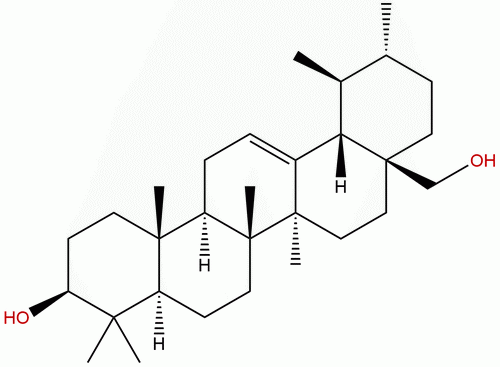


Product name: Uvaol
Synonym name: OLEAN-12-ENE-3B,28-DIOL
Catalogue No.: SBP01343
Cas No.: 545-46-0
Formula: C30H50O2
Mol Weight: 442.728
Botanical Source:
Physical Description:
Type of Compound: Triterpenoids
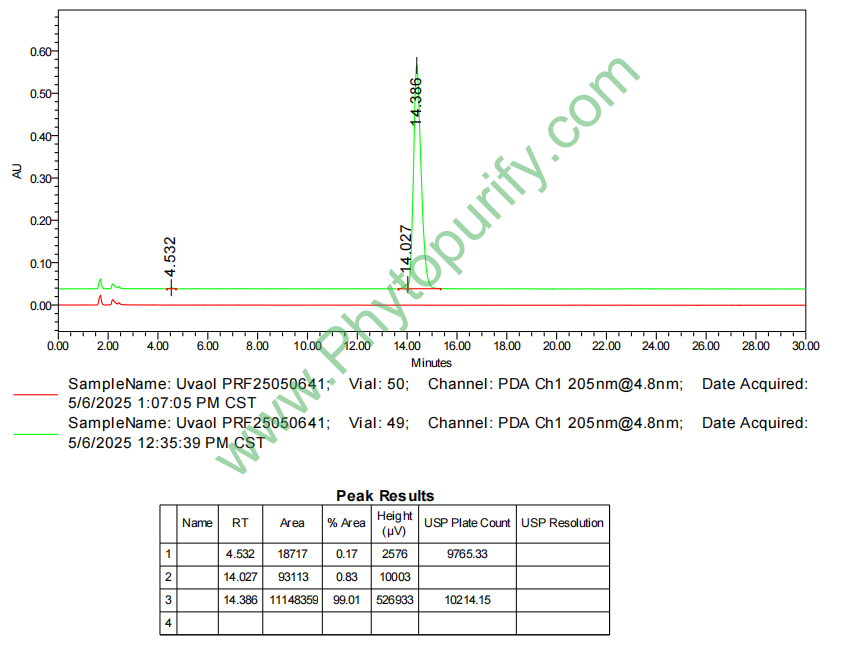
Purity: 95%~99%
Analysis Method: HPLC-DAD or/and HPLC-ELSD
Identification Method: Mass, NMR
Packing: Brown vial or HDPE plastic bottle
The product could be supplied from milligrams to grams
Inquire for bulk scale.
For Reference Standard and R&D, Not for Human Use Directly.
HPLC of Uvaol
Storage conditions:Short-term storage at 2~8℃, long-term storage at -20 ~ -80℃
40.4600
7.1289
7.1289
.0002
7.7185
6.7497
High
91.8242
4.8232
No
No
No
No
No
No
0.0
No
No
Yes
No
Natural products, as an important source of drug discovery, play an indispensable role in maintaining human health and treating diseases. Among numerous natural compounds with biological activity, triterpenoids have attracted much attention due to their structural diversity and wide pharmacological activities. Uvaol, also known as 12-ursen-3 β, 28 diol, is a pentacyclic triterpenoid compound widely present in olives(Olea europaea)It is also found in various medicinal plants such as rosemary and hawthorn in its virgin olive oil. Its CAS number is 545-46-0, and its molecular formula is C ∝₀ H ₅₀ O ₂.
The discovery and research history of wufa alcohol are closely related to the health benefits of olive oil. The Mediterranean diet is renowned for its preventive effects on cardiovascular disease, cancer, and age-related diseases, with olive oil as the core component. Its rich polyphenols and triterpenoids are considered the main contributors to these health effects. Wufa alcohol, as a triterpenoid diol with relatively abundant content and significant activity in olive oil, has gradually become a research hotspot in the field of natural product pharmacology since the 1990s. Early research mainly focused on its anti-inflammatory and antioxidant properties, but in recent years, its potential in anti-tumor, neuroprotective, and metabolic regulation has been continuously revealed, demonstrating great development value as a lead compound or dietary supplement.
This review aims to systematically sort out the chemical structure, physicochemical properties, plant sources, extraction methods, pharmacological activities, mechanisms of action, medicinal properties, and clinical application prospects of wufa alcohol, in order to provide comprehensive references for the in-depth research and development of this compound.
Wufa alcohol belongs to the pentacyclic triterpenoids of the Ussurine type, and its core skeleton is composed of six isoprene units, including five rings A, B, C, D, and E. Its structural feature is that there is one hydroxyl group (- OH) at each of the C-3 and C-28 positions, located at the 3 β position of the A ring and the 28 position of the E ring, respectively, which gives wufa alcohol the chemical properties of a diol. In addition, there is a double bond present in its molecule, located between C-12 and C-13, which is a typical feature of the triterpenoid type. The molecular weight of Wufa alcohol is 442.7280 g/mol, with a precise mass of 442.3811 Da.
From the perspective of physical and chemical properties, wufa alcohol exhibits typical lipid soluble compound characteristics. Its calculated lipid water partition coefficient (LogP) is 7.1289, indicating that it has extremely high lipophilicity and is easily soluble in organic solvents such as chloroform, methanol, ethanol, dimethyl sulfoxide (DMSO), etc. Its solubility in water is extremely low, only 0.0002 mg/mL. This high lipophilicity determines that its absorption, distribution, metabolism, and excretion (ADME) process in the body has unique characteristics. Its topological polar surface area (TPSA) is 40.46 Å ², which is lower than 60 Å ², indicating good cell membrane permeability. The pharmacological parameters show that Wufa alcohol has high blood-brain barrier (BBB) penetration ability, which provides the possibility for its application in central nervous system diseases. In addition, hERG inhibition prediction was negative, and the Ames test result was 0.0, indicating low risk of cardiac toxicity and mutagenicity, and preliminary safety was good.
Wufa alcohol is widely distributed in nature, mainly found in plants such as Oleaceae, Lamiaceae, Rosaceae, etc. Among them, olives(Olea europaea)The fruits, leaves, and virgin olive oil are its most abundant and important sources. In virgin olive oil, wufa alcohol often coexists with triterpenoids such as oleanolic acid and malinic acid, and its content is influenced by olive variety, origin, maturity, and processing technology. Besides olives, rosemary(Rosmarinus officinalis)Hawthorn(Crataegus pinnatifida)Ligustrum lucidum(Ligustrum lucidum)Apple(Malus domestica)Peel, grape(Vitis vinifera)Black hair alcohol is also found in plants such as fruit peels, but the content is usually low.
The extraction method of wufa alcohol mainly relies on its high lipophilicity. Traditional extraction methods include solvent extraction, which typically involves soaking or refluxing plant materials using methanol, ethanol, chloroform, or their mixed solvents. For example, after drying and crushing olive leaves or olive pomace, they are refluxed and extracted 2-3 times with 80% ethanol or methanol at 60-80 ℃. The extracted liquids are combined and concentrated under reduced pressure to obtain the crude extract. Subsequently, preliminary enrichment was carried out through liquid-liquid extraction (such as petroleum ether, ethyl acetate extraction) or macroporous resin column chromatography (such as D101, AB-8 type). Further purification is usually carried out using silica gel column chromatography, with gradient elution using different ratios of petroleum ether ethyl acetate or chloroform methanol systems, combined with thin layer chromatography (TLC) or high performance liquid chromatography (HPLC) detection, to separate high-purity wufa alcohol. In recent years, high-speed countercurrent chromatography (HSCCC) and preparative HPLC have also been used for efficient separation and purification of wufa alcohol. In addition, supercritical fluid extraction (SFE) technology, especially the use of CO ₂ as a solvent, has shown potential for application in the extraction of wufa alcohol due to its green and efficient characteristics.
The pharmacological activity research of Wufa alcohol has covered multiple fields such as anti-inflammatory, antioxidant, anti-tumor, neuroprotective, and antimicrobial effects, demonstrating multiple pharmacological effects.
1. Anti inflammatory activity
The anti-inflammatory activity of wufa alcohol is one of its earliest recognized and most extensively studied effects. Both in vivo and in vitro experiments have confirmed that wufa alcohol can effectively inhibit various inflammatory models. In a macrophage model stimulated by lipopolysaccharide (LPS), Ufaol significantly reduces the production of pro-inflammatory cytokines such as tumor necrosis factor - α (TNF - α), interleukin-6 (IL-6), and interleukin-1 β (IL-1 β), and inhibits the synthesis of nitric oxide (NO) and prostaglandin E ₂ (PGE ₂). In animal models, wufa alcohol can alleviate carrageenan induced toe swelling in rats, increase vascular permeability induced by acetic acid, and alleviate pleurisy and eosinophil infiltration in mice sensitized with ovalbumin. These results indicate that wufa alcohol has significant inhibitory effects in both acute and chronic inflammation, and its mechanism is closely related to the inhibition of nuclear factor kappa B (NF - κ B) and mitogen activated protein kinase (MAPK) signaling pathways.
2. Antioxidant activity
The antioxidant activity of wufa alcohol is the basis for its various biological effects. The two hydroxyl groups in its molecular structure can directly scavenge free radicals, such as 1,1-diphenyl-2-trinitrophenylhydrazine (DPPH) free radical, 2,2 '- diazo-bis-3-ethylbenzothiazole-6-sulfonic acid (ABTS) cationic free radical, and superoxide anion. More importantly, wufa alcohol can upregulate the expression of a series of antioxidant enzymes, including superoxide dismutase (SOD1, SOD2), catalase (CAT), glutathione peroxidase 1 (GPX1), and heme oxygenase 1 (HMOX1), by activating the nuclear factor E2 related factor 2 (NFE2L2/NRF2) signaling pathway. This indirect antioxidant mechanism enables it to more persistently and effectively combat oxidative stress. In addition, wufa alcohol can inhibit tyrosinase (TYR) activity and regulate the expression of matrix metalloproteinases (MMP1, MMP3), suggesting its potential application value in skin photoaging and pigmentation related diseases.
3. Antitumor activity
The anti-tumor activity of wufa alcohol has received widespread attention in recent years. Studies have shown that Ufatol can inhibit the proliferation and induce apoptosis of many cancer cell lines, including human glioblastoma (U87MG, U251), breast cancer (MCF-7, MDA-MB-231), liver cancer (HepG2), lung cancer (A549), colorectal cancer (HT-29) and melanoma (B16-F10). Its mechanism of action involves multiple aspects: firstly, wufa alcohol can induce cell cycle arrest, usually blocking cells in the G0/G1 or G2/M phase; Secondly, it can induce cell apoptosis through endogenous (mitochondrial) and exogenous (death receptor) pathways, manifested as a decrease in mitochondrial membrane potential, release of cytochrome c, activation of caspase-3/9, and upregulation of Bax/Bcl-2 ratio. Of particular note is that wufa alcohol has been reported as an orally active inducer of apoptosis in astrocytes, capable of penetrating the blood-brain barrier and exhibiting significant anti-tumor effects in an in situ glioma animal model. It also has low toxicity to normal astrocytes and demonstrates good selectivity.
4. Other pharmacological activities
In addition to the main activities mentioned above, wufa alcohol also exhibits various other pharmacological effects. In terms of neuroprotection, wufa alcohol can alleviate the neurotoxicity induced by β - amyloid protein (A β), inhibit tau protein hyperphosphorylation, and improve cognitive function in Alzheimer's disease model mice. In terms of metabolic regulation, wufa alcohol can improve insulin resistance and lower blood glucose and lipid levels by activating the AMP activated protein kinase (AMPK) signaling pathway. In addition, Wufa alcohol also has antimicrobial (such as anti Staphylococcus aureus, Candida albicans), antiviral (such as anti-HIV-1), and hepatoprotective activities.
The pharmacological activity of Wufa alcohol is the result of its interaction with multiple molecular targets, and its mechanism of action exhibits networked and multi-target characteristics.
1. The core of anti-inflammatory and antioxidant mechanisms - NRF2/NF - κ B signaling axis
The core mechanism of the anti-inflammatory and antioxidant activity of Wufa alcohol lies in its regulation of two key signaling pathways, NRF2 and NF - κ B. Under normal circumstances, NRF2 binds to its inhibitory protein Keap1 and is in an inactive state. Wufa alcohol can promote the dissociation of NRF2 and Keap1, allowing NRF2 to enter the nucleus and bind to antioxidant response elements (ARE), initiating the transcription of downstream antioxidant enzyme genes (such as HMOX1, NQO1, SOD, CAT, GPX1), thereby enhancing the cell's defense against oxidative stress. At the same time, wufa alcohol can inhibit the activity of I κ B kinase (IKK), prevent the phosphorylation and degradation of I κ B α, thereby inhibiting the nuclear translocation of NF - κ B and reducing the expression of downstream pro-inflammatory factors (TNF - α, IL-6, IL-1 β) and inflammatory mediators (iNOS, COX-2). There is a cross dialogue between the activation of NRF2 and the inhibition of NF - κ B, which together constitute the core molecular basis of the anti-inflammatory and antioxidant effects of wufa alcohol.
2. Mechanisms of inducing tumor cell apoptosis
The mechanism by which wufa alcohol induces apoptosis in tumor cells involves multiple signaling pathways. Firstly, it can activate the endogenous apoptotic pathway by downregulating the expression of anti apoptotic proteins Bcl-2 and Bcl xL, upregulating the expression of pro apoptotic proteins Bax and Bad, resulting in increased mitochondrial outer membrane permeability, release of cytochrome c and apoptosis inducing factor (AIF), and subsequently activating caspase-9 and caspase-3, ultimately leading to cell apoptosis. Secondly, wufa alcohol can also activate exogenous apoptotic pathways, upregulate the expression of death receptors Fas and TRAIL-R1/R2, and activate caspase-8. In addition, wufa alcohol can promote apoptosis by inhibiting the PI3K/Akt/mTOR signaling pathway and activating the p38 MAPK/JNK signaling pathway. In glioma cells, it has been confirmed that wufa alcohol can specifically inhibit the phosphorylation of STAT3, thereby blocking its downstream pro survival signals, which is one of the key mechanisms for its anti glioma activity.
3. Regulation of matrix metalloproteinases and tyrosinase
The inhibitory effect of wufa alcohol on MMP1 and MMP3, as well as its impact on upstream regulatory factors, are related to its anti skin aging and anti-inflammatory effects. MMPs are key enzymes that degrade extracellular matrix, and their overexpression is closely related to skin photoaging, arthritis, and tumor invasion and metastasis. Wufa alcohol downregulates the expression of MMP1 and MMP3 by inhibiting the activity of AP-1 and NF - κ B. At the same time, the inhibitory effect of wufa alcohol on tyrosinase (TYR) enables it to reduce melanin synthesis and has potential skin whitening effects.
The pharmacological evaluation of Wufa alcohol is based on a comprehensive consideration of its physicochemical properties, pharmacokinetic characteristics, and preliminary toxicological data.
1. Analysis of pharmacological parameters
As mentioned earlier, the molecular weight of Wufa alcohol (442.73 Da) meets the requirement of the Lipinski rule that the molecular weight should be less than 500. Its LogP value (7.13) is much higher than 5, indicating that its lipophilicity is too strong, which may lead to poor water solubility (0.0002 mg/mL), thereby affecting oral bioavailability. The TPSA (40.46 Å ²) is less than 140 Å ², indicating good cell membrane and blood-brain barrier permeability. HERG inhibition was negative, and Ames test was negative, indicating a low risk of cardiac and genetic toxicity. Overall, Wufa alcohol has certain medicinal properties, but its extremely low water solubility is the main bottleneck limiting its medicinal properties.
2. Pharmacokinetic characteristics
The pharmacokinetic studies on wufa alcohol are relatively limited, but some key characteristics have been revealed in previous studies. Due to its high lipophilicity, wufa alcohol may be mainly absorbed through the lymphatic system after oral administration and is easily highly bound to plasma proteins such as albumin. It has a large distribution volume and can be widely distributed in tissues, especially penetrating the blood-brain barrier, which provides a pharmacokinetic basis for its application in central nervous system diseases. The metabolism of wufa alcohol mainly occurs in the liver and may undergo phase II metabolic reactions such as hydroxylation, glucuronidation, and sulfation. Its excretion pathway may mainly be through bile and feces. Due to poor water solubility, the oral bioavailability of wufa alcohol is usually low, which may be the main challenge facing its clinical application. At present, research has attempted to improve its solubility and oral bioavailability through novel delivery systems such as nano formulations (such as liposomes, nanoemulsions, solid lipid nanoparticles) or phospholipid complexes.
Based on the rich pharmacological activity and preliminary safety evaluation of wufa alcohol, it has shown broad clinical application prospects in multiple disease fields.
1. Anti inflammatory and antioxidant related diseases
Its anti-inflammatory and antioxidant activities make it potentially valuable in the treatment of chronic inflammatory diseases (such as rheumatoid arthritis, inflammatory bowel disease, chronic obstructive pulmonary disease) and oxidative stress related diseases (such as atherosclerosis, diabetes complications, neurodegenerative diseases). As a natural ingredient in olive oil, it can be supplemented through dietary intake or developed as a functional food ingredient for the prevention and adjuvant treatment of these diseases.
2. Tumor treatment
The significant inhibitory effect of wufa alcohol on various cancer cells, especially glioblastoma, makes it a highly promising candidate compound for anti-tumor treatment. Its ability to penetrate the blood-brain barrier and low toxicity to normal cells gives it a unique advantage in the treatment of brain tumors. In the future, wufa alcohol or its derivatives are expected to be used as chemotherapy sensitizers or as monotherapy for the treatment of refractory tumors such as glioma.
3. Skin health and anti-aging
The inhibitory effect of wufa alcohol on tyrosinase and its regulation of MMPs make it potentially applicable in skin whitening, anti-aging, and anti wrinkle products. As a natural source of active ingredients, it conforms to the current development trend of "green, safe, and effective" in the cosmetics industry.
4. Challenges and Future Directions Faced
Despite its broad prospects, the development of wufa alcohol still faces many challenges. The primary issue is its extremely low water solubility and oral bioavailability. Future research directions should focus on: ① developing efficient drug delivery systems, such as nanoparticles, liposomes, cyclodextrin inclusion complexes, etc., to improve their solubility and bioavailability; ② Structural modification is carried out to introduce hydrophilic groups while retaining activity, and a series of derivatives of wufa alcohol are synthesized in order to obtain lead compounds with better drug properties; ③ Conduct more systematic and in-depth pharmacokinetic and toxicological studies to clarify its metabolic pathways, metabolites, and long-term safety of use in vivo; ④ By utilizing modern molecular biology techniques such as network pharmacology, transcriptomics, and proteomics, the multi-target mechanism of action is comprehensively revealed, providing a basis for precision medicine.
Wufa alcohol, as a naturally occurring pentacyclic triterpenoid diol, has become a prominent star molecule in the field of natural product pharmacology due to its significant anti-inflammatory, antioxidant, anti-tumor, neuroprotective and other pharmacological activities, as well as preliminary good safety characteristics. It exerts biological effects through various mechanisms such as regulating the NRF2/NF - κ B signaling axis, inducing tumor cell apoptosis, and inhibiting MMPs and TYR activity. Although its extremely low water solubility poses a serious challenge to drug development, this bottleneck is expected to be overcome through the application of modern medicinal chemistry methods and new delivery technologies. In the future, with the continuous deepening of understanding of the mechanism of action of wufa alcohol and the advancement of formulation technology, wufa alcohol and its derivatives are expected to be transformed into clinically valuable drugs or functional products in the fields of anti-inflammatory, anti-tumor, neuroprotection, and skin health, contributing to the cause of human health. The research process of wufa alcohol, from natural ingredients in the Mediterranean diet to lead compounds with clear pharmacological activity, vividly illustrates the enormous potential of natural products in modern drug discovery.
