Introduction/Overview
Neurodegenerative diseases such as Alzheimer's disease (AD) and Parkinson's disease (PD) have become major global public health challenges. Its complex pathological mechanisms, including protein misfolding and aggregation, oxidative stress, mitochondrial dysfunction, and neuronal apoptosis, make the therapeutic effect of single target drugs limited and often accompanied by significant side effects. Therefore, searching for lead compounds with multi-target and multi pathway neuroprotective activity from natural products has become one of the important strategies for current drug development. Stemonaceae plants, especially those with leaves(Stemona sessilifolia)In traditional medicine, it is often used to relieve cough and kill insects, but modern research has revealed that it is rich in alkaloids with novel structures and significant biological activity. Protostemitine (CAS: 169534-85-4) is a type of alkaloid with a pyrrolo [1,2-a] nitrogen-containing core skeleton isolated from it. In recent years, studies have found that protoporphyrin exhibits broad neuroprotective potential, involving multiple aspects such as regulating apoptosis, autophagy, oxidative stress, and key pathogenic protein metabolism, making it an attractive candidate molecule for the treatment of neurodegenerative diseases. This article aims to provide a systematic review of the chemical properties, plant sources, pharmacological activities, mechanisms of action, medicinal properties, and clinical application prospects of the compound, in order to provide comprehensive scientific references for the in-depth research and development of this compound.
Chemical structure and physicochemical properties
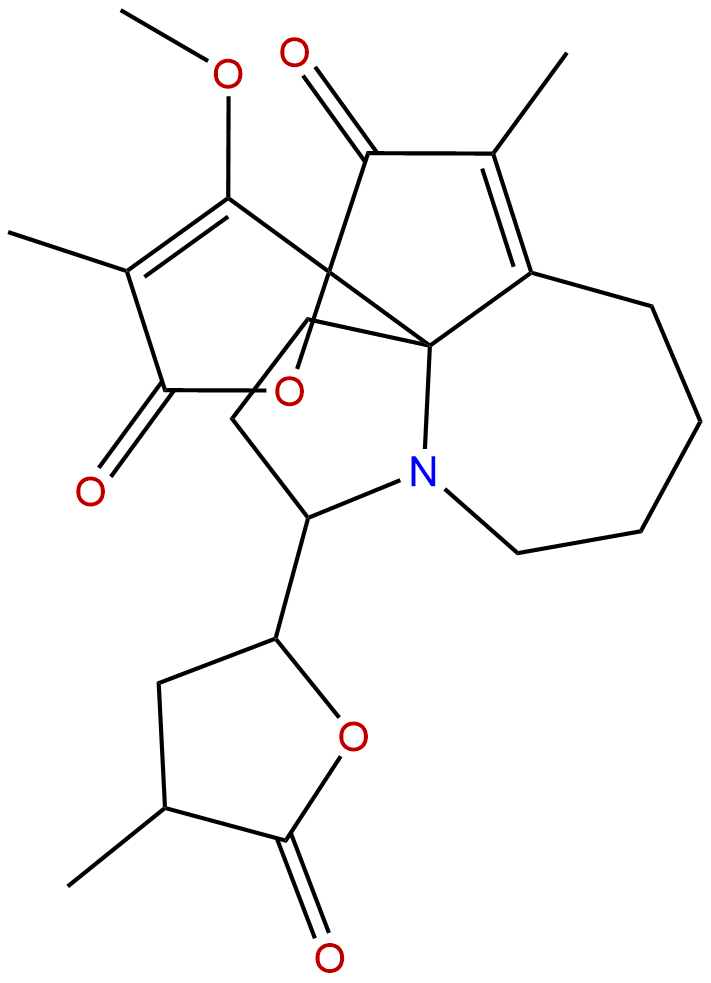
The molecular formula of the original Baibu base is C ₂∝ H ₂₅ NO ₆, with a molecular weight of 415.4860. Its core structure belongs to the more complex type of Baibu alkaloids, with a unique pyrrolo [1,2-a] nitrogen-containing ring system as the basic skeleton, and multiple oxygen-containing substituents (such as methoxy, hydroxyl, etc.) connected to form its specific stereochemical configuration. This complex polycyclic condensed structure is the material basis for its biological activity and determines its specific physicochemical properties.
According to the provided pharmacological parameters, the lipid water partition coefficient (LogP) of the original berberine is 2.2270, indicating that the compound has moderate lipophilicity, which facilitates its penetration of the cell membrane and interaction with intracellular targets. Its topological polar surface area (TPSA) is 82.1400 Å ², which is relatively moderate and suggests that it may have some membrane permeability. The water solubility parameter is 0.0547, indicating that it has a low solubility in water and belongs to a poorly soluble compound. This may be one of the key physical and chemical bottlenecks that need to be overcome in the development of its oral dosage form. It is worth noting that its predicted blood-brain barrier (BBB) permeability is "high", which is crucial for its therapeutic effect on central nervous system (CNS) related diseases, and is a significant advantage of the original berberine as a neuroprotective agent. In addition, preliminary toxicity predictions indicate that it has no inhibitory activity on hERG potassium channels (hERG inhibition: no), suggesting a low potential risk of arrhythmia; The Ames test predicted a value of 0.6, indicating a low risk of mutagenicity. These preliminary pharmacological parameters provide a favorable starting point for further drug development.
Plant sources and extraction methods
The original Baibu alkaloid mainly comes from the leaves of Baibu plants in the Baibu genus of the Baibu family(Stemona sessilifolia Dry tubers of (Miq.) Miq. Duiye Baibu is mainly distributed in the southern region of the Yangtze River Basin in China, and is one of the mainstream varieties of traditional Chinese medicine "Baibu". It has the effects of moistening the lungs, relieving cough, and killing insects.
The extraction and separation of primary berberine from plant materials usually follow the conventional process of natural product chemistry, but its structural characteristics need to be optimized. The general steps are as follows:
1. Extract After crushing the dried root tubers of Platycodon grandiflorus, alcohol solvents such as methanol and ethanol are often used for cold soaking or reflux extraction, and the principle of similar solubility is used to preliminarily extract alkaloid components. Alternatively, acid water extraction can be used to dissolve alkaloids into salts, followed by alkalization and extraction with organic solvents.
2. Enrichment and Coarse Separation The extract is concentrated under reduced pressure to obtain a paste. The extract is dissolved in dilute acid, and after filtering out acid insoluble substances, it is alkalized with ammonia water or sodium hydroxide solution until alkaline (pH>9). At this point, alkaloids are free and precipitated, and then repeatedly extracted with organic solvents such as chloroform, dichloromethane, or ethyl acetate to obtain the total alkaloid fraction.
3. Separation and Purification The components of total alkaloids are complex and require multiple chromatographic techniques for separation. Usually, silica gel column chromatography is used first, and gradient elution is carried out with different ratios of petroleum ether ethyl acetate or chloroform methanol systems to obtain fractions of different polarities. The stream containing proto tetrandrine was further refined and purified by repeated silica gel column chromatography, Sephadex LH-20 gel column chromatography, and high performance liquid chromatography (HPLC, usually using reversed phase C18 column, methanol water or acetonitrile water as mobile phase). The separation and identification of the original Baibu alkaloid usually require a combination of thin-layer chromatography (TLC) tracking, nuclear magnetic resonance (NMR, including ¹ H-NMR, ¹ ³ C-NMR, 2D-NMR such as COSY, HMQC, HMBC), mass spectrometry (MS), and spectroscopic methods such as specific rotation to confirm its structure.
Pharmacological activity research
A large number of in vitro and in vivo pharmacological studies have shown that the core pharmacological activity of protoberberine is concentrated in the field of neuroprotection, and its effects are extensive and significant.
- Anti neuronal apoptosis In primary cultured cortical neurons or various neuron like cell lines (such as PC12 cells) models, protoplasmic reticulum can significantly inhibit cell apoptosis induced by β - amyloid protein (A β), glutamate, hydrogen peroxide (H ₂ O ₂), or serum deprivation. Manifested as improving cell survival rate, reducing lactate dehydrogenase (LDH) leakage, decreasing the proportion of apoptotic cells (such as Annexin V/PI double staining, TUNEL staining), and inhibiting caspase-3 activation.
- Improve oxidative stress damage The original Baibu alkaloid has clear antioxidant activity. In the oxidative stress model, it can effectively enhance the activity of endogenous antioxidant enzymes (such as superoxide dismutase (SOD) and glutathione peroxidase (GSH Px)) in cells, reduce the production levels of reactive oxygen species (ROS) and malondialdehyde (MDA), maintain cellular redox balance, and protect neurons from oxidative damage.
- Regulating pathological proteins associated with Alzheimer's disease In the AD cell model, the original berberine showed the potential to regulate A β metabolism and Tau protein phosphorylation. It can reduce the level of A β secreted by cells and decrease the accumulation of over phosphorylated Tau protein. In addition, it may also have a regulatory effect on the activity of β - secretase 1 (BACE1) closely related to AD pathology.
- Promote neurite outgrowth and synaptic plasticity Research suggests that protoporphyrin may have neurotrophic effects, promoting the growth of neuronal processes and increasing the expression of synaptic related proteins such as PSD-95 and Synapsin-1. This is of great significance for the repair and maintenance of damaged neural networks.
- Internal neuroprotective effect In AD transgenic mice (such as APP/PS1 mice) or cognitive impairment mouse models induced by chemical drugs, intraperitoneal injection or gavage of protoporphyrin can significantly improve the learning and memory abilities of mice (as demonstrated by Morris water maze and new object recognition experiments), reduce the burden of A β plaques and neuroinflammatory reactions in the brain, and protect hippocampal neurons from loss.
Mechanism of action and molecular targets
The neuroprotective effect of the original Baibu alkaloid is not achieved through a single target, but through regulating an interconnected signaling network, reflecting the characteristics of multi-target intervention. Its mechanism of action mainly involves the following key pathways and targets:
- Anti apoptotic pathway and BCL2/CASP9 Original Baibu alkaloid can upregulate the expression of anti apoptotic protein Bcl-2, while possibly downregulating the expression of pro apoptotic protein Bax, thereby stabilizing mitochondrial membrane potential and inhibiting the release of cytochrome C from mitochondria to cytoplasm. This process blocks the activation cascade of caspase-9, ultimately inhibiting the activation of the key protease caspase-3 that executes apoptosis, which is one of its core mechanisms for anti neuronal apoptosis.
- Activate endogenous antioxidant defense system and NFE2L2 (Nrf2) pathway Nuclear factor E2 related factor 2 (Nrf2) is a key transcription factor that regulates antioxidant response elements (ARE). Research has shown that the original berberine can promote the translocation of Nrf2 from cytoplasm to nucleus, enhance its binding ability with ARE, and thereby upregulate the expression of a series of downstream phase II detoxifying enzymes and antioxidant proteins (such as HO-1, NQO1, GCLC), which is an important molecular basis for its anti oxidative stress.
- Regulating protein kinases and the GSK3B/MATP (Tau) pathway Glycogen synthase kinase-3 β (GSK3 β) is one of the key kinases involved in Tau protein hyperphosphorylation. The original Baibu alkaloid may inhibit the activity of GSK3 β (possibly by regulating its phosphorylation state), reduce the phosphorylation of Tau protein at AD related sites, and thus inhibit the formation of neurofibrillary tangles. In addition, it may also have a regulatory effect on the mitogen activated protein kinase (MAPK) signaling pathway, particularly the ERK (MAPK1) pathway, which is involved in cell survival, proliferation, and differentiation.
- Affects the processing of amyloid precursor protein (APP) and BACE1 The original Baibu alkaloid may reduce the production of A β fragments via the β - secretase 1 (BACE1) pathway by interfering with the metabolic processes of APP. The specific mechanism may include downregulating the expression or activity of BACE1, or promoting the processing of APP's non amyloid alpha secretase pathway.
- Epigenetic regulation and SIRT1 Silent Information Regulatory Factor 1 (SIRT1) is an NAD ⁺ - dependent deacetylase involved in the regulation of energy metabolism, stress response, and cellular aging. The activation of SIRT1 is beneficial for neuroprotection. There are studies suggesting that protocarbazine may act as an activator or regulator of SIRT1, affecting its downstream targets (such as PGC-1 α, FOXOs) through deacetylation, thereby improving mitochondrial function, enhancing antioxidant capacity, and inhibiting apoptosis.
In summary, the original Baibu alkaloid forms a comprehensive neuroprotective network by synergistically acting on multiple targets such as BCL2, NFE2L2, GSK3B, APP/ACE1, SIRT1, etc., from inhibiting apoptosis, resisting oxidation, to regulating pathogenic protein metabolism.
Evaluation of drug properties and pharmacokinetics
Based on existing data, a preliminary evaluation of the pharmacological properties of the original berberine is conducted
Clinical application prospects and prospects
As a natural alkaloid derived from traditional Chinese medicine, Yuanbaici alkaloid has shown broad application prospects in the treatment of neurodegenerative diseases.
- Potential drugs for treating Alzheimer's disease (AD)Its multi-target mechanism of action - simultaneous intervention in A β production, Tau phosphorylation, oxidative stress, and neuronal apoptosis - precisely targets the multiple pathological processes of AD and may have advantages over single target drugs, potentially delaying or improving the disease progression of AD.
- Treat other neurodegenerative diseases and brain injuries Its core neuroprotective mechanisms (anti apoptosis, antioxidant) are also applicable to Parkinson's disease (PD), Huntington's disease (HD), amyotrophic lateral sclerosis (ALS), as well as acute or chronic neurological diseases such as stroke and traumatic brain injury.
- Candidate components for combination therapy Given its multi-target nature, the original Baibu alkaloid may be used in combination with existing AD symptomatic treatment drugs (such as acetylcholinesterase inhibitor memantine) or other drugs with complementary mechanisms of action (such as anti-inflammatory drugs and mitochondrial function enhancers) in the future, in order to produce synergistic effects.
- Structural optimization of lead compounds Using it as the parent nucleus for chemical structure modification and modification, aiming to further enhance its activity, improve its water solubility and pharmacokinetic properties, reduce potential toxicity, and thus obtain better clinical candidate compounds.
Future research directions should focus on:
* In depth mechanism research Using techniques such as gene knockout/knockdown and proteomics to more accurately elucidate its direct interaction with key targets such as SIRT1 and Nrf2.
* Systematic pharmacokinetics and toxicology research Please supplement complete preclinical ADME/Tox data as soon as possible to lay the foundation for subsequent development.
* Pharmaceutical research Develop advanced delivery systems suitable for oral or injectable administration to address their solubility issues.
* Conduct standardized preclinical pharmacological validation Evaluate the effectiveness of long-term administration in animal models closer to human diseases, such as various AD transgenic mice.
Conclusion
Yuanbaicui alkaloid is a structurally unique alkaloid isolated from traditional Chinese medicine, Hedyotis diffusa. Numerous studies have shown that it exerts strong neuroprotective effects such as anti apoptosis, antioxidant, and regulation of AD related pathological proteins by regulating multiple key targets and signaling pathways such as BCL2, NFE2L2, GSK3B, and SIRT1, demonstrating enormous potential for treating neurodegenerative diseases such as Alzheimer's disease. Its predicted high blood-brain barrier permeability and preliminary good safety characteristics further enhance its attractiveness as a candidate molecule for central nervous system drugs. However, its poor water solubility and unclear systemic pharmacokinetic properties are currently the development bottlenecks that urgently need to be overcome. In the future, through in-depth mechanism exploration, systematic preclinical pharmacy and pharmacology research, and optimization with modern medicinal chemistry and formulation technology, the original berberine is expected to gradually develop from a potential natural active molecule into an innovative drug with clinical application value, bringing new hope to patients with neurodegenerative diseases.